
The short answer is yes. All-on-6 treatment in Turkey at Aylan Clinic allows patients from Toronto, Montreal, Vancouver, Calgary, Ottawa and across Canada to replace a full arch of teeth on six implants, with a fixed bridge, for up to 60% less than Canadian private prices. But more implants is not automatically better: All-on-6 is the right choice in specific situations — soft upper bone, heavy bite forces, bruxism, a long arch — and unnecessary expense in others.
This guide complements our All-on-6 in Turkey procedure page, within our wider dental care in Turkey section. It explains which situations genuinely call for six implants, the honest timeline, what the assessment must never skip, and how to live with the result. At any time you can see pricing in Turkey or request a free quote, with no obligation.
Three things belong at the top. First, more implants is not automatically better — this guide explains which situations call for six and which do not, because that judgement is what you are actually paying a clinician for. Second, you will leave your first trip with a temporary bridge, not your final teeth; the definitive bridge comes months later, on a second trip, and any offer implying one week completes the treatment is describing the temporary. Third, All-on-6 requires more bone than All-on-4: six implants need six viable sites, and if your bone is limited the honest options may be All-on-4, grafting with a longer timeline, or a different solution entirely.
1. Understanding All-on-6
What is All-on-6?
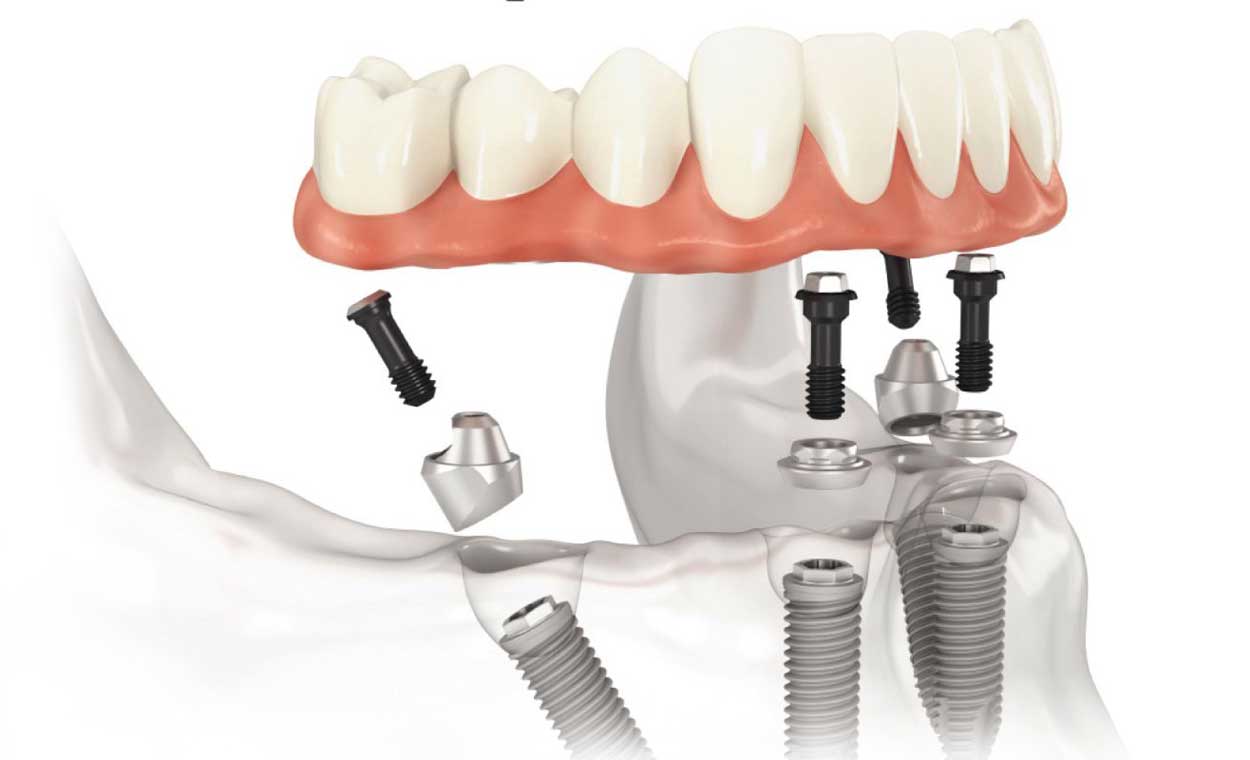
A full-arch fixed bridge supported by six implants rather than four. The implants are distributed along the arch, with the posterior ones often tilted to engage more bone and avoid the sinus or nerve canal. The bridge is screwed onto the implants. It does not come out. You clean it in place.
How does it differ from All-on-4?
Two additional implants, distributed along the arch. That difference produces several consequences:
- Force distribution — bite forces spread across six support points rather than four, reducing the load on each.
- Redundancy — if one implant fails to integrate, five remain. With four, losing one is more consequential.
- Longer bridge span support — the posterior extension of the bridge beyond the last implant is shorter, which reduces leverage on the terminal implants.
- Requirements — six viable implant sites are needed, which means more bone than All-on-4 demands.
- Cost — higher, both for the implants and often for a more extensive prosthesis.
Why does force distribution matter?
Think of the bridge as a beam. Any part of it extending beyond the last support point acts as a lever, and force applied there is magnified at that support. With four implants, the bridge typically extends further back beyond the last implant, creating a longer lever arm. With six, the last implant sits further back, so that unsupported extension is shorter. This is why All-on-6 is often preferred in patients with heavy bite forces: it reduces the mechanical stress that causes screw loosening and bridge fracture over years.
Does All-on-6 last longer?
The published evidence for both techniques is good, and neither is clearly superior across all patients. What can be said with more confidence is that All-on-6 tolerates adverse conditions better — soft bone, heavy occlusal forces, bruxism. In a patient with dense bone, a moderate bite and no grinding, four well-placed implants perform very well and the additional two add cost without proportionate benefit.
2. When Six Implants Are Genuinely Worth It
This is the central question of the page, and it deserves a direct answer rather than a marketing one.
Situations favouring All-on-6
- Soft upper bone. The upper jaw is generally less dense than the lower, and in some patients markedly so. Softer bone provides less initial stability per implant, and spreading the load across six reduces the demand on each.
- Heavy bite forces. Some patients simply generate more force — often men with strong musculature and a square jaw pattern. More support points reduce the stress on each.
- Bruxism. Habitual grinding transmits repeated heavy loads. This is one of the strongest arguments for six implants, and it should be disclosed at planning.
- A long arch. A wide dental arch means a longer bridge, which mechanically benefits from more support.
- Opposing natural teeth or a fixed bridge. If your other arch has natural teeth or its own implant bridge, the forces generated are higher than if it opposes a denture. This is a real consideration that patients rarely know about.
- Patient preference for redundancy. Some patients, having understood the trade-off, prefer the additional security. That is a legitimate reason.
Situations where All-on-4 is sufficient
- Dense bone with good primary stability.
- Moderate bite forces, no grinding.
- An opposing denture rather than natural teeth, generating lower forces.
- Limited bone that would require grafting to accommodate six implants — in which case the honest comparison is All-on-4 now versus All-on-6 after nine months of grafting and a third trip.
- Budget constraints, where the alternative to All-on-4 is no treatment at all.
How is the decision actually made?
On your CBCT scan and clinical examination — bone volume and density at each potential site, arch dimensions, bite analysis, evidence of wear from grinding, and what is happening in the opposing arch. Ask your clinician to explain the reasoning for your specific case. A clinic that recommends six for everyone, or four for everyone, is not individualising. Both answers can be right; the explanation is what tells you whether it was considered.
3. All-on-6 Versus the Alternatives
Versus All-on-4
Covered above. Summarised: All-on-6 for adverse conditions, All-on-4 where conditions are favourable or bone is limited.
Versus eight or more implants
For most full arches, six is the practical upper limit of benefit. Beyond that, additional implants add cost, surgical time and cleaning complexity without clear advantage in most cases. Some very specific situations justify more, but a proposal for ten or twelve implants in one arch deserves a detailed explanation.
Versus individual implants and crowns
Replacing twelve teeth with twelve implants is rarely feasible or affordable, and in a resorbed arch the bone often will not permit it. Full-arch approaches exist precisely because individual replacement is impractical at that scale.
Versus an implant-retained overdenture
Worth genuine consideration if cost is a constraint. An overdenture clips onto two to four implants and comes out for cleaning. It is dramatically more stable than a conventional denture and costs substantially less than All-on-6. Ask about it before dismissing it. For a lower arch in particular, it solves the actual problem — a denture that will not stay in place — at a fraction of the cost. Many patients who could not tolerate a lower denture describe an overdenture as transformative. The trade-off: it comes out, it covers more tissue, and chewing efficiency is good but not equal to a fixed bridge.
Versus doing nothing yet
A legitimate option if you are not ready. Bone continues to resorb over time, which can complicate future treatment, but this happens over years rather than months. Waiting a year to save or to be certain is not usually damaging. Waiting a decade may be.
4. The Honest Timeline
What happens on trip one?
Assessment with CBCT, extraction of any remaining teeth in the arch, placement of six implants, and fitting of a temporary fixed bridge, usually the same day or the next. You leave with teeth. This matters to most patients more than any other feature of the treatment.
What is the temporary like?
Fixed, functional, and acceptable in appearance. Usually acrylic. Not as strong, refined or aesthetically precise as the definitive bridge. You will be asked to avoid hard and crunchy foods for the entire healing period. Acrylic chips and fractures under heavy load.
How long do I wear it?
Three to six months. Osseointegration cannot be accelerated.
What happens on trip two?
Integration confirmed radiographically. Impressions or digital scan. A try-in where you approve shape, shade and length. Definitive bridge fitted, with adjustment appointments over several days.
Why not fit the definitive bridge immediately?
Two reasons. Bone must integrate before a rigid prosthesis loads it. And the gums must finish remodelling after extractions — they shrink over the following months, and a definitive bridge made too early would leave a visible gap.
Total duration
Roughly a year: two trips, three to six months apart, plus planning time. Any presentation that compresses this is describing something other than a finished treatment.
5. Why Canadians Consider Turkey
| Factor | Canada (private) | Turkey — Aylan Clinic |
|---|---|---|
| Cost | Very high for full-arch work | Up to 60% less, all-inclusive |
| Coverage | Annual maximums, typically $1,500–$3,000 | Same limitations; foreign care often excluded |
| Wait time | Variable | Rapid scheduling |
| Accommodation | Your responsibility | 5-star hotel, full board included |
| Companion | Additional cost | Free, accommodated and fed |
| Number of trips | None | Two |
Why is full-arch work where the gap matters most?
Because the absolute figures are large. A percentage saving on a single crown is modest in dollars; the same percentage on two full arches is substantial. All-on-6 is among the most expensive treatments in dentistry, which is why it is one of the most common reasons Canadians look abroad.
Will Canadian insurance help?
Rarely to a meaningful degree, and the constraint is the annual maximum rather than exclusion. A full-arch case exhausts several years of typical benefits. Practical steps: ask your insurer in writing whether foreign care is reimbursed and at what rate; request pre-determination; insist on itemised invoicing listing each implant, each abutment and the prosthesis separately. A single-line package invoice is very hard to claim against. If treatment spans two calendar years, ask how the insurer dates a claim — two annual maximums may be available.
6. Assessment: What Should Never Be Skipped
Why CBCT is mandatory
All-on-6 requires six viable implant sites, each with adequate bone height and width, positioned to avoid the sinus in the upper jaw and the nerve canal in the lower. A panoramic radiograph cannot establish this. It does not show bone width, it distorts dimensions, and it cannot map the nerve canal in three dimensions. Planning six implant positions without CBCT is planning six times more guesswork than a single implant. A clinic proposing All-on-6 without 3D imaging should be declined.
Does the scan determine whether four or six?
Substantially, yes. It shows how much bone exists at each candidate site and its density. A patient with adequate bone at only four sites cannot have six without grafting. This is why a quote for All-on-6 issued before a CBCT is provisional. If a clinic has priced six implants from a panoramic film alone, the number may change once they see the scan — and it is better to know that now.
What else is assessed?
Remaining teeth and their prognosis, periodontal status, bone quality across the arch, bite and jaw relationship, evidence of grinding, gum display when smiling, lip support, and facial proportions. The opposing arch is assessed too, since what it contains determines the forces your new bridge will face.
Is digital planning used?
Increasingly, and it is particularly valuable here. CBCT data allows six implant positions to be planned in software and transferred to the mouth with a surgical guide. With six implants, the cumulative benefit of precision is greater than with one. Ask whether guided surgery is planned for your case.
7. What the Treatment Involves at Aylan Clinic
| Element | Detail |
|---|---|
| Implants | Six per arch, distributed along the arch, posterior often tilted |
| Extractions | Any remaining teeth in the treated arch |
| Temporary bridge | Fixed, fitted at trip one, worn 3–6 months |
| Definitive bridge | Fitted at trip two |
| Bridge materials | Zirconia, or titanium framework with ceramic or composite |
| Digital planning | CBCT-based, with surgical guide where indicated |
The clinical team
- Senior oral and maxillofacial surgeon — extractions and implant placement
- Prosthodontist — bridge design, try-in and fitting
- Implantology-focused dentist — planning and coordination
- Dental radiologist — CBCT interpretation
- In-house laboratory — same-day temporary fabrication and adjustments
What the package includes
- Free consultation and detailed treatment plan, no obligation
- 3D CBCT imaging on site
- Extractions of remaining teeth in the treated arch
- Six implants per arch, abutments, temporary bridge and definitive bridge
- 5-star hotel accommodation, full board
- A companion at no extra cost, accommodated and fed in the same room
- Airport–clinic–hotel transfers
- A personal coordinator throughout both stays
- Implant passport recording brand, model, dimensions and lot number for each implant
- Written treatment report and radiographs for your Canadian dentist
- English and French-speaking Canadian patient liaison available on request
8. The Journey, Step by Step
Trip 1 (7–10 days)
- Arrival — transfer to your 5-star hotel with your companion
- Assessment day — examination, CBCT, photographs, plan confirmed
- Planning discussion — implant positions, bridge design, tooth shape and shade
- Surgery day — extractions and placement of six implants, under local anaesthesia or sedation; two to four hours per arch
- Temporary bridge fitted — same day or next day
- Review appointments — bite adjustment, healing check
- Discharge — instructions, medication, implant passport, radiographs
Between trips (3–6 months)
Osseointegration at home. Wearing the temporary. Interim monitoring in Canada.
Trip 2 (7–10 days)
- Review — radiograph confirming integration of all six
- Impressions or digital scan
- Try-in — you approve shape, shade, length and bite
- Definitive bridge fitted
- Adjustment appointments over several days
- Final documentation for your Canadian dentist
The try-in appointment: use it properly
This is the only moment at which the appearance of your entire smile can still be changed. Look at yourself in natural daylight, not clinic lighting. Smile fully. Speak. Look from the side. Check how much tooth shows at rest and when smiling. Take a photograph and send it to someone whose judgement you trust. If something is wrong — too white, too long, too uniform, insufficient tooth display — say so at this appointment. Changing it now is routine. Changing it afterwards means remaking the bridge.
9. Recovery, Day by Day
Surgery day
Multiple extractions plus six implants, under local anaesthesia with or without sedation. Anaesthetic wears off over several hours. Oozing from extraction sites for the first few hours is normal. Take analgesia before the numbness fades. Ice on the outside of the cheeks in twenty-minute cycles. Cool liquids only. No straws, no forceful rinsing. If the temporary is fitted the same day, you will have teeth by evening.
Day 1
Swelling develops. Six implants plus extractions produces more swelling than a single implant — facial swelling extending across the cheeks is expected. Continue ice, cool soft foods, medication on schedule. Sleep propped up on two pillows.
Days 2 to 3
Swelling peaks, often noticeably. Bruising may appear on the cheeks or under the jaw. Most patients look worse than they feel. This is the window in which infection would declare itself. Increasing pain, fever, or a foul taste warrant contacting the clinic. Diet remains liquid to pureed. You have a bridge, but the healing sites beneath should not be loaded.
Days 4 to 7
Marked improvement. Swelling recedes, discomfort becomes intermittent, most patients switch to over-the-counter analgesia. Diet progresses to soft foods. Bite adjustments happen in this window and they matter — a temporary that is high in one area concentrates force on one implant.
Days 7 to 10
Sutures removed if not self-dissolving. Final check before flying. Most patients feel functional, with residual tightness.
Weeks 2 to 6
Gums remodel beneath the bridge as extraction sites heal. A small gap may appear between bridge and gum. This is normal shrinkage, and it is one reason the definitive bridge is made later. Food may trap in that space. Cleaning technique matters; see section 12.
Months 2 to 6
Osseointegration proceeds silently across all six implants. Maintain hygiene, treat the temporary gently, do not smoke.
After the definitive bridge
Adaptation over a few weeks: speech adjusts, the tongue learns new contours, chewing becomes progressively more efficient. Most patients report full adaptation within a month.
10. Pain, Swelling and Eating Through the Healing Months
How painful is it?
More than a single implant, mainly because of the extractions, and marginally more than All-on-4 because two additional implant sites are involved. Most patients describe a strong ache for two to three days, well controlled with prescribed medication. Patients who have had teeth extracted before generally find it comparable.
What helps most
Ice for the first forty-eight hours. Sleeping propped up. Analgesia on schedule rather than on demand. Avoiding heat — hot drinks, hot showers on the face, saunas. Gentle salt water rinsing from day two.
Eating: the practical challenge
- Days 1 to 3: cool liquids and smooth purees. Soups, yoghurt, smoothies without a straw, mashed vegetables.
- Days 4 to 14: soft foods requiring minimal chewing. Scrambled eggs, fish, well-cooked pasta, soft cheese.
- Weeks 2 to 6: progressively firmer soft foods. Minced meat, crustless bread, cooked vegetables.
- Months 2 to 6, with the temporary: most foods, but no hard or crunchy items — raw carrots, nuts, crusty bread, hard candy, ice, corn on the cob, ribs. Cut food smaller and chew on both sides.
- After the definitive bridge: most patients return to a normal diet. Zirconia is strong. Very hard items remain inadvisable.
If the temporary breaks
Usually from biting something too hard. Not a medical emergency, but it needs repair within a few days. This is precisely what your Canadian dentist arrangement is for. Tell the clinic as well, and be honest about what you were eating — it may inform the definitive bridge design.
11. Risks and Complications
Surgical risks
- Infection — uncommon with prophylaxis but requiring prompt treatment.
- Bleeding — usually minor oozing rather than bleeding.
- Swelling and bruising — expected, more pronounced than after single implants.
- Nerve injury — in the lower jaw, altered lip and chin sensation. Usually temporary, occasionally permanent. CBCT planning is what minimises this. With six implants there are more sites near the nerve, which makes accurate imaging more rather than less important.
- Sinus complications — in the upper jaw, though tilting is designed to avoid the sinus.
- Failure of one implant to integrate — here the redundancy of six is a genuine advantage. Losing one of six is usually manageable without redesigning the whole prosthesis, whereas losing one of four is more consequential. Ask about the cost policy in writing: if an implant fails, who pays for replacement and for the additional trip?
Prosthetic and long-term risks
- Fracture of the temporary bridge — relatively common, usually from hard food.
- Screw loosening — mechanical, straightforward to address if components are identifiable.
- Fracture of the definitive bridge — uncommon with zirconia, more likely in grinders.
- Peri-implantitis — inflammation with bone loss around implants, plaque-driven. The leading cause of late failure. See section 12.
- Food trapping beneath the bridge — manageable with technique, influenced by design.
- Speech changes — usually transient.
- Cleaning complexity — a point worth naming honestly: six implants mean more surfaces and more spaces to clean than four. Your daily routine is marginally more demanding.
What increases the risk of failure?
Smoking above all. Then poor plaque control, uncontrolled diabetes, bruxism without a night guard, and skipping maintenance appointments.
Contraindications
Uncontrolled diabetes, active infection requiring treatment first, intravenous bisphosphonate therapy, recent head and neck radiotherapy, incomplete jaw growth, and insufficient bone at six sites without grafting.
12. Cleaning an All-on-6 Bridge
Why this section matters most
The bridge does not come out, and the space beneath it is where problems begin. Plaque left there causes inflammation and eventually peri-implantitis with bone loss — the leading cause of late failure, and almost entirely preventable. With six implants there are more emergence points and more spaces than with four. The routine is the same but takes slightly longer.
The tools that actually work
- A water flosser is the single most useful item. Directed along the underside of the bridge, it flushes the space effectively. Patients who succeed long term almost all use one daily.
- Superfloss or bridge threaders — thicker floss passed under the bridge and drawn along it. Slower but very effective.
- Interdental brushes sized to fit at each implant emergence point.
- A soft toothbrush for the bridge surfaces and outer gum.
How long does it take?
Seven to twelve minutes daily once the technique is established. Awkward for the first week, then routine. Ask for a hands-on demonstration before you leave the clinic, with your own bridge in your own mouth. It is worth far more than written instructions.
How often is professional cleaning needed?
Twice yearly minimum, more if you have a history of gum disease. The hygienist should have instruments appropriate for implants. Some clinicians recommend removing the bridge periodically for thorough cleaning underneath, which is possible with screw-retained designs. A reasonable question to ask.
Does design affect cleanability?
Substantially. A bridge with a smooth, convex underside is far easier to clean than one with concavities and ledges. This is a laboratory design decision that directly affects your long-term outcome. Ask: “Is the underside designed for cleaning access?”
13. Bridge Materials
Monolithic zirconia
A single milled piece. Very strong, resistant to fracture and wear, and the most common choice for full-arch work. Good aesthetics, though a highly layered ceramic can still surpass it for optical realism. Particularly appropriate for All-on-6 in a patient with heavy bite forces, since the six-implant support and the material strength complement each other.
Titanium framework with ceramic or composite teeth
A metal bar supporting individual teeth. Repairable — a single tooth can be replaced without remaking the whole bridge, a genuine practical advantage over a fourteen-year lifespan. Bulkier than zirconia, and composite wears faster.
Acrylic on a titanium bar
Lower cost, lighter, and shock-absorbing, which some clinicians prefer for heavy grinders. Wears and stains faster.
Which is right?
Broadly: zirconia for strength and low maintenance; titanium with ceramic for repairability; acrylic for cost and shock absorption. If you grind, say so. It changes the recommendation, and in some cases a deliberately more forgiving material on six implants outperforms a rigid one.
14. Aesthetics: Designing a Full Smile
Why this is harder than a single crown
You are designing an entire smile from scratch: tooth shape, size, colour, arrangement, display at rest and when smiling, and lip support. All are decisions rather than givens.
The most common regret
Teeth that are too white and too uniform. A full arch of identical brilliant white teeth reads as artificial immediately, particularly in someone over fifty. Natural teeth have slight irregularities, subtle shade variation between teeth, and translucency at the edges. A skilled technician builds these in. Ask to see the clinic’s full-arch work photographed in natural light. If every case looks like a row of white tiles, that reveals their aesthetic default.
Choosing your shade
Discuss it explicitly and honestly. Some patients want conspicuously white teeth, which is a legitimate choice. Others want what their own teeth looked like at thirty. Both are achievable — but only if you say which. Bring an old photograph of yourself smiling. More useful than any shade guide.
The opposing arch
If treating one arch only, the bridge must harmonise with your remaining natural teeth. A brilliant white upper bridge above natural lower teeth looks wrong. Whiten natural teeth before the bridge is made, if you intend to. Zirconia does not respond to whitening.
Lip support and facial appearance
A full-arch bridge influences upper lip fullness and lower face proportions. Long-term denture wearers often find that a well-designed bridge visibly improves facial appearance. A bridge that is too thin or set too far back leaves the lip unsupported. This is a planning consideration and part of what the try-in is for.
15. Living With All-on-6 Long Term
What can I eat?
After the definitive bridge, most patients report near-normal function — and with six implants, bite force tolerance is generally slightly better than with four. Sensible limits: avoid very hard items, do not use teeth as tools, be cautious with hard nuts and ice.
Taste and sensation
Taste is unaffected. An upper bridge, unlike a denture, does not cover the palate — patients who have worn dentures notice this immediately and welcome it. Sensation differs, since implants have no nerve. Most patients adapt within weeks.
Speech
A brief adaptation period of days to a couple of weeks. Persistent difficulty can usually be corrected by modifying the bridge — raise it rather than accepting it.
How long will it last?
The implants frequently last decades with maintenance. The bridge typically ten to fifteen years or longer, depending on material, bite forces and hygiene. Plan for eventual bridge replacement as a normal maintenance cost.
Ongoing costs
Professional cleaning twice yearly. Periodic radiographs. A night guard if you grind, replaced as it wears. Occasional screw tightening or minor repair. Eventual bridge replacement. Modest annually, but real — and they belong in your comparison with alternatives.
16. Bruxism and All-on-6
Why grinding is central to this decision
A full-arch bridge concentrates bite force onto the implants, with no natural teeth to share the load and no cushioning ligaments. Grinding transmits that force repeatedly. This is one of the strongest arguments for choosing six implants over four, since the load per implant is lower.

What else is done about it?
Material choice — some clinicians prefer acrylic or composite for heavy grinders, since it absorbs shock rather than transmitting it. A custom night guard, worn every night without exception. Bite design — a carefully adjusted occlusion that avoids concentrating force on the posterior extension.
How do I know if I grind?
Waking with jaw ache or headaches, a partner who has heard it, previously worn or chipped teeth, or a dentist who has identified the wear pattern. Disclose it at planning. It affects the number of implants, the material, and whether a guard is needed — and it is far cheaper to plan for than to repair.
17. Smoking and All-on-6
Why it matters
You are asking six implants to integrate simultaneously and then to carry an entire arch. Nicotine constricts blood vessels and impairs the bone healing this depends on, and increases the risk of peri-implantitis afterwards.
For how long should I stop?
Ideally permanently. At minimum from two weeks before surgery until integration is complete, three to six months later.
Does vaping count?
Nicotine is the vasoconstrictor, so the concern applies. Discuss it rather than assuming it is neutral.
Practical support
Canadian provincial quitlines are free. Pharmacists can advise on nicotine replacement and prescription options. Combining behavioural and pharmacological support roughly doubles success rates. Be honest with the team about where you actually are. A plan can be adjusted for a patient who still smokes; it cannot be adjusted for information withheld.
18. Aylan Clinic Across Canada: 50 Cities We Serve
The process begins identically wherever you live: a free online consultation with no need to travel beforehand. These are the fifty Canadian cities from which we most frequently receive enquiries, across English-speaking and French-speaking communities.
Ontario
Toronto and the Greater Toronto Area lead, including Mississauga, Brampton, Markham, Vaughan, Richmond Hill and Oshawa. Along the lake: Hamilton, Burlington, Oakville, St. Catharines and Niagara Falls. In the southwest: London, Kitchener, Waterloo, Cambridge, Guelph, Windsor and Barrie. Eastern Ontario: Ottawa and Kingston. Northern Ontario: Sudbury, Thunder Bay and Sault Ste. Marie — the first two with substantial francophone communities served in French.
Quebec
Montreal and surrounding municipalities including Laval, Longueuil and Brossard, together with Quebec City, Gatineau, Sherbrooke, Trois-Rivières, Saguenay, Drummondville, Saint-Jérôme and Lévis. All Quebec patients are served in French from first contact through the prosthetic phase.
British Columbia
Vancouver, Surrey, Burnaby and Richmond in the Lower Mainland, plus Victoria, Kelowna, Abbotsford, Nanaimo and Kamloops.
Alberta
Calgary and Edmonton, with additional patients from Red Deer and Lethbridge.
Prairies
Winnipeg, including the francophone community of Saint-Boniface, plus Saskatoon and Regina.
Atlantic Canada
Halifax, Moncton, Fredericton and Saint John — with Moncton and surrounding Acadian communities served in French — Charlottetown, and St. John’s.
Northern Canada
Whitehorse, and patients from the Northwest Territories and Nunavut.
A note for patients outside major centres
All-on-6 involves a temporary bridge worn for months, and temporaries occasionally break. If you live somewhere with limited dental access, plan this explicitly: identify who could repair a temporary, and consider timing your trips around periods when you have easier access to a dental office.
A note on domestic connections
Do not schedule a same-day domestic connection on your return from trip one. You will have had multiple extractions and six implants placed, and swelling peaks around day two to three. Build in an overnight stay near your international arrival airport.
19. The Honest Comparison
| What matters to you | Canada (private) | Turkey — Aylan Clinic |
|---|---|---|
| Clinical quality | Excellent | Equivalent, with high-volume experience |
| Cost | Very high for full-arch | Up to 60% less, all-inclusive |
| Coverage | Annual maximums make this largely out of pocket | Same, and foreign care often excluded |
| Number of trips | None | Two, spanning about a year |
| Temporary bridge repairs | Your own dentist | Requires a Canadian dentist arranged in advance |
| If an implant fails | Handled locally | Ask about the cost policy in writing first |
| Bridge replacement in 12 years | Your dentist has the records | Depends on your implant passport |
| Accommodation and meals | Your expense | 5-star hotel, full board included |
| Companion | Your expense | Free |
The bottom line: full-arch work is where the absolute dollar difference is largest, which is why it is among the most common reasons Canadians travel for dental care. There is no publicly funded alternative to weigh. What you must arrange deliberately is the continuity: a Canadian dentist for the healing months, and documentation good enough that any dentist can service the bridge in a decade.
20. Common Misconceptions
“Six implants is always better than four.”
Not always. Six is better in adverse conditions — soft bone, heavy bite, grinding, long arch, opposing natural teeth. In favourable conditions, four well-placed implants perform very well and the additional two add cost without proportionate benefit. A clinic that recommends six for every patient is not individualising, and neither is one that recommends four for every patient. The reasoning is what matters.
“One week and I’m finished.”
No. One week gives you implants and a temporary bridge. The definitive bridge comes months later on a second trip.
“More implants means I can skip the maintenance.”
The opposite. Six implants mean more surfaces and spaces to clean than four. Maintenance is what determines whether this lasts fifteen years or five.
“All-on-6 means I can eat anything immediately.”
With the temporary, no — avoid hard and crunchy food for the whole healing period. After the definitive bridge, most things.
“It will feel exactly like natural teeth.”
Very close for eating and speaking. Different in sensation, since implants have no nerve. Most patients stop noticing within weeks.
“If I can afford six, I should have six.”
Affordability is not the criterion; suitability is. If your bone and bite favour four, the money saved is better spent on the quality of the definitive bridge, or simply kept.
21. Mistakes to Avoid
- Choosing six implants without understanding why six rather than four
- Accepting a plan with no CBCT imaging
- Accepting a six-implant quote issued from a panoramic film alone — the number may change
- Believing one trip completes the treatment
- Having full-arch treatment when you still have healthy teeth in the arch
- Not asking whether an implant-retained overdenture would serve you at lower cost
- Not asking what happens if an implant fails to integrate
- Leaving without your implant passport
- Not identifying a Canadian dentist for temporary repairs before travelling
- Biting hard foods on a temporary bridge
- Skipping the bite adjustment appointments
- Approving the definitive bridge at try-in without seeing it in natural light
- Choosing a shade too white and too uniform
- Whitening natural teeth after the bridge is made
- Not disclosing bruxism — it is central to the four-versus-six decision
- Skipping the hands-on cleaning demonstration
- Neglecting professional maintenance afterwards
- Continuing to smoke through the healing months
22. Illustrative Cases
A clear case for six
A man of fifty-two with a failing upper arch, soft maxillary bone on CBCT, heavy bite forces, documented grinding, and natural lower teeth opposing. Every factor points the same way: six implants distribute the load, and a night guard is included in the plan. This is what a well-reasoned All-on-6 recommendation looks like — several specific findings, each pushing in the same direction.
A clear case for four
A woman of seventy with a lower arch to restore, dense mandibular bone, moderate bite, no grinding, and an upper denture opposing. Four implants are entirely adequate. Recommending six here would add cost without proportionate benefit. She is told this directly, and she uses the difference toward a better bridge material.
A case where bone decides
A patient wanting six implants, but CBCT shows adequate bone at only four sites. The options are All-on-4 now, or grafting with nine months’ delay and a third trip before All-on-6. Presenting both honestly, with costs and timelines, is the correct approach. Many patients choose four when they see what six would actually require.
A case where we recommend against full-arch treatment
A patient of forty-six missing five upper teeth, with seven healthy well-supported teeth remaining. He has read about All-on-6 and requests it. Removing seven healthy teeth to place six implants is not in his interest. Individual implants or an implant-supported bridge address his actual problem.
A case where an overdenture is the better answer
A patient of seventy-four on a fixed income, unable to tolerate a lower denture, for whom All-on-6 is genuinely unaffordable. Two implants with clip attachments transform her ability to eat at a fraction of the cost. This option should always be on the table. A clinic that only presents the most expensive solution is not serving the patient.

A staged case
A patient with active infection around several teeth. Extractions and infection control first, healing for several months, then implant placement — three trips rather than two. Slower and more expensive, and also correct. Placing implants into infected sites compromises the whole investment.
23. Choosing a Clinic: The Questions That Discriminate
| Question to ask | Reassuring answer | Concerning answer |
|---|---|---|
| Why six implants rather than four, in my case specifically? | Specific findings — bone density, bite force, grinding, opposing arch | “Six is always better.” |
| Will I have a CBCT before the plan and price are finalised? | “Yes, and the number of implants may be confirmed then.” | A firm six-implant price from a panoramic film |
| Will the posterior implants be tilted, and why? | An explanation referencing your sinus or nerve anatomy | Not understanding the question |
| Is the bridge I leave with temporary or definitive? | A clear two-trip explanation | “You’ll go home with your new teeth.” |
| Which implant brand, and is it distributed in Canada? | A specific named system | “A premium European brand.” |
| What happens if one implant fails to integrate? | A written policy, and why six provides redundancy | “That doesn’t happen.” |
| Would All-on-4 or an overdenture achieve enough for me? | A genuine discussion of the trade-offs | Immediate dismissal of cheaper options |
| Is the underside of the bridge designed for cleaning access? | Yes, with an explanation of the contour | Puzzlement |
| Will I get a hands-on cleaning demonstration before I leave? | Yes, with the hygienist | “We’ll give you a leaflet.” |
| Can I see full-arch cases at one year or later, in natural light? | A range including patients over sixty with natural shades | Only bright white uniform smiles photographed at delivery |
24. Warranties and Later Maintenance
What is typically guaranteed?
Implant manufacturers generally guarantee the fixture against defect, often for life. Clinics typically guarantee prosthetic work for a defined period.
What is usually excluded?
Failure attributable to smoking, poor hygiene, missed maintenance, trauma, or untreated bruxism. Normal wear of the bridge is also excluded.
The questions that matter when treated abroad
“If the bridge fractures in three years, who pays for the remake, and who pays for the travel?” “Does the warranty require maintenance appointments, and must they be with you?” “If a screw loosens, can a Canadian dentist address it, or does it require a return trip?” That last question is worth asking specifically. Minor prosthetic maintenance is far easier if your components are widely available and your documentation complete. Get the answers in writing.
25. Understanding the Full Cost
What the quote should cover
Consultation, CBCT, extractions, six implants per arch, abutments, temporary bridge, definitive bridge, hotel with full board, transfers, coordination, implant passport and documentation.
What is not in the quote
Flights for two trips, travel insurance, interim visits and temporary repairs in Canada, ongoing professional maintenance, a night guard if you grind, and eventual bridge replacement in ten to fifteen years.
Building an honest total
Add two sets of flights, Canadian interim care, and the maintenance you will need regardless. Compare that figure — not the headline price — against a Canadian quote. See our pricing in Turkey page for a fuller overview.
The comparison worth making before anything else
All-on-6 versus All-on-4 versus an overdenture, priced properly, for your specific anatomy. The difference between these three options is far larger than the difference between clinics offering the same one. Getting the right treatment at a fair price beats getting the wrong treatment cheaply.
Why the cheapest quote is rarely best value
Savings on full-arch work come from: no CBCT, an unidentified implant system, a temporary presented as definitive, a lower-grade bridge material, no try-in stage, and no cleaning instruction. Each either transfers cost to you later or shortens how long the result lasts.
26. Second Opinions
Worth getting?
Yes, particularly on the four-versus-six question, on whether you need full-arch treatment at all, and on whether an overdenture would serve you adequately. These three questions account for most of the variation between treatment plans, and each has major cost implications.
How does Aylan Clinic respond?
We encourage it. On full-arch work especially, a patient who understands why a particular plan was proposed is better informed and more satisfied.
27. Glossary
- All-on-6 — full-arch fixed bridge on six implants
- All-on-4 — the same concept on four implants, two of them tilted
- Tilted implant — angled placement to engage more bone and avoid sinus or nerve
- Cantilever — the part of the bridge extending beyond the last implant; a lever arm
- Immediate loading — fitting a temporary bridge at the time of placement
- Temporary bridge — fixed acrylic prosthesis worn during osseointegration
- Definitive bridge — the final prosthesis, fitted on the second trip
- Osseointegration — bone growing onto the implant surface; three to six months
- CBCT — cone beam CT; the imaging that determines whether six sites are viable
- Monolithic zirconia — single-material bridge, maximum strength
- Peri-implantitis — inflammation with bone loss around implants
- Screw-retained — bridge fixed with screws, removable for maintenance
- Implant passport — record of brand, model, dimensions and lot number
- Overdenture — removable denture clipping onto implants; a lower-cost alternative
- Try-in — appointment to approve appearance before the bridge is finalised
28. How Canadians Actually Search for This
- “All on 6 dental implants Turkey cost” — the search that starts most enquiries.
- “All on 4 vs All on 6” — the question this page exists to answer. It depends on bone, bite force and grinding.
- “How many implants for full mouth” — usually four or six per arch; more is rarely better.
- “All on 6 cost Canada” — the comparison point. Full-arch work is where the dollar gap is largest.
- “Is All on 6 worth the extra cost” — in adverse conditions yes; in favourable conditions the money is better spent elsewhere.
- “Teeth in a day” — describes immediate loading with a temporary bridge.
- “All on 6 problems” — most commonly temporary fractures, screw loosening, food trapping and peri-implantitis.
- “Cleaning under full arch bridge” — water flosser plus superfloss, daily. The skill that protects the investment.
- “All on 6 too white” — a real and frequent regret. Address it at the try-in.
- “Implant supported denture vs All on 6” — the cost comparison most patients should make and often do not.
- “All on 6 and teeth grinding” — grinding is one of the strongest arguments for six rather than four.
- “Do I need bone graft for All on 6” — possibly, since six sites need more bone than four. CBCT decides.
- “How long does All on 6 last” — implants often decades; the bridge ten to fifteen years or more.
- “Full arch implants opposing natural teeth” — generates higher forces, which favours six implants.
In Summary: The Complete Guide to All-on-6 in Turkey
All-on-6 in Turkey with Aylan Clinic combines experienced oral surgeons and prosthodontists, CBCT-based planning of six implant positions, a fixed temporary bridge so you are never without teeth, a try-in stage before the definitive bridge is finalised, and comprehensive support — 5-star hotel, free companion — for up to 60% less than Canadian private prices.
Five things determine whether this goes well: understand why six rather than four, in your case specifically; insist on CBCT before the price is fixed; understand the two-trip timeline; learn to clean under the bridge, with a hands-on demonstration before you leave; and leave with your implant passport, having arranged a Canadian dentist before your first trip. And one thing worth doing before any of that: get All-on-4, All-on-6 and an overdenture priced honestly for your own anatomy — the difference between those three options is larger than the difference between clinics offering any one of them.
To go further, read our full All-on-6 in Turkey procedure page, explore the wider range of dental care in Turkey, or see pricing in Turkey. When you are ready, request a free quote with a recent panoramic radiograph and photographs, and a personalised plan follows within 24 to 48 hours.

