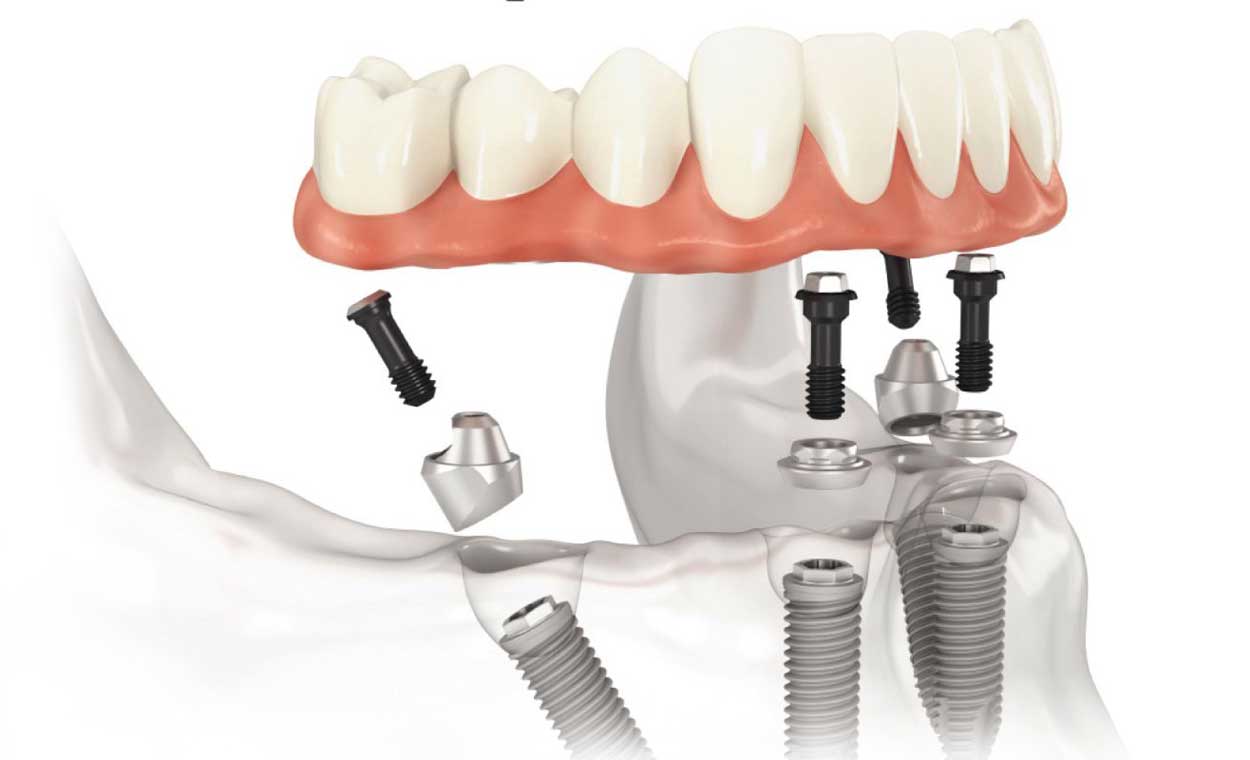
All-on-4 restores an entire arch of missing or failing teeth using only four dental implants, strategically angled to maximize contact with available jawbone and support a full fixed bridge, offering a specific engineering solution for patients who would otherwise need extensive bone grafting or many more individual implants to achieve the same full-arch result.
This page sits within our dental care in Turkey hub, alongside our foundational dental implants content. Below you will find the specific angulation principle that makes four implants sufficient, who is a genuine candidate, the complete surgical process, realistic timelines, risks worth understanding, and the practical details for pursuing this in Turkey. At any point you can request a free quote, with no obligation.
Understanding the Specific Angulation Principle Behind This Technique
The defining innovation behind this approach lies in how the two posterior implants are placed: rather than positioning them vertically as conventional implants typically are, they are angled, often between thirty and forty-five degrees, specifically to avoid critical anatomical structures such as the sinus cavities in the upper jaw or the nerve canal in the lower jaw, while simultaneously engaging a longer path of available bone than a vertical placement in that same location would achieve. The two anterior implants are placed more conventionally, vertically, in the bone at the front of the jaw where volume is typically more abundant.
Why This Angulation Allows Four Implants to Support a Full Arch
This specific angled placement achieves two things simultaneously: it allows implant placement in patients whose posterior jawbone would otherwise be too limited or too close to critical structures for conventional vertical implants, and it distributes chewing forces across a wider base than four vertically placed implants would achieve, since the angled posterior implants effectively span a greater length of bone. Together, these two effects allow just four implants to provide adequate support for a full arch of prosthetic teeth, avoiding the six or more implants, or the extensive bone grafting, that a more conventional full-arch approach might otherwise require.
Comparison Table: All-on-4 vs. All-on-6 vs. Individual Implants
| Criterion | All-on-4 | All-on-6 | Individual Implants |
|---|---|---|---|
| Number of implants per arch | Four | Six | One per missing tooth |
| Bone grafting typically needed | Often avoided through angled placement | Sometimes still needed | Varies by individual case |
| Best suited for | Adequate anterior bone, limited posterior volume | Cases needing additional support or coverage | Isolated missing teeth, not full-arch loss |
| Typical treatment speed | Often faster given fewer implants and reduced grafting need | Slightly more involved | Varies considerably by case |
For a fuller comparison of the six-implant alternative, see our dedicated All-on-6 content, and for isolated missing teeth our dental implants page.
Who Is a Genuine Candidate for All-on-4
- Extensive tooth loss or failing teeth across an entire arch, rather than a few isolated missing teeth better suited to individual implants already detailed in our dedicated content.
- Adequate anterior jawbone volume, since the two front implants still require sufficient bone at this specific location even though the technique reduces overall grafting need.
- Good general health supporting surgical healing, following the same fundamental candidacy principles already detailed in our dental implant content.
Indications and Contraindications for All-on-4
| Common Indications | Contraindications or Precautions |
|---|---|
| Extensive tooth loss or failing dentition across a full arch | Insufficient anterior bone volume even for the reduced grafting this technique typically requires |
| A desire to avoid extensive bone grafting given limited posterior jawbone | Uncontrolled diabetes or other conditions significantly impairing bone healing |
| Patients seeking a fixed, non-removable full-arch solution | Active periodontal disease requiring treatment first |
Step-by-Step: What the Procedure Involves
Before the Procedure
Your surgical team conducts thorough 3D imaging to assess your specific jawbone anatomy and plan the precise angle and position for each of your four implants, accounting for your individual sinus, nerve, and bone volume characteristics.
During the Procedure
Performed under local anesthesia or sedation, any remaining failing teeth are removed if necessary, the four implants are placed following the specific angled protocol, and a temporary fixed bridge is often attached the same day, allowing you to leave with functional teeth immediately.
After the Procedure
Initial healing involves swelling and dietary modification while wearing your temporary bridge, followed by the months-long osseointegration period before your final, permanent bridge replaces this temporary restoration.
Recovery Timeline
| Period | Typically Reported Progress |
|---|---|
| Days 1 to 14 | Swelling and soft diet requirements, temporary bridge in place |
| Weeks 3 to 8 | Gradual return to more varied diet as initial healing progresses |
| Months 4 to 6 | Osseointegration completes, confirmed through imaging |
| Months 6 onward | Final permanent bridge attached, replacing the temporary restoration |
Expected Results and Longevity
Once fully integrated and fitted with a final bridge, this solution typically functions for many years to decades, with the implant posts themselves, once successfully integrated, generally as durable as those used in standard single-tooth dental implant procedures already detailed in our dedicated content.
Risks and Possible Complications
- The same osseointegration risks already detailed in our foundational implant content, including reduced success rates in smokers or patients with uncontrolled systemic conditions.
- Prosthetic complications, such as bridge fracture under heavy bite forces, generally addressed through appropriate material selection and bite adjustment.
- Nerve or sinus proximity complications, minimized through the careful angled placement this technique specifically employs to avoid these structures.
- The need for revision if initial angle planning does not achieve adequate long-term stability, underscoring the importance of thorough pre-surgical imaging.
The Rigorous Medical Oversight Behind Turkey's Dental Industry
Turkey's Ministry of Health framework for international patients and Joint Commission International accreditation held by many leading facilities apply to this procedure with the same rigor already detailed in our foundational implant content, given this technique's shared underlying surgical principles.
Why Surgeon Experience With This Specific Angulation Technique Matters
Successfully executing the angled posterior implant placement central to this technique requires specific training and experience beyond standard vertical implant placement alone, since achieving the correct angle while avoiding critical anatomical structures and still providing adequate long-term support demands refined three-dimensional surgical judgment. A surgeon's general implant experience does not automatically indicate equal proficiency with this specific angled technique.
Understanding Same-Day Loading as a Genuine Practical Advantage
Many All-on-4 protocols allow same-day loading, meaning you leave your procedure with a functional temporary bridge rather than an extended period without teeth, a genuinely meaningful practical and psychological benefit for patients undergoing full-arch restoration, distinct from some individual implant cases that require a longer wait before any restoration is placed.
The Value of Understanding This Technique's Origin and Evolution
This specific approach emerged from research into how to provide full-arch fixed restoration for patients with limited bone volume without resorting to extensive grafting procedures, and the technique has continued refining over subsequent years as accumulated case experience has informed improved protocols and implant designs specifically suited to this angled application.
Quality Signals Worth Looking for in a Clinic
A genuinely experienced provider demonstrates specific documented case volume with this exact technique, uses thorough 3D imaging for angle planning, and discusses honestly whether All-on-4, All-on-6, or another approach genuinely suits your specific bone anatomy rather than defaulting to one technique regardless of individual circumstances.

Preparing for Your Consultation
Bring any existing dental records or imaging, and discuss your complete dental and medical history, particularly regarding any remaining teeth requiring extraction as part of this treatment plan.
Maintaining Continuity of Care Between Turkey and Canada
Request detailed documentation of your specific implant brand, angle, and bridge material, since this information supports any future maintenance or consultation with a dentist in Canada.
Patient Experiences Reported After All-on-4
Many patients describe particular satisfaction with same-day functional teeth, especially those who had lived with extensive tooth loss or failing dentition for extended periods before pursuing this comprehensive solution.
Combining This Procedure With Other Treatments
All-on-4 is sometimes preceded by tooth extraction when failing teeth remain, and occasionally combined with limited bone grafting in specific cases where even the reduced bone requirement this technique offers is not fully met by natural anatomy alone.
Why a Second Opinion Matters for This Decision
Given how significantly precise angle planning affects long-term success, comparing proposed treatment plans and specific surgeon experience between two consultations is genuinely worthwhile before committing to this comprehensive procedure.
Questions Worth Asking During Your Consultation
Ask specifically about your surgeon's documented experience with this exact technique, whether same-day loading is appropriate for your specific case, and what specific bridge material and warranty terms apply to your treatment.
Understanding Why Bite Force Distribution Matters for Long-Term Success
Beyond simply anchoring the prosthetic bridge, the four implants in this technique must collectively withstand the full biting and chewing forces an entire arch of natural teeth would normally distribute across many more root structures, meaning careful biomechanical planning regarding implant position and angle directly affects long-term structural success. Surgeons with genuine expertise in this technique consider not just where sufficient bone exists, but how forces will transmit through the entire arch once your final bridge is in full function.
Understanding the Specific Materials Used for Final Bridges
Final bridges used in this technique are typically constructed from either acrylic with a titanium framework, zirconia, or a combination approach, each offering different trade-offs between cost, aesthetics, and long-term durability. Zirconia generally offers superior strength and a more natural translucent appearance but at a higher cost than acrylic-based alternatives, and discussing which specific material genuinely suits your priorities and budget represents a worthwhile conversation during treatment planning.
Understanding Why Temporary and Final Bridges Serve Genuinely Different Purposes
The temporary bridge placed on procedure day, while functional, is specifically designed to allow your gum tissue and implants to heal without full biting force during the critical early integration period, meaning patients should understand this temporary restoration involves some dietary modification and is not intended to withstand the same forces your eventual final bridge will handle once osseointegration has genuinely completed.
Understanding How This Technique Addresses Both Function and Facial Support
Beyond restoring chewing function, full-arch tooth loss often affects facial support and appearance, since teeth and their surrounding bone provide structural support to facial soft tissue, and patients who have experienced extended tooth loss sometimes notice their facial profile has changed as a result. A well-planned full-arch restoration using this technique can help restore appropriate facial support alongside function, an additional consideration worth discussing during your treatment planning if this has been a concern for you specifically.
Understanding the Value of Provisional Restoration Adjustment Periods
Many patients find their bite and speech patterns require some adjustment period while adapting to their new temporary bridge, and clinics offering thoughtful follow-up during this adjustment window, making refinements to bite alignment or fit as needed, provide meaningfully better support than those treating this initial period as a simple placement without ongoing attention to your comfort and function during this transition.
All-on-4 Pricing in Turkey
| Pricing Factor | Cost Impact |
|---|---|
| Whether any tooth extraction or additional grafting is required alongside the four implants | A primary factor influencing overall cost |
| Specific bridge material selected for your final restoration | Influences overall total investment |
For a broader view of what full-arch dental work costs in Turkey, see our detailed pricing in Turkey guide, or request a free quote tailored to your specific case.
Understanding Why Follow-Up Care Matters Beyond the Initial Procedure
Once your final bridge is in place, ongoing professional maintenance, including periodic check-ups assessing implant stability and bridge fit, remains important for long-term success, similar to the maintenance requirements already detailed in our foundational dental implant content. Patients who commit to this ongoing care alongside diligent home hygiene tend to experience considerably better long-term outcomes than those who treat the procedure as a one-time intervention requiring no further attention.
Understanding Why This Technique Suits Certain Patients Better Than Removable Dentures
Patients who have previously worn removable dentures and experienced their common drawbacks, including slipping, discomfort, and reduced chewing efficiency, often find this fixed, implant-supported alternative represents a meaningful quality-of-life improvement, since the fixed nature of this solution eliminates the movement and adjustment concerns removable appliances frequently involve.
Understanding the Importance of Realistic Speech Adjustment Expectations
Some patients notice a brief adjustment period affecting speech clarity immediately following bridge placement, since the tongue and lips need time to adapt to the new prosthetic's specific contours and thickness, though this adjustment typically resolves within days to a few weeks as normal speech patterns re-establish themselves around the new restoration.
Understanding Why Age Alone Does Not Determine Candidacy
While extensive tooth loss requiring this comprehensive solution becomes more common with advancing age, candidacy for this procedure depends primarily on bone quality, overall health, and healing capacity rather than chronological age alone, meaning older patients in good general health often remain excellent candidates for this technique when appropriately evaluated.
Understanding the Value of Comparing Total Treatment Cost Rather Than Per-Implant Pricing Alone
Since this technique's total cost includes not just the four implants themselves but also imaging, any necessary extractions, the temporary and final bridges, and follow-up care, comparing total comprehensive treatment cost between providers offers a more accurate basis for decision-making than comparing isolated per-implant pricing figures alone, which can obscure meaningful differences in what is actually included within each specific quote.
Why Turkey Has Become a Leading Destination for All-on-4
Turkey Compared to Other Medical Tourism Destinations
| Criterion | Turkey | Tunisia | Costa Rica | Dominican Republic | Colombia | Mexico |
|---|---|---|---|---|---|---|
| Common clinic language | English widely spoken, growing French support | French and English widely spoken | Spanish, limited English | Spanish, variable English | Spanish, variable English | Spanish, variable English |
| Documented expertise with this specific technique | Particularly well established | Good availability | Variable | Variable | Good availability | Good availability |
| Estimated pricing level | Particularly accessible | Accessible | Moderate to high | Moderate | Moderate | Moderate |
| Direct flight access from Canada | Direct flights to Istanbul | Generally via a European stopover | Variable | Variable | Variable | Variable |
The Turkish Cities Most Recognized for This Procedure
Istanbul concentrates a particularly high density of clinics with dedicated full-arch restoration experience, given substantial demand for this comprehensive solution within the broader industry. Antalya, Izmir, and Ankara also host recognized clinics offering this procedure.
Why So Many Canadians Choose Turkey for All-on-4
Patients from Toronto, Montreal, Calgary, Ottawa, Edmonton, Winnipeg, Quebec City, Hamilton, Kitchener, London, Victoria, Halifax, Oshawa, Windsor, Saskatoon, Regina, Sherbrooke, St. Catharines, Barrie, Kelowna, Abbotsford, Kingston, Trois-Rivières, Guelph, Moncton, Brantford, Saint John, Peterborough, Thunder Bay, Saguenay, Lethbridge, Nanaimo, Kamloops, Belleville, Chilliwack, Drummondville, Sudbury, Sarnia, Wood Buffalo, and Fredericton travel to Turkey for this procedure, drawn by well-documented expertise and pricing considerably below typical Canadian private clinic rates for comparable full-arch restoration.
How to Choose a Clinic for All-on-4
- Confirm the facility holds recognized accreditation and operates under licensed dental surgeon supervision.
- Ask specifically about documented case volume with this exact angled technique, not general implant experience alone.
- Request to review before-and-after results specifically for full-arch cases similar to your own.
Planning Your Medical Trip to Turkey
- Entry requirements: Canadian citizens generally need an electronic visa before departure.
- Flights and transfers: several airlines offer direct service from major Canadian cities to Istanbul.
- Length of stay: plan for an initial visit of seven to ten days for surgery and temporary bridge placement, with a second visit several months later for your final restoration.
In Summary: An Engineering Solution for Full-Arch Restoration
All-on-4 uses strategically angled implant placement to support a full arch of teeth using just four implants, often avoiding extensive bone grafting other approaches might require. Turkey offers well-established, dedicated expertise for this specific technique.
Before making a decision, ensure your specific bone anatomy has been thoroughly evaluated to confirm this technique genuinely suits your case. Patients interested in a personalized assessment can request a free quote from the Aylan Clinic team. To explore further, see all dental care in Turkey or the broader aesthetic surgery in Turkey hub.
Everything about All-on-4 in Turkey
Technique, pricing, results and the full patient journey — every detailed answer in our complete guide.