
Nanofat uses your own fat not to add volume, but to deliver a concentration of regenerative cells to your skin. It is fat harvested then mechanically transformed until it holds no whole fat cells at all, leaving a fine liquid rich in stem cells, growth factors and extracellular matrix. The consequence is direct: nanofat adds no volume, whatever the quantity used. It works on the quality, texture and appearance of the skin, which makes it a tool entirely distinct from microfat.
This guide complements our Nanofat in Turkey procedure page, which sets out how the step works, the stay and the after-care. Here we explain what the preparation actually is, what the publications have documented since it was first described, the areas where it delivers most, why it so often accompanies microfat, and the cost difference between private Canadian care and Istanbul. It sits within our wider facial surgery in Turkey section. No figures appear here: the amount depends on the areas treated and any combination with other steps, so you can request a personalized quote at any time, with no obligation.
What Nanofat Actually Is
Nanofat is fat harvested then mechanically transformed until it holds no whole fat cells at all. What remains is a fine liquid, rich in stem cells, growth factors and extracellular matrix. The consequence is direct: it adds no volume, whatever quantity is used. It works on the quality, texture and appearance of the skin, which makes it a tool entirely distinct from microfat.
How It Was First Described
The technique was described in 2013 by a Belgian team, on an initial series of sixty-seven cases. Its author summed it up in three words that explain its rapid adoption: simple, quick and inexpensive to carry out.
One technical point matters particularly. The preparation being purely mechanical, it is done directly in theatre without recourse to enzymes, which considerably simplifies its use while preserving the biological activity of the product obtained.
How Rich Adipose Tissue Is
Fat is among the most stem-cell-dense tissues in the human body. Work published in 2020 reports that it yields roughly five hundred times more mesenchymal stem cells per unit volume than bone marrow.
That density explains the interest adipose tissue has drawn in regenerative medicine over two decades. Nanofat is its most direct application in facial surgery, since it concentrates that cellular fraction and delivers it exactly where it needs to act.
The Preparation, Step by Step
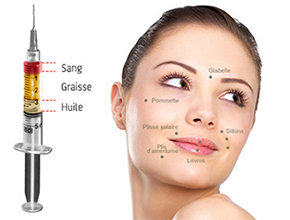
The fat is first harvested gently, as for conventional fat grafting. It then passes through three successive filters of two millimetres, one millimetre and half a millimetre, each reducing the particle size.
It is finally emulsified mechanically by repeated transfers between two syringes, which breaks the fat cells while preserving the stem cells and growth factors. The final product is a fluid liquid, injectable through very fine needles.
Comparing Nanofat, Microfat and Fillers
The table places each approach according to what it actually does.
| Criterion | Nanofat | Microfat | Dermal filler |
|---|---|---|---|
| Adds volume | No | Yes | Yes |
| Improves skin quality | Yes, that is its role | Partly | No |
| Origin | Your own tissue | Your own tissue | An outside product |
| Injection depth | Very superficial | Deep | Variable |
| Time to result | Three to six months | Gradual over six months | Immediate |
| Duration | Lasting | Permanent for the grafted portion | Six to eighteen months |
The second row sums up the essential point. Nanofat is the only one of the three whose main objective is skin quality itself, which is why it complements the other two rather than replacing them.
What Nanofat Addresses
Publications document its use on fine lines, textural irregularities, colouration of the lower eyelid, acne and surgical scars, and skin with long sun exposure.
Those indications appear in the literature from the initial series onward and have been confirmed since. A systematic review published in 2025 concludes it is effective on skin scars, particularly in the months following treatment.
The Under-Eye Area, the Flagship Indication
Colouration of the lower eyelid often combines two components: a lack of volume letting the deeper structures show, and skin quality that allows vessels and pigment to show through.
That is precisely why pairing microfat with nanofat gives the best results there. Work covering patients aged twenty to forty describes injecting a few cubic centimetres of microfat deep, completed with nanofat in the dermis, addressing both components in a single session.
The Areas Treated, and How the Session Runs
Nanofat addresses precise areas and clearly defined objectives. Here is which ones, and how the step proceeds.
The Eyelids and Eye Contour
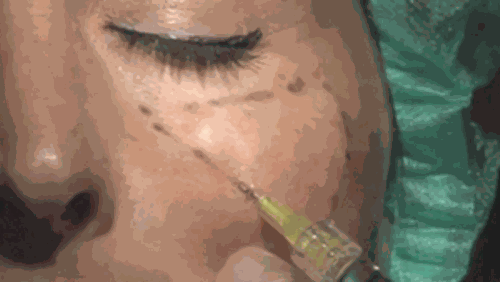
The skin there is the thinnest on the body, which makes it particularly receptive to an improvement in its quality. Nanofat is placed in the dermis, at the surface, through very fine needles at multiple points.
It is the area where publications document its use most, notably on colouration of the lower eyelid. The improvement concerns the thickness and density of the skin, which reduces the transparency of the structures beneath.
Fine Lines Around the Mouth
The fine vertical lines of the upper lip respond well to this treatment, the skin there also being thin and exposed. Nanofat stimulates remodelling of the skin matrix there across several months.
It is an area where fillers suit less well, the fineness of the lines making their placement delicate. Nanofat works differently since it adds no material but improves the skin itself.
Scars
A systematic review published in 2025 concludes that nanofat is effective on various types of skin scars, with results particularly documented in the months following treatment.
Acne scars are the most studied indication. A controlled trial reports a significant increase in dermal thickness from the first month onward, with improvement in the surface and depth of the scars treated.
Comparing the Areas and What They Gain
The table gathers the best-documented indications.
| Area or indication | What nanofat brings | Time to result |
|---|---|---|
| Lower eyelid | Thickness and density of the skin | Three to six months |
| Fine lines around the mouth | Remodelling of the skin matrix | Three to six months |
| Facial texture | Refined skin grain | Three to six months |
| Acne scars | Increased dermal thickness | From the first month |
| Surgical scars | Improved suppleness and appearance | Three to six months |
| Skin with long sun exposure | Improved general quality | Three to six months |
The fourth row stands out for its speed. The trial cited measures a significant increase in dermal thickness from the first month on acne scars, which makes it the indication where the result settles fastest.
The Harvest
It is identical to that of conventional fat grafting and involves small quantities, the abdomen or inner thigh supplying far more than is needed. A fine cannula and gentle suction preserve the cellular fraction being sought.
That stage counts as much here as for microfat, even though the final product no longer holds whole fat cells. It is the stem cells and growth factors that must be preserved, and they are just as sensitive to a rough harvest.
The Emulsification
The fat first passes through the three decreasing filters, then moves many times from one syringe to the other through a narrow connector. That mechanical shuttling breaks the fat cells while releasing their cellular content.
The resulting product is a homogeneous liquid, very different in appearance from the fat it started as. Its fluidity is what allows injection through fine needles, into the dermis, where microfat could not be placed.
The Injection
The practitioner lays the nanofat very superficially, in the dermis, through multiple closely spaced points. Some teams also use a micro-needling technique that distributes the product evenly across a whole surface.
That distribution counts for more than the total quantity. Nanofat works through cellular contact with the surrounding tissue, so a well-distributed deposit delivers more than a volume concentrated at a few points.
Anaesthesia and Duration
The step on its own is done under local anaesthesia as a day case, which makes it highly accessible. It is also commonly combined with fat grafting, eyelid surgery or a facelift, in which case it simply joins the programme.
Allow thirty to sixty minutes when performed alone, harvest included. It is among the shortest steps offered, and its recovery is counted in days rather than weeks.
Choosing Your Practitioner
On this step, the preparation counts as much as the injection. Here is how to assess that.
What Sets Practitioners Apart
Two parameters determine the quality of the product obtained: the gentleness of the harvest and the rigour of the emulsification. A practitioner who describes their three filters and their transfer protocol is working to an established method.
Availability of the step poses no difficulty. What varies more is joint command of nanofat and microfat, which allows volume and skin quality to be addressed in the same session.
The Questions That Tell You Most
Do you use nanofat alone or paired with microfat in my case, and for which areas? That question immediately separates a constructed approach from a single offering.
Then: how do you prepare the nanofat, and at what depth do you inject it? The expected answer mentions decreasing filters and injection into the dermis, very superficially.
What a Portfolio Must Show
Images at six months minimum, nanofat acting through progressive remodelling of the skin matrix. A photograph taken at one month does not yet show the essential of what this step delivers.
Look above all for close views of the skin itself, taken under the same lighting. This step works on texture and grain rather than on volumes, which calls for a different framing from the usual surgical photographs.
What Each Criterion Tells You
The table separates what predicts a good result from what predicts nothing.
| Criterion | What it indicates | Reliability |
|---|---|---|
| Filtration protocol described precisely | Preparation under command | Very high |
| Injection into the dermis mentioned | Understanding of the mechanism | Very high |
| Microfat and nanofat offered together | A complete approach to the face | Very high |
| Close images of skin texture | The right framing for this step | High |
| Results shown at six months | Remodelling genuinely settled | High |
| Even distribution explained | A considered injection technique | High |
| Volume promised with nanofat | Confusion about what the product does | Low |
The last row is the most telling signal in this whole guide. A practitioner announcing filling with nanofat is describing something the product does not do, whatever quantity is used.
Reaching Nanofat from Canada, Region by Region
Toronto, the GTA and Mississauga
The region offers this step in several clinics, often alongside fat grafting. The question therefore concerns the preparation protocol rather than availability. Toronto Pearson links Istanbul without a stopover. Allow three to five nights for this step alone, longer if it accompanies a more extensive procedure. A free quote compares both figures, the Turkish one often sitting up to around 70 percent lower.
Vancouver, Surrey and Victoria
On the West Coast nanofat is performed unevenly and its distinction from microfat often stays implicit. Ask which of the two preparations will be used for each area; that reveals the depth of the approach immediately. The flight from Vancouver is long, and the very brief recovery makes it manageable. English matters for the first-week instructions, particularly regarding sun protection of the treated areas.
Calgary and Edmonton
Alberta has practitioners offering this step without that guaranteeing command of both preparations. Ask when you book; it will save you a journey. Both cities reach Istanbul through a European hub. Have the planned areas and the injection depth envisaged for each specified in the quote.
Ottawa and Eastern Ontario
The region gives access to many practitioners. On this step the difference between them lies in the rigour of the preparation rather than in availability, which makes the questions above more useful than any comparison of facilities. Ottawa International connects to Istanbul. Ask for your instructions in writing, particularly regarding sun protection of the treated areas over the following weeks.
Winnipeg, Regina and Saskatoon
Across the Prairies this step usually means travelling to a larger centre, which stays very easy to arrange given a recovery of only a few days. From Winnipeg or Regina, reaching Istanbul takes a connection. Since you are travelling either way, compare preparation protocols rather than distances.
Halifax, Moncton and St. John's
Atlantic Canadians already travel for facial procedures, and the very brief recovery here makes a compact trip particularly realistic. Halifax connects onward in one stop. The rest comes down to arrangements: who meets you, where you stay for a few nights, and how the six-month photographic checks are handled.
Canadian Cities Against Istanbul
Here is what awaits you depending on your starting point. No sums appear in this table, this step being cosmetic everywhere.
| City / region | Airport | Access to Istanbul | Local offer and cost |
|---|---|---|---|
| Toronto, GTA, Mississauga | YYZ | Direct links | Available; package often up to around 70 percent less |
| Vancouver, Surrey, Victoria | YVR | With connection | Uneven practice, distinction to verify |
| Calgary / Edmonton | YYC / YEG | Via Europe | Available, method to verify |
| Ottawa | YOW | With connection | Many practitioners, rigour varies |
| Winnipeg, Regina, Saskatoon | YWG | With connection | Recovery of only a few days |
| Halifax, Moncton, St. John's | YHZ | With connection | Compact trip particularly realistic |
One reading emerges from this table: the very brief recovery makes this step compatible with a stay of only a few nights, which sets it apart from most facial procedures.
Comparing the Destinations Canadians Choose
A search in English will lead you toward Mexico, the Dominican Republic, Colombia, Costa Rica and Thailand. The grid that follows compares working methods, and it serves equally to separate two practitioners in the same city.
| Value criterion | Turkey / Istanbul (Aylan) | Mexico | Dominican Rep. | Colombia / Costa Rica / Thailand |
|---|---|---|---|---|
| Filtration protocol described | Yes, on request | To verify | To verify | To verify |
| Microfat and nanofat in one session | Yes, systematically | Variable | Variable | Variable |
| Pairing with eyelids or a facelift | Yes, same session | Yes | Yes | Yes |
| Direct with the clinic | Yes, no middleman | Often via agency | Often via agency | Often via agency |
| Cost vs private Canadian care | Often up to around 70 percent less | Often lower | Often lower | Often lower |
The second row counts particularly here. Addressing volume and skin quality in one session presupposes holding both preparations, which is not universal and is verified with a single question.
Istanbul, Ankara, Izmir and Antalya
Istanbul brings together teams using both preparations daily, often alongside a surgical step. That habit lets them compose a complete plan rather than apply an isolated service. Excellent practitioners also work in Ankara, Izmir and Antalya, with additional connections from Canada. The deciding criterion remains the rigour of the preparation protocol.
Preparing Your Session and Getting Through Recovery
Preparation is the lightest of any facial step and recovery is counted in days. Here is the full arrangement.
One Month Ahead
First contact, sending your photographs and receiving a quote specifying the planned areas and any pairing with microfat. This is also when to stop smoking, tobacco limiting the activity of grafted cells. A simple preoperative work-up in Canada, very light since the step is done under local anaesthesia when performed alone; blood tests suffice in most cases.
Two Weeks Ahead
Blood thinners stop on medical advice, including fish oil, turmeric and vitamin E. On a step involving numerous fine punctures, that precaution markedly reduces small bruises. Also pause exfoliating treatments and irritating actives on the areas to be treated, a week before the session. Calm skin receives the product better and recovers faster.
The Photographs to Send
They differ from those for other steps, since it is the skin itself that must be documented.
| View | What it reveals |
|---|---|
| Front, neutral lighting | Complexion and general evenness |
| Close-up of the eye contour | Thinness and transparency of the skin |
| Close-up around the mouth | Vertical fine lines |
| Profile in raking light | Texture and skin grain |
| Scar area if relevant | Contour and colouration |
The fourth view tells you most and is the one nobody thinks to take. Light coming from the side reveals the skin grain that frontal lighting erases completely, and it is precisely on that grain that nanofat works.
What to Pack
Very little, this being the lightest step of all. A high-factor sunscreen, a soothing fragrance-free product, and cold packs if your accommodation does not supply them. Plan also to go without makeup for two to three days. The fine punctures close quickly but the skin is better left at rest for the first forty-eight hours.
How Your Stay Unfolds
The table gives the usual rhythm for this step performed alone.
| Day | What happens |
|---|---|
| Arrival | Airport welcome, transfer, rest |
| Day 1 | Consultation, areas confirmed, session performed |
| Day 2 | Rest, light swelling, cold on the areas |
| Day 3 | Swelling clearly receding, outings possible |
| Day 4 | Check-up, sun protection instructions |
| Departure | Flight to Canada possible from this point |
This three to five night stay is the shortest of any facial procedure. That is what makes this step particularly compatible with limited leave, and why many people add it to a trip already planned.
The First Days in Practice
Light swelling and fine pink marks occupy the first forty-eight hours, then fade quickly. Cold applied on the first day markedly speeds up that resolution. Avoid irritating products, scrubs and direct sun exposure for two weeks. The skin has just received a regenerative stimulus and it is better left to work without adding other demands.
The Result Calendar
The table gives the real reference points, which account for most avoidable impatience.
| Milestone | What you observe | What is happening |
|---|---|---|
| Days 1 to 3 | Light swelling, fine marks | Normal response to injection |
| Weeks 1 to 4 | Skin settled, little change | The cells begin their work |
| Months 2 to 3 | First signs on the grain | Matrix remodelling under way |
| Months 3 to 6 | Clear improvement in texture | Remodelling reaching its term |
| Beyond six months | Result established | Lasting improvement of the tissue |
The second row explains most of the messages received at one month. Visibly not much happens during the first weeks, while the cellular work has in fact begun, and that quiet phase is part of the protocol.
Follow-Up from Canada
It runs on close photographs, under the same lighting as before the session, generally at three and six months. The result is genuinely judged at six months. Reproduce the raking-light profile without fail, the one showing skin grain. On a step that works on texture rather than volume, it is the only comparison that shows anything.
The Misconceptions About Nanofat
This technique is recent and often poorly explained, which leaves several approximations circulating. Here are the commonest, clarified against the publications.
Misconception: Nanofat Fills Like an Injectable Product
This is the commonest confusion and the costliest in terms of expectations. Nanofat holds no whole fat cells at all after emulsification, so it occupies no space and adds no volume. Its role is different and well established: delivering to the skin a concentration of stem cells and growth factors that remodel the skin matrix. A practitioner promising filling with nanofat is describing something the product does not do.
Misconception: It Is Simply a Variant of Fat Grafting
Both start from the same harvest, then diverge completely. Microfat keeps the fat cells to restore volume; nanofat deliberately breaks them to retain only the cellular fraction. The resulting product also handles differently. Its fluidity allows injection into the dermis, through very fine needles, where microfat is placed far deeper. They are two distinct steps that complement each other.
Misconception: The Results Are Immediate
Nanofat works through progressive remodelling of the tissue, which takes three to six months for most indications. That relative slowness is the sign of a real change rather than a surface effect. Acne scars are the documented exception: a controlled trial measures a significant increase in dermal thickness from the first month. Elsewhere, patience is part of the protocol.
Misconception: It Is an Experimental Technique
It was described in 2013 on a series of sixty-seven cases and the literature has grown considerably since. A systematic review published in 2025 concludes it is effective on skin scars. Its purely mechanical preparation, without enzymes, also makes it one of the simplest regenerative approaches to carry out in theatre. That simplicity explains its rapid spread.
Comparing Beliefs Against the Publications
The table sets the commonest claims against what the studies show.
| What you hear | What is actually the case |
|---|---|
| Nanofat fills hollows | It adds no volume at all, ever |
| It is a variant of fat grafting | Two preparations, two distinct objectives |
| The results are immediate | Three to six months of progressive remodelling |
| It is experimental | Described in 2013, literature established since |
| It must be repeated often | One session suffices in most cases |
| It replaces eyelid surgery | Two different objectives, often combined |
| Large quantities are needed | The product is concentrated, volumes minimal |
The second-to-last row deserves clarifying. Nanofat addresses skin quality while eyelid surgery addresses excess skin and fat; the two are in fact very often performed in the same session.
Misconception: It Only Suits Sun-Exposed Skin
Long sun exposure is among the documented indications, though far from the only one. Fine lines, textural irregularities and the thinness of the skin around the eyes belong just as much to this treatment. The useful question is therefore not your exposure history but the objective you have in mind. If you are looking to improve tissue quality rather than change volume, nanofat matches that request.
Misconception: A Large Harvest Is Needed
The final product is concentrated, so a few dozen millilitres of fat is more than enough to treat a whole face. The donor area is not changed by it. What counts more is how the product is distributed across the treated areas. Nanofat works through cellular contact with the tissue, which makes an even deposit more effective than a volume concentrated at a few points.
What Comes from the Step and What Comes from You
Some things are decided in theatre, others belong entirely to you.
| What you want | Comes from the step | Comes from you |
|---|---|---|
| Improving skin texture | Yes, that is its purpose | Sun protection, skincare |
| Densifying the skin around the eyes | Yes, through dermal injection | No |
| Improving a scar | Yes, documented | Sun protection of the area |
| Restoring volume | No, that belongs to microfat | No |
| Maintaining the result | The remodelling is lasting | A great deal: sun, tobacco, skincare |
| Speed of the result | Three to six months by nature | Patience |
The second-to-last row is the one you have most influence over. Daily sun protection directly preserves the remodelling obtained, and it is a simple measure whose effect compounds with that of the treatment.
The Vocabulary, and How to Decide
This glossary lets you follow a consultation and express your request in the terms your practitioner uses.
The Words You Will Hear
- Nanofat means fat mechanically emulsified until it holds no whole fat cells, leaving only a liquid rich in regenerative cells.
- Emulsification is the repeated passage of fat between two syringes through a narrow connector, a mechanical step that breaks the cells while releasing their content.
- The stromal vascular fraction covers all the regenerative cells contained in adipose tissue, including the stem cells. That is what nanofat concentrates.
- The extracellular matrix is the supporting framework of the dermis. Nanofat stimulates its remodelling, which accounts for the progressive improvement in skin texture.
- Intradermal injection means placing the product in the dermis, very superficially, as opposed to the deep placement of microfat.
- Growth factors are molecules contained in adipose tissue that promote blood vessel formation and the activity of skin cells.
The Terms That Cause Confusion
Four confusions come up almost every time.
| Term | Not to be confused with | The difference |
|---|---|---|
| Nanofat | Microfat | Skin quality, versus volume |
| Nanofat | Dermal filler | Regenerative cells, versus a material |
| Emulsification | Centrifugation | Breaking the cells, versus purifying them |
| Intradermal | Subcutaneous | In the dermis, versus under the skin |
The first pair is the one that costs most in poorly set expectations. Both preparations come from the same harvest and pursue opposite objectives, which makes distinguishing them essential from the consultation onward.

The Decision Summary
Everything above fits into this table, worth consulting before your appointment.
| The question | The short answer |
|---|---|
| What nanofat does | Improves the quality and texture of the skin |
| What it does not do | No addition of volume, ever |
| Origin of the technique | Described in 2013, on 67 cases |
| Preparation | Three filters then mechanical emulsification |
| Injection depth | Intradermal, very superficial |
| Main indications | Eyelids, fine lines, texture, scars |
| Time to result | Three to six months |
| Session length | Thirty to sixty minutes |
| Anaesthesia | Local when the step is done alone |
| Stay in Turkey | Three to five nights |
| Flight home to Canada | A few days afterwards |
| Gap vs private Canadian care | Often up to around 70 percent |
The first two rows alone are enough to frame your expectation. Knowing precisely what this product does and does not do is what makes the outcome match what you were hoping for, and it is the single most useful thing to settle before you begin.
Three Checks Before You Commit
First: does the practitioner describe their filtration and emulsification protocol? Second: do they inject into the dermis, very superficially? Third: do they offer to pair microfat if your request also has a volume component? A practitioner who clearly distinguishes the two is offering you a complete plan.
In Summary: A Different, Documented Approach to Skin Quality
Nanofat delivers to your skin a concentration of your own regenerative cells, and the change it produces concerns the tissue itself. It adds no volume, improving instead the quality, texture and density of the skin, and it is a different approach, patient, and documented for more than a decade. Send your five views, including without fail the raking-light profile that shows skin grain, and you will receive a plan area by area, specifying whether pairing with microfat would suit your request.
To go further, read our Nanofat in Turkey procedure page for the step, the stay and the after-care, explore the wider facial surgery in Turkey section, or request a personalized quote built on your own case, handled in English from the first exchange through to your six-month check.