
An endoscopic facelift applies the principles of the deep plane, a vertical vector and work in the deep planes, through short incisions hidden in the scalp. It addresses early signs of facial ageing, before a full facelift becomes the indication. A fine camera introduced through those small openings projects a magnified image of the deep structures onto a screen, so the surgeon works with vision superior to the naked eye through a considerably smaller opening. What he then does is exactly what a deep plane does: release the attachments, reposition the deep planes vertically, and fix them solidly. Only the access route changes, not the logic of the step.
This guide complements our Endoscopic Facelift in Turkey procedure page, within our wider facial surgery in Turkey section. It explains what the camera genuinely allows, the five-group classification recent publications propose, the safety and durability data, and the profile of people in whom this approach delivers most. You will find the published figures, an honest comparison with the full deep plane facelift, and the cost difference between private Canadian care and Istanbul. No prices appear here, because the amount depends on the levels addressed and the extent of the work; at any time you can see our pricing in Turkey or request a free quote built on your own case.
The Principle in One Sentence
A fine camera introduced through short incisions projects a magnified image of the deep structures onto a screen. The surgeon therefore works with vision superior to the naked eye, through a considerably smaller opening. What he then does is exactly what a deep plane does: release the attachments, reposition the deep planes vertically, and fix them solidly. Only the access route changes, not the logic of the step.
The Three Principles Both Techniques Share
The first is the vertical vector. Tissues descend vertically under gravity, and raising them along that same axis restores their original position rather than moving them toward the ear.
The second is minimal skin undermining. The skin stays attached to the deep planes, which preserves its blood supply and markedly speeds recovery. The third is working in the deep planes rather than at the surface.
What Recent Publications Document
A study published in 2025 describes this approach precisely, under the name endoscopic deep plane facelift. The authors classify patients into five groups by profile, and follow every case for at least twelve months. The results are clear: no permanent nerve injury across the whole series, and ninety-five point two percent of patients without revision. The authors note that most revisions fell among their first hundred cases, which reflects the learning curve of the technique.
The Five-Group Classification
The main contribution of that work lies in its method. Rather than applying a single step, the authors classify each person by their pattern of facial ageing and adapt the extent of the dissection accordingly. The table sets out that logic.
| Profile | Level concerned | Extent of the work |
|---|---|---|
| Upper third signs | Brow and forehead | Dissection limited to the forehead |
| Middle third signs | Cheekbone and cheek | Forehead and midface |
| Lower third signs | Jawline | Descending toward the lower face |
| Associated cervical signs | Neck and cervical angle | Neck work added |
| Combined signs | Several levels | Extended, progressive dissection |
This group-based approach accounts for part of the results reported. Matching the extent of the dissection to the profile rather than applying a single protocol gives both better precision and a lighter recovery.
A Series Followed Across Eighteen Years
Another study provides a useful confirmation about who is concerned. It covers two hundred and one patients operated on between 2006 and 2024 through a temporal endoscopic route, with midface repositioning and vertical SMAS plication. The authors conclude that this approach particularly suits people under forty-five presenting early signs of soft tissue descent. It is a useful age reference, and it matches exactly the moment when a full facelift looks premature.
What Twenty-Two Years of Practice Reports
A team describing twenty-two years of a minimal-incision endoscopic variant reports that the repositioned structures hold their position for years, with no significant recurrence of descent. The authors attribute that durability to two elements: the strategic selection of fixation points, and the extent of the mobilization obtained under endoscopic control. It is complete release that allows repositioning without tension, exactly as in the open deep plane.
Who This Technique Suits, and at What Moment
The indication for this operation rests on a precise profile. A series covering two hundred and one patients followed between 2006 and 2024 concludes that this approach particularly suits people under forty-five presenting early signs of soft tissue descent. Another team places the indication for its lightest variant between twenty and thirty-five, where the concern centres on the eye contour region. These references are not strict limits, but they describe the moment when this approach delivers most.
The Signs That Match
An early descent of the midface, a cheekbone beginning to flatten, a nasolabial fold starting to draw itself, and a jawline whose definition softens slightly without the neck being genuinely involved. To those are often added upper-third signs: a brow tail dropping, horizontal forehead lines marked by constant contraction, and lines at the nasal root linked to the tone of the glabellar muscles.
Comparing Your Profile Against the Indications
| Your situation | Suitable approach | Why |
|---|---|---|
| Early signs, toned skin, under 45 | Endoscopic facelift | Repositioning without skin removal |
| Isolated midface descent | Mid-face lift | A single level concerned |
| Brow tail dropped alone | Endoscopic brow lift | Upper level only |
| Jowls formed, neck loosened | Full deep plane facelift | Skin removal needed |
| Marked excess skin | Full deep plane facelift | Endoscopy does not remove skin |
| Early signs across several levels | Extended endoscopic facelift | Progressive dissection matched to profile |
The fourth and fifth rows contain the essential limit of this technique. Endoscopy repositions without removing skin, so marked excess calls for a full facelift through periauricular incisions.
The Eye Contour Profile
One team describes precisely the characteristics of its best candidates for the lightest variant. It notes a low brow position, affecting the tail, the body or the head depending on the case. It also records a rounded eye shape, congenital or following a previous procedure, lines at the nasal root, marked horizontal forehead lines, and descent of the outer corner of the eye. That profile matches exactly what this technique addresses best.
What This Technique Brings to the Midface
The series of two hundred and one patients describes midface elevation through a temporal route combined with vertical SMAS plication. The authors report consistent improvement in soft tissue volume and position. They also record the disappearance of the slight puckering appearing early in the lower face, along with improvement in the cervical and mandibular contours. It is a benefit few people anticipate from an approach designed for the midface.
When This Approach Loses Its Advantage
Where the skin has lost enough elasticity for excess to remain after repositioning, the full facelift regains the advantage. Its periauricular incisions allow that excess to be removed, which endoscopy does not do. A surgeon who directs you toward the full facelift rather than endoscopy because your skin calls for it is reasoning correctly. Offering the lightest approach to everyone would mean ignoring that parameter.
Comparing the Two Deep Approaches
| Criterion | Endoscopic facelift | Full deep plane |
|---|---|---|
| Incisions | Short, in the scalp | In front of and behind the ear |
| Surgeon's view | Magnified by the camera | Direct after opening |
| Repositioning | Vertical, deep planes | Vertical, deep planes |
| Skin removal | No | Yes |
| Profile concerned | Early signs, toned skin | Established laxity |
| Documented age | Often under forty-five | Generally beyond |
| Recovery | Shorter | Rapid thanks to the deep plane |
The repositioning row shows what the two share. Both raise the deep planes vertically after releasing the attachments, which is why the result reads as natural in both cases.
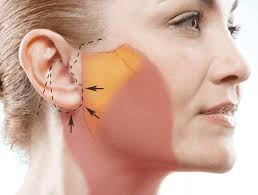
The Technique in Detail, Step by Step
The Incisions
Three to five short incisions, measuring one to two centimetres, are distributed across the scalp: one or two at the forehead, one on each side at the temple, sometimes one behind the ear depending on the levels addressed. None appears on the face. They hide entirely once the hair has grown back, the technique preserving the follicles along each line so hair grows through them.
Introducing the Camera
The endoscope is a fine tube with a light source and a camera, introduced through one of the incisions. It projects a magnified image of the structures beneath the tissues onto a screen. That magnified view is the technique's major asset. The surgeon distinguishes the nerve branches, vessels and attachments to be released precisely, with a level of detail direct vision does not always offer.
The Dissection
The surgeon advances in a natural gliding plane, against the bone at forehead level, then beneath the SMAS heading toward the midface. These planes exist naturally and separate without traumatizing the neighbouring tissues. The extent of that dissection depends on which group you fall into under the classification. It stays limited to the forehead for an upper-third profile, and descends progressively toward the lower face for broader profiles.
Releasing the Attachments
This is the decisive stage, exactly as in an open deep plane. The ligaments anchoring the soft tissues to the skeleton are released one by one under visual control, which makes the whole mobile. A team describing twenty-two years of practice stresses that it is the extent of that mobilization which governs how durable the result proves. Tissues still anchored do not rise, whatever fixation force is applied afterwards.
Vertical Repositioning
Once released, the tissues are raised vertically, along the exact axis of their descent. That direction restores their original position rather than moving them laterally toward the ear. It is the fundamental principle the endoscopic facelift shares with the open deep plane, and it is what produces a natural result. No tension is applied to the skin, which simply rests on repositioned planes.
The Fixation
Several methods exist: sutures anchored to bone, resorbable screws, dedicated devices, or suspension with strong threads. The 2025 study describes suspension using looped threads fixed at depth. The authors of the twenty-two-year series stress the strategic selection of those anchor points. It is the combination of complete mobilization and well-placed fixation that accounts for the hold observed over time.
| Method | Principle | What is noted |
|---|---|---|
| Sutures anchored to bone | Thread through a bone tunnel | A solid, durable anchor |
| Resorbable screw | Temporary support that dissolves | Nothing to remove afterwards |
| Tined device | Multiple fixation on the scalp | Rapid placement, under two minutes per side |
| Thread suspension | Loops fixed at depth | Described in the 2025 study |
What counts more than the method chosen is the solidity of the anchor during the weeks when adherence settles. A surgeon who explains which he uses and why is working to a method rather than to a habit.
Anaesthesia and Duration
The operation is performed under general anaesthesia or deep sedation depending on the extent chosen and the team's practice. Allow two to four hours depending on the number of levels addressed. One technical observation is worth knowing: some teams use an ultrasonic instrument rather than electrocautery, which releases less heat into the tissues and reduces postoperative swelling.
What the Camera Allows and Does Not
It gives a magnified view of the deep structures and allows precise dissection through a reduced opening. That is a real advantage, particularly at forehead and midface level. It does not, however, allow excess skin to be removed, which a full facelift does through its periauricular incisions. That is precisely why the indication concerns early signs rather than established laxity.
The Planes Crossed, and What the Camera Reveals There
The Forehead Plane
At forehead level, the surgeon advances directly against the bone, beneath the frontal muscle and beneath the periosteum. It is a natural gliding plane, almost avascular, which separates without traumatizing the neighbouring structures. That proximity to bone provides a solid landmark. The camera distinguishes precisely the nerves emerging from the superior orbital rim, allowing them to be worked around with a safety direct vision does not always offer.
The Midface Plane
Descending toward the cheekbone, the surgeon joins the plane beneath the SMAS. It is exactly the plane of the open deep plane, reached here from the temple rather than from in front of the ear. That continuity between the forehead plane and the sub-SMAS plane is what allows the midface to be reached with no incision on the face. It is the central technical principle of the approach.
The Attachments to Release
Three groups matter particularly. The attachments of the superior orbital rim hold the brow. Those of the inferior orbital rim and the zygomatic arch hold the midface. Those in front of the ear limit the mobility of the whole. The camera allows them to be identified one by one and released under visual control. It is that complete release the authors of the twenty-two-year series name as one of the two factors of durability.
| Plane crossed | What it allows | Level concerned |
|---|---|---|
| Subperiosteal, against bone | Release of the brow | Upper third |
| Beneath the SMAS | Repositioning of the malar fat | Middle third |
| Beneath the SMAS, descending | Jawline | Lower third |
| Beneath the platysma | Cervical angle | Neck |
| Deep temporal fascia | Anchor point for the suspension | Support |
The last row is worth noting. The deep temporal fascia is not a dissection plane but a solid structure serving as anchor, exactly as in the mid-face lift.
Why Skin Undermining Stays Minimal
The skin stays attached to the planes it covers, exactly as in an open deep plane. The composite block moves as one, without the skin being separated from what carries it. That attachment preserves cutaneous blood supply and leaves very little dead space beneath the skin. It accounts for the fast recovery observed with both techniques, and it clearly separates the deep approaches from superficial lifts.
What the Camera Shows That the Naked Eye Does Not
A magnified image on screen reveals fine structures direct vision distinguishes poorly, notably the nerve branches at temple level. The 2025 study in fact reports no permanent nerve injury across its series. That precision also accounts for the clean surgical field the authors describe. A precise dissection bleeds less, which further improves visibility and allows a more accurate step, in a virtuous circle.
The Anatomical Limit of the Technique
The camera reaches the deep planes but does not allow excess skin to be removed. That step calls for periauricular incisions, through which the surgeon redrapes and resects what remains. That is why the indication concerns early signs in still-toned skin. The technique does very well what it does, provided skin removal is not required.
Comparing the Three Lifts, and Knowing Which Concerns You
Three operations carry the name facelift and address three different moments. The endoscopic facelift addresses early signs in still-toned skin, often before forty-five. The full deep plane facelift addresses established laxity, where excess skin would remain after simple repositioning. The traditional facelift tightens a superficial layer with lateral traction, which makes it the least durable of the three. Its hold sits between three and seven years according to the publications, against more than fifteen for the deep plane.
| Criterion | Endoscopic | Full deep plane | Traditional |
|---|---|---|---|
| Working plane | Deep planes | Deep planes | Surface |
| Direction | Vertical | Vertical | Lateral |
| Skin undermining | Minimal | Almost none | Extensive |
| Skin removal | No | Yes | Yes |
| Scar on the face | None | In front of the ear | In front of the ear |
| Recovery | Fast | Markedly fast | Longer |
| How long it lasts | Years | More than fifteen years | Three to seven years |
The first two rows show the essential. The endoscopic and the deep plane both work in the deep planes with a vertical vector, which brings them far closer to each other than to the traditional lift.
Why the Vertical Vector Changes Everything
Tissues descend vertically under gravity. Raising them along that same axis restores exactly their original position, producing a result people notice without being able to identify it. Lateral traction toward the ear instead moves the volumes without putting them back. That direction produces the pulled look the public associates with facelifts of the past, and both deep techniques avoid it by construction.
Why Minimal Skin Undermining Speeds Recovery
When the skin stays attached to the planes it covers, its blood supply remains intact and the dead space beneath it stays minimal. Swelling and bruising then resolve markedly faster. The traditional lift widely undermines the skin before redraping it, which lengthens its recovery. It is a concrete advantage of the deep approaches, and it weighs more than the length of the operation itself.
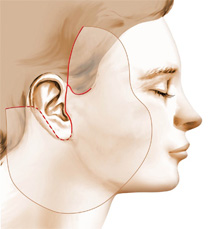
The Pathway Over Time
Many people follow a natural progression between these techniques. An endoscopic facelift around forty addresses early signs with no facial scar, then a full deep plane later when the skin calls for it. These operations therefore do not exclude one another. The deep planes approached endoscopically stay perfectly accessible to a later deep plane, and the first operation complicates the second in no way.
Comparing Against Your Situation
| Your situation | Indicated approach | Why |
|---|---|---|
| Early signs, toned skin | Endoscopic | Repositioning without skin removal |
| Jowls formed, less toned skin | Full deep plane | Skin removal needed |
| Neck clearly loosened | Full deep plane | Deep neck structures addressed |
| No facial scar acceptable | Endoscopic | Incisions only in the hair |
| Seeking maximum hold | Full deep plane | More than fifteen years documented |
| Revision after an older lift | Full deep plane | Deep planes never approached |
The fourth row counts for many people. The complete absence of any scar on the face is the most decisive argument of the endoscopic approach, and it often weighs as much as the technical considerations.
What a Good Surgeon Should Tell You
He should place you among these three approaches and explain why, and be willing to direct you toward the one he does not perform if your anatomy calls for it. A team commanding both endoscopy and the full deep plane can select the technique that suits rather than the one available. That is the most useful criterion you can verify before committing.
Choosing Your Surgeon, and Reaching This Technique From Canada
This technique rests on regular endoscopic practice and on an honest classification of your profile. Working by screen calls for particular ease: the view is magnified but indirect, the space is confined, and complete release of the attachments entirely governs how durable the result proves. The authors of the 2025 study note that most of their revisions fell among their first hundred cases. That is honest and useful information: it indicates that annual volume counts more here than on many other operations.
The Questions That Tell You Most
How many endoscopic facelifts do you perform each year? This technique is acquired through practice, and the publications say so explicitly when describing their own learning curve. Then: which group do you place me in, and what extent of dissection does that imply? A surgeon who reasons by profile rather than applying a single protocol is working to the published method.
The question that protects most: does my skin elasticity allow this approach, or would a full facelift suit better? It is the most important question of all, and an honest surgeon may well direct you toward the other technique. Endoscopy repositions without removing skin. Where excess would remain after repositioning, the full facelift regains the advantage, and a practitioner who tells you so does you considerable service.
What a Portfolio Must Show
Results at twelve months minimum, the milestone the 2025 study uses for its follow-up. Images at three months show a stabilization phase rather than a settled result. Look also for varied profiles and three-quarter views. That is the angle at which midface repositioning reads best, and a front view shows little of it.
| Criterion | What it indicates | Reliability |
|---|---|---|
| Annual number of endoscopic facelifts | Regular practice, curve passed | Very high |
| Classification by profile explained | Published method applied | Very high |
| Willing to direct toward the full facelift | Honesty about the limits | Very high |
| Vertical vector and release described | Understanding of the mechanism | Very high |
| Results shown at twelve months | Follow-up matching the publications | High |
| Fixation points explained | Attention to durability | High |
| Technique offered to everyone | No classification applied | Low |
The third row is the most revealing in this guide. A surgeon able to tell you this technique would not suit you is reasoning from your anatomy rather than from his offering.
Reaching Istanbul From Your Region
Around Toronto, the GTA and Mississauga, the region has facial surgeons, and full endoscopic practice remains a subspecialty; many perform forehead endoscopy without descending toward the midface and lower face. Toronto Pearson links Istanbul without a stopover: allow seven to ten nights on site and around two weeks before the return flight, and a free quote often shows the Turkish figure up to around 70 percent lower.
On the West Coast, facial surgery is available in Vancouver, Surrey and Victoria while endoscopy extended to the midface remains scarce, a matter of the volume the technique needs. The flight from Vancouver is long, and English matters for the first-week instructions, particularly regarding resting the scalp and the sleeping position. In Calgary and Edmonton, Alberta has facial surgeons without that guaranteeing the extent of endoscopic practice, so ask about the annual number and the classification; both cities reach Istanbul through a European hub.
Around Ottawa and Eastern Ontario the region gives access to a reasonable number of practitioners without this extended technique being widespread; ask for your instructions in writing, particularly regarding sun protection of the scalp over the following months. Across the Prairies, from Winnipeg, Regina and Saskatoon, reaching a practitioner who performs this technique regularly means travelling to a larger centre, so travel enters the calculation from the outset. In Atlantic Canada, from Halifax, Moncton and St. John's, this technique is not performed and travel is a given, which reduces the decision to choosing the team: who meets you, where you stay, in which language you receive your instructions, and how the first year of follow-up is organized.
| City / region | Airport | Access to Istanbul | Availability and cost |
|---|---|---|---|
| Toronto, GTA, Mississauga | YYZ | Direct links | Subspecialty present; package often up to around 70 percent less |
| Vancouver, Surrey, Victoria | YVR | With connection | Facial surgery yes, extended endoscopy scarce |
| Calgary / Edmonton | YYC / YEG | Via Europe | Available, extent to verify |
| Ottawa | YOW | With connection | Not widespread among practitioners |
| Winnipeg, Regina, Saskatoon | YWG | With connection | Travel a given |
| Halifax, Moncton, St. John's | YHZ | With connection | Technique not performed locally |
The right-hand column shows a constant: many Canadian practitioners use endoscopy at the forehead without extending it to the midface and lower face. That extent is what distinguishes a complete practice, and it is verified with a single question.
Comparing the Destinations Canadians Choose
A search in English will lead you toward Mexico, the Dominican Republic, Colombia, Costa Rica and Thailand. The grid that follows compares working methods, and it applies equally to two practitioners in the same city.
| Value criterion | Turkey / Istanbul (Aylan) | Mexico | Dominican Rep. | Colombia / Costa Rica / Thailand |
|---|---|---|---|---|
| Annual extended facial endoscopy volume | High | Variable | Variable | Variable |
| Classification by profile applied | Systematic | To verify | To verify | To verify |
| Honest referral to the full facelift | Systematic | To verify | To verify | To verify |
| Direct with the clinic | Yes, no middleman | Often via agency | Often via agency | Often via agency |
| Cost vs private Canadian care | Often up to around 70 percent less | Often lower | Often lower | Often lower |
The third row counts most here. A team practising both techniques can direct you toward the one suiting your skin; a team performing only one will adapt your case to its offering. Istanbul concentrates teams performing extended facial endoscopy routinely, and equally commanding the full deep plane facelift, so the suitable technique can be chosen rather than the available one. Excellent practitioners also work in Ankara, Izmir and Antalya, with additional connections from Canada; the deciding criterion remains annual volume and command of both approaches.
The Misconceptions About Endoscopic Facelifts
This technique carries an ambiguous reputation, pulled between those presenting it as miraculous and those judging it insufficient. Here is what the publications actually establish.
It Is a Lighter Facelift
Recent literature calls it an endoscopic deep plane facelift, precisely because it applies the same principles: complete release of the attachments, vertical repositioning, minimal skin undermining. What distinguishes it is not the depth of the step but the access route and the absence of skin removal. A genuine repositioning of the deep planes, performed through short incisions, remains a genuine repositioning.

The Result Does Not Hold
A team describing twenty-two years of practice reports that repositioned structures hold their position for years, with no significant recurrence of descent. The authors identify precisely the two conditions for that hold: strategic selection of the fixation points, and the extent of the mobilization obtained. Incomplete release accounts for most results that fade, whatever the technique used.
The Camera Limits What Can Be Done
It gives instead a magnified view the naked eye does not reach, particularly useful for identifying the nerve branches at temple level. The 2025 study in fact reports no permanent nerve injury across its whole series. What the camera does not allow is skin removal, and that precise limit is what defines the indication.
It Is a Recent and Uncertain Technique
One team publishes twenty-two years of practice with its variant, and another follows two hundred and one patients operated on between 2006 and 2024. The track record therefore exceeds a decade by a wide margin. What is recent is the formalization of the five-group classification published in 2025. It brings a reproducible method where each team previously applied its own judgement.
| What you hear | What is actually the case |
|---|---|
| It is a lighter facelift | Same principles as the deep plane, another access route |
| The result does not hold | Years without recurrence per a twenty-two-year series |
| The camera limits the surgeon | It gives a magnified view the naked eye does not reach |
| It is a recent technique | Series published since 2006, over a decade of follow-up |
| It suits everyone | Early signs and toned skin, otherwise a full facelift |
| It is necessarily cheaper | The price follows the extent, forehead alone to four levels |
| It replaces the deep plane | Two different moments, not two competing options |
The last row sums up the essential. These two techniques do not compete: endoscopy addresses early signs in toned skin, the full deep plane addresses established laxity. Many people in fact have both, several years apart.
Revisions Are Frequent, and It Is Only for Women
The 2025 study reports ninety-five point two percent of patients without revision, a level comparable to other facial operations, and adds the honest precision that most of those revisions fell among the first hundred cases, which tells you exactly what to ask a practitioner. Male demand also exists and is growing, often prompted by a face that reads as tired in meetings or on video calls. The principle of the step is identical; what changes is the dosage and the placement of the incisions, adapted to the male hairline.
What Comes From the Operation and What Comes From You
| What you want | Comes from the operation | Comes from you |
|---|---|---|
| Raising the midface | Yes, through the vertical vector | No |
| Raising the brow tail | Yes, if the forehead is addressed | No |
| Removing excess skin | No, that belongs to the full facelift | No |
| Restoring lost volume | No, that belongs to fat grafting | No |
| Skin quality | No, a separate treatment | A great deal: sun, skincare |
| Durability of the repositioning | Complete release and fixation | Elasticity, lifestyle |
The third and fourth rows explain why a thorough consultation examines several parameters. Repositioning addresses the position of the tissues, while volume and excess skin each belong to another step.
Preparing Your Operation and Organizing Your Stay
Preparation sits between that of an isolated step and that of a full facelift. Three months ahead comes first contact, sending your photographs and discussing which levels concern you; this is when your profile is classified and the extent of the dissection is decided, and when to ask whether your skin elasticity allows this approach. Two months ahead you receive the quote setting out the levels planned and the extent chosen, stop smoking so the scalp and deep planes benefit from good blood supply during adherence, and arrange accommodation for a seven to ten night stay. One month ahead comes the preoperative work-up in Canada, matched to an operation under general anaesthesia or deep sedation, and two weeks ahead blood thinners stop on medical advice, including fish oil, turmeric and vitamin E.
The Photographs to Send
| View | What it reveals |
|---|---|
| Front, forehead completely relaxed | Real brow position and symmetry |
| Right and left three-quarter | Cheekbone position and transition |
| Right and left profile | Jawline and neck angle |
| Front, cheekbones lifted by your fingers | Approximate effect of the repositioning |
| Front, outer brow lifted by finger | The share coming from the upper third |
| Skin pinch in front of the ear | Elasticity and speed of return |
The last view is the most rarely sent and one of the most decisive. Gently pinching the skin in front of the ear and filming how quickly it returns informs on your elasticity, the parameter determining whether this approach suits you.
What to Pack and the Day Before
Bring button-front tops, pillows for sleeping with the head raised, cold packs if your accommodation does not supply them, a gentle fragrance-free shampoo, a wide-brimmed hat for early outings and something to occupy the quieter days, since the scalp calls for careful sun protection over several months. The day before, the surgeon examines you standing, assesses your skin elasticity, measures the position of your brows and cheekbones, then confirms your group and the corresponding extent of dissection. This is the moment to ask how far his dissection will descend and which fixation points he will use.
How Your Stay Unfolds
| Day | What happens |
|---|---|
| Arrival | Airport welcome, transfer, rest |
| Day 1 | Upright consultation, profile classified, extent confirmed |
| Day 2 | Surgery, one night of monitoring |
| Days 3 to 5 | Rest, cold, swelling peaks on day two |
| Days 6 to 8 | Swelling receding, first outings |
| Days 9 to 10 | Sutures removed, check-up, instructions |
| Departure | Flight to Canada at around two weeks |
This seven to ten night stay stays shorter than for a full facelift, reflecting the more limited extent of the undermining. Paired with eyelid surgery, it keeps the same format. Swelling of the forehead and temples occupies the first week, peaking around the second day; sleeping with the head raised and applying cold over the first forty-eight hours markedly speeds up comfort. Tightness of the scalp is usual, and transient numbness behind the incisions is common and fades progressively over a few months.
The Result Calendar, and Follow-Up From Canada
This operation evolves across several months. In the first forty-eight hours swelling sets in and peaks around the second day, so the face reads as considerably more lifted than it will be; it is the phase where cold applied regularly to the forehead and temples delivers most. During the first week swelling begins receding and any bruising fades, tightness of the scalp corresponds to the suspension put in place, and sutures are removed between the ninth and tenth day at the pre-departure check-up. Over the first month the shape becomes clearer as the swelling disappears; many people feel the effect fading during this period, which is expected, the face returning from its swollen state toward its real position.
| Milestone | What you see | What is happening |
|---|---|---|
| Days 1 to 2 | Effect strongly marked | Swelling at its maximum |
| Days 3 to 7 | Swelling receding | Gradual return toward the real position |
| Weeks 2 to 4 | Effect appearing to soften | Swelling gone, real position apparent |
| Weeks 6 to 8 | Shape readable | Tissue adherence under way |
| Months 3 to 6 | Position stabilized | Result close to final |
| Month 12 | Result established | Follow-up milestone of the publications |
| Beyond | Durable hold | Years without significant recurrence |
The third row explains most of the messages received at one month. The effect does not genuinely diminish: swelling is disappearing and revealing the position obtained, which will then stay stable. The 2025 study uses twelve months as its minimum follow-up for every case, the milestone at which adherence is complete and the position definitively acquired, and the milestone to ask for when reviewing a portfolio.
Follow-Up and What Preserves the Result
Follow-up runs on photographs reproducing exactly the same views and the same lighting as before surgery, generally at one, three, six and twelve months. Reproduce the front view with the forehead completely relaxed and the three-quarter views without fail, since the first documents the upper third and the others the midface repositioning a front view shows poorly. Three elements then preserve the result: weight stability, since significant variation alters the volumes the repositioning placed; daily sun protection, which preserves skin quality; and stopping smoking, whose effect on skin elasticity is well documented. Those measures do not change the position obtained, but they slow the evolution that would occur around it.

The Vocabulary, and How to Decide
The endoscope is a fine tube with a camera and a light source, introduced through a short incision and projecting a magnified image onto a screen. The SMAS is the fibrous membrane wrapping the muscles of expression, and the plane beneath it is where extended endoscopy and the deep plane both work. The vertical vector means the direction of repositioning, along the exact axis of the tissues' descent. The retaining attachments anchor the soft tissues to the skeleton, and their complete release governs both the scale of the repositioning and its durability. The deep temporal fascia is the solid structure at the temple serving as anchor for the suspension. The five-group classification is the method published in 2025 that classifies each person by their pattern of ageing and adapts the extent of the dissection.
| Term | Not to be confused with | The difference |
|---|---|---|
| Endoscopic facelift | Endolift | Surgery under camera, versus a laser |
| Endoscopic facelift | Full deep plane | Without skin removal, versus with |
| Endoscopic | Traditional facelift | Deep planes vertical, versus surface lateral |
| Temporal lift | Full endoscopic facelift | One level, versus several |
The first pair costs most in poorly set expectations. Endolift generally refers to a laser treatment through microfibres, which has nothing in common with repositioning surgery under endoscopic control.
The Decision Summary
| The question | The short answer |
|---|---|
| What the operation does | Repositions the deep planes vertically |
| Access route | Three to five incisions in the scalp |
| Scar on the face | None |
| What it does not do | It does not remove excess skin |
| Profile concerned | Early signs, toned skin |
| Documented age | Often under forty-five |
| Published method | Five-group classification |
| Safety reported | No permanent nerve injury |
| Without revision | 95.2 percent of cases |
| Operation length | Two to four hours |
| Stay in Turkey | Seven to ten nights |
| Flight home to Canada | Around two weeks |
| Result settled | Three to six months, follow-up at twelve |
| Gap vs private Canadian care | Often up to around 70 percent |
The elasticity row determines whether this technique concerns you. Everything else follows from it, which is why the question of your skin elasticity precedes all others at consultation.
Three Checks Before You Commit
First: how many endoscopic facelifts does the surgeon perform each year, and how far does his dissection descend? Second: which group does he place you in, and why? Third: would he direct you toward a full facelift if your skin called for it? That last question is the most revealing, since it tests the honesty of the reasoning as much as the competence.
In Summary: The Deep Plane Through Short Incisions
This technique applies deep plane principles through short incisions hidden in the hair, leaving not the slightest trace on the face. It does very well what it does, provided skin removal is not required: it repositions the deep planes vertically for early signs in still-toned skin, with published safety and durability data behind it. The team at Aylan Clinic accompanies you in English at every stage, from classifying your profile through to the first-year check, with a technique chosen for your anatomy rather than for what is most widely performed.
To go further, read our Endoscopic Facelift in Turkey procedure page, explore the full range of facial surgery in Turkey, or see our pricing in Turkey. When you are ready, request a free quote with your six photographs, including the elasticity test where you gently pinch the skin in front of the ear, and you will receive a classification of your profile, the corresponding extent of dissection and, where appropriate, an honest referral to the full facelift.