Professional teeth whitening at Aylan Clinic lets patients from across Canada lighten their teeth by several shades in a single visit, for up to 60% less than Canadian private prices. It is the most conservative cosmetic dental treatment available: nothing is removed from the tooth and nothing is bonded on, because the result is achieved by lightening the natural colour of your own enamel and dentine. For many patients it is also the most cost-effective — if your teeth are well-shaped and reasonably aligned and colour is your main concern, whitening may achieve most of what you are looking for.
This guide complements our Teeth Whitening in Turkey procedure page, within our wider dental care in Turkey section. Below you will find how professional whitening actually works, the available methods, whether it is right for you, a step-by-step appointment, how to manage sensitivity, the forty-eight-hour diet, maintenance, how whitening interacts with existing dental work, and how the price is built and compared. At any time you can review our pricing in Turkey and request an itemised quote.
1. Understanding Professional Whitening
How does whitening actually work?
Tooth discolouration accumulates in two places. Surface staining sits on the enamel, deposited by coffee, tea, red wine, tobacco and time. Internal discolouration lies within the dentine beneath, and it darkens naturally with age as the dentine layer thickens and the enamel above it thins.
Professional whitening uses a peroxide gel that penetrates the enamel and breaks down the pigmented molecules held within the tooth structure. It does not bleach the tooth in the sense of coating it; it lightens the colour that is already there. This is why professional whitening reaches discolouration that no toothpaste can. Abrasive whitening toothpastes remove surface stain; they cannot reach into the dentine.
What results are realistic?
Most patients achieve a lightening of several shades, measured on a standard dental shade scale. The exact number depends on your starting colour, the nature of your discolouration, and the protocol used. Yellowish discolouration responds particularly well. Greyish tones respond more slowly and less completely. Both improve; the degree differs.
How long does it last?
Typically one to three years, depending substantially on your habits. Coffee, tea, red wine and smoking all shorten it; a patient who consumes little of these and maintains good hygiene keeps the result considerably longer. Whitening is maintainable. Once you have achieved a shade you like, occasional top-up sessions with a custom tray keep you there — and top-ups are quick and inexpensive compared with the initial treatment.
Is it safe for enamel?
Professional whitening under supervision does not damage enamel. The peroxide concentrations used are well established, the exposure is controlled, and the gums and soft tissues are protected during in-clinic treatment. Temporary sensitivity during and shortly after treatment is common and expected. It resolves, and there are practical measures that reduce it considerably — covered in section 6.
2. Whitening Methods
In-clinic whitening
A higher-concentration gel applied by a clinician, with the gums and lips carefully isolated, in one or more sessions during a single appointment. Results are immediate and visible when you leave. This is the fastest route and the one most patients travelling for treatment choose. A full appointment takes ninety minutes to two hours.
Take-home whitening with custom trays
Trays made from impressions of your teeth, so they fit precisely, used with a lower-concentration gel over a period of days or weeks at home. Slower but very effective, and gentler on sensitive teeth because the concentration is lower and the exposure gradual. Custom trays matter: an ill-fitting tray leaks gel onto the gums, which causes irritation and uneven results.
Combined protocol
An in-clinic session for immediate results, followed by custom trays and gel to take home for continued lightening and future maintenance. For patients travelling from Canada this is usually the best value. You leave with a visible result and the means to continue improving it and to maintain it indefinitely, without needing to return for top-ups.
Internal whitening for a single dark tooth
Where one tooth has darkened after root canal treatment or an old injury, whitening from the inside is possible. The gel is placed within the tooth itself, behind the front surface, and it lightens the tooth from within. This is a specific and often very successful treatment for a problem that external whitening cannot solve — and it is considerably more conservative than crowning the tooth.
What about over-the-counter products?
Whitening strips and pastes achieve modest results on surface staining. They do not reach internal discolouration, the concentrations are low, and generic trays fit poorly. They are not harmful in ordinary use, but the results are not comparable to professional treatment.
3. Is Whitening Right for You?
Where whitening works well
- Yellowing with age. The most common reason patients seek whitening, and among the most responsive.
- Staining from coffee, tea, red wine or tobacco. Responds particularly well, especially combined with a professional cleaning first.
- Generalised dullness in otherwise healthy, well-shaped teeth.
- A single dark tooth after root canal treatment — treated internally.
Where whitening has limits
Existing fillings, crowns and veneers do not whiten. Restorative materials are colour-stable, which means they stay exactly as they are while the natural teeth around them lighten. This matters practically. If you have a white filling on a front tooth, whitening the tooth will make that filling stand out. The solution is straightforward — replace the filling afterwards to match the new shade — but it should be planned rather than discovered.
Greyish discolouration from certain antibiotics taken in childhood responds partially. Improvement is real but usually incomplete, and some patients in this group ultimately prefer veneers. White spots on enamel may become temporarily more noticeable during whitening before evening out. This is normal and it settles.
Whitening before other treatment
This is one of the most useful things on this page. If you are planning veneers, crowns or a bridge, whiten first. Ceramic does not respond to whitening. Your new restorations will be made to match whatever shade your natural teeth are at the time. If you whiten afterwards, the natural teeth lighten and the restorations stay put — and the only remedy is remaking them. Whitening first, then matching the ceramics to your lightened shade, gives you both a brighter smile and a match that lasts.
Who should wait
Patients with untreated decay or active gum disease — both are treated first, since whitening gel on an exposed cavity or inflamed gum is uncomfortable and unhelpful. Whitening is also generally postponed during pregnancy and breastfeeding, and it is not carried out on patients under sixteen.
4. Why Canadians Combine Whitening with a Treatment Trip
| Factor | Canada (private) | Turkey — Aylan Clinic |
|---|---|---|
| Cost | Moderate to high | Up to 60% less |
| Custom trays | Additional cost | Included in the combined protocol |
| Timing with other treatment | Separate appointments | Sequenced correctly in one visit |
| Accommodation | Not applicable | 5-star hotel, full board included |
| Companion | Not applicable | Free, accommodated and fed |
Whitening as part of a larger plan
Most Canadian patients who whiten with us are already travelling for something else — veneers, crowns, a bridge or implants. Whitening is sequenced at the start of that plan, so that everything made afterwards matches your lightened teeth. Doing it this way costs very little on top of a treatment you were already having, and it means the whole result is coherent rather than the new work looking noticeably brighter than everything around it.
Whitening as a treatment in its own right
Some patients come specifically for whitening, often combined with a professional cleaning and a course of take-home trays. It is a short appointment within a longer trip, and it suits patients who want a visible improvement without any irreversible work.
Why the cleaning comes first
A professional cleaning removes surface deposits and stain, which allows the gel to act on the tooth rather than on the film covering it. It also frequently produces a visible improvement on its own, which is worth seeing before deciding how much whitening you actually want.
5. Your Appointment, Step by Step
Assessment
A full examination of your teeth and gums, with attention to any existing fillings and restorations on visible teeth, any exposed dentine, gum recession, and areas of sensitivity. Your starting shade is recorded against a standard scale and photographed. This matters: whitening is gradual enough that patients frequently underestimate how much has changed, and a before photograph settles it.
Professional cleaning
Removal of plaque, calculus and surface stain. This is done first, both because it improves the result and because it sometimes achieves more than patients expect on its own.
Protection
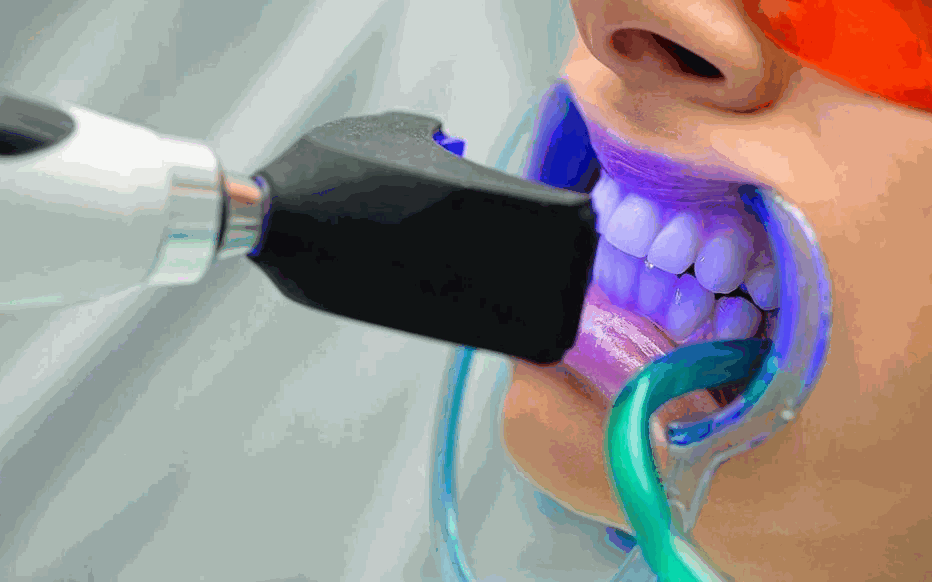
The gums and lips are isolated with a protective barrier, so that the gel acts only on the enamel. This step is what distinguishes professional in-clinic whitening from home products, and it is why higher concentrations can be used safely.
The whitening session
Gel is applied and left for a set period, then removed and reapplied — typically two to three cycles within one appointment. Some protocols use a light; the evidence on whether it adds significantly to the result is mixed, and the gel chemistry does most of the work. You sit comfortably throughout. Most patients read or watch something.
Immediate result and shade check
Your new shade is recorded against the same scale and photographed under the same conditions, so you can see the change objectively rather than relying on impression. Teeth appear at their lightest immediately after treatment because they are dehydrated. They will darken very slightly over the following days as they rehydrate, which is normal and expected — the shade you have at one week is your real result.
Custom trays
Impressions or a digital scan are taken for trays, which are made in our on-site laboratory and given to you before you leave, with gel for continued lightening and future maintenance. This is the part that makes the treatment durable rather than temporary.
Instructions
Written guidance on the first forty-eight hours, how to use your trays, how to manage any sensitivity, and how to maintain the result.
6. Sensitivity: What to Expect and How to Manage It
Is sensitivity normal?
Yes, and it is the most common experience after whitening. It typically presents as brief sharp sensations, sometimes described as zings, or as generalised sensitivity to cold. It usually appears during or shortly after treatment and resolves within a few days. It is a temporary effect of the whitening process, not damage.
Who is more likely to experience it
Patients with existing sensitivity, exposed dentine at the gum line, gum recession, cracks in the enamel, or a history of grinding. If any of these apply to you, say so at assessment. The protocol can be adjusted.
What genuinely reduces it
- Desensitising toothpaste, started before treatment. Using a potassium nitrate or fluoride toothpaste for a week or two beforehand measurably reduces post-treatment sensitivity. This is the single most effective preparatory step, and it is worth starting before you travel.
- Fluoride application immediately after the session, which we include.
- A gentler protocol. Lower concentration over a longer period, or shorter application cycles, if you are prone to sensitivity.
- Avoiding very hot and very cold for the first day or two.
- Spacing tray sessions rather than using them on consecutive nights if you are sensitive.
If sensitivity persists
It very rarely does beyond a week. If it does, stop tray use, continue with desensitising toothpaste, and contact us. Persisting sensitivity usually indicates something specific — an exposed area or a crack — that is worth examining.
Gum irritation
A whitish appearance or mild tenderness of the gum can occur where gel has contacted the tissue. It resolves within a day or two. With in-clinic treatment the gums are isolated, so this is uncommon. With trays it usually indicates too much gel in the tray — a smaller amount is more effective, not less.
7. The First Forty-Eight Hours: The White Diet
Why it matters
Immediately after whitening, the enamel is temporarily more porous and more receptive to pigment. Anything strongly coloured consumed in this window is more readily absorbed, which can undo part of the result. Following a pale diet for forty-eight hours protects the shade you have just paid for. It is a small inconvenience for a meaningful benefit.
What to avoid for forty-eight hours
Coffee, tea, red wine, cola, dark fruit juices. Tomato sauce, soy sauce, curry, balsamic vinegar, beetroot. Berries, dark chocolate. Red and orange spices including paprika and turmeric. Smoking.
What is fine
Chicken, fish, white rice, pasta with cream or oil, potatoes, cauliflower, white cheese, plain yoghurt, bananas, apples with the skin removed, white bread, milk, water, clear spirits with tonic if you wish.
A practical suggestion
Plan this into your trip. If you are having whitening on day two of a treatment week, that is a good moment to be eating simply anyway. Coffee drinkers: a straw genuinely helps if you cannot manage two days without, and a light-coloured coffee with plenty of milk is less pigmented than an espresso.
After forty-eight hours
Return to normal. Ongoing habits affect how long the result lasts, but the acute vulnerability has passed.
8. Maintaining Your Result
Realistic expectations
Whitening is not permanent, and it is not meant to be. It is maintainable, which is a different and more useful proposition. Expect one to three years from the initial treatment, depending on habits, then a top-up session with your trays to restore the shade.
How top-ups work
Two to three consecutive nights with your custom trays, roughly once or twice a year, restores the original result. Gel refills are inexpensive and long-lasting. This is the reason the combined protocol represents good value: you leave with the means to maintain the result indefinitely without further appointments.
Habits that shorten it
Coffee and tea, particularly without milk. Red wine. Smoking, which stains substantially and quickly. Dark berries and sauces. None of these needs eliminating — they simply mean you will top up more often.
Habits that extend it
Rinsing with water after coffee, tea or wine. Using a straw for iced coffee and dark juices. Brushing twice daily. Regular professional cleaning, which removes the surface film that dulls the appearance.
Toothpaste
A non-abrasive fluoride toothpaste for daily use. Whitening toothpastes work by abrasion, which removes surface stain but gradually roughens enamel and any restorations — occasional use is fine, daily long-term use less so.
Professional cleaning
Twice yearly. A cleaning appointment alone often restores much of the brightness by removing accumulated film, which is why the interval between top-ups can be longer than patients expect.
9. Whitening and Existing Dental Work
Restorations do not whiten
This is the single most important practical point about whitening, and it determines the correct sequence of any larger treatment plan. Composite fillings, crowns, veneers, bridges and implant crowns are all colour-stable. They will not lighten with the gel.
What that means for you
If you have a white filling on a front tooth, whitening the tooth will make that filling darker by comparison. The straightforward answer is to replace it afterwards to match your new shade — which is a short appointment, and which we can do in the same visit. If you have crowns or veneers already, whitening the natural teeth around them will create a mismatch. This is worth thinking about before proceeding. Sometimes the answer is to whiten anyway and replace the restoration; sometimes it is to leave things as they are. If you are planning new restorations, whiten first. Always. The new work is then made to your lightened shade.
A useful sequence for a combined plan
Professional cleaning. Whitening. A week for the shade to settle and rehydrate. Then shade selection for any veneers, crowns or bridges, matched to your new colour. This is how we sequence combined cases, and it is why whitening appears early in most treatment plans rather than as an afterthought.
10. Whitening a Single Dark Tooth
Why one tooth darkens
Most commonly after root canal treatment, or years after an injury that damaged the nerve. The tooth darkens from the inside as blood pigments break down within the dentine, and no amount of external whitening reaches it.
Internal whitening
Gel is placed inside the tooth, through a small access point at the back, and sealed in for a period. It lightens the dentine from within. The process may be repeated over a few sessions. Results are frequently very good, and it is markedly more conservative than the alternative — crowning a tooth that is otherwise structurally adequate.
When a crown is the better option
Where the tooth is also heavily filled, cracked, or structurally weak, a crown addresses strength as well as colour. Where the tooth is sound apart from its colour, internal whitening is worth trying first. Your radiograph and examination establish which applies.
What to expect
Internal whitening typically requires more than one appointment, which suits patients already staying for a week of treatment. The result is assessed against the neighbouring tooth, since matching that specific tooth is the objective.
11. Aylan Clinic Across Canada: 50 Cities We Serve
Aylan Clinic works with patients from every province and territory in Canada. Wherever you live, the process begins the same way: a free online consultation, with photographs sent from home and no need to travel before your treatment dates are confirmed. Below are the fifty Canadian cities from which we most frequently receive enquiries, with practical notes on travelling to Istanbul from each region.
Greater Toronto Area and southern Ontario
Toronto is our single largest source of Canadian patients, and Pearson offers the most direct connections to Istanbul of any Canadian airport — the simplest journey in the country for this treatment. Across the wider Greater Toronto Area we regularly work with patients from Mississauga, Brampton, Markham, Vaughan, Richmond Hill and Oshawa, all within straightforward reach of Pearson. Along the western end of Lake Ontario, patients travel to us from Hamilton, Burlington and Oakville, and from the Niagara region including St. Catharines and Niagara Falls. In southwestern Ontario we see patients from London, from the Waterloo region — Kitchener, Waterloo and Cambridge — and from Guelph, Windsor and Barrie. Most drive to Pearson rather than connecting domestically.

Eastern and northern Ontario
Ottawa patients typically connect through Toronto or Montreal, with many choosing Montreal for its frequency of European departures. Kingston patients generally drive to either. In northern Ontario we work with patients from Sudbury, Thunder Bay and Sault Ste. Marie. Journeys from the north involve a domestic connection, so we recommend an overnight stay near your departure airport before your outbound flight. Sudbury and Thunder Bay both have substantial francophone populations, and those patients are served in French from first contact onward.
Montreal and the surrounding region
Montreal is our second-largest Canadian source, with excellent direct and one-stop connections to Istanbul from Trudeau. Patients from Laval, Longueuil and Brossard are all within easy reach of the airport. Whitening is frequently added to a Montreal patient’s trip for other treatment, sequenced at the beginning so that everything made afterwards matches the new shade.
Quebec City and across the province
From Quebec City and the Capitale-Nationale region, including Lévis, most patients connect through Montreal. The same applies to Trois-Rivières, Sherbrooke, Drummondville and Saint-Jérôme — all within driving distance of Trudeau. Gatineau patients usually depart from Ottawa or drive to Montreal. From Saguenay, a domestic connection through Montreal is the norm. All Quebec patients are served in French throughout: consultation, treatment, and the written aftercare guidance you take home.
Vancouver and British Columbia
Vancouver patients connect through European hubs, typically one connection and a full day of travel. We schedule assessment for the day after arrival so that you are rested. Across the Lower Mainland we work with patients from Surrey, Burnaby and Richmond. From Victoria and Nanaimo, patients cross to Vancouver by ferry or short flight. Kelowna, Abbotsford and Kamloops patients typically connect through Vancouver or Calgary. Because whitening is a short appointment, British Columbia patients almost always combine it with other treatment rather than travelling for it alone.
Alberta
Calgary and Edmonton both offer good European connections, and Alberta is consistently among our strongest sources of Canadian dental patients. Patients from Red Deer and Lethbridge generally drive to Calgary. We schedule Alberta patients with the same rest-day approach as British Columbia.
Manitoba and Saskatchewan
Winnipeg patients connect through Toronto or Montreal. The francophone community of Saint-Boniface is served in French, as are Franco-Manitoban patients from the surrounding region. From Saskatoon and Regina, journeys involve a domestic connection followed by a transatlantic flight. An overnight stay near your arrival airport on the return turns a long day into two manageable ones.
Atlantic Canada
Halifax offers seasonal and connecting European service, and Nova Scotia patients typically route through Toronto or Montreal. In New Brunswick we work with patients from Moncton, Fredericton and Saint John. Moncton and the surrounding Acadian communities are served in French, as are Acadian patients across the province. Most connect through Montreal, which for francophone patients has the added convenience of French-language service throughout. From Charlottetown in Prince Edward Island and St. John’s in Newfoundland and Labrador, journeys involve one or two connections. St. John’s patients benefit from the shortest transatlantic leg in Canada.
Northern Canada
We work with patients from Whitehorse in Yukon, and from communities across the Northwest Territories and Nunavut. For northern patients, travel to any specialist dental centre already involves considerable distance. Whitening is invariably combined with other treatment on the same trip, and the take-home trays are particularly valuable — they mean maintenance can be done at home indefinitely rather than requiring further travel. We plan northern itineraries with buffer days at both ends.
How we handle the logistics
Whichever city you are travelling from, your coordinator arranges airport transfers at both ends in Istanbul, confirms your hotel before you depart, and builds your clinical schedule around your arrival time. Two recommendations for every Canadian patient. Schedule your assessment for the day after you land. And avoid a same-day domestic connection on your return, particularly in winter. One whitening-specific tip: if you are coming for whitening as part of a larger plan, start using a desensitising toothpaste a week or two before you travel. It measurably reduces sensitivity, and it costs almost nothing.
12. What the Package Includes
- Free online consultation and treatment plan
- Full examination with attention to existing restorations and sensitivity
- Starting shade recorded and photographed against a standard scale
- Professional cleaning before whitening
- Gum and lip isolation during in-clinic treatment
- In-clinic whitening session with multiple gel cycles
- Fluoride application afterwards
- Final shade recorded and photographed under the same conditions
- Custom trays made in our on-site laboratory, with gel for continued lightening and maintenance
- Written aftercare guidance including the forty-eight-hour diet
- Replacement of visible composite fillings to match your new shade, where this forms part of your plan
- 5-star hotel accommodation, full board
- A companion at no extra cost, accommodated and fed in the same room
- Airport–clinic–hotel transfers
- A personal coordinator throughout your stay
- English and French-speaking Canadian patient liaison available on request
The clinical team
- Cosmetic dentistry specialist — assessment, shade evaluation and protocol selection
- Dental hygienist — professional cleaning before treatment
- Endodontist — internal whitening of a single dark tooth where indicated
- In-house laboratory technicians — custom tray fabrication
13. Results by Patient Profile
Age-related yellowing
A patient in her fifties with healthy, well-aligned teeth that had gradually darkened. Cleaning, an in-clinic session, and trays for continued lightening at home. Several shades lighter, no tooth structure touched, and the result maintained since with occasional top-ups. This is the most common whitening case and among the most satisfying, because the improvement is substantial and nothing was altered.
Coffee and tobacco staining
A patient with heavy surface staining from years of coffee and smoking. The cleaning alone produced a visible change; the whitening took it considerably further. He was advised that the result would need more frequent top-ups given his habits, and he was content with that trade-off.
Whitening before veneers
A patient planning six upper veneers. Whitening first lightened her lower teeth and the upper teeth not being veneered, so the porcelain could be matched to a brighter shade across the whole smile rather than to her original colour. Had she whitened afterwards, the veneers would have been the darkest teeth in her mouth. Sequencing is the whole point here.
A single dark tooth
A patient whose upper incisor had darkened years after root canal treatment. Internal whitening over several sessions during a treatment week brought it close to its neighbour — avoiding a crown on a tooth that was otherwise sound.
A patient who whitened and stopped there
A patient who came enquiring about veneers for discolouration. After cleaning and whitening, she decided her teeth were where she wanted them and cancelled the veneer plan. That is a good outcome. She kept her enamel and her money, and every option remains open to her.
Whitening with filling replacement
A patient with two visible composite fillings on upper front teeth. Whitening first, then replacement of both fillings to match the new shade — a short appointment that completed the result and which would have been wasted if done in the other order.
14. Questions Worth Asking Any Clinic
- “Will my starting shade be recorded and photographed?” — objective before-and-after documentation is standard practice and it lets you see the change accurately.
- “Will I have a professional cleaning first?” — it improves the result and sometimes achieves more than expected on its own.
- “How are my gums protected during treatment?” — isolation is what allows a higher concentration to be used safely.
- “Do I get custom trays to take home?” — this is what makes the result maintainable rather than temporary.
- “I have fillings on my front teeth — what happens to them?” — a clinic that raises this before you ask is paying attention.
- “I’m planning veneers as well — what order should we do things in?” — the answer should be whitening first, without hesitation.
- “I have sensitive teeth — can the protocol be adjusted?” — it can, and it should be.
- “Could internal whitening treat my dark tooth instead of a crown?” — worth asking if the tooth is otherwise sound.
15. Practical Points to Know
What to expect
Temporary sensitivity during and shortly after treatment is common and resolves within a few days. Mild gum tenderness where gel has contacted the tissue can occur and settles quickly. Teeth appear lightest immediately after treatment because they are dehydrated, and darken very slightly over the following days as they rehydrate. The shade at one week is your genuine result. Existing fillings, crowns and veneers do not lighten, which may create a mismatch that is worth planning for. White spots on enamel can appear temporarily more prominent during treatment before evening out. Your assessment will note anything specific to your teeth, including areas of exposed dentine or recession that may need a gentler protocol.

Who this suits
Adults with healthy gums and no untreated decay. Existing decay or gum inflammation is treated first.
Who should wait
Whitening is generally postponed during pregnancy and breastfeeding, and is not carried out on patients under sixteen.
Sensitive teeth
Not a barrier. Starting a desensitising toothpaste a week or two beforehand, and using a gentler protocol, makes the treatment comfortable for the great majority of sensitive patients.
16. Aftercare and Maintenance
The first forty-eight hours
Follow the pale diet in section 7. This is the single most useful thing you can do to protect the result.
Using your trays
Follow the written guidance you receive. A small amount of gel is more effective than a generous one, since excess simply overflows onto the gum. If you experience sensitivity, space the sessions out rather than stopping altogether.
Storing your gel
Refrigerated, and used within its stated shelf life. Gel loses potency over time, which is why refills are worth ordering when you need them rather than stockpiling.
Top-ups
Two to three consecutive nights with your trays, once or twice a year, maintains the result. Many patients time this before an event.
Your Canadian dentist
Keep your twice-yearly cleaning appointments. Cleaning removes the surface film that dulls brightness, and it frequently restores much of the effect on its own — which is why the interval between whitening top-ups can be longer than expected. Mention that you whiten and use trays, so your dentist can check the fit periodically as teeth shift very slightly over years.
Staying in touch
Send us a photograph at six months if you would like an assessment of whether a top-up is due, or if you have any question about your trays.
17. Price: How It Is Built and How to Compare It
Why we quote per case rather than publishing a price list
Because whitening is offered in several forms and is frequently part of a larger plan. An in-clinic session alone, a combined protocol with trays, and internal whitening of a single tooth are different treatments with different costs. Your quote is itemised and fixed once you approve it.
What determines your price
Five factors.
- The protocol. In-clinic alone, take-home trays alone, or the combined approach. Combined costs more initially and delivers considerably more value, because it includes the means to maintain the result indefinitely.
- Whether custom trays are included. Trays require impressions and laboratory fabrication. They are what make the treatment durable, and they are included in our combined protocol.
- The number of in-clinic sessions. Most patients need one; heavier staining sometimes benefits from two.
- Internal whitening, where a single dark tooth is being treated from within, which involves separate appointments.
- Replacement of visible fillings afterwards to match the new shade, where that forms part of your plan.
Whitening as part of a larger plan
Where you are already travelling for veneers, crowns, a bridge or implants, whitening is a modest addition to the overall cost — and it is sequenced at the start so that everything made afterwards matches. Patients frequently find this the best-value element of their whole plan, because the incremental cost is small and it affects the coherence of the entire result.
What is included in your quote
Assessment. Shade recording and photography before and after. Professional cleaning. Gum isolation. The in-clinic session with multiple gel cycles. Fluoride application. Custom trays with gel. Written aftercare guidance. Your hotel with full board. Airport transfers. Your coordinator throughout. A companion is accommodated and fed at no additional cost.
What sits outside it
Flights, travel insurance, future gel refills, and your routine cleaning appointments in Canada.
How to compare quotes properly
Four checks make whitening quotes comparable.
- Is a professional cleaning included? Whitening without cleaning first delivers a poorer result.
- Are custom trays included, or is it an in-clinic session only? This is the single largest difference between quotes, and it determines whether you can maintain the result.
- Is gel included with the trays, and how much? Trays without adequate gel are of limited use.
- Is fluoride application included afterwards? It reduces sensitivity and takes moments.
Why the lowest quote is rarely the best value
The cheapest whitening is usually a single in-clinic session with no cleaning, no trays and no gel. It produces a visible result that fades over a year or two with no means of restoring it. The combined protocol costs more once and then costs very little for years. For a patient travelling from Canada, that difference matters — you are unlikely to fly back for a top-up. For a fuller overview, see our pricing in Turkey page.
Insurance
Whitening is a cosmetic procedure and is not covered by Canadian dental plans. Professional cleaning, however, generally is, and it may be claimable separately if itemised. Your invoice separates cleaning from whitening for exactly this reason.
Payment
A deposit confirms your dates where whitening is part of a larger plan. For whitening alone within a treatment trip, it is settled on site. Terms are set out in full when you approve your plan.
Getting your figure
Send photographs of your teeth in natural light — smiling widely, and a close view of the upper and lower front teeth — plus a note of any existing fillings or crowns on visible teeth and whether your teeth are sensitive. An itemised quote follows within 24 to 48 hours.
18. Glossary
| Term | Meaning |
|---|---|
| Peroxide gel | The active agent that lightens tooth structure |
| In-clinic whitening | Higher-concentration treatment applied by a clinician |
| Take-home whitening | Lower-concentration gel used in custom trays |
| Custom trays | Trays made from impressions of your teeth for precise fit |
| Combined protocol | In-clinic session plus take-home trays |
| Internal whitening | Whitening a single dark tooth from within |
| Shade scale | The standard reference used to record tooth colour objectively |
| White diet | The pale diet followed for forty-eight hours after treatment |
| Rebound | The slight darkening as teeth rehydrate over the days after treatment |
| Desensitising toothpaste | Potassium nitrate or fluoride paste that reduces sensitivity |
19. How Canadians Search for This
- “Teeth whitening Turkey” — often as part of a larger treatment trip, which is how most patients combine it.
- “How many shades whiter” — several shades is typical, depending on your starting colour and the type of discolouration.
- “Does whitening damage enamel” — professional whitening under supervision does not. Temporary sensitivity is common and resolves.
- “Whitening before or after veneers” — before, always. Ceramic does not whiten.
- “Teeth whitening sensitive teeth” — manageable. Start desensitising toothpaste beforehand and use a gentler protocol.
- “How long does teeth whitening last” — one to three years depending on habits, then a top-up with your trays.
- “White diet after whitening” — forty-eight hours of pale food and drink protects the result.
- “Do fillings whiten” — no. A visible filling may need replacing afterwards to match.
- “Whitening one dark tooth” — internal whitening can treat this, and it is more conservative than a crown.
- “Custom trays vs strips” — custom trays fit precisely, which means even results and no gel on the gums.
- “Zoom whitening” — a light-activated in-clinic protocol. The gel chemistry does most of the work; evidence on the light’s added benefit is mixed.
- “Whitening toothpaste” — works by abrasion on surface stain only. It cannot reach internal discolouration.
- “Is teeth whitening covered by insurance” — no, it is cosmetic. The cleaning may be claimable separately.
In Summary: A Brighter Smile You Can Maintain
Professional whitening at Aylan Clinic combines a cleaning before treatment, objective shade recording before and after, gum isolation allowing a higher concentration to be used safely, and custom trays made in our on-site laboratory so you can maintain the result at home indefinitely — with 5-star accommodation and a companion at no extra cost, for up to 60% less than Canadian private prices.
Four things that make the difference: have the cleaning first, because it improves the result and sometimes achieves more than expected on its own; take the trays home, because they turn a one-off result into something you maintain for years; whiten before any veneers, crowns or bridges, because ceramic does not lighten and the sequence is what makes the whole smile match; and follow the pale diet for forty-eight hours, a small effort that protects everything you have just achieved.
If colour is your main concern, whitening may well get you where you want to be — and we will tell you honestly if it would. To go further, read our Teeth Whitening in Turkey procedure page for how the treatment works, your stay and your care, review our pricing in Turkey, and explore the full range of dental care in Turkey.