
The short answer is yes — and the scar is the most visible one in body contouring, which is the thing to settle first. An arm lift at Aylan Clinic Tunisia — brachioplasty — removes excess skin and fat from the upper arm, over a stay of eight to ten days, for up to 60% less than Canadian private prices. The scar runs from the armpit to the elbow on the inner arm, and unlike an abdominoplasty scar it is not hidden by clothing in warm weather, by a swimsuit, or by anything you would normally wear. A proportion of patients who ask for this operation need liposuction instead, and the pinch test tells you which. And it scars less well than most body incisions, because the inner arm is under tension with every movement.
This guide is the long-form companion to our procedure page on Brachioplasty Arm Lift in Tunisia, which sets out how the operation is performed, the stay and the aftercare. Here we take the decision apart: the scar, the pinch test that decides whether you need one at all, mini versus standard versus extended, the recovery that patients consistently underestimate, and the Canadian logistics. Read it alongside our body contouring in Tunisia overview and the current plastic surgery prices in Tunisia.
One thing distinguishes Tunisia: it is a French-speaking country. Not a clinic with French-speaking staff — a country where French is a working language across medicine and daily life.
Part one — deciding
1. What the operation is
The standard brachioplasty. An incision along the inner arm — from the armpit toward the elbow — excess skin and fat removed, and the wound closed. One and a half to three hours, under general anaesthesia or sedation with local. Frequently with liposuction of the arm at the same time, to thin the tissue before the skin is removed.
The variants. Mini-brachioplasty is a short scar confined to the armpit, for laxity limited to the upper third of the arm — a narrow indication, covered in section 4. Extended brachioplasty continues the incision onto the chest wall, where laxity extends beyond the arm; it is common after massive weight loss, and our guide to post-weight-loss skin removal covers that context. And liposuction alone is not a brachioplasty at all — it is the right operation for a proportion of patients, and section 3 explains how to tell.
Where the incision sits. Three broad positions are used:
- The inner arm — along the medial line, the most common, and visible when the arm is raised or held away from the body.
- Posterior — toward the back of the arm, less visible from the front and more visible from behind.
- Within the bicipital groove — the natural furrow — which some surgeons favour.
Which position is used is a judgement, and you should know which before you consent.
2. The scar, stated first
We put this section before everything else because it is the reason a proportion of patients decide against this operation, and they should decide before rather than after.
Where it is. From the armpit to near the elbow, on the inner surface of the upper arm. Which means it is visible:
- When you raise your arm.
- When you hold your arm away from your body.
- In short sleeves, from certain angles.
- In a swimsuit.
- And when you reach for something on a shelf.
How it compares. An abdominoplasty scar is hidden by underwear. A breast scar is hidden by a bra. An arm scar is not hidden by anything you would wear in summer. Which is why we put it first.
How it heals. The inner arm is under tension with every movement — and tension is the principal cause of scar widening. Which means arm scars widen more often than abdominal ones. Red and raised for six months. Fading over eighteen months to two years. And a widened, pale, slightly depressed scar is the common long-term appearance rather than a fine line.
Hypertrophic and keloid scarring. More common here than in most sites — and a personal or family history of poor scarring is directly relevant and should be disclosed. It does not necessarily prevent the operation; it changes the counselling and makes early treatment more important.
The question to ask yourself. Would you accept this scar to be rid of the skin? A patient whose skin excess is functional — chafing, difficulty with sleeves, hygiene problems — frequently answers yes without hesitation. A patient whose concern is purely how her arms look in photographs should think about it longer, because the scar will be in those photographs too.
3. The pinch test: do you need a scar at all?
This is the assessment that decides which operation you need.
The test. Sit with your arm relaxed at your side, elbow bent. Pinch the tissue of the underside of your upper arm. What you are grasping is fat. Now let it go, and look at what remains — and gently lift the skin. Does the skin snap back briskly, or does it hang and crease?
What the answers mean.
| What you find | What it means | The operation |
|---|---|---|
| Thick pinch, skin snaps back | Fat with good skin | Liposuction alone — no scar |
| Thin pinch, skin hangs | Skin excess | Brachioplasty, and a scar |
| Thick pinch and skin hangs | Both — the commonest picture after weight loss | Liposuction with skin excision |
Where the finding is fat with good skin, liposuction in Tunisia is a considerably smaller operation with no visible scar — and a proportion of patients who enquire about an arm lift are better served by it. We do the test at consultation and tell you.
Ask: « Ai-je besoin d’une exérèse cutanée, ou la liposuccion suffit-elle ? »
A clinic that recommends a brachioplasty to a patient with good skin elasticity is recommending a permanent visible scar she did not need.
4. Mini, standard or extended?
| Mini | Standard | Extended | |
|---|---|---|---|
| Scar | Armpit only | Armpit to elbow | Onto the chest wall |
| Laxity treated | Upper third | Whole arm | Arm and chest wall |
| Suits | A narrow group | Most | After massive weight loss |
| Skin removed | Limited | Substantial | Extensive |
Who a mini actually suits. Laxity confined to the upper third, with good skin toward the elbow. A genuinely narrow group — and considerably narrower than the number offered one.
The problem with a mini in the wrong patient. Laxity below the treated zone remains — and frequently looks worse by contrast. And a second, longer operation is then needed, with a scar that would have been the first choice.
What we do. Assess the whole arm and recommend accordingly — and where a patient wants a mini for the shorter scar and needs a standard, we explain that the shorter scar would buy an incomplete result.
5. Where we would want more information first
- Good skin elasticity with a request for excision — section 3.
- Unstable weight, or further loss planned.
- Smoking — four weeks before and after.
- A history of keloid or hypertrophic scarring — section 2.
- Lymphoedema of the arm, or previous axillary lymph node surgery — an important disclosure, because the operation involves the inner arm and axilla and lymphatic disruption matters more in that context. Our guide to lipo-lymphoedema surgery covers related considerations.
- Previous breast cancer treatment with axillary clearance — for the same reason, and this warrants specific assessment.
- Uncorrected nutritional deficiency after weight loss — the nutritional section of our body lift guide applies.
6. Your Canadian options
Not covered as a cosmetic procedure.
One exception worth exploring: where redundant arm skin causes recurrent infection, ulceration or documented functional impairment, a functional application may be considered in some provinces — and the criteria are strict and vary. Documentation of recurrent skin problems supports it, and it is worth asking.
Otherwise it is private against private.
Part two — preparing and the stay
7. From first contact to confirmed dates
The online consultation. Send photographs:
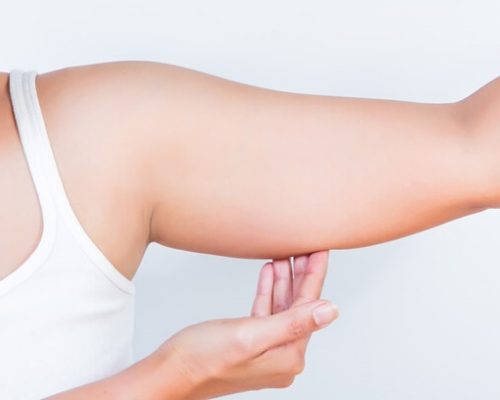
- Both arms, raised to shoulder height, from the front — which shows the excess.
- Both arms from behind, raised.
- Arms hanging relaxed at your sides.
- And a photograph of the underside pinched — section 3 — showing what you can grasp.
Natural daylight, no filters. Plus your age, height and weight and their stability, your weight history and any bariatric surgery, any lymphoedema or axillary surgery — section 5 — any scarring problems, whether you smoke, your medications, any clot history, and any medical conditions.
What you receive. A plan stating whether liposuction alone would serve you — section 3 — whether mini, standard or extended is appropriate — section 4 — where the scar will sit — section 1 — the stay, and the cost. Within 24 to 48 hours.
Questions worth asking before you commit.
- « Ai-je besoin d’une cicatrice, ou la liposuccion suffit-elle ? » — section 3, and the first question.
- « Où exactement passera la cicatrice, et pourquoi là ? »
- « Mini, standard ou étendue, et pourquoi ? »
- « Quel est votre taux d’élargissement cicatriciel ? » — section 2.
- « Comment gérez-vous le drainage lymphatique du bras ? » — section 10.
What to arrange at home before you travel. Stop smoking, four weeks. Stabilise your weight. Correct any nutritional deficiency. Arrange help at home — because you cannot use your arms normally, section 9, and that is more disabling than patients expect. Prepare your home: nothing above shoulder height, loose front-fastening clothing, and pre-prepared food. And arrange time off — three to four weeks.
8. Your stay in Tunisia
Eight to ten days.
Day 1 — Arrival. Your driver meets you at the airport and takes you to your hotel with your companion. Nothing clinical today.
Day 2 — Consultation and marking. Standing examination with arms raised and relaxed. Pinch assessment — section 3. Skin elasticity tested. Assessment of the axilla, and of any previous surgery there. Documentation of asymmetry — and arm asymmetry is common. Marking made standing, with the arm abducted, because the skin position changes entirely with arm position and marking lying down produces the wrong excision. Blood tests, weight, anaesthetic assessment. Then the planning conversation, including the scar.
Day 3 — Surgery. One and a half to three hours. Liposuction of the arm where planned, thinning the tissue first. Excision of the marked skin. Closure in layers, with attention to distributing tension — which is what determines the scar. Drains in some cases. And compression sleeves applied. Day case or one night.
Days 4 to 9 — Recovery and review. Swelling of the arms and frequently the hands — expected, and alarming if unexpected. Limited arm use — section 9. Daily wound review. Sleeves worn continuously.
Day 10 — Final review and departure. Final examination, and your documentation: an operative report stating the pattern, the tissue removed, any liposuction and the closure technique; written aftercare in French or English, including the sleeve schedule, movement restrictions, scar care and flight precautions; and a letter for your Canadian physician. Then your transfer to the airport.
Part three — recovery
9. Not being able to use your arms
This is the practical difficulty of the operation, and it is underestimated.
The restrictions. No lifting above shoulder height for the period specified. No lifting anything heavy — typically for four to six weeks. No pushing or pulling. And limited reaching, because reaching tensions the closure.
What that means practically.
- You cannot wash your own hair easily.
- You cannot dress in anything that goes over your head — front-fastening clothing only.
- You cannot drive for a period.
- You cannot carry shopping, a handbag, or a child.
- You cannot reach a high shelf.
- And you cannot push yourself up out of a chair with your arms — which is how most people stand up.
Which is why help at home is necessary rather than convenient — and more so than after an abdominoplasty, because the arms are what you use to compensate for everything else.
Duration. The strictest phase is two weeks. Four to six weeks before normal use. And the scar continues to be sensitive to tension for months.
10. Swelling, and the lymphatic question
Specific to this operation.
Arm and hand swelling. Common in the first weeks, because the operation disturbs lymphatic drainage in the inner arm. Which produces swelling of the forearm and hand, sometimes marked. Generally resolving over weeks to a few months.
What helps. Compression sleeves, worn as instructed. Elevation — and this matters more here than in most operations. Hand and finger movement, frequently. And lymphatic drainage massage where indicated.
When it is a concern. Where swelling persists beyond a few months, or worsens rather than improves. Particularly in a patient with previous axillary surgery — section 5 — where the risk of persistent lymphoedema is higher and warrants specific assessment. Report it rather than waiting.
11. Complications
- Wound separation — at the closure, particularly where tension is highest.
- Seroma — common, and drained.
- Infection.
- Haematoma.
- Scar widening and hypertrophy — more common here than at most sites, section 2.
- Altered sensation of the inner arm — common, and frequently permanent in a patch.
- Nerve injury — the medial antebrachial cutaneous nerve runs in the operative field, and injury produces numbness of the inner forearm, which may be permanent. Uncommon and recognised.
- Lymphatic disruption and persistent swelling — section 10.
- Contour irregularity or dog ears at the ends.
- Asymmetry.
- Venous thromboembolism — lower risk than abdominal surgery and not absent, and the flight home applies.
- And recurrence of laxity with weight change or ageing.
12. Scar care
The scar-care discipline set out in our tummy tuck guide applies here, with more emphasis.
- Silicone from three to four weeks, for at least three months and preferably longer — and longer here because the scar is under continuous tension.
- Sun protection, absolutely — because the inner arm is exposed in summer clothing, and a pigmented scar there is considerably more visible.
- Massage once healed.
- Avoiding tension — which is what the movement restrictions are for.
- And early treatment of any raising or itching — which matters more here because hypertrophic scarring is more common at this site.
13. Your Canadian follow-up
Arrange a physician before you travel.
What warrants urgent attention. Spreading redness, discharge or fever. Wound separation. Calf pain or breathlessness.
What warrants a routine appointment. Persistent or worsening arm swelling — section 10. A soft swelling, which is a seroma. Numbness of the forearm that concerns you. And a scar becoming raised — early treatment, section 12.
Canadian coverage. Not covered, with the functional exception in section 6. Treatment of any complication is covered.
Part four — practical matters
14. Canadian patients: travelling to Tunisia from your region
Aylan Clinic works with patients from every province and territory in Canada. And the specific problem here is managing luggage with arms you cannot use.
Montreal and the surrounding region. Montreal is our largest Canadian source for Tunisia, with connections through Paris, Frankfurt or Istanbul. Patients from Laval, Longueuil and Brossard are within easy reach of the airport. And travelling with a companion matters more here than for most procedures, because you cannot lift your own bag, reach an overhead locker, or manage a suitcase.
Quebec City and across the province. From Quebec City and the Capitale-Nationale region including Lévis, most patients connect through Montreal — as do patients from Trois-Rivières, Sherbrooke, Drummondville and Saint-Jérôme. Gatineau patients depart from Ottawa or drive to Montreal.
On this operation the francophone advantage is at the scar conversation. You are being told that this is the most visible scar in body contouring — not hidden by a swimsuit, not hidden by short sleeves, and visible every time you raise your arm. And you are being asked whether you would accept it. Patients consistently tell us they weighed it properly in their own language — and that several chose liposuction alone instead, which for them was the right answer.
Acadia and New Brunswick. We work with patients from Moncton, Fredericton and Saint John. Moncton and the surrounding Acadian communities are served in French throughout.
Francophone Ontario. Sudbury, Thunder Bay and Sault Ste. Marie all have substantial francophone populations, served in French from first contact onward. Ottawa patients typically connect through Montreal.
Greater Toronto Area and southern Ontario. Toronto patients connect through European hubs. Across the wider Greater Toronto Area: Mississauga, Brampton, Markham, Vaughan, Richmond Hill and Oshawa. Along the lake: Hamilton, Burlington, Oakville, St. Catharines and Niagara Falls. In southwestern Ontario: London, the Waterloo region — Kitchener, Waterloo and Cambridge — plus Guelph, Windsor and Barrie. Kingston patients generally drive to Toronto or Montreal.

Vancouver and British Columbia. Vancouver patients face the longest journey, typically two connections. The practical problems are luggage and overhead lockers — neither of which you can manage — and a companion or assistance arranged with the airline solves both. Elevation on the flight helps the swelling; a pillow supporting both forearms is worth arranging. And the general flight precautions apply. Across the Lower Mainland: Surrey, Burnaby and Richmond. From Victoria and Nanaimo, ferry or short flight. Kelowna, Abbotsford and Kamloops connect through Vancouver or Calgary.
Alberta. Calgary and Edmonton both offer European connections. Red Deer and Lethbridge patients generally drive to Calgary.
Manitoba and Saskatchewan. Winnipeg patients connect through Toronto or Montreal. Saint-Boniface is served in French. From Saskatoon and Regina, a domestic connection plus two further flights. And a winter note: getting a coat on over compression sleeves and restricted arms is genuinely difficult — a large front-fastening coat, arranged beforehand.
Atlantic Canada. Halifax routes through Montreal or Toronto. From Charlottetown and St. John’s, two or three connections.
Northern Canada. We work with patients from Whitehorse in Yukon, and from communities across the Northwest Territories and Nunavut. Two points. The arm restrictions and remote living: where you cannot rely on someone else for four to six weeks, this operation is difficult, and that is worth planning honestly. And the coat problem, as above, more acutely.
How we handle the logistics. Your coordinator arranges transfers, confirms your hotel, and builds your schedule around your arrival time.
Five recommendations. Do the pinch test. Look at where the scar will be, on yourself, in a mirror. Bring a companion. Arrange front-fastening clothing. And plan for four weeks of not using your arms.
15. What your package includes
- Free consultation in French or English, with an honest statement of whether liposuction alone would serve you — section 3.
- Full on-site assessment: standing examination with arms raised and relaxed, pinch assessment, skin elasticity, axillary assessment, and documentation of asymmetry.
- Marking made standing with the arm abducted — section 8.
- Blood tests, weight, anaesthetic assessment.
- Brachioplasty with liposuction where indicated, closed in layers with tension distributed.
- Drains where used.
- Compression sleeves.
- Thromboembolic risk assessment.
- Day case or one night, per your case.
- Lymphatic drainage guidance and elevation instruction — section 10.
- Medication and aftercare supplies.
- Daily wound review across the stay.
- Operative report stating the pattern, tissue removed, any liposuction, and the closure technique.
- Written aftercare in French or English, including the sleeve schedule, movement restrictions, elevation, scar care and flight precautions.
- A letter for your Canadian physician.
- Continued contact in French or English after you return.
- Hotel accommodation, full board.
- A companion at no extra cost, accommodated and fed in the same room — and genuinely useful here.
- Airport–clinic–hotel transfers.
- A personal coordinator from arrival to departure.
- French-speaking care throughout, with English available on request.
16. Results by patient profile
Where liposuction was the answer. A patient of thirty-six with thick pinchable arm fat and skin that snapped back briskly. Liposuction alone — section 3. No scar, and a result she was happy with. A brachioplasty would have given her a permanent visible scar she did not need.
The right candidate for excision. A patient after a fifty-kilogram weight loss, with skin hanging from the upper arm, chafing, and difficulty with sleeves. Extended brachioplasty with liposuction. At twelve months her scar is visible and she considers the trade clearly worthwhile — which is what a functional indication looks like.
Where the scar changed the decision. A patient whose concern was cosmetic rather than functional. We showed her where the scar would sit, on her own arm, in a mirror — section 2. She decided against surgery. Which was a legitimate decision, made before rather than after.
Where a mini would not have served. A patient offered a short-scar procedure elsewhere, with laxity extending to the elbow. A mini would have treated the upper third and left the rest — section 4 — frequently looking worse by contrast.
Where axillary history mattered. A patient with previous axillary lymph node clearance after breast cancer. We assessed her specifically — section 5 — and discussed the higher risk of persistent arm swelling. She proceeded knowing it, with close attention to compression and lymphatic care.
A patient from Montréal. A patient who chose Tunisia after being unable to picture the scar. Her comment was about the mirror: « On a tracé la cicatrice sur mon bras et on m’a demandé de lever le bras devant le miroir. C’est là que j’ai compris. J’ai quand même choisi l’opération, mais en sachant. »
17. Practical points to know
What to expect. A pinch test that may redirect you to liposuction. Marking made standing with the arm raised. A one and a half to three hour operation. Arm and hand swelling for weeks. Compression sleeves. Four to six weeks of substantially restricted arm use. And a visible scar, permanently.
Recognised points. Brachioplasty is a well-established operation, and your surgeon will discuss the considerations relevant to you. The main ones: scar widening and hypertrophy, more common at this site than most; wound separation; seroma, common; infection; haematoma; altered sensation of the inner arm, frequently permanent in a patch; injury to the medial antebrachial cutaneous nerve, producing forearm numbness; lymphatic disruption with persistent swelling, particularly after previous axillary surgery; contour irregularity and dog ears; asymmetry; venous thromboembolism; and recurrence with weight change.
Three things within your control. Deciding honestly about the scar. Respecting the movement restrictions. And silicone and sun protection for the scar.
Who this suits. Genuine skin excess confirmed on pinch testing, stable weight, acceptance of a visible scar, and four to six weeks of restricted arm use.
Who should have liposuction instead. Good skin elasticity with fat — section 3, and a proportion of patients who enquire fall into this group.
18. Price: how it is built and how to compare it
What determines your price. Mini, standard or extended. Whether liposuction is combined. Whether one night is required. And the length of stay. Itemised, and fixed once you approve it. Our published plastic surgery prices in Tunisia give you the starting frame.
What is included. Everything in section 15. A companion is accommodated and fed at no additional cost.
What sits outside it. Flights, travel insurance, a second set of sleeves, silicone products, and any revision.
How to compare quotes properly. Four checks.
- Has a pinch test been done and reported? Section 3 — and a clinic quoting a brachioplasty from a photograph without it may be quoting a scar you do not need.
- Is the scar position stated, and shown to you? Section 1.
- Is mini, standard or extended recommended with reasoning? Section 4.
- And has your axillary history been asked about? Section 5.
Why the lowest quote is a concern here. Because the failure mode is not usually technical. It is a visible permanent scar in a patient who did not need one — or a mini in a patient who needed a standard, requiring a second operation with a longer scar. Both are assessment failures rather than surgical ones.
Canadian coverage. Not covered, with the functional exception. Treatment of any complication is covered.
19. Glossary
| Term | Meaning |
|---|---|
| Brachioplasty | Surgical removal of excess upper arm skin |
| Mini-brachioplasty | A short scar confined to the armpit; a narrow indication |
| Extended brachioplasty | The incision continuing onto the chest wall |
| Bicipital groove | A natural furrow sometimes used for the incision |
| Medial antebrachial cutaneous nerve | Supplies the inner forearm; at risk in this operation |
| Lymphatic disruption | The cause of arm and hand swelling after surgery |
| Dog ear | A pucker at the end of a closure |
20. How Canadians search for this
- “Arm lift Tunisia cost” — the most common search.
- “Redrapage des bras Tunisie” — how most Quebec patients search.
- “Arm lift scar” — armpit to elbow on the inner arm, the most visible scar in body contouring, and not hidden by summer clothing or a swimsuit.
- “Arm lift vs arm liposuction” — the pinch test decides. Good skin with fat means liposuction and no scar. Section 3.
- “Does an arm lift scar fade” — it fades and widens. The inner arm is under tension with every movement, and a widened pale scar is the common long-term appearance.
- “Mini arm lift” — a narrow indication, for laxity confined to the upper third, and it leaves the rest.
- “Arm swelling after brachioplasty” — common for weeks, from lymphatic disruption. Elevation and compression, and report persistence.
- “Numb forearm after arm lift” — nerve injury is recognised, and may be permanent in a patch.
- “Arm lift after weight loss” — usually extended, and nutritional correction comes first.
- “Arm lift recovery” — four to six weeks of restricted arm use, and you cannot wash your hair, dress overhead, or push out of a chair.
- “French speaking plastic surgeon abroad” — Tunisia’s distinguishing feature.
In summary
The scar is the most visible one in body contouring, and that is the thing to settle first. It runs from the armpit toward the elbow on the inner arm — and it is not hidden by short sleeves, by a swimsuit, or by anything you would wear in summer. It is visible every time you raise your arm. And it scars less well than most body incisions, because the inner arm is under tension with every movement, so widening is common and a fine line is not the usual outcome.

Which is why the first question is whether you need a scar at all. The pinch test answers it — thick pinchable fat with skin that snaps back means liposuction alone, and a proportion of patients who enquire about an arm lift are better served by it. A clinic recommending excision to a patient with good elasticity is recommending a permanent visible scar she did not need.
And the recovery is more disabling than patients expect. Four to six weeks without lifting, reaching, carrying or pushing up out of a chair — which is what you use your arms for all day — and a companion matters more here than for most operations.
At Aylan Clinic Tunisia that means a pinch test at consultation with an honest answer, the scar drawn on your own arm and shown to you in a mirror, marking made standing with the arm raised, and a willingness to tell you that liposuction alone is your operation. It takes place in a French-speaking country, which matters at a decision about a scar you will see every day. With accommodation, full board and a companion at no extra cost, for up to 60% less than Canadian private prices.
Five things to hold onto.
- Do the pinch test first. Good skin with fat means liposuction and no scar — and that is a proportion of the people reading this.
- Look at where the scar will be, on your own arm, in a mirror. Raise it. That is the moment to decide.
- A mini suits a narrow group. Laxity below the treated zone remains — and frequently looks worse by contrast.
- Plan four to six weeks of not using your arms. Front-fastening clothing, nothing on high shelves, and help at home — it is more disabling than it sounds.
- Silicone and sun protection, for longer than you think. This scar is under continuous tension and exposed in summer — both matter more here than anywhere.
Send photographs of both arms raised, and the pinch — and you will have an honest answer within 24 to 48 hours, including whether liposuction alone would serve you.
When you are ready for the procedure detail, read our page on Brachioplasty Arm Lift in Tunisia, compare the current plastic surgery prices in Tunisia, browse the full body contouring in Tunisia overview, or request a free, personalized quote.