
All-on-4 dental implants in Tunisia are an option for selected adults who need all the teeth in an upper or lower arch replaced with a fixed implant-supported restoration. Four implants support a connected set of replacement teeth; they do not replace only four individual teeth. The main decision is whether this approach fits your bone, remaining teeth, bite and ability to maintain the restoration, and whether you can complete the necessary treatment stages when travelling from Canada.
In this article, you will find an explanation of the All-on-4 concept, the distinction between temporary and definitive teeth, alternatives, suitability, treatment stages, recovery and possible complications. You will also find practical information about total costs, departure cities across French-speaking and English-speaking Canada, and care between international visits. When contacting Aylan Clinic, confirm whether the proposed full-arch treatment can be arranged, identify the responsible dental team and request a plan tailored to your situation.
What All-on-4 dental implants are and how they work
Four implants supporting one complete arch
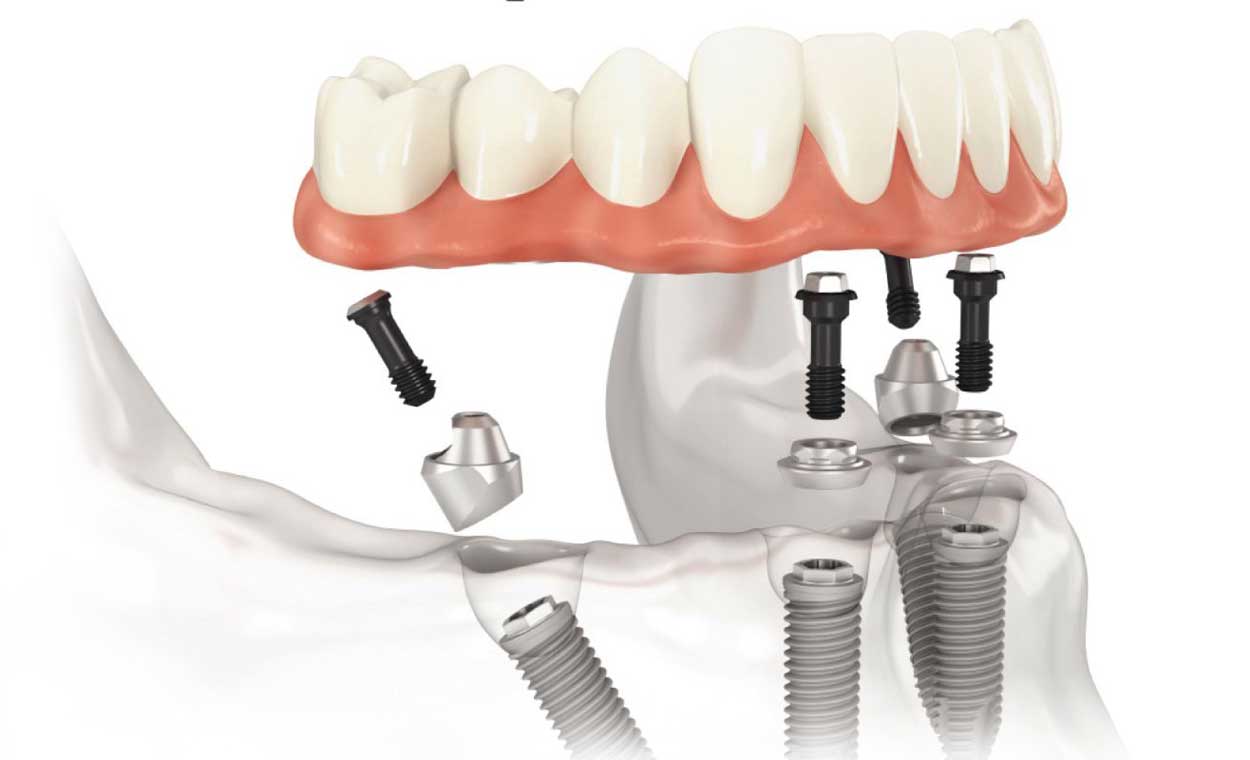
The All-on-4 concept uses four implants to support a fixed restoration for one jaw. The classic arrangement includes two implants towards the front and two posterior implants placed at an angle. The intended benefit is to use suitable available bone and distribute support for the replacement teeth. The positions must follow an individual assessment; a diagram showing four implants does not establish that the same arrangement will work in your mouth.
All-on-4 is a registered treatment-concept name associated with Nobel Biocare. In everyday advertising, similar wording may be used loosely for other restorations supported by four implants. Ask what system and protocol are actually proposed. A reference to the concept does not confirm that a provider uses a particular manufacturer, holds a specific certification or has been approved by the brand.
The upper and lower jaws are assessed separately. Treatment of both arches generally involves four implants in each arch when this approach is suitable, rather than four shared between the two jaws. A quotation must therefore specify whether it concerns the upper arch, the lower arch or both. The number of visible replacement teeth is another detail to clarify because it is not determined simply by the name of the treatment.
A fixed bridge with several connected parts
The implants sit in the jawbone. Connecting components called abutments support the bridge, which contains the replacement teeth and may include gum-coloured material. In a screw-retained design, a dental professional can access the screws when removal is clinically necessary. You do not remove the bridge at home in the way you would remove a conventional denture.
The term “fixed” describes how the restoration is retained. It does not mean that the bridge cannot require adjustment, repair or replacement. Ask to see how the proposed restoration will be assembled and maintained. Understanding the difference between the implant, abutment, screw and bridge makes a later discussion about a loose or damaged part much clearer, particularly when a different dentist examines you in Canada.
Bone healing beneath the provisional teeth
Implants need a biological connection with surrounding bone, called osseointegration. Early mechanical stability at placement is important, but it is not the same as completed healing. A fixed temporary bridge may be fitted early when the conditions allow. It can provide teeth during healing while still requiring a carefully controlled diet and review schedule.
For a Canadian patient, this creates two separate questions: what teeth will be present when you return home, and what treatment will remain unfinished? Ask the clinician to describe both. Feeling comfortable with a temporary bridge does not prove that the underlying implants are ready for unrestricted function or that a later appointment for the definitive bridge can be cancelled.
The relationship between teeth, gums and facial support
Full-arch treatment replaces more than a row of tooth shapes. Tooth loss and changes in the supporting ridge can affect the space between the jaws, the visible gum line and support for the lips. The restoration may need gum-coloured material to restore missing volume. Its junction with your own tissues may be visible in some smiles, depending on anatomy and design.
Discuss these features before surgery. Ask what the bridge may look like when you smile broadly, speak and relax your lips. A photograph showing only the teeth does not answer those questions. Your priorities may include a natural appearance, comfortable lip support or reducing a bulky denture sensation; the clinician needs to explain how those goals interact with the available space and cleaning requirements.
All-on-4 technical choices and alternatives
All-on-4 compared with a bridge supported by more implants
Four implants may be appropriate for a complete fixed arch in a selected case. A different patient may benefit from a plan using more implants or a different distribution. The choice depends on the available bone, arch shape, restoration, opposing teeth and the consequences if one support develops a problem. More implants are not automatically necessary, and fewer implants are not automatically less demanding to maintain.
If you receive competing four-implant and six-implant proposals, ask each clinician to explain the recommendation using your records. Compare the intended bridge as well as the implant count. Questions about where forces are carried, how the bridge will be cleaned and what happens if an implant is lost are more useful than asking which number is universally best. A change to six implants is a different plan and should be documented accordingly.
Immediate placement compared with immediate loading
Immediate placement means inserting an implant at the time a tooth is removed. Immediate loading concerns attaching a functioning restoration soon after implant placement. They are separate decisions. A patient can have implants placed in a jaw that has been toothless for years and still be considered for early fixed teeth. Another patient can have implants placed during extractions but need to wait before those implants support a bridge.
The suitability of early loading may not be confirmed until surgery. Ask which findings would lead the clinician to delay it and what temporary solution would then be used. The alternative should be explained before you consent to extractions. A plan that depends entirely on receiving fixed teeth immediately, without addressing what happens if that is unsuitable, leaves an important question unanswered.
Provisional teeth compared with the definitive bridge
A provisional full-arch bridge is intended for a particular phase of treatment. It may help the team assess appearance, speech and bite while tissues heal. The definitive bridge is planned after the necessary reassessment and restorative work. Temporary teeth are real treatment components, but their presence should not be used to imply that all laboratory stages and long-term decisions are complete.
Ask which materials are proposed for each stage, how the definitive design will be approved and whether the final bridge is included in the quotation. Clarify what happens if the temporary bridge needs repair while you are in Canada. The clinician should also explain how feedback about tooth shape, speech or comfort will be recorded so that it can inform the final restoration rather than being lost between visits.
Angled implants and the limits of avoiding grafting
Angled implant placement can help use available bone in selected jaws and may reduce the need for some grafting procedures. It cannot create bone where there is insufficient support, and it does not make every severely resorbed jaw suitable for four conventional implants. Important structures, including nerves and sinuses, still need to be assessed during planning.
If a proposal describes treatment without grafting, ask whether that conclusion is final or conditional on examination and imaging. You should understand the alternative if the available bone does not support the intended positions. A different implant arrangement, staged preparation or another type of restoration may be more appropriate. The decision should follow the clinical findings, rather than a commitment to keep the same package name.
Extractions and possible reshaping of the ridge
Some candidates already have no teeth in the arch. Others have teeth that may be judged unsuitable for retention. Each remaining tooth deserves an assessment before a full-arch extraction plan is accepted. A desire for even, white teeth does not establish that removal is necessary. Ask which teeth could reasonably be retained, what preservation would involve and how that option compares with the proposed reconstruction.
Full-arch planning may also include reshaping or reducing part of the bony ridge to create restorative space or manage the transition between tissues and prosthesis. This is an additional irreversible step. If it is proposed, ask how much alteration is intended, why it is needed and how it affects future options. Consent should cover the actual planned changes, not only the placement of implants.
Digital planning and conventional surgical access
Digital planning can combine imaging and restorative records to help position implants in relation to the intended bridge. A surgical template may help transfer the plan to the mouth. The technique still depends on accurate records, appropriate use and the clinician's judgment during the operation. Digital planning does not remove the need to assess bone, tissues and the restoration as a complete system.
Ask whether the proposed approach requires opening the gum to assess and treat the ridge. An advertised small-incision technique may not be appropriate when extractions, bone reshaping or other preparation are required. The clinician should explain the approach chosen for your case and when it might change. Equipment descriptions should answer a clinical question, rather than serve as a substitute for discussing the treatment itself.
Fixed teeth compared with an implant-retained removable denture
An implant-retained removable denture is a different restorative option. It can improve retention while allowing you to remove the prosthesis for cleaning. A fixed full-arch bridge remains attached during daily care and requires cleaning beneath and around its contours. Patient preference matters, but anatomy, lip support, maintenance and the ability to clean should also influence the decision.
Discuss how each option would fit your routine. Someone with limited dexterity may find certain cleaning tasks difficult, while another person may strongly prefer a fixed restoration and be able to maintain it effectively. Neither preference should be assumed from age or previous denture experience. Ask for a practical explanation of insertion, removal where applicable, cleaning, servicing and the likely response to a damaged component.
Preserving teeth and non-surgical replacement options
If useful teeth remain, a plan that preserves them may deserve consideration before complete extraction. Where implants are unsuitable or not preferred, a conventional removable denture can replace a full arch without implant placement. It has different stability and adaptation requirements, but it avoids the implant surgical stage. These alternatives should be discussed in relation to your actual mouth rather than dismissed as inferior in every situation.
A second opinion is particularly reasonable when proposals differ on whether to remove all remaining teeth. Bring the competing plans and ask what findings explain the difference. You should understand the long-term responsibilities of each option, including maintenance and possible retreatment. Choosing an implant reconstruction is a major commitment; the available alternatives help put its potential benefits and limitations into context.
| Option | Main distinction | Decision to clarify |
|---|---|---|
| All-on-4 fixed restoration | One complete arch supported by four implants | Whether support, bridge design and maintenance are suitable |
| Fixed restoration on more implants | A different number and distribution of supports | Why the additional implants improve the individual plan |
| Implant-retained removable denture | Removed by the patient for daily care | Retention, lip support, attachment servicing and handling |
| Conventional complete denture | No implant placement | Fit, comfort, stability and adaptation |
| Preservation of suitable remaining teeth | Retains natural teeth where reasonable | Prognosis, preparation and future restorative needs |
Real indications for All-on-4 dental implants
- Complete tooth loss in an arch where a fixed implant-supported restoration is clinically appropriate.
- Remaining teeth with a poor overall prognosis after an individualized assessment of preservation options.
- Significant difficulty with a conventional complete denture where fixed replacement could address the patient's priorities.
- Adequate suitable bone and restorative space for the proposed four-implant arrangement.
- The ability and willingness to follow postoperative restrictions, maintain the bridge and attend ongoing care.
The goal is a usable and maintainable full arch, not simply a rapid change in appearance. A clinician may recommend another approach when the anatomy, health risks or daily cleaning requirements make All-on-4 unsuitable. The ability to finance the first operation alone is also different from being able to complete definitive treatment and long-term maintenance. These practical responsibilities belong in the initial decision, especially when care involves international travel.
Indications and contraindications for All-on-4 dental implants
| Situation to assess | How it affects the decision |
|---|---|
| Fully toothless arch with suitable bone and space | May support candidacy after examination and restorative planning. |
| Teeth that can reasonably be preserved | Requires discussion of retention before an irreversible extraction plan. |
| Inadequate bone for the intended implant positions | May require a different plan, preparation or an alternative restoration. |
| Active infection or uncontrolled gum disease | Needs diagnosis and management; elective treatment may be postponed or modified. |
| Inadequate implant stability during surgery | Can prevent immediate loading even if implants have been placed. |
| Poorly controlled diabetes or unstable systemic illness | May require medical coordination and postponement of elective surgery. |
| Smoking | Increases concerns about healing and long-term tissue health; cessation support is relevant. |
| Anticoagulant or antiplatelet medication | Requires individualized bleeding management; medication must not be stopped independently. |
| Antiresorptive medication or certain cancer treatments | Requires assessment of medication-related jaw risks, including dose and treatment indication. |
| Previous radiotherapy affecting the jaws | Requires specialist assessment and can substantially change suitability. |
| Significant grinding or an unfavourable bite | Affects loading, prosthetic design and the plan for mechanical complications. |
| Limited cleaning access or ability | May favour a different design or removable option; support with daily care may be needed. |
| Inability to attend essential reviews | May make the proposed international treatment course impractical. |
| Pregnancy or another reason to defer elective treatment | Timing, investigations and medications need individual review. |
A risk factor is not always an absolute contraindication. Some conditions can be improved before surgery; others require another professional's opinion or a different restorative choice. Equally, suitability for implant placement does not automatically establish suitability for immediate fixed teeth. Ask the clinician to separate these decisions clearly. You should know whether a concern affects the operation, the loading timetable, the final bridge or the feasibility of travelling for care.
How the procedure is performed, step by step
Before the procedure
Assessment begins with your medical and dental history, an examination and appropriate records. The clinician evaluates the remaining teeth, gums, ridge, jaw relationship and existing dentures. Imaging helps assess bone and relevant structures; three-dimensional imaging is commonly part of planning a complex full-arch reconstruction. Existing images may be useful, but their date, quality and relevance need to be checked before a final plan is made.
The restorative assessment should take place before implant surgery. It may involve photographs, scans or impressions, bite records and discussion of tooth arrangement. Explain what you like or dislike about your current teeth or denture, including speech, facial support and chewing. The team should record those priorities so that the surgery supports the intended prosthesis rather than leaving important design decisions until afterwards.
Disclose all prescribed and non-prescription medicines, allergies, smoking and previous reactions to anaesthesia. If sedation is planned, ask who provides it, what assessment and monitoring are required and whether a companion must remain with you. Instructions about medication, food and drink must come from the treating professionals. The consent and financial plan should identify the alternative if early fixed teeth cannot be provided.
During the procedure
The operation follows an individualized plan under the agreed form of anaesthesia. Local anaesthesia may be used, with sedation or another approach when appropriate to the procedure and patient. If extractions or ridge preparation are required, these are performed as part of the consented treatment. The implants are placed in the planned positions, with attention to the available bone and surrounding structures.
The clinician assesses the stability achieved and decides whether the proposed loading approach remains suitable. Abutments and the provisional bridge are managed according to that decision. Early fixed teeth require coordination between the surgical, restorative and laboratory work. The exact timing depends on the clinical findings and the agreed workflow; the treatment name alone does not guarantee delivery on the same day.
Ask how the team communicates any changes while preserving meaningful consent. A revised implant arrangement, delayed loading or a different temporary option should be explained and documented. The surgical record should identify what was actually placed and performed. This record will be important if you need an examination in Canada before the next planned visit to Tunisia.
After the procedure
Before discharge, the team assesses bleeding, comfort and recovery from any sedation or anaesthesia. You should receive written instructions tailored to extractions, implant placement and the temporary restoration. These should explain eating, cleaning, activity, prescribed medication and warning signs. Confirm the first review appointment and the contact route for a clinical problem outside ordinary appointment hours.
If a fixed provisional bridge has been fitted, the review includes its fit, bite and condition as well as the surgical sites. Report pressure, an unusual contact or difficulty following the diet. A bridge that looks complete can still need adjustment and protection during healing. The early review does not establish that every implant has integrated or that the definitive bridge is ready to be made.
Later assessment determines when definitive restorative work can proceed. This may involve new records, trial stages and more than one fitting appointment. Ask which changes can be made before final approval and how the clinician will evaluate speech and cleaning access. The complete course ends with an agreed maintenance plan and transferable records, rather than simply the attachment of the final teeth.
Recovery and time away from normal activities
Recovery from a full-arch reconstruction depends on the extent of treatment, not only the number of implants. Multiple extractions, ridge preparation, treatment of both jaws and relevant medical conditions can change the early course. Separate the recovery from surgery, the protection of a provisional bridge and the later fitting of definitive teeth. The following periods are planning examples, not personal clearance to travel, work or resume unrestricted eating.
| Approximate period | Expected changes and practical decisions |
|---|---|
| Day of surgery and the first day | Rest, discharge instructions, bleeding control and any sedation restrictions take priority. |
| First several days | Soreness, swelling or bruising may affect meals, speech and sleep; report unexpected deterioration. |
| Around the first one to two weeks | Wound review and any required suture management are arranged according to the actual procedure. |
| Following weeks | The gum may feel better while the implants and provisional bridge still require protection. |
| Following months | Clinical reassessment determines whether healing supports progression to definitive restorative work. |
| Definitive bridge appointments | Records, trials, fitting and adjustments may require several appointments. |
| After completion | Maintenance continues according to individual risk and the needs of the restoration. |
Swelling and comfort after full-arch surgery
The first days may involve tenderness, swelling or bruising, especially when extractions accompany implant placement. Follow the prescribed pain-management plan and ask what pattern of improvement the team expects. A change towards increasing pain or swelling after initial improvement deserves attention. Do not use another patient's experience to decide whether your symptoms require assessment.
Tell the clinician if discomfort prevents you from drinking adequately or following the recommended diet. A sore area may relate to the surgical site, the bridge or another cause, and the response depends on an examination. If both arches have been treated, discuss how you will manage meals and cleaning when there is no untreated side to rely on. Recovery arrangements should match that greater practical burden.
Eating with a provisional All-on-4 bridge
A fixed provisional bridge does not give immediate permission to chew anything that feels manageable. During healing, the team may prescribe restrictions on texture and biting forces. Ask for examples that fit your usual foods and establish when the diet will be reviewed. Hard, sticky or demanding foods can create problems even if you are able to bite them without immediate pain.
Plan suitable meals in Tunisia and for the journey home. Airport food choices may not match the instructions, and a long layover can complicate eating regularly. If you have diabetes or another condition affecting nutrition, discuss a workable plan with your clinicians. The objective is to protect the restoration while meeting your nutritional needs, rather than simply eating as little as possible.
Cleaning beneath the bridge
Cleaning needs change as the surgical sites heal. Early instructions should specify what to avoid around wounds and when to introduce particular cleaning aids. Later, you need a practical method for cleaning under the bridge and around its supports. The correct tools and technique depend on the shape of the restoration and should be demonstrated by the dental team.
Before you leave, show that you can reach the relevant areas yourself or with agreed help. Ask what to do if food repeatedly collects beneath the bridge or you cannot pass the recommended aid through a particular space. Poor access may be a design issue rather than a failure of effort. Do not force objects beneath the bridge or use a high-pressure cleaning device on fresh surgical sites without instructions.
Speech, work and social commitments
A new full-arch restoration can change how the tongue and lips contact the teeth. Some people need time to adapt, and persistent speech difficulties may require review of the design. If your work involves teaching, telephone calls or public speaking, raise this before choosing dates. Allow time to evaluate how the provisional teeth feel in ordinary conversation rather than scheduling an important event immediately after treatment.
Return to work also depends on swelling, sleep, medication and job demands. Desk work, heavy physical work and employment far from dental care involve different considerations. Request restrictions relevant to your role. For a patient who travels frequently or works in a remote location, being back at work should not remove access to the examinations needed during the healing phase.
Exercise and activities that load or endanger the jaw
Ask when you may resume lifting, vigorous exercise and contact activities. The advice should reflect your operation and recovery. Sports that expose the face to impact need specific discussion, and any protective appliance must be appropriate for the restoration. Do not resume an activity solely because the swelling has reduced if the clinician has advised a longer restriction.
Also describe grinding, clenching or habits such as chewing on hard objects. These can affect the prosthetic plan and the need for protective measures. A night appliance, if recommended, needs professional assessment and fitting; it should not be assumed that an old appliance still fits a new bridge. Ongoing mechanical concerns should be addressed before they lead to repeated damage.
Flying back to Canada
The return date depends on your clinical condition, the procedures performed and the full itinerary. The clinician should consider bleeding, pain control, wound condition, infection concerns and the temporary bridge. If treatment involved a sinus-related procedure, ask specifically about flying precautions. A scheduled departure is a logistical target, not evidence that you are ready to travel.
Provide all journey details, including a regional flight or long drive after arriving in Canada. Ask what would justify postponement and how you would obtain another examination if departure were delayed. Flexible bookings and accessible accommodation make a medical change more manageable. Carry essential records and prescribed medication in a way that complies with applicable travel rules and keeps them available during the journey.
Reviews while healing in Canada
Agree on a Canadian dental contact before treatment begins. Ask what the practice can provide: assessment of healing, professional cleaning, emergency care, provisional repairs or involvement in the definitive restoration. These are different responsibilities. A local dentist may require examination and detailed records before agreeing to a role and may not be equipped to service every component.
Remote contact with Tunisia can support communication but cannot answer every clinical question. If a bridge feels mobile, a wound deteriorates or symptoms require an examination, local care may be necessary. The plan should identify how records are shared and who authorizes or performs changes. It should also distinguish routine review from a problem requiring urgent assessment.
Expected results and durability
What a fixed full arch may improve
For an appropriate candidate, a fixed implant-supported arch can provide a more stable replacement than a moving conventional denture and support everyday chewing and appearance. The relevant outcome is how the restoration works for you. Discuss the activities you want to improve, such as eating with family, speaking at work or smiling comfortably, so they can be assessed during treatment.
Do not assume the result will reproduce every sensation of natural teeth. The bridge has its own contours and maintenance requirements. Your response may also differ depending on whether you previously wore a complete denture or still had some natural teeth. Ask the clinician to explain likely changes without treating adaptation as either guaranteed or impossible.

Assessing the provisional before final approval
The provisional stage can provide useful information about tooth length, appearance, lip support and speech. Keep clear notes about persistent concerns and raise them at the planned reviews. A photograph can help describe an appearance issue, while speech and bite problems may need a direct assessment. Feedback is most useful before the definitive restoration is completed.
Ask which aspects of the design can reasonably change and what those changes would involve. A colour preference is different from a problem related to implant position or limited space. The team should explain the constraints and record the agreed design. An approval appointment should give you enough time to understand the proposed result rather than taking place under pressure from an imminent return flight.
Bridge materials and long-term service
A definitive bridge may use different combinations of framework and tooth materials. The choice affects appearance, available space, repair methods and wear. Ask for a description of the complete construction rather than a single material label. A zirconia restoration, for example, does not establish the material of the implant body or the details of every connecting component.
Discuss who could repair the chosen design in Canada and what would happen if a tooth chipped or the bridge fractured. Some repairs can be relatively contained; others may require laboratory work or a replacement prosthesis. The best choice is not established by the word “premium.” It should fit the clinical plan and the practical maintenance arrangements available to you.
Durability without a lifetime promise
The implants and the bridge do not necessarily have the same lifespan or maintenance needs. Tissue disease can threaten implant support, while wear or mechanical damage can affect the prosthesis independently. The absence of discomfort does not replace professional review. Ask what baseline records will be provided so later examinations can identify meaningful changes.
Routine maintenance should be individualized. A fixed bridge does not automatically need removal at every appointment, and repeated removal should have a clinical reason. Equally, a claim that the bridge will never need professional attention is unrealistic. Understand any warranty as a separate agreement defining parts, labour, exclusions and travel costs, rather than a guarantee that the treatment cannot develop problems.
Risks and possible complications
All-on-4 combines implant surgery with a full-arch restoration. Problems may therefore involve the surgical sites, the supporting implants, the surrounding tissues or the bridge. Ask the treating clinician to describe the risks that are particularly relevant to your anatomy and health. The consent discussion should also address the consequences of a complication when you are far from the original practice.
- Bleeding or delayed wound healing: extensive extractions, medication and other individual factors can affect early recovery.
- Infection: increasing swelling, discharge, worsening pain or fever can require prompt examination and treatment.
- Failure of an implant to integrate: one or more implants may need removal, a revised loading plan or further treatment.
- Nerve injury: altered sensation in the lip, chin or other areas may occur and can sometimes persist.
- Sinus or adjacent-structure injury: the risks depend on implant sites, anatomy and any additional surgery.
- Peri-implant mucositis or peri-implantitis: inflammation can involve the gum or extend to loss of supporting bone.
- Provisional or definitive bridge damage: a fracture or chipped tooth can affect eating and require professional repair.
- Loose or fractured screws and connecting parts: movement may involve the restoration or a support and needs diagnosis.
- Bite, speech or appearance problems: an unsatisfactory contour or contact may require adjustment or more extensive revision.
- Medication, sedation or anaesthesia complications: assessment and monitoring should reflect the method and your health.
Why a problem with one implant matters
The bridge depends on the planned group of supports. If one implant fails or cannot be used, the original restorative design may no longer be appropriate. Do not assume that the remaining implants can safely support the same bridge without reassessment. The clinician needs to consider the location of the problem, healing and the available alternatives.
Before treatment, ask how this scenario would be managed both during the first stay and after your return. The answer may involve a change to the temporary restoration, additional healing, another implant or a different prosthesis. A promise to replace an implant at no charge does not explain all the consequences. Clarify laboratory fees, local assessment and any extra travel separately.
Warning signs that should not wait
Difficulty breathing or swallowing, rapidly spreading swelling of the face or neck, or bleeding that cannot be controlled requires emergency assessment. Do not wait for an overseas reply in these circumstances. Worsening pain, fever, pus, unexpected persistent numbness, or movement of the bridge or an implant also requires prompt professional contact and may need an examination.
Avoid repeatedly testing a moving bridge or attempting to tighten a screw yourself. If a piece breaks, contact a dental professional and follow instructions about eating and retaining any detached part safely. An apparent minor defect can change how the restoration carries force. A photograph may help explain the problem, but it cannot identify every underlying cause or establish that continued use is safe.
Managing complications across two countries
In Tunisia, establish the named clinician responsible for unplanned examinations and the facility used when a problem requires more than a routine appointment. Ask how evening or weekend concerns are handled. A booking coordinator may help reach the team, but clinical assessment and decisions need to come from the appropriate professional.
In Canada, seek necessary local care rather than assuming that you must immediately fly back. The original team should be able to supply records and communicate with the examining clinician. Any financial agreement about repairs or complications should be available in writing. An unresolved reimbursement question should not delay urgent assessment, and a warranty should not be interpreted as a medical instruction to wait.
Why consider Tunisia for All-on-4 dental implants?
Assessing the complete reconstruction proposal
A patient may consider Tunisia because of an individual treatment proposal, anticipated affordability or the possibility of coordinating surgical and restorative appointments within planned visits. Those potential advantages need to be assessed against the complexity of full-arch care. Compare the complete reconstruction, including provisional teeth, definitive teeth and review arrangements, rather than only the surgical phase.
When speaking with Aylan Clinic, confirm whether this treatment can be arranged and request the identity and location of the dental professionals involved. Do not infer their experience from a general medical tourism service description. Full-arch reconstruction requires coordinated clinical decisions and laboratory work. The relevant question is how the proposed team will deliver and maintain your particular restoration.
Why an examination can change the remote proposal
Photographs and existing scans can support preliminary discussion, but they do not establish every detail of tooth prognosis, tissue condition, bite or cleaning access. The in-person assessment may change the extraction plan, implant positions or loading timetable. Ask which parts of the preliminary proposal remain conditional and how a revised plan would be discussed before treatment.
A responsible arrangement leaves room to postpone if the findings change the balance of benefits and risks. Travel expenses already paid should not determine consent to irreversible extraction or ridge reduction. Request a clear explanation of cancellation and rescheduling arrangements before departure so that you can evaluate a change without financial details obscuring the clinical decision.
Communication and a Canadian maintenance plan
Confirm whether the actual treating dentist or specialist can conduct clinical consultations in your preferred language. If sedation or anaesthesia involves another professional, confirm communication with that person as well. Only after those checks should English or French availability be treated as an advantage. A bilingual booking conversation does not establish the language of consent or postoperative clinical care.
For both language communities, records must also be usable by the Canadian professional providing follow-up. Ask how translation or interpretation would be arranged if needed. A useful handover identifies implants, abutments, the bridge, restrictions and outstanding treatment. It should enable a receiving clinician to understand the situation without relying on a marketing description of the package.
Cost of All-on-4 dental implants in Tunisia
Establishing what the quoted price covers
The cost of All-on-4 in Tunisia cannot be assessed without knowing whether the proposal covers one arch or both, what preparation is required and which teeth are included at each stage. The implant surgery, provisional bridge and definitive bridge are separate elements of the treatment course. A quotation that includes only the first stage should be identified as such.

Ask for the quoted currency and payment schedule, then calculate your likely expenditure in Canadian dollars using the applicable conversion and payment charges. No fixed amount can represent every case. For a meaningful comparison with care in Canada or another destination, match the clinical scope, final restoration and follow-up arrangements before comparing totals.
| Factor | Effect on total cost |
|---|---|
| One arch or both arches | Changes the number of treated jaws, implants, restorations and appointments. |
| Extractions and ridge preparation | May be separate from implant placement and alter postoperative needs. |
| Additional grafting or other preparation | Can add procedures, materials, healing stages and visits. |
| Implant and abutment system | Affects component charges and future servicing. |
| Provisional bridge | Confirm its manufacture, fitting and any repair arrangements during healing. |
| Definitive bridge | Material, laboratory stages, trials and adjustments may be priced separately. |
| Imaging, sedation and facility services | Ask which assessments and professional fees are included. |
| Transatlantic and Canadian connecting travel | Include every anticipated journey, not just the first operation. |
| Accommodation and local transport | Account for review appointments, a companion and possible extra nights. |
| Time away from work and home duties | Include unpaid leave, childcare and other practical support. |
| Complications and additional visits | May add clinical, laboratory, accommodation and transport costs. |
| Insurance and follow-up in Canada | Verify actual coverage and allow for local care and maintenance. |
Comparing the provisional and definitive stages
Request a written description of what you will receive during each visit. It should identify the type of temporary restoration, intended definitive construction, included appointments and circumstances that could change the price. Clarify whether the treatment fee includes modifications to the provisional, trial stages for the final bridge and a review after definitive fitting.
Ask how payment is handled if clinical findings prevent the planned immediate loading or delay completion. If a different implant count or restoration becomes necessary, the revised scope should be documented before you agree. A deposit should not leave you uncertain about whether an essential later stage has been excluded from the original price.
Insurance, complications and future repairs
Contact relevant insurers or benefits providers with the actual treatment plan and itinerary. Ask for written clarification about planned overseas care, related complications and any exclusions. Do not assume that ordinary travel insurance, public coverage or a workplace dental plan will pay for the reconstruction or its consequences. Coverage depends on the applicable plan and circumstances.
Set aside capacity for changes, including an extended stay or an examination after returning home. Also ask how future repairs are priced once any commercial warranty ends. A full-arch bridge is a long-term maintenance commitment, and affordability should include that responsibility. If the plan is manageable only when every clinical stage and flight occurs exactly as expected, reconsider the timetable or alternatives before proceeding.
Comparison: Tunisia and other medical tourism destinations
The comparison should concern identifiable providers and the same restorative goal. Canadian patients may also investigate care in Canada, Mexico or Türkiye. None of these country names establishes safety, expertise or value on its own. For All-on-4, the ability to coordinate surgery, provisional repairs, definitive fitting and future maintenance is particularly important.
| Country | Communication | Journey | Consultations | Quotation | Continuity of care |
|---|---|---|---|---|---|
| Tunisia | Confirm English or French with each relevant clinician. | Assess every transatlantic visit and local transfer. | Remote review must be followed by appropriate examination. | Separate provisional and definitive stages and travel inclusions. | Identify care in Canada during healing and after completion. |
| Canada | Confirm the preferred language with the selected practice. | Local or regional travel may still be needed. | Ask about access between surgical and restorative appointments. | Compare the complete full-arch scope and maintenance fees. | The original team may be easier to reach for adjustments. |
| Mexico | Verify direct clinical communication and written instructions. | Compare actual routes from your Canadian city. | Establish time for assessment before irreversible treatment. | Check the arch count, materials and all later stages. | Ask how urgent bridge repairs are handled after return. |
| Türkiye | Confirm the language of consent and clinical reviews. | Include repeat transatlantic journeys where needed. | Clarify which decisions remain conditional before arrival. | Identify final teeth, laboratory work and package exclusions. | Agree on record transfer and Canadian follow-up responsibilities. |
If one proposal recommends keeping teeth while another recommends complete extraction, resolve that difference before comparing travel packages. Likewise, a removable solution and a fixed bridge are not equivalent simply because both replace the same number of teeth. Ask for the reasoning behind each recommendation and compare the practical demands that will remain once you are home.
Tunisian cities to consider for this procedure
Locating the actual surgical and restorative team
Ask Aylan Clinic for the confirmed treatment address and the names of the professionals responsible for surgery and the bridge. If the proposed team is in Tunis, evaluate accommodation and transfers around those appointments. If the confirmed location is Sousse or Monastir, calculate the journey from the arrival airport to the actual practice. These cities are logistical possibilities, not evidence that a particular team or service is available there.
For a full-arch restoration, ask whether imaging, surgery, laboratory work and fitting occur at the same site. If not, establish who coordinates the sequence and how you will reach each appointment. A city's reputation cannot establish a clinician's competence. The practical value of a location comes from access to the identified team, including when the provisional bridge needs an unplanned review.
Staying close enough for adjustments
Early care may involve several appointments rather than one operation followed by a departure examination. Choose accommodation that makes these visits manageable when you are tired or uncomfortable. Ask how a short-notice bridge adjustment would be arranged, whether transport is included and who provides clinical cover if the usual clinician is unavailable.
Apply the same reasoning to the later restorative stay. The definitive bridge may need trials and adjustments before approval. An attractive accommodation package is less useful if it makes repeated visits difficult. Your schedule should be built around the treating team and laboratory sequence, with enough flexibility to respond to clinical findings or a necessary change to the prosthesis.
Which Canadian cities can patients travel from?
The useful starting point is the complete journey from your home to the treating practice, repeated for every expected stage. Check actual schedules, departure airports, transit rules and seasonal services before booking. None of the cities below should be understood as having a guaranteed direct flight to Tunisia. Your language preferences and Canadian follow-up arrangements should be confirmed individually, wherever you live.
Montreal, Laval and Longueuil
Patients from Montreal, Laval and Longueuil can compare available departures from Montréal–Trudeau with any other realistic route for their dates. Include the ground transfer, possible overnight accommodation and the return journey across the metropolitan area. If a companion is needed after treatment, consider their availability for both the Tunisian stay and your arrival home, rather than only the flight itself.
French-speaking and English-speaking patients should specify the language they want for clinical discussions and written instructions. Ask a dental practice near home whether it can assess the planned bridge during healing. Someone who can perform routine cleaning may not necessarily provide urgent repairs to every full-arch system. Clarify that distinction before the first trip, especially if you expect to return with provisional teeth.
Quebec City, Lévis, Trois-Rivières and Saguenay
For Quebec City and Lévis, compare actual options from Québec City Jean Lesage airport with routes requiring travel through another departure point. Patients from Trois-Rivières or Saguenay should include the full road or regional connection, not simply the international airfare. Repeat this calculation for the definitive-bridge visit, whose dates may depend on clinical reassessment rather than your preferred holiday period.
Plan the final journey home so that fatigue does not force a difficult drive after a long flight. Ask where a local examination could take place if the provisional bridge becomes uncomfortable or damaged. Follow-up near the airport is not automatically useful if you live several hours away. Confirm both access and language with the actual practice that has agreed to see you.
Ottawa, Gatineau and Sherbrooke
Patients in Ottawa and Gatineau should compare departure options using the whole itinerary, including any connection through another Canadian city. Consider the time needed to reach the airport and the assistance available after returning. Living near a provincial border does not determine where your dental follow-up must be arranged, but the chosen provider's role and fees need to be clear.
For someone in Sherbrooke, overland travel to a departure airport can add an overnight stay or require help from a companion. Build that into both treatment visits. Share these constraints with the dental team before accepting dates. Whether you prefer French or English, ask for records that the receiving Canadian clinician can use to identify the implants and manage the provisional restoration appropriately.
Toronto, Hamilton, Kitchener–Waterloo and London, Ontario
Patients from Toronto can investigate itineraries from Toronto Pearson, while residents of Hamilton, Kitchener–Waterloo and London should compare the practical options from their location. A cheaper international ticket can lose its advantage once parking, a hotel and a longer ground transfer are included. For full-arch treatment, calculate the total across all expected visits rather than treating each trip as an unrelated purchase.
Work arrangements also matter. The surgical visit may require recovery time, while the definitive visit needs availability for laboratory trials and adjustments. If you speak extensively for work, discuss adaptation to the provisional bridge when planning leave. Identify a local dental contact who can assess problems after return and confirm their ability to work with the proposed system, without assuming that every nearby practice provides full-arch implant services.
Vancouver, Surrey, Victoria and Kelowna
Travelling from British Columbia to Tunisia can involve a substantial total journey. Patients in Vancouver and Surrey should compare connection buffers and arrival times, while those in Victoria or Kelowna may need another regional leg. Allow time to rest after travel before important consent discussions. A tired arrival immediately before surgery can make a complex decision harder to process.
For the return, plan food, medication access and manageable transfers within the clinician's restrictions. Ask how urgent clinical contact works across the time difference. A Canadian contact becomes especially important when the Tunisian team is unavailable during your daytime or evening. Flexible bookings should cover the possibility that the bridge or wounds need another review before a long itinerary begins.
Calgary and Edmonton
For Calgary and Edmonton, compare the actual sequence of flights and the total time away from home for both the surgical and restorative stages. If the plan might require an additional preparatory visit, include that possibility before judging the travel burden. Ask when the team expects to know whether the next stage can proceed, so that non-refundable bookings do not get ahead of clinical decisions.
Your occupation may change the most practical schedule. Shift work, physical work or employment away from the city can complicate early reviews and access to repairs. Explain those circumstances to the treating team. A full-arch provisional that requires protection and monitoring may not fit an immediate return to a remote worksite, even if you otherwise feel ready to resume your job.
Winnipeg, Saskatoon and Regina
Patients from Winnipeg, Saskatoon and Regina should review connection arrangements, overnight stops and the journey from home to the departure airport. Routes may differ between the first visit and the later bridge fitting. Understand the consequences of a missed connection and how a medically necessary delay would affect each booking, particularly when separate tickets are involved.
If you live outside these cities, include the journey to any Canadian dental review. The practical question is whether you can obtain an examination or repair when needed, not merely whether a large city has implant practices. Request the exact implant and prosthetic information before returning. A local clinician needs that detail to determine what care is possible and which components may need to be ordered.
Halifax, Charlottetown and St. John's
For Halifax, Charlottetown and St. John's, compare the entire itinerary, including domestic travel and any overnight transit. A suitable outbound route may not be equally convenient on the intended return date. When planning a second visit for the definitive bridge, leave room for the appointments and adjustments specified by the clinician instead of assuming that fitting is a single brief event.
Arrange Canadian follow-up around the actual arrival date. If you return close to a weekend or holiday, know how to obtain urgent assessment. Consider how you will manage the prescribed diet during long connections and the final journey home. Confirm clinical communication in your preferred language and avoid relying on remote photographs as the only means of reviewing a full-arch restoration when an examination is needed.
Moncton, Dieppe, Edmundston and Fredericton
Patients from Moncton and Dieppe can compare local departure options with other feasible airports, while those in Edmundston or Fredericton should also account for road travel and possible accommodation before departure. Assess the itinerary against your recovery needs and the assistance available at home. The most convenient option for another New Brunswick patient may not suit your location or treatment dates.
Acadian and other French-speaking patients should state their preferences explicitly, as should English-speaking patients. Confirm communication with the actual clinician and the language of the written care plan. Ask a local dental practice about follow-up before travelling, with particular attention to provisional-bridge repairs and urgent assessment. A general promise of overseas assistance does not establish an available appointment near your home.
Smaller communities and the territories
Patients in smaller communities or the territories may need substantial travel within Canada to obtain an implant review. Discuss that access before committing to a fixed full-arch plan abroad. The proposed restoration should be compatible with a realistic maintenance arrangement, including your ability to attend appointments and obtain help if a component fails.
Ask how the plan would work during periods when transport or local dental access is limited. If the answer depends on rapid international travel for any problem, consider whether another provider or restoration would be more practical. These questions are part of treatment suitability. A technically feasible operation can still be a poor fit for someone whose ongoing care would be difficult to obtain.
How to choose a surgeon or dental clinician for All-on-4
Full-arch treatment requires expertise in both implant surgery and restorative dentistry. Depending on the case and local professional requirements, different qualified dental professionals may perform these roles. Ask who is responsible for diagnosis, extractions, implant placement, bridge design and final fitting. The coordinating organization and the treating clinicians should not be treated as interchangeable.
- Verify the clinician's identity, registration, claimed specialty and right to practise.
- Ask about experience with comparable full-arch cases and the proposed loading approach.
- Obtain a direct consultation covering tooth preservation and alternative restorations.
- Confirm the facility, infection-control arrangements and any sedation or anaesthesia provision.
- Request written arrangements for complications, complete pricing and ongoing care.
Evaluating the reasoning behind the plan
A useful consultation explains why four implants and the proposed bridge design are appropriate for your case. Ask how the clinician assessed remaining teeth, bone, smile line, bite and cleaning access. You should also understand the main uncertainties. An account of the decision-making is more informative than a claim that one technique is suitable for nearly everyone.
Ask what would make the clinician recommend against All-on-4. The ability to discuss limitations helps you assess whether the proposal is individualized. If another professional has recommended retaining teeth or using a removable solution, bring that recommendation to the consultation. Differences should be explained through findings and goals rather than dismissed without review.
Confirming responsibility for the bridge and its maintenance
Identify the professional who will approve the prosthetic design and manage any problem after fitting. If surgery and restoration are provided by different practices, ask how they share records and resolve changes. You need a clear contact route for a damaged tooth, a bite concern or a suspected implant problem, including after returning to Canada.
Request the implant system, abutment details, bridge material and relevant laboratory records at the appropriate stages. Discuss compatibility with a Canadian clinician where possible. That discussion does not automatically make the local dentist responsible for the overseas treatment. Each professional should define the care they are willing to provide, the information they require and the associated fees.
Planning a medical stay in Tunisia
Planning All-on-4 dental implants in Tunisia means organizing a complete reconstruction across assessment, surgery, provisional teeth, healing and definitive restoration. More than one visit may be necessary, and additional preparation or complications can alter the sequence. Establish the clinical milestones first, then build a flexible travel schedule around them. A package duration or prepaid return ticket cannot determine whether you are ready for the next stage.
Preparation before leaving Canada
Send the requested dental records, medical history and medication list through the agreed channel. Include information about current dentures, remaining teeth, previous implant treatment and any difficulties with cleaning or chewing. Ask which new images or examinations are needed before arranging them. Records should be relevant and recent enough for their intended purpose, while the final plan remains subject to clinical assessment.
Check current Tunisian entry requirements and transit rules for your actual nationality and documents. Canadian residency does not necessarily mean that Canadian-passport rules apply. Review current Canadian travel advice, insurance conditions and medication transport requirements. Eastern, central, western and Atlantic departures can involve different connections, so verify the route you will actually use rather than relying on another patient's itinerary.
The assessment and consent appointment in Tunisia
Leave time to review the confirmed diagnosis and treatment plan before surgery. Discuss any changes to extractions, ridge preparation, implant number, immediate loading or the temporary restoration. Ask for revised costs where the scope changes. The consultation should allow you to understand the consequences, including what will remain unfinished when you return to Canada.
Confirm the clinical team's language arrangements and request clarification whenever a term is unclear. A companion may help you remember questions, but does not replace direct communication with the responsible clinician. If the findings make you uncertain, ask for time to reconsider. The effort of reaching Tunisia should not become the reason to accept an irreversible procedure you do not understand.
The first days with the provisional restoration
Arrange a place to rest with access to suitable meals and transport for reviews. Know whether someone needs to remain with you after sedation or more extensive surgery. Keep the written instructions available and ask for practical demonstrations of cleaning and any other care tasks. The plan should remain workable if swelling or fatigue makes everyday activities harder.
Before leaving the practice, confirm what to do if the provisional bridge feels loose, cracks or changes your bite. Ask which number reaches a clinician and where an examination would take place. A bridge repair may require laboratory coordination, so allow for that possibility when planning the stay. Comfort and appearance alone do not replace the clinical checks scheduled by the team.
The examination before the return flight
The pre-departure review should assess wounds, symptoms, the provisional bridge and any concern that might require more observation. Show the clinician the complete return itinerary. A long western Canadian route, an Atlantic connection or a substantial drive after landing can change the practical demands even when the international flight segment appears manageable.
Obtain the treatment summary, implant identifiers, prescriptions and any restrictions before leaving. Ask who should receive these in Canada and whether an early local examination has been arranged. If the clinician recommends delaying departure, use the contingency plan discussed before surgery. The purpose of flexibility is to make a necessary change possible without letting ticket costs dictate clinical care.
Returning for definitive teeth and continuing care in Canada
Agree how readiness for the definitive bridge will be assessed while you are at home. If a Canadian examination or image is needed, establish who will provide it and how the results will reach the treating team. Confirm the next visit after the relevant reassessment rather than assuming that the passage of a fixed number of months is sufficient.
Allow time for records, trials, fitting and adjustment during the definitive stage. Before departure, ask for a demonstration of long-term cleaning and an updated maintenance plan. Record any unresolved issue and the agreed next step. The handover should make clear that treatment completion is followed by ongoing professional care, with a practical arrangement in Canada for the years ahead.
Request a personalized opinion on All-on-4 dental implants in Tunisia
Contact Aylan Clinic to ask whether an All-on-4 assessment can be arranged for your situation. Describe your missing and remaining teeth, current dentures, difficulties with eating or speaking, medical history and previous dental treatment. State whether you prefer English or French for clinical discussions, your departure city in Canada and any limits on the number or length of visits. Include available records when requested by the proposed treating team.
Request the responsible dental clinician's identity, the treatment location, a provisional medical schedule and an itemized quote distinguishing temporary and definitive teeth. Ask how changes to the plan, complications and maintenance in Canada would be handled. A remote preliminary review can help identify possible options and questions, but it is not a definitive decision to operate. That decision requires appropriate examination, an individualized plan and informed consent.
Continue exploring our dental care in Tunisia overview, the complete aesthetic surgery panorama, compare plastic surgery prices in Tunisia, or request a free, personalized quote.
Everything about All-on-4 Dental Implants in Tunisia
Technique, pricing, results and the full patient journey — every detailed answer in our complete guide.

