
Roux-en-Y gastric bypass at Aylan Clinic Tunisia creates a small gastric pouch and reroutes the small intestine, producing substantial and durable weight loss with the best metabolic outcomes of any standard bariatric operation, over a fourteen-day stay, for up to 60% less than Canadian private prices. Two things apply before anything else. Bariatric surgery is publicly funded in Canada, with lifelong follow-up built in — if the wait in your region is manageable, that route is better. And this is a lifelong commitment: a bypass alters absorption as well as restriction, deficiency risk is materially higher than after a sleeve, and we will not operate without your Canadian follow-up arranged.
This page is the long-form guide. If you want the procedure itself — how the operation is performed, what the stay covers day by day and what care you receive — see our page on Gastric Bypass in Tunisia. For where a bypass sits alongside the other weight-loss operations we perform, see the bariatric surgery in Tunisia overview, and for the cost framework across our treatments, plastic surgery prices in Tunisia.
Three things distinguish a bypass from a sleeve, and they are the reasons to choose it. It resolves reflux rather than worsening it — the most common reason a patient is directed here. It produces the strongest effect on type 2 diabetes of any standard operation, frequently before significant weight is lost. And it involves two joins rather than none, which is why the stay is fourteen days rather than ten. One thing distinguishes Tunisia: it is a French-speaking country. Not a clinic with French-speaking staff — a country where French is a working language across medicine and daily life. This guide is organised around your journey: deciding, preparing, the stay, and the rest of your life.
Part one — Deciding
What a gastric bypass is
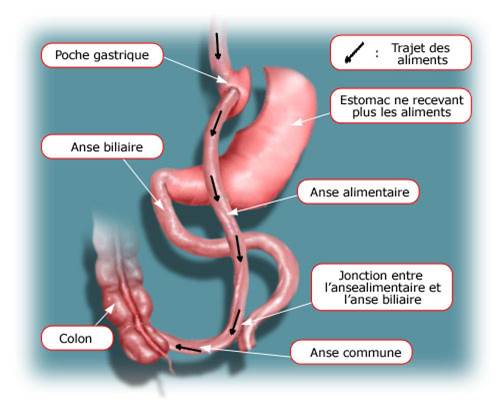
Two steps, performed laparoscopically under general anaesthesia, in two to three hours. A small pouch is created at the top of the stomach, roughly the size of an egg. The rest of the stomach is not removed — it remains in place, still producing digestive secretions, but food no longer passes through it. The small intestine is then divided and rerouted: the pouch is joined directly to a lower segment, bypassing the remainder of the stomach and the first portion of the small intestine. The resulting configuration has two joins — two anastomoses — which is why it is called Roux-en-Y.
How it works
Three mechanisms, which is more than any other standard operation. Restriction: the pouch holds very little. Malabsorption: food bypasses a segment of intestine, so fewer calories and fewer nutrients are absorbed — this is the source of both the effectiveness and the deficiency risk. Hormonal change, and this is the most interesting part: food arriving further down the small intestine triggers a different hormonal response — changes in GLP-1 and other gut hormones that reduce appetite and improve insulin sensitivity directly. That third mechanism is why diabetes frequently improves within days, before meaningful weight has been lost.
What to expect, and what it does not do
Typical published outcomes are in the region of 60 to 75% of excess weight lost, with most of it in the first twelve to eighteen months. Resolution or substantial improvement of type 2 diabetes occurs in a large proportion of patients — the highest rate of any standard bariatric operation. Reflux resolves in the great majority. Hypertension, sleep apnoea, fatty liver and joint pain generally improve. What it does not do is remove the need to change how you eat. And it is not reversible in practice: technically a bypass can be reversed, it is rarely done, and you should treat it as permanent.
Your Canadian options first
We put this before anything else because it matters. Bariatric surgery is covered by provincial health plans across Canada for patients meeting the criteria — generally a BMI of 40, or 35 with obesity-related conditions. Criteria vary by province. The Canadian programme gives you the surgery at no cost, a multidisciplinary team, structured preparation, and lifelong follow-up built in. That last point matters more for a bypass than for any other operation.
Patients look abroad because of waiting times, which in some regions are measured in years. For a patient with poorly controlled diabetes, that wait has a cost measured in complications — which is a legitimate reason to look elsewhere, and a reason worth discussing with your physician. Before anything else, ask your family doctor two questions: « Est-ce que je réponds aux critères pour une chirurgie bariatrique couverte ? » and « Quel est le délai d’attente réaliste dans ma région ? » Then decide with that information. Care received abroad is not reimbursed, so choosing Tunisia means paying for something you were entitled to receive without charge. That may still be right for you. It should be a decision rather than an oversight.
What we require before we operate — and why it is stricter here
This is firmer than on any other page on our site, and for a specific reason. A sleeve restricts. A bypass restricts and reduces absorption. Iron, vitamin B12, calcium and folate are absorbed principally in the portion of intestine that a bypass bypasses. Which means deficiency after a bypass is not a possibility — it is the default without supplementation.
- Vitamin B12 deficiency causes irreversible neurological damage — numbness, difficulty walking, cognitive change.
- Iron deficiency is common and frequently severe, particularly in menstruating women, and it sometimes requires intravenous iron rather than tablets.
- Calcium and vitamin D deficiency causes bone loss, silently, until a fracture.
- Thiamine deficiency in a patient with prolonged vomiting causes irreversible neurological damage within weeks.
- Protein malnutrition is possible where intake is inadequate.
Before we confirm your surgery, you must have arranged a Canadian physician who has agreed to order and review your blood tests. One doctor, one conversation. The conversation to have: « Je vais subir un bypass gastrique. Je reviendrai avec un compte rendu opératoire complet et un protocole de supplémentation et de suivi biologique. Accepteriez-vous de prescrire et de réviser mes analyses ? » Most family doctors say yes. This is routine blood work with a defined protocol, and they are not being asked to take over your bariatric care.
Where you cannot secure blood testing in Canada, we will not proceed. After a bypass we are firmer about this than after a sleeve, because the deficiency risk is materially higher and it is not optional. We would rather lose the case than operate on a patient who will develop a preventable, irreversible deficiency with nobody to detect it. A clinic that does not ask about your follow-up is not managing your safety — and it is a reasonable question to ask any clinic you are considering. If follow-up is genuinely unavailable where you live, that is an argument for the Canadian programme, where it is built in — or for a sleeve gastrectomy rather than a bypass, since the deficiency risk is lower. We would discuss both.
Reflux: the clearest reason to choose a bypass
This is the single most common reason a patient is directed to a bypass rather than a sleeve. A bypass resolves reflux because the acid-producing stomach is bypassed: food enters a small pouch and passes directly into the intestine — there is very little acid in the pouch, and very little to reflux. Published outcomes show resolution of reflux in the great majority of bypass patients, and it is one of the most reliable effects of the operation.
A sleeve does the opposite. It creates a narrow high-pressure tube and alters the valve at the top. A meaningful proportion of sleeve patients develop or worsen reflux, and in a small proportion it becomes severe enough to require conversion — to a bypass. So if you have significant reflux, a hiatus hernia, oesophagitis, or Barrett’s oesophagus, a bypass is frequently the right operation and a sleeve frequently is not. Barrett’s oesophagus in particular is generally considered a contraindication to a sleeve.
Be honest about your symptoms: heartburn, acid taste, regurgitation, chronic cough, waking at night with acid — and anything you take for it, including over-the-counter antacids. Patients sometimes downplay reflux because they have decided they want a sleeve. That is understandable and it works against them. The pre-operative endoscopy will tell us, and in a meaningful proportion of patients it changes the recommendation.
Diabetes: the strongest argument for a bypass
This deserves its own section, because the effect is larger than patients expect. Type 2 diabetes improves after a bypass frequently within days — before meaningful weight has been lost. That is not a weight-loss effect. It is the hormonal mechanism described above: food arriving further down the small intestine triggers changes in gut hormones that improve insulin sensitivity directly.
A large proportion of patients achieve remission — normal glucose without medication — and the rates are the highest of any standard bariatric operation. Patients on insulin frequently reduce or discontinue it, sometimes within the hospital stay. Long-term remission is more durable after bypass than after sleeve in published comparisons. If you have type 2 diabetes, particularly if it is poorly controlled or you are on insulin, this is the strongest reason to choose a bypass over a sleeve. And it is a reason to discuss the waiting time in Canada with your physician — because poorly controlled diabetes causes damage while you wait, and that is a clinical argument rather than a commercial one.
One important practical point: your diabetes medication will need adjusting, quickly. Continuing your pre-operative insulin dose after a bypass risks hypoglycaemia, and it can happen within days. We manage this during your stay — and your Canadian physician must be told immediately on your return, which is why your discharge letter states it explicitly. Do not adjust your own medication, and do not continue it unchanged without review.
Sleeve or bypass? The honest comparison
| Sleeve | Bypass | |
|---|---|---|
| Stomach | 75–80% removed | Small pouch, rest bypassed |
| Intestine rerouted | No | Yes — two joins |
| Excess weight loss | 55–70% | 60–75% |
| Diabetes remission | Good | Best |
| Reflux | Can worsen it | Resolves it |
| Deficiency risk | Lower | Higher — lifelong supplementation essential |
| Dumping syndrome | Uncommon | Common |
| Medication absorption | Unaffected | Can be affected |
| Internal hernia risk | None | Present — lifelong |
| Reversible | No | Technically, rarely done |
| Stay | 10 days | 14 days |
Where a bypass is clearly better: significant reflux, hiatus hernia, oesophagitis or Barrett’s; type 2 diabetes, particularly if poorly controlled or insulin-treated; very high BMI, where greater weight loss is needed; and revision after a failed sleeve or band.
Where a sleeve is better: where you have no reflux and no diabetes, and want the simpler operation; where you take medications with a narrow therapeutic window, since absorption after a bypass can be altered; where you have inflammatory bowel disease or extensive previous abdominal surgery, which can make a bypass technically difficult; and where you would find lifelong strict supplementation difficult to maintain — an honest consideration, and a legitimate one.
We decide from your reflux history, your diabetes status, your BMI, your medications, your previous surgery, and your endoscopy. Your plan states the recommendation and the reasoning, and where a sleeve would serve you better, we say so. Where a different configuration suits you, we will say that too — we also perform one-anastomosis gastric bypass and SADI-S.
The pre-operative endoscopy
Standard, and it genuinely changes plans. It finds hiatus hernia, frequently without symptoms — and it can be repaired at the same time as the bypass. It finds oesophagitis and Barrett’s oesophagus, both of which point firmly toward a bypass rather than a sleeve. It finds Helicobacter pylori, which is treated before surgery with antibiotics — and this matters more before a bypass than before a sleeve, because the bypassed stomach becomes difficult to examine afterwards. It also finds ulcers, gastritis or polyps.
Why it matters especially before a bypass: after the operation, the bypassed portion of your stomach cannot be reached by a standard endoscope. Anything that needs assessing there should be assessed now.
The bypassed stomach: a point worth understanding
Rarely explained, and worth knowing before you choose. The bypassed portion of the stomach stays in place. It continues to produce secretions, which drain into the intestine further down. It does not shrink away, and it is not removed.
This matters because it cannot be examined by standard endoscopy afterwards. A camera passed through the mouth reaches the pouch and then the intestine — it cannot enter the bypassed stomach, because there is no longer a route into it. Examining it later requires specialised techniques, and they are not available everywhere. Practically: anything needing assessment in the stomach should be assessed before the bypass, which is why Helicobacter pylori is treated first and why any suspicious finding is investigated before rather than after. It is also worth mentioning to your physician if you ever develop upper abdominal symptoms years later, because the assessment is not straightforward.
Is this a reason to choose a sleeve? For most patients, no — it is a consideration rather than a contraindication. Where it does weigh more: a patient with a family history of gastric cancer, or from a population with elevated gastric cancer incidence, may reasonably prefer a sleeve for this reason, and it is a conversation worth having.
Why Canadian patients choose Tunisia
| Canada (public) | Tunisia — Aylan Clinic | |
|---|---|---|
| Cost | Funded | At your expense |
| Wait time | Frequently years | Rapid |
| Follow-up | Built in | You arrange it |
| Language | English or French | French throughout the country |
| Surgeon training | Canadian | Frequently French-trained |
| Pre-operative endoscopy | Standard | Standard, included |
| Stay | 2–3 nights | 14 days |
| Companion | Not applicable | Free, accommodated and fed |
The fourteen-day stay. Longer than for a sleeve, and for a specific reason: two anastomoses. A bypass has two joins — pouch to intestine, and intestine to intestine. An anastomotic leak typically appears between day three and day seven, and the fourteen-day stay covers that window with margin. It also allows time for the dietary progression to be established under supervision, and for diabetes medication to be adjusted properly. A clinic offering a bypass with a seven-day stay is not covering both joins with margin.
Where the language matters on this treatment. At the dietary education, and after a bypass it is more complex than after a sleeve. You will be taught the staged progression, the protein requirement, the supplementation, and — specific to bypass — how to avoid dumping syndrome and what it feels like when you do not. That is a substantial body of practical instruction you will apply alone for years, and your written protocol is in French.
Surgeon training. A substantial proportion of Tunisian bariatric surgeons trained in France. Ask where yours qualified. We answer directly.
Part two — Preparing
From first contact to confirmed dates
The online consultation is a full submission. Send your height, current weight and BMI, and your weight history. Send all obesity-related conditions — diabetes with your most recent HbA1c and your current medications including insulin doses, hypertension, sleep apnoea and CPAP use, joint problems, fatty liver. Send all medications. Send your reflux symptoms honestly. Send any previous abdominal surgery, which can affect technical feasibility, and any previous bariatric surgery or balloon. Tell us whether you smoke, and it matters more here than for a sleeve. Tell us your mental health history, including any eating disorder or alcohol history, and any family history of gastric cancer. And tell us whether you have arranged Canadian follow-up. In French or in English, whichever you prefer.
What you receive: a plan stating whether a bypass is the right operation for you or whether a sleeve would serve you better, the pre-operative requirements, the length of stay, the supplementation protocol, and the cost — within 24 to 48 hours.
Questions worth asking before you commit:
- « Bypass ou sleeve dans mon cas, et pourquoi ? »
- « Une endoscopie est-elle réalisée avant l’opération ? »
- « Quelle est la durée du séjour, et pourquoi quatorze jours ? » — a clinic offering seven is not covering two anastomoses with margin.
- « Comment mes médicaments pour le diabète seront-ils ajustés ? »
- « Quel protocole de supplémentation, et à quelle fréquence les analyses ? »
- « Exigez-vous que j’aie organisé mon suivi au Canada ? »
- « Mes médicaments actuels seront-ils affectés par le bypass ? »
- « Où votre chirurgien a-t-il été formé ? »
What to arrange at home before you travel: your Canadian follow-up, which is a condition. Ask about the Canadian programme. Stop smoking — four weeks minimum, and ideally permanently, because smoking substantially increases the risk of marginal ulcer, the most common late complication, which can be severe. Begin the pre-operative diet, two to four weeks, to shrink the liver. Have your bloods done in Canada and bring the results — a pre-operative baseline is genuinely useful, and it is covered at home. Review your medications with your physician. And arrange time off: three to four weeks realistically.

Smoking and anti-inflammatories: two lifelong rules
Smoking substantially increases the risk of marginal ulcer — an ulcer at the join between pouch and intestine. Marginal ulcers are the most common late complication of a bypass, they can cause pain and bleeding, and in severe cases they perforate. Smoking after a bypass is the single largest risk factor, and the effect is not marginal. We ask for four weeks before and permanently afterwards. Canadian provincial quitlines are free, your pharmacist can advise on nicotine replacement, and combining behavioural with pharmacological support roughly doubles success rates.
Anti-inflammatory medication is the rule patients most often do not know about, and it is lifelong. Non-steroidal anti-inflammatory drugs — ibuprofen, naproxen, diclofenac, and aspirin at anti-inflammatory doses — substantially increase the risk of marginal ulcer after a bypass. They are generally avoided permanently. This matters practically, because many patients have joint pain, and because these are over-the-counter drugs people take without thinking of them as medication. Paracetamol is generally fine. Where you have a condition requiring regular anti-inflammatories, tell us — it is a genuine consideration in choosing between sleeve and bypass. And tell any physician prescribing for you that you have had a bypass.
Part three — The stay
Your fourteen days in Tunisia
Day 1 — Arrival. Your driver meets you at the airport and takes you to your hotel with your companion. Nothing clinical today.
Day 2 — Assessment. Clinical examination, weight and measurements, blood tests, ECG and chest imaging, abdominal ultrasound, and anaesthetic assessment. Consultation with the surgeon, and with the dietitian. Diabetes review where relevant, with a plan for how medication will be managed.
Day 3 — Endoscopy. Under sedation. Where findings change the recommendation, we discuss it before proceeding. Helicobacter pylori is treated if found, which may delay surgery by the duration of the antibiotic course.
Day 4 — Surgery. Laparoscopic Roux-en-Y gastric bypass, two to three hours under general anaesthesia. Leak tests performed intra-operatively on both anastomoses. You will be helped to stand and walk within hours.
Days 5 to 8 — In hospital. Pain managed, mobilisation encouraged. A contrast swallow study before liquids are started in most protocols. Progressive clear liquids. Diabetes medication adjusted — frequently reduced substantially or stopped, with glucose monitored closely. Discharge to your hotel at around day eight, though it varies.
Days 9 to 13 — At your hotel, monitored. Daily review, which is the core of why the stay is fourteen days. You are past the primary leak window but still within the period when problems present. Progressive dietary stages with the dietitian. Walking several times daily. And the dietary education, which after a bypass includes dumping syndrome.
Day 14 — Final review and departure. Final examination, blood tests, and glucose review. Your documentation: full operative report describing both anastomoses; your endoscopy report; your supplementation protocol; your staged dietary plan; your blood test schedule; a letter for your Canadian physician, stating explicitly that your diabetes medication requires urgent review; and written guidance in French or English. Then your transfer to the airport.
The complications that shape the stay
Anastomotic leak is the most serious early complication. A bypass has two joins, and either can leak — typically between day three and day seven. Symptoms: increasing abdominal pain, fever, a racing heart (frequently the earliest sign), difficulty breathing, and a sense of being unwell that is worsening. It is managed here, by the team that operated. This is the primary reason for the fourteen-day stay.
Internal hernia is specific to bypass, and lifelong. Rerouting the intestine creates spaces through which a loop of bowel can pass and become trapped. It can occur years later, frequently after significant weight loss, and it is a surgical emergency. The symptoms: crampy abdominal pain, frequently coming and going, sometimes with nausea and vomiting. This is the single most important thing for a bypass patient to know long term: severe or recurrent abdominal pain after a gastric bypass must be assessed urgently, and the treating physician must be told you have had a bypass. It can be missed, because imaging is not always conclusive and because a physician unfamiliar with bariatric anatomy may not consider it. Take your operative report.
Marginal ulcer is an ulcer at the join between pouch and intestine. It is the most common late complication, strongly associated with smoking and anti-inflammatory drugs. It presents with pain, sometimes bleeding, and is treated medically in most cases, occasionally requiring surgery.
Stricture is a narrowing at an anastomosis, causing difficulty swallowing or vomiting. It is treated endoscopically by dilatation. Dumping syndrome is common after bypass and is covered below. Also: bleeding; venous thrombosis and pulmonary embolism; gallstones from rapid weight loss; bowel obstruction; nutritional deficiency; and dehydration, the most common cause of readmission.
The dietary progression
The stages: days 1 to 7, clear liquids. Weeks 2 to 3, full liquids. Weeks 4 to 5, puréed. Weeks 6 to 8, soft. Week 8 onward, progressive solid texture. Your specific protocol is the one to follow.
The lifelong rules: protein first, sixty to eighty grams daily — and after a bypass this matters more, because protein absorption is reduced. Small portions. Chew thoroughly. Do not drink with meals — thirty minutes before or after. Eat slowly, twenty to thirty minutes. Hydrate between meals, one and a half to two litres daily.
What differs from a sleeve: sugar and fat cause dumping, which a sleeve patient experiences far less. Protein requirements are effectively higher, because absorption is reduced. And alcohol is absorbed faster still than after a sleeve, reaching higher levels more quickly — worth knowing, and worth mentioning if you have any history.
Dumping syndrome
Common after a bypass, and worth understanding rather than fearing. It is food — particularly sugar — passing rapidly into the small intestine. Early dumping, within thirty minutes: nausea, cramping, sweating, palpitations, a racing heart, light-headedness, sometimes diarrhoea. Late dumping, one to three hours later: a reactive drop in blood sugar causing shakiness, sweating, confusion and weakness. It happens because a normal stomach releases food gradually, and a pouch joined directly to intestine does not.
What causes it: sugar above all — sweets, fruit juice, sweetened drinks, desserts; high-fat food; large portions; and drinking with meals. How to avoid it: avoid sugar and read labels, because sugar is in a great many things; eat protein first; small portions, eaten slowly; no drinking with meals.
A point patients find useful: many describe dumping as a deterrent that helps them. It provides immediate, unpleasant feedback on exactly the foods that would otherwise cause regain — and a number of patients say it is the reason they changed their eating and kept the change. It is unpleasant. It is not dangerous in most cases. And it is largely avoidable once you know what causes it.
Part four — The rest of your life
Supplementation and blood testing
Stricter after a bypass than after a sleeve. What you take, daily, for life:
- A bariatric-specific multivitamin — and after a bypass, typically two doses daily rather than one.
- Vitamin B12, by injection or high-dose sublingual, because the normal absorption pathway is bypassed. This is not optional and it is not achievable through diet.
- Iron, frequently at higher doses, taken with vitamin C to improve absorption and away from calcium, which blocks it.
- Calcium citrate specifically — not carbonate, which requires stomach acid to absorb and is poorly absorbed after a bypass. This distinction matters and patients are frequently not told it.
- Vitamin D.
Your specific protocol is provided. The blood tests run at three months, six months, twelve months, and annually for life: full blood count; iron studies and ferritin; vitamin B12; folate; vitamin D; calcium and parathyroid hormone; albumin and protein; liver and kidney function; and zinc, copper and vitamin A, which are checked after bypass and not always after sleeve. Your protocol lists the exact panel, so your Canadian physician orders the right tests.
Why it does not end: because absorption remains reduced for life. A patient who supplements for two years, feels well, and stops is the patient who presents at year six with neurological symptoms. This is the whole reason we require arranged Canadian follow-up.
Medications after a bypass
A practical section that patients are frequently not given. Absorption of some medications is altered, because a segment of intestine is bypassed and because there is less acid. What to check with your physician: extended-release formulations may not be absorbed properly, and an immediate-release version is frequently preferred; thyroid hormone absorption can change, and the dose frequently needs adjusting; some antidepressants may be affected; anticoagulants may require monitoring adjustments; diabetes medication requires urgent review; and oral contraception may be less reliably absorbed — a non-oral method is generally advised, and this is important given that fertility frequently improves.

What to avoid permanently: anti-inflammatory drugs. What to do: review all your medications with your Canadian physician on your return, and give them your operative report. And tell any prescriber, for the rest of your life, that you have had a gastric bypass. It is one sentence, and it matters.
Weight regain
Honest, because most pages omit it. Loss continues for twelve to eighteen months. Then most patients regain some, which is normal. Substantial regain is less common and has identifiable causes: the pouch stretches with consistent overeating; grazing, which defeats restriction entirely; liquid calories, which pass straight through; drinking with meals; adaptation of the intestine over years, which partially restores absorption; and untreated binge eating disorder.
What protects against it: protein first; not grazing; not drinking calories; not drinking with meals; regular activity; and ongoing dietitian contact, which the evidence supports strongly. If it happens: dietary and behavioural review first, which resolves a substantial proportion; endoscopic options in some cases; and revision surgery where appropriate — though revision after a bypass is more complex than after a sleeve, which is worth knowing.
Your Canadian follow-up
What is required: blood tests at three, six and twelve months, then annually, for life — reviewed by a physician. Urgent medication review on your return, particularly diabetes medication. Dietitian contact, ideally ongoing. And your normal primary care, with your physician aware of your surgery.
The one thing to remember for life. Severe or recurrent abdominal pain after a gastric bypass must be assessed urgently. Tell the treating physician you have had a Roux-en-Y gastric bypass, and take your operative report. Internal hernia can occur years later, it is a surgical emergency, and it is missed when the physician does not know the anatomy. Keep your operative report accessible — not filed away.
Dietitian access in Canada. Registered dietitians are available across Canada. Generally not covered provincially but frequently covered in part by employer benefits — check your allowance. Some provinces offer publicly funded access through community health centres, including for patients who had surgery elsewhere. Worth asking.
Canadian coverage. Surgery abroad is not reimbursed. Your follow-up in Canada is covered — blood tests, physician visits, and treatment of any complication, as any medical care is.
Part five — Practical matters
Canadian patients: travelling to Tunisia from your region
Aylan Clinic works with patients from every province and territory in Canada. Wherever you live, the process begins the same way: a free consultation in French or English — and a requirement that your Canadian follow-up is arranged before we confirm surgery.
Montreal and the surrounding region. Montreal is our largest Canadian source for Tunisia. Connections from Trudeau to Tunis typically route through Paris, Frankfurt or Istanbul. Patients from Laval, Longueuil and Brossard are all within easy reach of the airport. One connection makes the return at day fourteen considerably more comfortable.
Quebec City and across the province. From Quebec City and the Capitale-Nationale region including Lévis, most patients connect through Montreal — as do patients from Trois-Rivières, Sherbrooke, Drummondville and Saint-Jérôme. Gatineau patients depart from Ottawa or drive to Montreal. From Saguenay, a domestic connection through Montreal is the norm, with an overnight worth building in. On this treatment the francophone advantage is at the dietary education, which after a bypass includes dumping syndrome, the protein requirement and the supplementation protocol — a substantial body of instruction you will apply alone for years, in a protocol written in French.
Acadia and New Brunswick. We work with patients from Moncton, Fredericton and Saint John. Moncton and the surrounding Acadian communities are served in French throughout. Most connect through Montreal.
Francophone Ontario. Sudbury, Thunder Bay and Sault Ste. Marie all have substantial francophone populations, served in French from first contact onward. Ottawa patients typically connect through Montreal.
Greater Toronto Area and southern Ontario. Toronto patients connect through European hubs, with Paris and Frankfurt the most common routes to Tunis. Across the wider Greater Toronto Area we work with patients from Mississauga, Brampton, Markham, Vaughan, Richmond Hill and Oshawa. Along the lake: Hamilton, Burlington, Oakville, St. Catharines and Niagara Falls. In southwestern Ontario: London, the Waterloo region — Kitchener, Waterloo and Cambridge — plus Guelph, Windsor and Barrie. Kingston patients generally drive to Toronto or Montreal.
Vancouver and British Columbia. Vancouver patients face the longest journey, typically two connections. We frequently recommend extending to fifteen or sixteen days, so the journey home falls well clear of the period when problems present. And plan for hydration — two connections and a long day is exactly the situation in which post-bariatric dehydration occurs. Across the Lower Mainland: Surrey, Burnaby and Richmond. From Victoria and Nanaimo, patients cross by ferry or short flight. Kelowna, Abbotsford and Kamloops patients connect through Vancouver or Calgary.
Alberta. Calgary and Edmonton both offer European connections onward to Tunis. Red Deer and Lethbridge patients generally drive to Calgary.
Manitoba and Saskatchewan. Winnipeg patients connect through Toronto or Montreal. The francophone community of Saint-Boniface is served in French. From Saskatoon and Regina, journeys involve a domestic connection followed by two further flights.
Atlantic Canada. Halifax patients typically route through Montreal or Toronto. From Charlottetown and St. John’s, journeys involve two or three connections, with an overnight advisable.
Northern Canada. We work with patients from Whitehorse in Yukon, and from communities across the Northwest Territories and Nunavut. For northern patients, a bypass requires the most careful assessment of any bariatric operation. Two things determine it: blood testing access, about which we are firmer after a bypass than after a sleeve; and emergency access, since internal hernia is a surgical emergency that can occur years later and a patient far from a surgical centre should weigh that. Where either is genuinely limited, we would recommend a sleeve rather than a bypass — lower deficiency risk, no internal hernia risk — or the Canadian programme with its built-in follow-up. That conversation happens before you book.
How we handle the logistics. Whichever city you are travelling from, your coordinator arranges airport transfers at both ends in Tunisia, confirms your hotel before you depart, and builds your schedule around your arrival time. Five recommendations: arrange your Canadian follow-up first; ask your doctor about the Canadian programme and the wait; stop smoking, permanently, for the ulcer risk; plan the full fourteen days; and keep your operative report accessible.
What your package includes
- Free consultation in French or English, with an honest assessment of whether a bypass or a sleeve suits you better
- Confirmation that your Canadian follow-up is arranged before surgery is scheduled
- Full on-site assessment: clinical examination, blood tests, ECG, chest imaging, abdominal ultrasound
- Anaesthetic assessment
- Pre-operative endoscopy, with findings discussed before proceeding
- Treatment of Helicobacter pylori where found
- Surgeon consultation, dietitian consultation, and diabetes review where relevant
- Laparoscopic Roux-en-Y gastric bypass, with intra-operative leak testing of both anastomoses
- Hiatus hernia repair where indicated
- Hospitalisation, with contrast study before liquids
- Pain management, thromboprophylaxis and compression stockings
- Close diabetes medication management during your stay
- Daily review across the fourteen-day stay
- Staged dietary education, including dumping syndrome
- Final examination, blood tests and glucose review before departure
- Full operative report describing both anastomoses, and your endoscopy report
- Your supplementation protocol, naming specific products including calcium citrate and B12 route
- Your blood test schedule, naming the exact panel
- A letter for your Canadian physician, stating explicitly that diabetes medication requires urgent review
- Written guidance in French or English, including internal hernia symptoms and what to tell an emergency department
- Continued contact in French or English after you return
- Hotel accommodation, full board, with meals matched to your dietary stage
- A companion at no extra cost, accommodated and fed in the same room
- Airport–clinic–hotel transfers
- A personal coordinator from arrival to departure
- French-speaking care throughout, with English available on request
The clinical team. Bariatric surgeon — laparoscopic Roux-en-Y bypass, frequently French-trained. Anaesthetist — assessment and monitoring. Gastroenterologist — pre-operative endoscopy. Dietitian — preparation and staged education including dumping management. Dedicated nurse — post-operative care and daily review.

Results by patient profile
Diabetes resolved. A patient with a BMI of 41, type 2 diabetes on insulin for six years, and an HbA1c that had not been controlled despite maximal medical therapy. A bypass rather than a sleeve, specifically for the metabolic effect. Her insulin was stopped during the hospital stay. At twelve months her HbA1c was in the normal range without medication. This is the strongest indication for a bypass, and the effect begins before meaningful weight loss.
Reflux that a sleeve would have worsened. A patient who arrived asking for a sleeve, whose endoscopy found a hiatus hernia and moderate oesophagitis. We recommended a bypass, explaining that a sleeve would likely worsen her reflux significantly and might require conversion later. She had a bypass with hiatus hernia repair. Her reflux resolved entirely.
Where we recommended a sleeve instead. A patient with a BMI of 38, no diabetes, no reflux, and a rheumatological condition requiring regular anti-inflammatory medication. We explained that anti-inflammatories are generally avoided permanently after a bypass, because of marginal ulcer risk. A sleeve was the better operation for her, and she had one.
A patient we would not proceed with. A patient who could not identify any Canadian physician to order her blood tests. After a bypass we are firmer about this than after a sleeve, because deficiency is the default rather than a possibility. We declined, explained why, and recommended the Canadian programme.
An internal hernia, three years later. A patient who developed crampy abdominal pain three years after her bypass, coming and going over several days. She had her operative report, she told the emergency physician she had had a Roux-en-Y bypass, and internal hernia was considered. It was found and repaired. Her comment afterwards was that she had almost not gone in, because the pain kept settling. This is why we insist on the rule above, and why she kept the report accessible.
Dumping as a teacher. A patient who experienced dumping twice in her first month, both times after eating something sugary. She has not done it since. She describes it as the most effective dietary education she has ever had — which is a common enough reaction to be worth including.
A patient from Val-d’Or. A patient who chose Tunisia so the education could happen in French. Her comment was about specificity. She asked what dumping actually feels like, how to tell it from a leak, and why calcium citrate rather than carbonate. « Ce sont des questions précises. Il fallait que je puisse les poser précisément. »
Practical points to know
What to expect: a pre-operative diet of two to four weeks; endoscopy before surgery; a fourteen-day stay; diabetes medication adjusted, frequently substantially, during the stay; a staged dietary progression over eight weeks, with dumping to learn about; rapid weight loss over twelve to eighteen months; and supplementation and blood testing for life, stricter than after a sleeve.
Recognised points: Roux-en-Y bypass is among the most studied operations in surgery, with a well-documented safety and outcome profile, and your surgeon will discuss the considerations relevant to you. The main ones: anastomotic leak, day three to seven; internal hernia, lifelong and a surgical emergency; marginal ulcer, the most common late complication, strongly associated with smoking and anti-inflammatories; stricture, treated endoscopically; dumping syndrome, common and manageable; nutritional deficiency, the default without supplementation; venous thrombosis and pulmonary embolism; bleeding; gallstones from rapid loss; dehydration, the most common readmission cause; altered medication absorption; hypoglycaemia, including late-onset reactive hypoglycaemia in some patients years later; loose skin, a consequence rather than a complication — see post-weight-loss skin removal surgery; regain; and the general risks of abdominal surgery under general anaesthesia.
Three things within your control: blood tests and supplementation, for life; never smoking, and avoiding anti-inflammatories; and knowing the internal hernia symptoms and acting on them.
Who this suits: adults meeting bariatric criteria, with Canadian follow-up arranged, particularly those with significant reflux or type 2 diabetes, and who understand the lifelong requirements. Who should consider a sleeve instead: patients requiring regular anti-inflammatory medication; patients on medications with narrow therapeutic windows; patients with limited access to blood testing or emergency surgical care; and patients who would find strict lifelong supplementation difficult to maintain, which is an honest consideration.
Price: how it is built and how to compare it
What determines your price: the operation, whether hiatus hernia repair is included, the length of stay, the pre-operative investigations, and whether any finding changes the recommendation. Your quote is itemised and fixed once you approve it. What is included is everything in the package list above — the full assessment, endoscopy, the operation with leak testing of both anastomoses, hospitalisation, diabetes management, fourteen days with daily review, dietitian education, the operative report, supplementation protocol, blood test schedule, the letter for your physician, hotel with full board matched to your dietary stage, transfers, and your coordinator. A companion is accommodated and fed at no additional cost.
What sits outside it: flights, travel insurance, your supplements for life, blood tests in Canada (covered by your provincial plan), dietitian support, and any body contouring later. The comparison that matters is against the funded Canadian programme and its waiting time.
How to compare quotes properly — five checks:
- Is pre-operative endoscopy included? Especially important before a bypass, because the bypassed stomach cannot be examined afterwards.
- What is the length of stay? Fourteen days covers two anastomoses with margin. Seven does not.
- Does the clinic require arranged Canadian follow-up? After a bypass, a clinic that does not ask is not managing your safety.
- Is the supplementation protocol specific — naming calcium citrate and the B12 route? Generic advice is not adequate after a bypass.
- Is a dietitian included, and does the education cover dumping?
Why the lowest quote is a serious concern here: the savings available are the stay and the assessment, and both are safety. A bypass has two joins. A seven-day stay does not cover both leak windows with margin, and sends you home a transatlantic flight from your surgeon. And a generic supplementation protocol after a bypass is not adequate — the B12 route and the calcium form both matter, and getting them wrong produces deficiency in a patient who believes she is supplementing correctly.
Travel insurance. Purchase it and read the exclusions. Many policies exclude complications of elective surgery, and some exclude anything obesity-related as pre-existing. Ask in writing, and prioritise repatriation and hospitalisation cover.
Payment. A deposit confirms your dates. The balance is settled on site, under terms set out when you approve your plan. There are no additional charges once accepted — and where the endoscopy changes the recommendation, we discuss it before proceeding.
Getting your figure. Send everything listed under the online consultation, including your diabetes details with current medication doses, your reflux symptoms honestly, all your medications, any family history of gastric cancer, and whether you have arranged Canadian follow-up. A plan and quote follow within 24 to 48 hours, in French or English.
Glossary
- Roux-en-Y — the Y-shaped configuration created by rerouting the intestine
- Anastomosis — a surgical join; a bypass has two
- Gastric pouch — the small stomach reservoir created at the top
- Bypassed stomach — the remainder, left in place but no longer receiving food
- Malabsorption — reduced absorption of calories and nutrients
- Marginal ulcer — ulcer at the pouch-intestine join; smoking and anti-inflammatories are the main causes
- Internal hernia — bowel trapped in a space created by rerouting; a surgical emergency, lifelong
- Dumping syndrome — rapid passage of sugar causing nausea, sweating and palpitations
- Calcium citrate — the form absorbed without stomach acid; required after bypass
- Remission — normal glucose without diabetes medication
How Canadians search for this
- “Gastric bypass Tunisia cost” — the most common search. Ask about the length of stay before comparing prices.
- “Bypass gastrique Tunisie” — how most Quebec patients search, and the reason this page exists in both languages.
- “Bariatric surgery covered Canada” — yes, for patients meeting the criteria.
- “Bypass vs sleeve” — bypass for significant reflux and for type 2 diabetes; sleeve where neither applies and for patients needing anti-inflammatories.
- “Does gastric bypass cure diabetes” — remission rates are the highest of any standard operation, and the effect begins before significant weight loss.
- “Gastric bypass reflux” — it resolves reflux, which is the opposite of a sleeve.
- “Internal hernia after gastric bypass” — a surgical emergency that can occur years later. Severe or recurrent abdominal pain must be assessed urgently.
- “Marginal ulcer” — the most common late complication. Smoking and anti-inflammatories are the main causes, and both are avoidable.
- “Can I take ibuprofen after gastric bypass” — generally no, permanently.
- “Dumping syndrome” — common after bypass, caused mainly by sugar, and largely avoidable once you know.
- “Vitamins after gastric bypass” — stricter than after a sleeve, with B12 by injection or sublingual and calcium as citrate.
- “Pregnancy after gastric bypass” — wait twelve to eighteen months, note that fertility improves and oral contraception may be unreliable.
- “French speaking bariatric surgeon abroad” — Tunisia’s distinguishing feature.
In summary
Gastric bypass at Aylan Clinic Tunisia includes pre-operative endoscopy, a fourteen-day stay covering both anastomotic leak windows with margin, close management of your diabetes medication, substantial dietary education including dumping, and a specific supplementation protocol naming the B12 route and calcium citrate — because generic advice is not adequate after a bypass. And we will not schedule your surgery until your Canadian follow-up is arranged: after a bypass, deficiency is the default without supplementation, not a possibility. It takes place in a French-speaking country, which matters most at the dietary education — a substantial body of instruction you will apply alone for years, in a protocol written in your own language. With accommodation, full board and a companion at no extra cost, for up to 60% less than Canadian private prices.
Five things to hold onto. Ask your family doctor about the Canadian programme and the wait, because bariatric surgery is funded in Canada with follow-up built in. Arrange a Canadian physician for your blood tests — it is a condition of proceeding. A bypass is the answer for reflux and for diabetes; if you have either, this is likely the right operation, and the endoscopy will confirm it. No smoking and no anti-inflammatories, permanently. And learn the internal hernia symptoms: severe or recurrent abdominal pain, years later, must be assessed urgently — tell them you had a bypass, and keep your operative report accessible.
When you are ready, read the procedure page on Gastric Bypass in Tunisia for how the operation and the fourteen-day stay are organised, compare the wider options in our bariatric surgery in Tunisia overview, review plastic surgery prices in Tunisia, or request a free, personalised quote. Send your details and you will have an honest answer within 24 to 48 hours, in French or in English.
Everything about Gastric Bypass in Tunisia
Technique, stay, supplementation and the full patient journey — every detailed answer on the procedure page.