Abdominal etching at Aylan Clinic Tunisia selectively removes fat along the natural lines of the abdominal muscles to reveal or enhance a defined six-pack appearance, over a stay of eight to ten days, for up to 60% less than Canadian private prices. The short answer is yes, for the right candidate — and the honest opening point is that most people who want this are not yet that candidate, and going to the gym harder is not a substitute for what this operation requires beforehand. Etching reveals definition that already exists; it does not create muscle.
This guide is the pedagogical companion to our procedure page on abdominal six pack etching in Tunisia, which sets out how the operation itself is run, the stay and the aftercare. The broader category — including BodyTite and Vaser use, the male and female design differences, and the twenty-year question — is covered on our HD liposculpture with BodyTite page and in our complete guide to liposuction in Tunisia. Read those first. This page is specifically about the etching technique itself. For how a quote is built and what it should be compared against, see plastic surgery prices in Tunisia, and for the wider map of procedures, our body contouring in Tunisia overview.
Three things before you read further. This is the single narrowest indication in our entire body library, and the candidacy bar is higher than for any other procedure we perform: you need the muscle definition already present beneath the fat, low body fat, and skin that will retract tightly — and a meaningful proportion of enquiries do not currently qualify, whatever the surgery could technically do. It works within the superficial fat layer specifically, which is the least forgiving plane in body contouring, and etching pushes that principle to its most demanding extreme, because the lines being created must follow your actual anatomy with millimetre precision. And the result is permanent in a way patients underestimate: the lines will still be there when you gain weight, lose muscle tone, or simply age — which is a different kind of permanence question from most cosmetic procedures.
One thing distinguishes Tunisia: it is a French-speaking country. Not a clinic with French-speaking staff — a country where French is a working language across medicine and daily life.
Part one — deciding
1. Who actually qualifies
This is the section that matters most, because it is where most enquiries end.
What must already be present. Genuine underlying abdominal muscle definition, built through training, that the fat layer is currently obscuring — not muscle that etching will create, because it creates nothing. There must be a six-pack under there already, simply hidden by fat. A low body fat percentage, considerably lower than for general body contouring, because the technique works by removing a thin layer of fat precisely along the muscle borders, and there needs to be little enough fat overall that this selective removal actually shows. And skin that will retract tightly onto the new, more sculpted contour — this matters more here than almost anywhere, because loose skin over an etched abdomen looks distinctly worse than loose skin over a simply contoured one.
What this actually means in practice. A meaningful proportion of people who want this are not, at the time they ask, candidates for it — because they have not yet built the underlying muscle definition, are carrying too much overall body fat for the technique to show through, or both. And the honest advice in that situation is training and further fat loss first, not surgery now.
What we do. We assess honestly against these specific requirements, rather than accepting every enquiry. Where a patient is not yet a candidate, we say so directly, and describe what would need to change — which for most people means continuing the training and fat loss already underway, sometimes for a considerable further period.
Ask yourself, honestly, before you enquire: is there a six-pack under there that I simply cannot see, or is there not yet one to reveal?
2. The technique, and why the superficial plane matters so much here
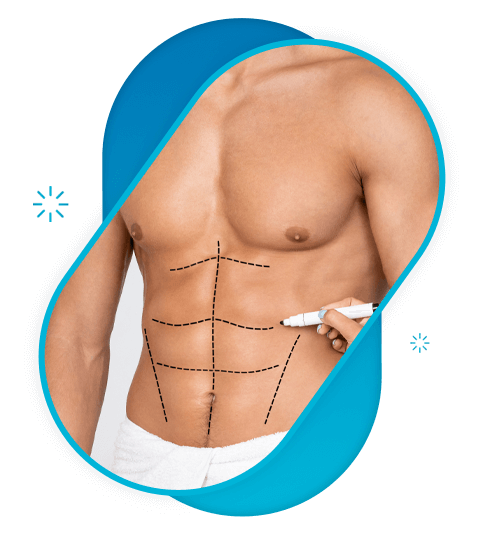
What etching actually is. Deliberate, precise fat removal along the natural anatomical grooves — the linea alba running down the midline, the linea semilunaris at the outer border of the rectus muscle, and the horizontal tendinous intersections that create the segmented six-pack appearance. It is performed in the superficial fat layer, close to the skin, because that is where the grooves need to be visible from — and it is the same demanding plane that is the source of both HD liposculpture’s power and its risk.
Why this is more demanding than general HD sculpting. HD liposculpture more broadly follows and enhances your general muscular contours. Etching specifically creates lines — and a line that is even slightly misplaced, too deep, too wide, or asymmetric between the two sides is far more noticeable than a general contour that is slightly imperfect, because the eye reads lines with much greater precision than it reads broad shape.
The consequence for irregularity risk. Waviness, over-aggressive grooving producing lines that look drawn rather than anatomical, and adherences are all recognised risks of superficial sculpting. Every one of them is present here, and etching’s precision requirement makes the margin for error narrower still.
What good technique looks like. Marking made with you standing and flexing, so the lines follow your actual anatomy rather than an imposed template. Conservative depth, removing a thin, precise layer rather than aggressively carving the groove. And symmetry checked repeatedly against your own natural asymmetry — because most people’s two sides are not identical, and forcing artificial symmetry can look more obviously operated than respecting the real, slight asymmetry your body already has. The same principle governs ear surgery on a completely different part of the body.
3. Male and female etching: different targets
The male pattern. A defined midline, semilunar lines, and visible tendinous intersections — the classic six-pack or eight-pack appearance, with the degree of segmentation and depth a specific design choice discussed with you.
The female pattern. Etching in women is generally far more conservative — a soft, subtle midline definition rather than heavily segmented lines, because an aggressively etched female abdomen reads as masculine and is a recognisable, undesirable sign of overcorrection. This is one of the most important design decisions specific to etching in a female patient.
What we do. We design toward your own anatomy and your own goals, rather than applying a single template regardless of your sex or your existing muscular pattern. Ask to see results in patients of your own sex, with a starting point similar to yours.
4. Where irregularity comes from, specifically in etching
The commonest problems.
- Asymmetric lines — one side’s groove deeper, wider, or positioned differently from the other, which is far more visible in a defined line than in a general contour.
- Over-etched grooves — too deep or too wide, producing lines that look drawn on rather than anatomical, and which do not soften with time the way a subtler result would.
- Lines that do not match your actual muscle anatomy — an imposed template rather than your own tendinous intersections, which looks wrong to anyone who knows what a real six-pack looks like, even if they cannot articulate why.
- Adherences at the grooves specifically — where the skin becomes tethered to the underlying fascia, which in a linear groove is a visible indentation that moves oddly with the muscle.
Why correction is particularly difficult here. Fat removed from a precise line cannot easily be replaced to soften an over-aggressive result. And because the error is a defined line rather than a general area, it is highly visible and highly specific — making even partial correction technically demanding.
What prevents it. Everything in section 2, plus a conservative approach specifically to depth and width in the actual etching, rather than the surrounding sculpting. Ask: « Combien d’etchings abdominaux réalisez-vous par an, spécifiquement — pas de la liposculpture générale, mais le tracé des lignes lui-même ? »
5. Permanence: what it means for this specific result
The fat is permanently gone from those precise lines. Which means the lines themselves persist even if the overall picture around them changes — and this cuts in an unexpected direction.
If you gain weight. Fat returns to the areas between the etched lines, but the lines — where fat cells were specifically removed — can remain relatively more defined, producing an odd, uneven appearance rather than simply a less six-pack-looking abdomen. This is a specific and under-discussed consequence of the technique’s permanence.
If you lose muscle tone. The fat stays removed, and the muscle does not stay defined without training. For etching specifically that means the lines can persist over an abdomen that no longer has the underlying tone that made them look like a real six-pack — producing a result that reads as strange rather than simply less defined.
As you age. Skin thins, and aggressive, deep etching ages less favourably than a conservative result, because deep grooves become more pronounced, not less, as the overlying skin and fat thin further with age.
The conversation we have is direct, and before rather than after — with the additional, etching-specific point that the lines themselves are what persist, for better or worse, regardless of what happens to the rest of your abdomen.
6. Where we would want more information first
- Insufficient existing muscle definition — section 1, and the most common reason we would not proceed yet.
- Body fat percentage above the range where the technique will show through — section 1.
- Poor skin elasticity, which matters more here given how visible any resulting laxity is over a linear, defined result.
- No established training routine, or no genuine intention to maintain one — which applies with particular force to a result this precise and this visible when it is not maintained.
- Expectations built on heavily filtered or professionally lit images, rather than an honest picture of what your own anatomy currently offers.
7. Your Canadian options
Not covered by any provincial plan or private insurance — abdominal etching is a cosmetic procedure throughout Canada. Beyond coverage, abdominal etching specifically is performed by a small number of surgeons even among those offering body contouring generally: it is a specific, narrow skill within an already specialised field, and this is worth knowing when comparing availability and pricing, in Canada or anywhere.
Part two — preparing and the stay
8. From first contact to confirmed dates
The online consultation. Alongside the standard HD liposculpture assessment, we specifically ask for photographs flexed and relaxed, from directly in front, showing exactly what muscle definition already exists beneath the fat; your training history and current routine in detail; and your approximate body fat percentage, if you know it.
What you receive. A plan stating whether your current muscle definition and body fat genuinely support this specific result — section 1 — whether further training and fat loss should come first, the design proposed for your anatomy and sex — section 3 — the stay, and the cost. Within 24 to 48 hours. And where you are not yet a candidate, the plan will say so plainly, along with what would need to change.
Questions worth asking before you commit.
- « Ai-je déjà la définition musculaire nécessaire, ou dois-je m’entraîner davantage d’abord ? » — section 1, and the first honest question.
- « Combien d’etchings abdominaux, spécifiquement, réalisez-vous par an ? » — section 4.
- « Le dessin suivra-t-il ma propre anatomie, marquée pendant que je contracte ? » — section 2.
- « À quoi ressemblera ce résultat si je prends du poids, ou si j’arrête de m’entraîner ? » — section 5.
What to arrange at home before you travel. Continue or intensify your training where relevant, and arrive as lean as safely achievable — because the operation reveals rather than creates, and arriving leaner produces a materially better result. Everything else follows the standard HD liposculpture preparation.
9. Your stay in Tunisia
Eight to ten days, following the structure of an HD liposculpture stay, with these etching-specific points.
Day 2 — consultation and marking. Marking is made standing and flexing, and takes considerably longer than for general HD sculpting, because the lines must be drawn to follow your specific tendinous anatomy precisely. This is not a step to rush.
Day 3 — surgery. The etching itself is performed conservatively, with depth and width checked repeatedly against symmetry, as part of the broader HD sculpting session. Everything else — the deep liposuction first, the superficial sculpting, any BodyTite use, the garment, the foams — follows that structure exactly.
Part three — afterwards
10. Recovery and the timeline
Recovery follows the HD liposculpture pathway in full: garment, lymphatic massage, swelling that increases before it decreases, and a result that settles over months rather than weeks.
One etching-specific note: because the lines are precise and linear, swelling in the first months can make them look uneven or asymmetric in a way that is particularly alarming — and this is exactly the period in which you should not be judging the result, more so here than for general sculpting. Do not assess line symmetry before nine to twelve months.
11. Your Canadian follow-up
Follow-up follows the standard HD liposculpture pathway in full. The letter we provide specifically documents the etching pattern created, which matters for any future assessment by a clinician in Canada.
Part four — practical matters
12. Canadian patients: travelling to Tunisia from your region
Aylan Clinic works with patients from every province and territory in Canada, and the full regional detail set out in our HD liposculpture material applies here without modification.
Montreal and the surrounding region. Montreal is our largest Canadian source for Tunisia, with connections through Paris, Frankfurt or Istanbul. On this page the francophone advantage is at the candidacy conversation specifically — telling a patient plainly that they are not yet a candidate, and what building the necessary muscle definition and reducing body fat would actually involve, is exactly the kind of nuanced, sometimes disappointing message that lands better when it can be discussed in genuine depth, in your own language. Patients consistently tell us they left the consultation with a specific training plan rather than a surgical booking, and returned when they were genuinely ready.
Quebec City and across the province, Acadia and New Brunswick, Francophone Ontario, the Greater Toronto Area, Vancouver and British Columbia, Alberta, Manitoba and Saskatchewan, Atlantic Canada, and Northern Canada. The flight precautions, the extended stay recommendations and the massage access considerations all apply here without modification, because the operation and recovery are governed by the broader HD liposculpture procedure.
How we handle the logistics. Your coordinator arranges transfers, confirms your hotel, and builds your schedule around your arrival time.
Five recommendations. Be honest with yourself about whether the muscle is already there. Send flexed photographs specifically. Ask how many etchings, not general HD cases, the surgeon performs annually. Do not expect to see the final line symmetry before a year. And read our HD liposculpture material fully first.
13. What your package includes
Everything included in an HD liposculpture package, with these specific to etching:
- An honest candidacy assessment against the specific requirements in section 1, before any surgical planning proceeds.
- Marking made standing and flexing, following your own tendinous anatomy precisely.
- Conservative, symmetry-checked etching technique — section 4.
- Design matched to your sex and your own muscular pattern rather than an imposed template — section 3.
- An operative report specifically documenting the etching pattern created.
14. Results by patient profile
The genuine candidate. A patient training consistently for several years, with visible but fat-obscured abdominal definition, low body fat, and excellent skin elasticity. Conservative etching following his own tendinous anatomy, marked while he flexed. At twelve months, a natural-looking result that reads as an athletic abdomen rather than a surgical one — which is exactly the aim, and precisely because the lines followed anatomy that was genuinely already there.
Where we recommended training first. A patient with moderate body fat and undeveloped abdominal musculature, requesting etching specifically. We explained directly that there was not yet a six-pack under there to reveal — section 1 — and that surgery now would not produce the result he was picturing. He began a structured training and nutrition programme with our guidance, and returned fourteen months later as a genuine candidate. That delay, and that honest first conversation, is what made his eventual result work.
Where symmetry mattered. A patient with naturally slightly asymmetric abdominal musculature, which is common and normal. We explained that forcing perfectly symmetric etched lines onto genuinely asymmetric underlying anatomy would look more obviously artificial than respecting the real, slight difference — the same principle that governs ear surgery on a completely different part of the body. A design following his actual anatomy, which reads as natural specifically because it was not forced into artificial perfection.

A patient from Montréal. A patient who had researched etching extensively and arrived expecting to book immediately. His comment was about being told to wait: « Je m’attendais à réserver directement. On m’a expliqué précisément ce qui manquait encore — moins de graisse, plus de développement musculaire — et on m’a dit de revenir dans un an. Je suis revenu, et le résultat était bien meilleur pour avoir attendu. »
15. Practical points to know
Everything that applies to HD liposculpture applies here, with these specific to etching. The recognised points specific to this technique: asymmetric or over-etched lines, the commonest and most visible failure mode; lines that persist oddly if weight is regained or muscle tone is lost, a specific consequence of the technique’s precision and permanence; and a genuine possibility that you are not yet a candidate, which is not a failure of the consultation but an honest assessment.
Who this suits. Genuine, already-present but fat-obscured muscle definition, low body fat, excellent skin elasticity, an established and continuing training routine, and realistic expectations specifically about permanence.
Who should train and lose fat further first. The largest single group of people who enquire about this procedure. And that is not a discouraging finding — it is simply the honest starting point for most people interested in this result.
16. Price: how it is built and how to compare it
What determines your price. The same factors as HD liposculpture, with the etching component itself, the extent of segmentation designed, and whether BodyTite or Vaser are used as part of the broader sculpting. Figures for every intervention are set out on plastic surgery prices in Tunisia.
How to compare quotes properly. Every check that applies to HD liposculpture, with these additions specific to etching:
- Has the clinic honestly assessed whether you currently qualify, or has it accepted the booking regardless? Section 1 — and this is the single clearest indicator of whether a clinic is protecting your result or simply taking a booking.
- Can you see results at two years specifically in etched patients, not general HD sculpting cases?
Why accepting every booking is the concern here, more than price itself. Because the most common failure mode with this procedure is not a technical surgical error — it is operating on a patient who was not yet a genuine candidate, and producing lines with insufficient underlying muscle or too much overlying fat to actually read as a six-pack. A clinic willing to say “not yet” is the one protecting your eventual result.
Canadian coverage. Not covered.
17. Glossary
- Abdominal etching — precise superficial fat removal along the natural muscle grooves.
- Linea alba / linea semilunaris — the midline and lateral rectus muscle borders followed by etching.
- Tendinous intersections — the horizontal lines creating the segmented six-pack appearance.
- Candidacy — the specific pre-existing conditions (muscle definition, low body fat, skin elasticity) that etching requires.
18. How Canadians search for this
- “Abdominal etching Tunisia cost” — the most common search. Ask whether you currently qualify first.
- “Six pack surgery Tunisie” — how most Quebec patients search.
- “Do I qualify for abdominal etching” — you need existing, fat-obscured muscle definition, low body fat, and good skin elasticity, and a meaningful proportion of people asking do not yet qualify. Section 1.
- “Abdominal etching vs working out” — etching reveals existing definition; it does not create muscle. Training comes first, always.
- “Six pack surgery looks fake” — usually asymmetric or over-etched lines, or lines imposed as a template rather than following real anatomy. Section 4.
- “Abdominal etching for women” — considerably more conservative than for men, avoiding a masculine over-etched look. Section 3.
- “French speaking plastic surgeon abroad” — Tunisia’s distinguishing feature.
In summary
This is the narrowest indication in our entire body library, and most people who want it are not yet the candidate it requires. You need muscle definition that already exists beneath the fat, low overall body fat, and skin that will retract tightly — etching reveals; it does not create. A meaningful proportion of enquiries are, honestly, better served by continued training and fat loss than by surgery now, and we say so directly rather than accepting every booking.
The technique works in the most demanding plane in body contouring, pushed to its most precise extreme. Lines are far more visible than general contours when even slightly wrong — asymmetric, over-deep, or following an imposed template rather than your actual tendinous anatomy — which is why experience with etching specifically, not general HD sculpting, is the question worth asking.
And the permanence cuts in a specific direction here. If you gain weight or lose muscle tone afterwards, the etched lines can persist in a way that looks odd rather than simply less defined, because the fat removed along those precise lines does not return the way fat elsewhere on your body does.
At Aylan Clinic Tunisia that means an honest candidacy assessment before any surgical planning, marking made while you flex, following your own anatomy, conservative, symmetry-checked technique, design matched to your sex rather than a single template, and a willingness to tell you to come back in a year. It takes place in a French-speaking country, which matters when the honest message is often “not yet” rather than “yes” — with accommodation, full board and a companion at no extra cost, for up to 60% less than Canadian private prices.
Three things to hold onto. Ask yourself honestly first: is the muscle already there, hidden by fat? If not, training and fat loss come before any surgical conversation. Ask specifically how many etchings — not general HD cases — the surgeon performs annually, because this procedure’s failure mode is asymmetric or over-deep lines, and experience with the specific technique is what prevents it. And understand that the permanence works differently here: if you gain weight or lose tone afterwards, the lines can persist oddly, which is a different kind of commitment from most cosmetic procedures.
Send flexed photographs showing your current definition, and you will have an honest answer within 24 to 48 hours — including, where it applies, what would need to change before you are a candidate. The procedure itself, with the stay, the team and the aftercare set out step by step, is on our abdominal six pack etching in Tunisia page; figures for every intervention are on plastic surgery prices in Tunisia; and you can request a free, personalised quote whenever you are ready.
Continue exploring our body contouring in Tunisia overview, or compare related techniques: HD liposculpture with BodyTite, high definition liposuction, liposuction in Tunisia, Vaser liposuction and BodyTite Quantum RF.