
The short answer is yes — and the two things to understand first are that the grafts come from your scalp, and that the design is permanent in a way a hairline is not. A beard transplant at Aylan Clinic Tunisia places scalp follicles into the beard area — filling patches, building density, defining a jawline, or creating a beard where there is very little — over a stay of four to six days, for up to 60% less than Canadian private prices. The angle is the whole operation, the transplanted hair keeps its scalp characteristics and needs trimming for life, and the donor supply it spends is the same finite supply a future hair transplant would draw on.
This guide is the research companion to our dedicated Beard And Moustache Grafting in Tunisia page, which sets out exactly how the operation is performed, your stay and your aftercare. It sits inside our wider hair transplant in Tunisia section, and our main hair transplant guide covers donor supply, extraction and aftercare — read it first if you have not. At any point you can review plastic surgery prices in Tunisia or request a free, personalized quote. One thing distinguishes Tunisia: it is a French-speaking country. Not a clinic with French-speaking staff — a country where French is a working language across medicine and daily life.
Three things before you read further
Beard grafts are taken from your scalp donor area. Which means they are spent from the same finite account that a future hair transplant would draw on. A man with early hair loss should think about that order carefully.
The angle is the whole operation. Beard hair emerges almost flat against the skin, at angles that change across the face — and grafts placed at scalp angles produce a beard that sticks out and reads as wrong immediately.
Your beard will need shaving, trimming and shaping for the rest of your life. The transplanted hair is scalp hair. It keeps scalp characteristics, including growing continuously rather than stopping at beard length.
Part one — deciding
1. What it treats
Patchy growth. The commonest reason — areas that never filled in, typically on the cheeks or along the jaw.
A weak or absent beard. Where growth is minimal overall, and where genetics rather than any condition is the cause.
Defining the jawline. Building density along the mandibular border, which sharpens the lower face — and which is a genuine aesthetic goal, not a marginal one.
Connecting the moustache to the beard. Where the two do not meet — a specific and common complaint.
The moustache alone. Density, or filling a gap beneath the nose.
Scars. Covering scars in the beard area — from acne, trauma, surgery, or cleft repair — which is one of the more satisfying indications.
After burns or trauma. Where beard-bearing skin was damaged, with the caveat set out further down in the section on where we would want more information first.
Gender-affirming beard construction. For transgender men, frequently after a period on testosterone.
2. Whether you should wait
Two situations where the answer is not yet.
Young men whose beard is still developing. Beard growth continues to develop into the mid-twenties and sometimes beyond. A patchy beard at twenty may fill in considerably by twenty-six — and a transplant at twenty spends donor supply on something that was going to arrive. We generally decline under twenty-one, and assess carefully into the mid-twenties.
Where testosterone is a factor. Where a man has low testosterone, treating it can improve beard growth — and that is a medical route worth pursuing first. Symptoms worth mentioning: low libido, fatigue, reduced muscle mass, low mood. A physician can assess it, and it is covered in Canada. And for transgender men, time on testosterone changes what grows.
Where a condition is the cause. Alopecia areata affecting the beard — which is common, frequently patchy, and which can recover spontaneously. Transplanting into active alopecia areata is inappropriate, and the patches frequently regrow on their own or with treatment. A beard patch with a sharply defined circular border is alopecia areata until proven otherwise. See a physician.
3. The donor cost
The consideration that patients most often overlook.
Where beard grafts come from. Your scalp donor area — the same safe zone a hair transplant would use.
Why that matters. Donor supply is finite and does not regenerate. Which means: grafts spent on your beard are grafts unavailable for your scalp later.
The order question. A man of twenty-eight with a patchy beard and early temporal recession has a decision to make. And the honest framing is this: if your hair loss is progressive, it will demand grafts over the coming decades. Your beard will not change. Which argues for addressing the scalp first, or at least reserving supply for it. We raise this directly, and a clinic that takes two thousand grafts for a beard from a man with a family history of advanced baldness, without that conversation, is not planning his lifetime.
The graft numbers. Beard work typically uses several hundred to a couple of thousand grafts, depending on the goal. A moustache or a small patch is modest. A full beard construction is substantial — and it is the case where the donor conversation matters most.
And the reverse direction. Beard hair can be used to supplement scalp donor supply. Which means the two areas draw on each other, and the planning should be done together rather than one at a time.
Ask: « Si je fais ma barbe maintenant, que me reste-t-il pour mon cuir chevelu plus tard ? »
4. The angle is the operation
The technical heart of beard work.
How beard hair grows. Almost flat against the skin — at a considerably sharper angle than scalp hair. And the angle changes across the face: downward on the cheeks, fanning along the jawline, downward and outward on the moustache, and in specific directions at the chin and under the lip. There are also whorls and directional changes that must be reproduced.
Why it decides the result. A graft placed at a scalp angle stands away from the skin. Which reads as wrong immediately — before any question of density. And it cannot be corrected without removing and replacing the graft, which is difficult.
What good technique looks like. Recipient sites created at very acute angles, by the surgeon. Direction mapped across the whole area before placement. Single-hair grafts almost exclusively — because beard hair grows as single follicles, and multi-hair grafts produce a tufted, doll-like appearance. And appropriate graft selection — finer scalp grafts for the moustache and the upper cheek, coarser for the jaw.
What to ask. « Comment allez-vous reproduire les angles de ma barbe ? » and « Utilisez-vous uniquement des greffons à un cheveu ? » A surgeon who describes the directional mapping is doing it.
5. It is scalp hair, permanently
The fact patients underestimate.
What transplanted beard hair does. It keeps its scalp characteristics. Which means it grows continuously, rather than stopping at a natural beard length. So it must be trimmed — regularly, for life.
And the texture. Scalp hair is generally finer and straighter than beard hair, and it may look and feel different from your native beard. Which blends well in most patients, and is noticeable in some — particularly where native beard hair is very coarse and curly.
The colour point. Scalp hair and beard hair frequently differ in colour — and beards go grey at a different rate. Which means the transplanted hair may age differently from the beard around it. Worth knowing, and rarely mentioned.
And it is permanent. Grafts taken from the DHT-resistant scalp zone are permanent in the beard. Which means the design you choose is the design you keep.
6. Design, and why it is permanent
A distinction from scalp work worth making.
A hairline can be added to. If a hairline is designed conservatively, more can be added later.
A beard is different. Because the shape you build is the shape that grows. A beard line placed too high on the cheek, or too low on the neck, is permanent — and removing transplanted beard hair means laser or electrolysis over many sessions, or excision. Which is why conservative design matters here too, and for a different reason.
The specific errors. A cheek line placed too high — which looks unnatural and is the commonest design error. A neck line placed too low — producing a beard that grows down the throat. Too straight a line — because natural beard borders are irregular. And a moustache built too wide or too low, which interferes with the lip.
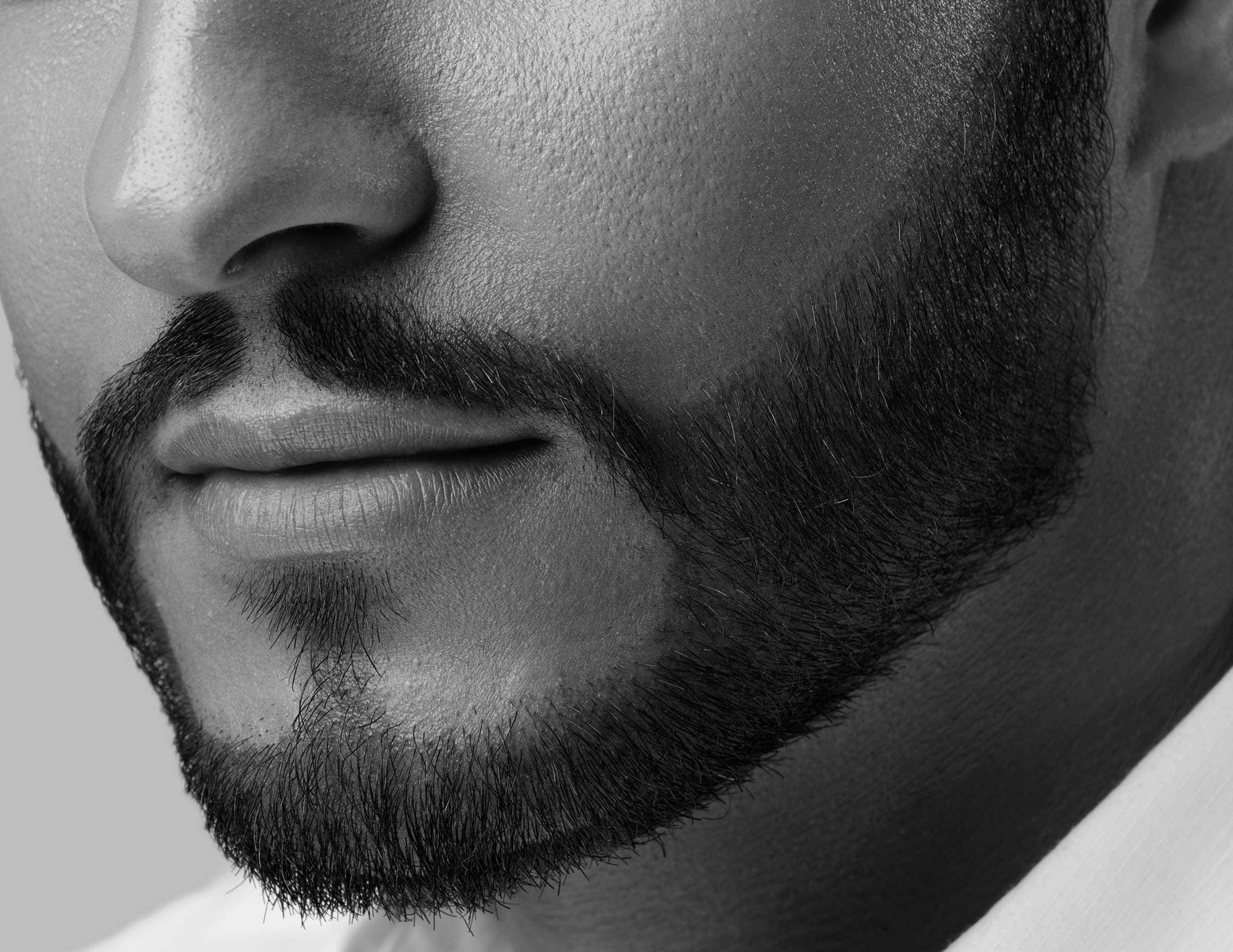
What we do. Draw the design with you, on your face, in a mirror — and photograph it before we begin. And we design conservatively, because adding is straightforward and removing is not.
Ask: « Où exactement placez-vous la ligne de la joue et du cou, et pourquoi là ? »
7. Where we would want more information first
- Active acne in the beard area — treated first, because inflamed skin heals poorly and infection risk rises.
- Pseudofolliculitis barbae — ingrown hairs from shaving, common in curly-haired men — which is not a contraindication and which needs discussion, because the transplanted hair will behave similarly.
- Keloid tendency — and the jaw and neck are sites where hypertrophic scarring occurs.
- Active alopecia areata — see the section on whether you should wait.
- Burn or radiotherapy-damaged skin — where the blood supply is compromised, graft survival is lower and the plan must be conservative. A test session is sometimes appropriate.
- And significant scalp hair loss — see the donor cost.
8. Gender-affirming beard construction
A distinct indication, and one we discuss honestly.
Timing. Testosterone therapy produces beard growth over a period of years — and the final extent is not clear early. Which argues for waiting — typically at least two years on stable therapy, and frequently longer — so that the transplant supplements what has actually grown rather than duplicating it.
What surgery adds. Density where growth has been patchy, and definition where it has not developed. And it works well — the same techniques, the same angles.
The donor question. The donor cost applies, and scalp hair loss on testosterone is a real possibility — which makes reserving donor supply relevant.
What we ask. How long you have been on therapy, whether your levels are stable, and whether your beard growth is still changing. And we work with your prescribing physician’s timeline, rather than around it.
9. Your Canadian options
Not covered. Beard transplantation is available privately in Canada, and cost is the principal difference. And one genuine Canadian route: where low testosterone is the cause, assessment and treatment are covered — and that comes first.
Part two — preparing
10. From first contact to confirmed dates
The online consultation. Send photographs:
- Front, clean-shaven or with the beard trimmed very short — so the actual growth pattern is visible rather than what styling conceals.
- Both profiles.
- Both three-quarter views.
- The chin and under the jaw, from below.
- A close photograph of the patchy areas specifically.
- And the scalp donor area at the back.
Natural daylight, no filters. Plus: your age, how your beard has developed over the last five years, whether you have scalp hair loss and family history of it, any acne or ingrown hair problems, any patches with sharply defined circular borders, keloid history, testosterone therapy if applicable, medications, and whether you smoke.
What you receive. A plan stating the graft number and where they would go, the design proposed, the donor cost and what it leaves for your scalp, whether waiting is advisable, the stay, and the cost. Within 24 to 48 hours.
Questions worth asking before you commit.
- « Si je fais ma barbe maintenant, que me restera-t-il pour mon cuir chevelu ? » — the question most patients do not think to ask.
- « Comment allez-vous reproduire les angles ? »
- « Uniquement des greffons à un cheveu ? »
- « Où exactement placez-vous les lignes ? »
- « Le chirurgien crée-t-il les sites ? »
- « Suis-je trop jeune ? »
What to arrange at home before you travel. Treat any active acne in the beard area. See a physician about testosterone where that applies. Stop smoking — four weeks before and after. Stop alcohol for a week before. And arrange time off — ten to fourteen days, and a beard transplant is conspicuous because it is on your face rather than under hair.
Part three — the stay
11. Your stay in Tunisia
Four to six days.
Day 1 — Arrival. Your driver meets you at the airport and takes you to your hotel with your companion. Nothing clinical today.
Day 2 — Consultation and design. Assessment of your existing beard pattern, and of the scalp donor area. Trichoscopy of the donor zone, and assessment of any scalp hair loss. Examination of the beard area for acne, ingrown hairs or scarring. Blood tests. Then the design conversation — drawn on your face with you, in a mirror, and photographed. With the donor cost stated explicitly.
Day 3 — The procedure. Four to eight hours depending on graft number, under local anaesthesia. Scalp donor area trimmed — and the area used is usually chosen so it is easily concealed. FUE extraction, with finer grafts selected for the moustache and upper cheek. Recipient sites created by the surgeon — at very acute angles, with direction mapped across the face. Single-hair grafts placed. No dressing on the face, generally.
Day 4 — First wash and review. Performed at the clinic and demonstrated — and washing the face requires particular gentleness.
Days 5 to 6 — Review and departure. Final examination, and your documentation: an operative report stating grafts by area of the face, the donor site used, and the technique; written aftercare in French or English, including shaving and trimming guidance; and a letter for your Canadian physician. Then your transfer to the airport.
12. The first two weeks
Appearance. Small crusts at each graft, visible on the face — which is the main practical difference from a scalp transplant. Redness and mild swelling for several days. And crusts falling over seven to ten days. You will look as though you have a rash or a heavy stubble with scabbing — which is conspicuous, and which is why we recommend planning the time.
Sleeping. On your back, avoiding any contact between your face and the pillow for the first nights. A travel pillow helps.
Eating and talking. Normal, though exaggerated facial movement is worth avoiding for the first days.
Washing. Gently, as demonstrated — and not scrubbing the crusts.
What to avoid. No shaving of the transplanted area for the period your surgeon specifies — typically around ten days for careful trimming and longer for a blade. No touching or picking. No strenuous exercise for two weeks — sweating on a fresh graft area is not helpful. No sun for months — the face is exposed, and pigment change is a real consideration in darker skin. And no smoking.
Part four — what follows
13. Shedding and growth
The same biology as a scalp transplant.
| Stage | Timing | What you see |
|---|---|---|
| Shedding | 2 – 6 weeks | Expected and universal, and alarming on the face because it is visible |
| Growth begins | 3 – 4 months | The first new hairs appear across the grafted area |
| Meaningful density | 6 – 8 months | Frequently faster-looking than scalp work, because a beard needs less density to read as full |
| Final result | 12 months | Texture, direction and blending settled |
Judging it. Do not judge before eight months. And photograph monthly, in the same light.
14. Living with a transplanted beard
Trimming. Required, for life. The transplanted hair grows continuously, and it will need trimming to blend with your native beard.
Shaving. Normal once healed — and your surgeon will tell you when. And a transplanted beard can be shaved clean — the follicles are permanent and regrow.
Ingrown hairs. Possible, particularly in curly hair — and the transplanted hair can behave the same way your native beard does. Where you have pseudofolliculitis barbae, that consideration continues.
If you want a second session. Adding density to a transplanted beard is straightforward — and it is common, because the first session is frequently deliberately conservative. Typically at eight to twelve months, once the first result is assessable. And it draws on the same donor supply.
If you want it removed. Difficult. Laser or electrolysis over many sessions — and laser is less effective on light or grey hair. Which is why conservative design matters.
15. Your Canadian follow-up
Little is required medically, though arrange a physician who will see you if needed.
What warrants attention. Increasing redness, pus or fever — infection, uncommon. Folliculitis, common at three to five months and usually settling. A graft area that becomes lumpy or raised — and where you have a keloid tendency, early treatment matters. And ingrown hairs that become inflamed. Take your operative report.
Canadian coverage. Not covered. Treatment of any complication is covered.
Part five — practical matters
16. Canadian patients: travelling to Tunisia from your region
Aylan Clinic works with patients from every province and territory in Canada.
Montreal and the surrounding region. Montreal is our largest Canadian source for Tunisia, with connections through Paris, Frankfurt or Istanbul. Patients from Laval, Longueuil and Brossard are within easy reach of the airport.
Quebec City and across the province. From Quebec City and the Capitale-Nationale region including Lévis, most patients connect through Montreal — as do patients from Trois-Rivières, Sherbrooke, Drummondville and Saint-Jérôme. Gatineau patients depart from Ottawa or drive to Montreal.
On this page the francophone advantage is at the design conversation. You are deciding exactly where the line on your cheek and your neck will sit, permanently — and describing the beard you want requires precision. Patients consistently tell us they described what they wanted more exactly in their own language — and on a design that cannot easily be undone, that matters.
Acadia and New Brunswick. We work with patients from Moncton, Fredericton and Saint John. Moncton and the surrounding Acadian communities are served in French throughout.
Francophone Ontario. Sudbury, Thunder Bay and Sault Ste. Marie all have substantial francophone populations, served in French from first contact onward. Ottawa patients typically connect through Montreal.
Greater Toronto Area and southern Ontario. Toronto patients connect through European hubs. Across the wider Greater Toronto Area: Mississauga, Brampton, Markham, Vaughan, Richmond Hill and Oshawa. Along the lake: Hamilton, Burlington, Oakville, St. Catharines and Niagara Falls. In southwestern Ontario: London, the Waterloo region — Kitchener, Waterloo and Cambridge — plus Guelph, Windsor and Barrie. Kingston patients generally drive to Toronto or Montreal.
Vancouver and British Columbia. Vancouver patients face the longest journey — typically two connections. And a practical point specific to beard work: you travel home with visible crusting on your face, which is more conspicuous than a scalp procedure under a hood. We frequently recommend extending by a day or two, so the worst of it has settled. Across the Lower Mainland: Surrey, Burnaby and Richmond. From Victoria and Nanaimo, ferry or short flight. Kelowna, Abbotsford and Kamloops connect through Vancouver or Calgary.
Alberta. Calgary and Edmonton both offer European connections. Red Deer and Lethbridge patients generally drive to Calgary. And high-altitude sun matters — the face is exposed, and sun protection is part of the aftercare.
Manitoba and Saskatchewan. Winnipeg patients connect through Toronto or Montreal. Saint-Boniface is served in French. From Saskatoon and Regina, a domestic connection plus two further flights. Cold dry air on a freshly grafted face is uncomfortable — a loose scarf, not touching the grafts.
Atlantic Canada. Halifax routes through Montreal or Toronto. From Charlottetown and St. John’s, two or three connections.
Northern Canada. We work with patients from Whitehorse in Yukon, and from communities across the Northwest Territories and Nunavut. Two points. Visibility — a beard transplant is on your face and cannot be covered. In a small community that is noticed, and timing the trip is worth considering. And cold — a scarf that does not touch the grafts is the practical answer for the first weeks. We plan the full stay plus buffer.
How we handle the logistics. Your coordinator arranges transfers, confirms your hotel, and builds your schedule around your arrival time.
Five recommendations. Photograph yourself clean-shaven or very short. Ask what the donor cost leaves for your scalp. Ask exactly where the lines will sit. Plan for visible crusting for ten days. And if you are under twenty-five, ask whether to wait.
17. What your package includes
- Free consultation in French or English, with an honest statement of the donor cost
- Assessment of your existing beard pattern and of any condition requiring treatment first
- Trichoscopic assessment of the scalp donor area, and assessment of any scalp hair loss
- Blood tests where indicated
- A design drawn on your face with you, in a mirror, and photographed before surgery
- FUE extraction from a concealable scalp donor site, with graft selection matched to facial region
- Recipient sites created by the surgeon at acute beard angles, with direction mapped across the face
- Single-hair grafts
- The first wash performed at the clinic and demonstrated
- Medication and aftercare supplies
- Review appointments across the stay
- Operative report stating grafts by facial area, the donor site used, and the technique
- Written aftercare in French or English, including shaving and trimming guidance and sun protection
- A letter for your Canadian physician
- Continued contact in French or English through the growth period
- Hotel accommodation, full board
- A companion at no extra cost, accommodated and fed in the same room
- Airport–clinic–hotel transfers
- A personal coordinator from arrival to departure
- French-speaking care throughout, with English available on request
The clinical team. A surgeon experienced in facial hair restoration, frequently French-trained; an experienced technical team working under supervision; and a dedicated nurse.
18. Results by patient profile
Patchy cheeks filled. A patient of thirty-one with good growth along the jaw and persistent patches on both cheeks. A modest graft number, single hairs, angled to match the surrounding growth. At ten months the patches are indistinguishable — and the modest donor cost left his scalp supply largely intact.
Where we raised the order question. A patient of twenty-seven wanting a full beard construction, with early temporal recession and a father at Norwood 6. We set out the arithmetic and explained that a large beard session would spend supply his scalp would demand. He chose a smaller beard session and started finasteride. That conversation is the one most beard patients do not get.
Where we said wait. A patient of twenty with a patchy beard. We explained that beard growth develops into the mid-twenties, and that a transplant now would spend grafts on hair that may arrive anyway. He did not proceed.
Alopecia areata identified. A patient with two sharply defined circular patches in his beard. That pattern is alopecia areata until proven otherwise — and it frequently recovers. We recommended he see a physician rather than have surgery.
A scar covered. A patient with a scar along the jaw from an injury. Grafts placed into and around it, at matched angles. One of the more satisfying indications, and the result conceals it well.
Gender-affirming construction. A patient three years into stable testosterone therapy, with growth that had plateaued. A full construction supplementing what had grown. Waiting until the growth had settled is what made the plan accurate.
A patient from Montréal. A patient who chose Tunisia for the design conversation. His comment was about the permanence: « On m’a dessiné la ligne sur le visage, on l’a photographiée, et on m’a expliqué qu’elle serait définitive. J’ai demandé qu’elle soit plus discrète que ce que je pensais vouloir. »
19. Practical points to know
What to expect. A design drawn on your face and agreed before surgery. A four to eight hour procedure under local anaesthesia. Visible crusting on your face for seven to ten days. Shedding at two to six weeks, which is conspicuous. Growth from three to four months, and a result at eight to twelve. And lifelong trimming.
Recognised points. The general considerations are those in our main hair transplant guide and our FUE guide. Beard-specific: incorrect angles, producing hair that stands away from the skin — the commonest aesthetic failure and difficult to correct; an unnatural or too-high cheek line, which is permanent; a tufted appearance from multi-hair grafts; texture or colour mismatch with native beard hair; ingrown hairs, particularly in curly hair; folliculitis, common and usually settling; keloid or hypertrophic scarring at the jaw or neck in susceptible patients; cysts; numbness of the face, usually temporary; and donor depletion from a large session.
Three things within your control. Considering the donor order before you commit. Designing conservatively. And not touching the crusts.
Who this suits. Adults over about twenty-five with settled beard growth, adequate scalp donor supply, no active condition in the beard area, and realistic expectations about texture and trimming.
Who should wait. Under twenty-five with developing growth. Untreated low testosterone. Active alopecia areata or acne. And men with significant progressive scalp loss — who should at least have the order conversation.
20. Price: how it is built and how to compare it
What determines your price. The number of grafts — and beard work ranges widely, from a few hundred to a couple of thousand. The areas treated. And the length of stay. Itemised, and fixed once you approve it.
What is included. Everything listed under what your package includes. A companion is accommodated and fed at no additional cost.

What sits outside it. Flights, travel insurance, and any second session — which is common at eight to twelve months.
How to compare quotes properly. Four checks.
| Check | Why it matters |
|---|---|
| Has the clinic discussed what this costs your scalp? | A clinic that quotes a large beard session to a man with progressive hair loss, without that conversation, is not planning his lifetime. |
| Are single-hair grafts used throughout? | Multi-hair grafts in a beard produce a tufted look. |
| How are the angles and directions planned, and who creates the sites? | The angle is the whole operation. |
| Is the design drawn and agreed before surgery? | Because it is permanent. |
Why the lowest quote is a concern here. Because the two failure modes are invisible in a price. Wrong angles, which read as artificial immediately and are difficult to correct. And a line placed where you did not intend, which is permanent and removable only by laser or electrolysis over many sessions. Both are design and technique, not cost.
Canadian coverage. Not covered. Treatment of any complication is covered — and assessment of low testosterone is covered, which may come first.
Getting your assessment. Send photographs clean-shaven or very short, from all angles including the chin from below and close views of the patches, plus the scalp donor area. And tell us about your scalp hair loss and family history. A plan and quote follow within 24 to 48 hours, in French or English — including where waiting or addressing your scalp first would serve you better.
21. Glossary
| Term | Meaning |
|---|---|
| Single-hair graft | The unit used almost exclusively in beard work |
| Angle | The near-flat emergence of beard hair; the defining technical requirement |
| Direction mapping | Planning which way hair points across the face |
| Cheek line | The upper border of the beard; permanent once grafted |
| Pseudofolliculitis barbae | Ingrown hairs from shaving, common in curly hair |
| Alopecia areata | Patchy autoimmune loss; sharply defined circular borders |
| Donor cost | The scalp supply consumed by beard work |
| Shock loss | Temporary shedding; visible on the face |
22. How Canadians search for this
- “Beard transplant Tunisia cost” — the most common search.
- “Greffe de barbe Tunisie” — how most Quebec patients search.
- “Where do beard transplant grafts come from” — your scalp donor area, the same finite supply a hair transplant would use.
- “Beard transplant angle” — beard hair grows almost flat, and grafts at scalp angles stick out and read as wrong immediately.
- “Does a beard transplant need trimming” — yes, for life. It is scalp hair and it grows continuously.
- “Beard transplant at 20” — frequently too early; beard growth develops into the mid-twenties.
- “Patchy beard alopecia areata” — sharply defined circular patches are alopecia areata until proven otherwise, and they frequently recover. See a physician.
- “Can you shave a transplanted beard” — yes, once healed; the follicles are permanent.
- “Beard transplant removal” — difficult; laser or electrolysis over many sessions, which is why conservative design matters.
- “Beard transplant texture different” — scalp hair is generally finer and straighter, and it may age and grey differently.
- “Beard transplant scar coverage” — one of the more satisfying indications.
- “Beard transplant FTM” — wait until testosterone-driven growth has settled, typically at least two years.
- “French speaking hair surgeon abroad” — Tunisia’s distinguishing feature.
In summary
Two things govern this operation. The grafts come from your scalp — the same finite supply a future hair transplant would use — which means a man with progressive hair loss has an order to decide. His hair loss will demand grafts over decades; his beard will not change. That conversation is the one most beard patients never get, and we have it directly.
And the angle is the whole operation. Beard hair emerges almost flat against the skin, at directions that change across the face — and grafts placed at scalp angles stick out and read as artificial immediately, before any question of density. Single-hair grafts, acute angles, and direction mapped across the face are what make it look real.
The design is also permanent in a way a hairline is not. A cheek line placed too high grows there for good — and removal means laser or electrolysis over many sessions — which is why we draw it on your face, agree it, photograph it, and design conservatively. And the transplanted hair keeps its scalp characteristics: it grows continuously and needs trimming for life.
At Aylan Clinic Tunisia that means the donor cost stated explicitly, a design drawn with you and photographed before we begin, single-hair grafts at beard angles created by the surgeon, and a willingness to say you are too young or that your scalp should come first. It takes place in a French-speaking country, which matters when the design is permanent and the description has to be precise. With accommodation, full board and a companion at no extra cost, for up to 60% less than Canadian private prices.
Five things to hold onto.
- Ask what this costs your scalp. Beard grafts come from the same finite donor supply — and if your hair loss is progressive, the order matters.
- The angles are the operation. Beard hair grows almost flat — ask how the directions will be mapped and who creates the sites.
- The design is permanent. A cheek line placed too high stays there, and removal means laser or electrolysis over many sessions. Conservative is safer.
- It is scalp hair. It grows continuously and needs trimming for life, and it may differ in texture and grey at a different rate.
- If you are under twenty-five, ask whether to wait. Beard growth develops into the mid-twenties, and grafts spent now cannot be recovered.
Send your photographs, clean-shaven, and you will have an honest answer within 24 to 48 hours — including where waiting or treating your scalp first would serve you better.
When you are ready to move from research to a real plan, read our dedicated Beard And Moustache Grafting in Tunisia page for the procedure itself, explore the wider hair transplant in Tunisia section, compare plastic surgery prices in Tunisia, or request a free, personalized quote.