
Can a mommy makeover be done in Tunisia? Yes — and the two honest questions are how much can safely be combined, and who is looking after your children for six weeks. A mommy makeover at Aylan Clinic Tunisia combines abdominal and breast surgery, frequently with liposuction, in one operation, over a stay of twelve to fourteen days, for up to 60% less than Canadian private prices. There is a limit to what can safely be combined, and it is lower than most packages suggest. You cannot lift your children for six weeks. And the abdominal component is not reversible by a future pregnancy.
This guide is the pedagogical companion to our procedure page on Post Pregnancy Body Makeover in Tunisia, which sets out how the operation itself is run, what the stay involves and how aftercare is organised. Here we explain the decisions behind it: what the term actually covers, what we would combine and what we would refuse, when to operate, and what the recovery looks like when there are small children at home. Costs are itemised alongside every other procedure on our plastic surgery prices in Tunisia page, and the whole family of body procedures sits inside our body contouring in Tunisia overview.
Three things before you read further. Operating time is itself a risk factor, and the combination that produces a convenient single trip is not always the one that produces a safe operation — section 2. For the patients this operation is named after, the six-week lifting restriction is the defining practical problem, and it requires planning rather than optimism — section 11. And pregnancy separates a repaired diastasis and stretches the skin, which makes “have you finished?” the question that decides the timing — section 3.
Our abdominoplasty guide covers the abdominal component in full, and our breast surgery pages cover the breast component. This page is about combining them.
One thing distinguishes Tunisia: it is a French-speaking country. Not a clinic with French-speaking staff — a country where French is a working language across medicine and daily life.
Part one — Deciding
1. What the term covers
The usual components. Abdominoplasty — with rectus diastasis repair, which is the part that addresses the change pregnancy actually made. Breast surgery — a lift, an augmentation, a reduction, or a lift with implants — depending on what happened to your breasts (section 5). And liposuction — flanks, and frequently more.
Sometimes added. Mons pubis surgery, which is frequently a genuine complaint and frequently unmentioned, and we ask about it. Labiaplasty or vaginal procedures — see our intimate surgery in Tunisia pages; these are separate decisions rather than a package item. And other areas, which is where the combination limit in section 2 applies.
What the term is. A marketing description of a combination, not a defined operation. Which means what is included varies by clinic — and comparing packages requires knowing what is in each.
And one thing we would say about the name. It describes a group of patients rather than a procedure. A number of the women who have it have not had children — the same combination addresses weight change, ageing and genetics. We use the term because it is what patients search for, and the assessment is individual either way.
2. The combination limit
The safety section, and the one that shapes everything else.
Why operating time matters. Venous thromboembolism risk rises with operating time, and abdominoplasty already carries one of the higher risks in cosmetic surgery. Blood loss accumulates. Fluid shifts accumulate. Anaesthetic time accumulates. And surgical precision declines over a very long operation, which is a real factor.
| Position | What it covers |
|---|---|
| What we would combine | Abdominoplasty with breast surgery — the core combination, and a reasonable one. With liposuction of the flanks. And with a mons procedure, which adds little time. |
| What we would assess carefully | Abdominoplasty with breast surgery and extensive liposuction of multiple areas. Adding a significant secondary procedure. And any combination in a patient with elevated thromboembolic risk — raised body mass index, previous clot, hormonal contraception, or a clotting disorder. |
| What we would decline | A list producing an operation of many hours. And a combination that looks efficient for a single trip and is not defensible clinically. |
| What we do instead | Propose a sequence — two operations rather than one, three to six months apart. Which means two trips. And that is the honest answer rather than an inconvenient one. |
Ask: « Que refuseriez-vous de combiner dans mon cas, et pourquoi ? » A surgeon who names something is exercising judgement. A clinic whose package includes everything is selling convenience.
3. Timing: have you finished?
Asked directly, because the answer decides whether to operate.
What pregnancy does to the abdominal repair. A repaired diastasis can separate again. And the skin stretches again. Which makes an abdominoplasty before a further pregnancy an operation that frequently has to be repeated.
What pregnancy does to the breast. Breast shape changes with each pregnancy and with breastfeeding — and a lift or an augmentation performed beforehand will change. Implants do not prevent it.
Our recommendation. Wait until you have finished. And where you are uncertain, treat that uncertainty as an answer — because the operation will still be available.
It is not a contraindication to conceiving. Pregnancy after these operations is safe. What suffers is the result. And some patients choose to proceed knowing that, which is a legitimate decision made informed.
How long after a birth. Six to twelve months minimum — and longer where you are breastfeeding. Breastfeeding should have finished for at least three to six months before breast surgery, so that the breast has settled to its final volume and shape. And weight should be stable.
4. The abdominal component
Our abdominoplasty guide covers it in full. The points specific to this group:
Diastasis is the usual finding. And it is the part that addresses what pregnancy actually did. The muscles separated; the tissue between them stretched. No amount of exercise corrects it, and liposuction makes it more visible. Which is why a patient told her abdomen is “just fat” after two pregnancies is frequently being told the wrong thing.
The functional element. Diastasis is associated with back pain, poor core function and in some patients urinary symptoms — and repair frequently improves them. Which is worth mentioning to your Canadian physician, because it changes how the operation is understood.
The scar. Permanent, hip to hip, and marked on the underwear you actually wear.
Caesarean scars. Frequently incorporated into the new incision, which is a genuine advantage. And they can affect the blood supply of the flap, which is assessed.
5. The breast component
What happened, and what addresses it.
What pregnancy and breastfeeding do. The breast enlarges, then deflates. The skin envelope stays stretched. Which produces a breast that has lost upper fullness and sits lower — the combination patients describe as “empty.”
| Operation | What it does |
|---|---|
| A lift — mastopexy | Repositions the breast and the nipple, and tightens the envelope. It does not add volume. |
| An augmentation | Adds volume. It does not lift, and in a descended breast an implant alone frequently makes it look larger and still low. |
| A lift with implants | Volume and position together — which is what a majority of post-pregnancy patients actually need. A more complex operation than either alone, with a higher revision rate. |
| A reduction | Where the breast remained large. |
| Fat transfer | An alternative to implants in selected patients. |
Which you need. Determined by where your nipple sits relative to the fold beneath the breast — and by how much volume you want. We assess it and explain.
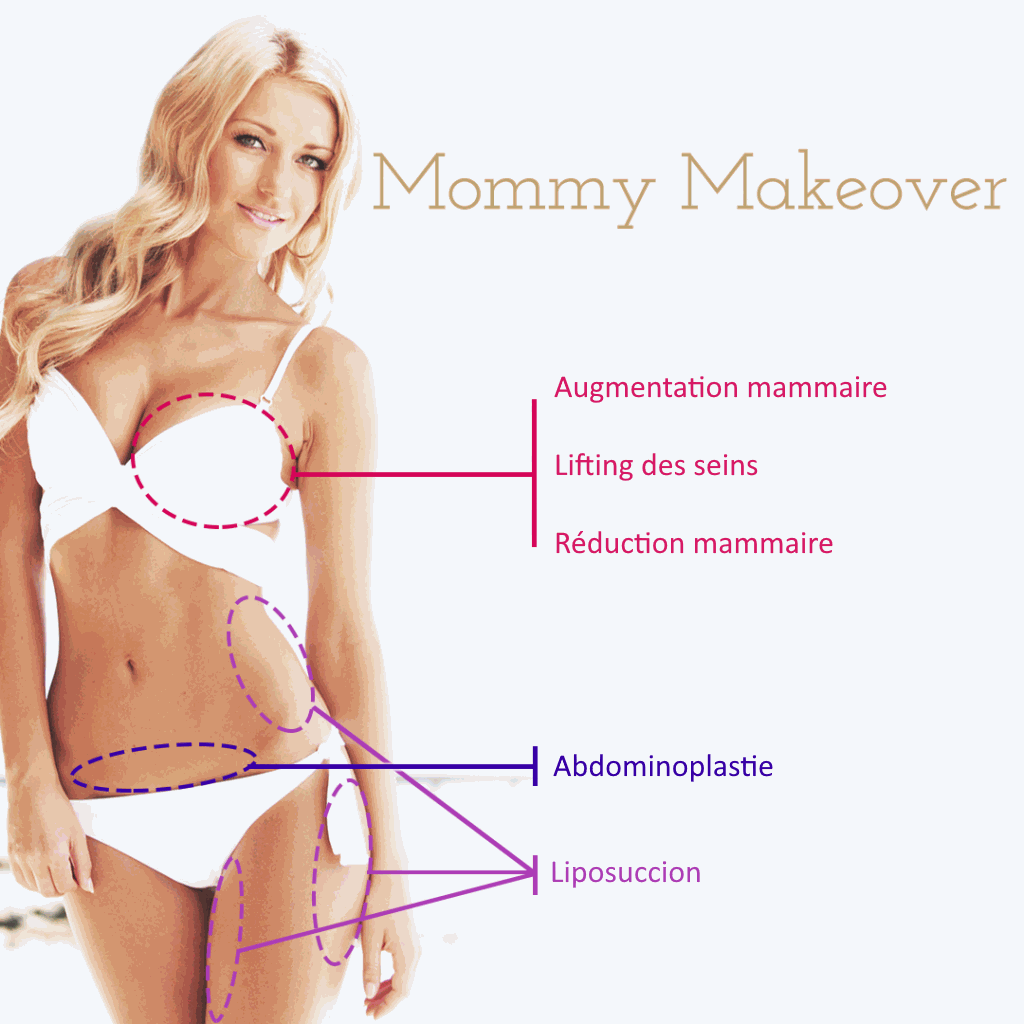
The honest point about lift with implants. Combining them is a well-established operation and it carries a higher revision rate than either alone — because two opposing forces are being balanced. Worth knowing beforehand.
6. The liposuction component
See our liposuction in Tunisia guide. Usually the flanks, which the abdominoplasty does not address and which shows when the front is flattened. Frequently a 360 approach. And the skin quality question applies, because liposuction in an area with poor elasticity produces looser skin, not less. Volume limits apply, and they interact with the combination limit in section 2.
7. Who should wait
- Further pregnancy planned or possible — section 3.
- Breastfeeding, or within three to six months of stopping.
- Within six to twelve months of a birth.
- Unstable weight, or planned weight loss.
- Smoking — four weeks before and after, and we defer, because skin necrosis is the commonest serious wound complication of abdominoplasty.
- Uncorrected anaemia — common after pregnancy, and relevant to a long operation.
- Inadequate help at home — section 11. Which is a genuine reason to defer rather than a soft one.
- And elevated thromboembolic risk without careful assessment.
8. Your Canadian options
Not covered as a cosmetic package. Three parts are worth pursuing separately.
Panniculectomy — covered in some provinces on strict functional criteria, and it is a different and lesser operation. Breast reduction — covered in some provinces on symptomatic criteria: shoulder grooving, neck and back pain, rashes beneath the breast. Worth asking about specifically, because a patient whose breasts remained large after pregnancy may qualify. Hernia repair, covered where one exists. And diastasis repair alone is generally not covered, though where it coexists with a hernia the position can differ — worth asking.
Part two — Preparing and the stay
9. From first contact to confirmed dates
The online consultation. Send photographs. Front, standing, in close-fitting underwear, arms at your sides. Both sides. The abdomen relaxed and tensed — which shows diastasis. A side view with the skin lifted. Breasts, front and both sides, arms down — and a view with arms raised. And a photograph in the underwear or swimwear you intend to wear, for scar planning. Natural daylight, no filters, unposed.
Plus: your age, height and weight and stability, number of pregnancies and deliveries, caesarean or vaginal, whether you breastfed and when you stopped, whether you have finished having children (section 3), your weight history, previous surgery, any hernia, whether you have back pain or urinary symptoms, whether you smoke, medications including hormonal contraception, any clot history, and who is available to help you at home (section 11).
What you receive. A plan stating which components are appropriate, which we would combine and which we would stage (section 2), the breast operation recommended and why (section 5), whether to defer (section 3), where the scar will sit, the stay, and the cost. Within 24 to 48 hours.
Questions worth asking before you commit.
- « Que refuseriez-vous de combiner ? » — section 2, and the question that identifies judgement.
- « Combien d’heures durera l’intervention ? »
- « Ai-je besoin d’un lifting, d’implants, ou des deux ? » — section 5.
- « Le diastasis sera-t-il réparé sur toute la longueur ? » — section 4.
- « Combien de nuits d’hospitalisation ? »
- « Qui va s’occuper de mes enfants pendant six semaines ? » — a question to ask yourself, section 11.
What to arrange at home before you travel. Stop smoking — four weeks. Check your haemoglobin and ferritin, and correct them, because a long combined operation in an anaemic patient is a different proposition. Discuss hormonal contraception with your physician. Arrange childcare for six weeks (section 11) and arrange it properly rather than assuming. Prepare your home — a recliner, things at waist height, and food prepared in advance. And arrange time off — six weeks minimum.
10. Your stay in Tunisia
Twelve to fourteen days, given the combination.
Day 1 — Arrival. Your driver meets you at the airport and takes you to your hotel with your companion. Nothing clinical today.
Day 2 — Consultation and marking. Standing examination of the abdomen and breasts. Examination for diastasis and hernia. Assessment of caesarean scars. Breast assessment — nipple position, envelope, volume and asymmetry, which is present in almost everyone and documented before. Scar planning with your own underwear. Blood tests, weight, anaesthetic assessment — and the assessment matters here given the combined operating time. Then the planning conversation, including what is being staged if anything.
Day 3 — Surgery. Four to six hours for the usual combination. Markings made standing. The breast component, then the abdominal, or the reverse — sequenced to manage positioning. Diastasis repair from ribs to pubis. Navel repositioning. Liposuction of the flanks. Drains or progressive tension sutures — see our drainless abdominoplasty page. And garments applied. Two to three nights in hospital, with monitoring.
Days 4 to 13 — Recovery and review. Walking bent at the hips for the first days. Both areas sore, and moving involves both. Drains managed. Daily review. And garments continuously.
Day 14 — Final review and departure. Final examination, and your documentation: an operative report stating each procedure performed, the diastasis repair, any hernia repair, the breast technique and any implant details with lot numbers, the liposuction volumes, and drain management. An implant card where applicable. Written aftercare in French or English. And a letter for your Canadian physician. Then your transfer to the airport.
Part three — Recovery
11. Six weeks without lifting your children
The defining practical problem, and it needs planning rather than optimism.
The restriction. Nothing above a few kilograms for six weeks — because the diastasis repair must hold, and because the breast closure is under tension. Which means no lifting your children. At all. For six weeks.
What that actually means. A toddler cannot be picked up. A baby cannot be lifted from a cot. A child cannot be carried to bed. A car seat cannot be lifted. And a child who runs to be picked up will need someone else to do it.
The practical workarounds. Teach an older child to climb onto a chair and then onto your lap — set up beforehand rather than improvised. A cot with a drop side, or a mattress on the floor. A car seat left in the car with the child climbing in. Someone else doing bath time. And accepting help, which patients find harder than they expect.
What we ask. Who is doing this for six weeks? And where the answer is uncertain, we would say that is a reason to defer — because a patient who lifts her child at week two risks the repair, and frequently does it without thinking.
The emotional part. Patients describe the inability to pick up a small child as harder than the pain. And a young child may not understand. Which is worth preparing for, and worth mentioning to them beforehand in a way they can grasp.
12. The combined recovery
Both areas at once, which is different from either alone.
The abdomen. Walking bent, deep cramping pain from the repair, and no standing upright for the first days.
The breasts. Soreness and tightness, and restricted arm movement where implants or a lift were performed.
Together. You cannot use your abdomen to sit up. And you cannot use your arms to push up either. Which means getting out of bed requires a technique — rolling to the side, and being helped in the first days. This is the practical difference from either operation alone, and it is why help at home matters more.
Sleeping. Semi-reclined with knees bent — which suits both. A recliner is better than a bed.
Garments. An abdominal binder and a surgical bra, both continuously.
13. Complications
Those of each procedure, with these of particular relevance to a combination:
- Venous thromboembolism — elevated by the operating time, section 2. The most serious.
- Seroma — abdominal, common.
- Skin necrosis — strongly associated with smoking.
- Wound separation.
- Infection — and where implants are used, an infected implant frequently requires removal.
- Haematoma, breast particularly.
- Altered nipple sensation — common, and sometimes permanent.
- Asymmetry, breast particularly.
- Capsular contracture, where implants are used.
- Recurrence of diastasis with a further pregnancy — section 3.
- And a higher revision rate where a lift and implants were combined — section 5.
14. Breastfeeding afterwards
Asked frequently and worth answering. A breast lift or augmentation can affect the ability to breastfeed — and the risk depends on the technique and on how the nipple and ducts are handled. Many women breastfeed successfully afterwards. Some cannot. And it is not predictable in an individual case. Which means: where future breastfeeding matters to you, that is a reason to defer the breast component — and a reason to discuss technique specifically. The abdominal component does not affect breastfeeding.

15. Your Canadian follow-up
Arrange a physician before you travel.
What warrants urgent attention. Calf pain or breathlessness — and the combined operation raises this risk; go to an emergency department. Spreading redness, discharge or fever — and where an implant is present, promptly. Sudden breast swelling or asymmetry — haematoma. Darkening at the centre of the abdominal incision.
What warrants a routine appointment. A soft abdominal swelling — seroma. A wound not healing. And a scar becoming raised.
Keep your implant card where applicable.
Canadian coverage. Not covered, with the exceptions in section 8. Treatment of any complication is covered.
Part four — Practical matters
16. Canadian patients: travelling to Tunisia from your region
Aylan Clinic works with patients from every province and territory in Canada. And the childcare question in section 11 shapes this more than the travel does.
Montreal and the surrounding region. Montreal is our largest Canadian source for Tunisia, with connections through Paris, Frankfurt or Istanbul. Patients from Laval, Longueuil and Brossard are within easy reach of the airport. And two weeks away from small children is itself the constraint for many patients — which is worth planning around as much as the flights.
Quebec City and across the province. From Quebec City and the Capitale-Nationale region including Lévis, most patients connect through Montreal — as do patients from Trois-Rivières, Sherbrooke, Drummondville and Saint-Jérôme. Gatineau patients depart from Ottawa or drive to Montreal.
On this operation the francophone advantage is at two conversations: what we would refuse to combine, and why a longer operation is not better value; and whether you have finished having children, which is a personal question asked directly and which changes the recommendation. Patients consistently tell us they answered both more fully in their own language — and that one of them deferred by two years as a result.
Acadia and New Brunswick. We work with patients from Moncton, Fredericton and Saint John. Moncton and the surrounding Acadian communities are served in French throughout.
Francophone Ontario. Sudbury, Thunder Bay and Sault Ste. Marie all have substantial francophone populations, served in French from first contact onward. Ottawa patients typically connect through Montreal.
Greater Toronto Area and southern Ontario. Toronto patients connect through European hubs. Across the wider Greater Toronto Area: Mississauga, Brampton, Markham, Vaughan, Richmond Hill and Oshawa. Along the lake: Hamilton, Burlington, Oakville, St. Catharines and Niagara Falls. In southwestern Ontario: London, the Waterloo region — Kitchener, Waterloo and Cambridge — plus Guelph, Windsor and Barrie. Kingston patients generally drive to Toronto or Montreal.
Vancouver and British Columbia. Vancouver patients face the longest journey — typically two connections. And the combined operation raises the thromboembolic risk that the flight compounds. What we require: compression stockings throughout, an aisle seat, standing and walking every hour, ankle exercises, and hydration. And we recommend extending the stay by three or four days. A practical point: sitting upright after a muscle repair is uncomfortable — a cushion behind the lower back helps. Across the Lower Mainland: Surrey, Burnaby and Richmond. From Victoria and Nanaimo, ferry or short flight. Kelowna, Abbotsford and Kamloops connect through Vancouver or Calgary.
Alberta. Calgary and Edmonton both offer European connections. Red Deer and Lethbridge patients generally drive to Calgary.
Manitoba and Saskatchewan. Winnipeg patients connect through Toronto or Montreal. Saint-Boniface is served in French. From Saskatoon and Regina, a domestic connection plus two further flights.
Atlantic Canada. Halifax routes through Montreal or Toronto. From Charlottetown and St. John’s, two or three connections.
Northern Canada. We work with patients from Whitehorse in Yukon, and from communities across the Northwest Territories and Nunavut. Two points: childcare across six weeks in a small community, which some patients manage well and which needs establishing honestly; and wound assessment access, because seromas and wound problems present after you return.
How we handle the logistics. Your coordinator arranges transfers, confirms your hotel, and builds your schedule around your arrival time.
Five recommendations. Send the tensed abdominal photograph. Bring your own underwear for the scar marking. Ask what would be refused from the combination. Arrange six weeks of childcare properly. And stop smoking four weeks before.
17. What your package includes
- Free consultation in French or English, with a stated position on what we would combine and what we would stage — section 2
- Full on-site assessment: abdominal examination for diastasis and hernia, caesarean scar assessment, breast assessment including nipple position, envelope and asymmetry, and scar planning with your own underwear
- Blood tests, weight, anaesthetic assessment
- Abdominoplasty with diastasis repair from ribs to pubis, navel repositioning and hernia repair where found
- The breast procedure appropriate to your anatomy — section 5
- Liposuction of the flanks where planned
- Drains or progressive tension sutures, per your case
- Thromboembolic risk assessment, compression and prophylaxis — which matters more in a combined operation
- Two to three nights in hospital with monitoring
- Abdominal binder and surgical bra
- Medication and aftercare supplies
- Daily review across the stay
- Operative report stating each procedure, the diastasis repair, the breast technique, any implant details with lot numbers, and liposuction volumes
- An implant card where applicable
- Written aftercare in French or English, including the lifting restriction, garment schedules, scar care, activity timeline and flight precautions
- A letter for your Canadian physician
- Continued contact in French or English after you return
- Hotel accommodation, full board
- A companion at no extra cost, accommodated and fed in the same room
- Airport–clinic–hotel transfers
- A personal coordinator from arrival to departure
- French-speaking care throughout, with English available on request
18. Results by patient profile
The standard combination. A patient of thirty-seven, two pregnancies, finished, weight stable, with diastasis and deflated breasts. Abdominoplasty with repair, a lift with small implants, and flank liposuction. Five hours, two nights in hospital. At a year her contour and her back pain had both improved — and the diastasis repair contributed to the second.
Where we staged it. A patient wanting the abdomen, breasts, arms and extensive liposuction. The combination would have produced an operation of many hours (section 2). We proposed two trips. She had the abdomen and breasts first, and the arms five months later.
Where we deferred. A patient of thirty-two uncertain whether she had finished having children. We treated the uncertainty as an answer (section 3). She has since had a third child, and will have the surgery afterwards.
Where childcare was the obstacle. A patient with a two-year-old and no help available for six weeks. We explained that she would lift him without thinking (section 11) and that the repair would suffer. She deferred until her mother could stay. Which was the right decision, and which she made herself once the constraint was explained.
Where a lift alone was the answer. A patient who had asked for implants. Her volume was adequate; her position was not (section 5). An implant alone would have made her breasts larger and still low. A lift, and she was satisfied.
A patient from Québec. A patient who had been offered a package including everything at another clinic. Her comment was about the refusal: « Ailleurs on m’a proposé tout en une seule opération de huit heures. Ici on m’a dit non et on m’a expliqué pourquoi. J’ai fait deux voyages. »
19. Practical points to know
What to expect. A four to six hour operation. Two to three nights in hospital. Both areas sore, and neither available to help you move. Six weeks without lifting your children. A permanent abdominal scar and breast scars. And a settled result at six to twelve months.
Recognised points. Section 13, and the full lists in our abdominoplasty and breast guides.
Three things within your control. Stopping smoking. Arranging six weeks of childcare properly. And not asking for a longer operation than is safe.
Who this suits. Finished having children, weight stable, non-smoking, with genuine skin excess and diastasis, realistic about the scars, and with six weeks of help arranged.
Who should wait. Further pregnancy possible. Breastfeeding or recently stopped. Within a year of a birth. Ongoing smoking. And inadequate help at home — which is a genuine reason.
20. Price: how it is built and how to compare it
What determines your price. Which components are included. The breast operation, and whether implants are used. The liposuction areas. The nights in hospital. And the length of stay. Itemised by component, and fixed once you approve it. Our plastic surgery prices in Tunisia page sets out the reference ranges.

What is included. Everything in section 17. A companion is accommodated and fed at no additional cost.
What sits outside it. Flights, travel insurance, a second set of garments, silicone scar products, and any revision — which is more likely where a lift and implants were combined.
How to compare quotes properly — five checks.
- What exactly is in the package? Section 1 — “mommy makeover” is not a defined operation, and packages differ.
- Is the diastasis repair included, over what length? A quote that does not specify it may be for skin removal alone.
- How long will the operation take, and what would the clinic refuse to combine? Section 2.
- Which breast operation, and why? Section 5 — an implant in a descended breast is the commonest mismatch.
- And how many nights in hospital?
Why the longest package is the concern here. Because in this operation the temptation is the opposite of cutting corners. A patient travelling wants everything done, and a clinic that agrees produces a very long operation — and operating time is the risk factor that matters most in a combination. The clinic that says no to part of your list is the one exercising judgement.
21. Glossary
| Term | Meaning |
|---|---|
| Mommy makeover | A marketing term for a combination, not a defined operation |
| Rectus diastasis | Separation of the abdominal muscles; what pregnancy actually did |
| Mastopexy | A breast lift; repositions without adding volume |
| Augmentation mastopexy | Lift with implants; higher revision rate than either alone |
| Panniculectomy | Apron removal; covered in some provinces on strict criteria |
| Progressive tension sutures | The drainless abdominal technique |
| Operating time | The risk factor that governs how much can be combined |
22. How Canadians search for this
- “Mommy makeover Tunisia cost” — the most common search. Ask what is in the package.
- “Mommy makeover Tunisie” — how most Quebec patients search.
- “What is included in a mommy makeover” — it varies by clinic; it is a marketing term rather than a defined operation.
- “How long does a mommy makeover take” — four to six hours for the usual combination, and operating time is the risk factor that limits how much can be added. Section 2.
- “Mommy makeover before or after more children” — after; pregnancy separates a repaired diastasis and reshapes the breast.
- “Can I breastfeed after a breast lift” — many women can, some cannot, and it is not predictable, which is a reason to defer the breast component if it matters to you.
- “Diastasis recti repair” — the part that addresses what pregnancy did, and a quote that does not specify it may be for skin removal alone.
- “Mommy makeover recovery with toddler” — six weeks without lifting, and the defining practical problem. Section 11.
- “Lift or implants after pregnancy” — an implant in a descended breast makes it larger and still low. Section 5.
- “Panniculectomy covered Canada” — in some provinces on strict criteria, and worth asking.
- “French speaking plastic surgeon abroad” — Tunisia’s distinguishing feature.
In summary
Two honest questions decide this operation.
How much can safely be combined — and the answer is less than most packages suggest. Operating time is itself the risk factor, and abdominoplasty already carries one of the higher thromboembolic risks in cosmetic surgery. We would combine the abdomen, the breasts, flank liposuction and a mons procedure; beyond that we stage. A patient travelling wants everything done in one trip, and a clinic that agrees produces a very long operation — so the clinic that says no to part of your list is the one exercising judgement.
And who is lifting your children for six weeks. Nothing above a few kilograms, because the diastasis repair must hold — which means a toddler cannot be picked up, a baby cannot be lifted from a cot, and a car seat cannot be carried. Patients describe this as harder than the pain, and where the help is uncertain we would say that is a reason to defer, because a patient lifts her child at week two without thinking.
The timing question sits behind both. Pregnancy separates a repaired diastasis and reshapes the breast — so the operation before a further pregnancy is frequently one that has to be repeated. Where you are uncertain, we treat the uncertainty as an answer.
At Aylan Clinic Tunisia that means a stated position on what we would combine and what we would stage, diastasis repaired over its full length, the breast operation matched to your anatomy rather than to a package, the scar marked on your own underwear, and a willingness to defer. It takes place in a French-speaking country, which matters at a personal question about children and a technical one about safety. With accommodation, full board and a companion at no extra cost, for up to 60% less than Canadian private prices.
Five things to hold onto.
- Ask what the clinic would refuse to combine. A package that includes everything is selling convenience — and operating time is the risk.
- Arrange six weeks of childcare properly. You will lift your child without thinking — and the repair is what suffers.
- If another child is possible, wait. Pregnancy undoes the abdominal repair — and the operation will still be there.
- Ask which breast operation and why. An implant in a descended breast makes it larger and still low — the commonest mismatch.
- Check whether the diastasis repair is included, and over what length. A quote that does not specify it may be for skin removal alone.
Send your photographs, including the abdomen tensed, and tell us who is helping you for six weeks — and you will have an honest answer within 24 to 48 hours, including what we would stage rather than combine.
Read the procedure itself on our Post Pregnancy Body Makeover in Tunisia page, compare plastic surgery prices in Tunisia, explore the wider body contouring in Tunisia overview, or request a free, personalized quote.
Related guides
- Abdominoplasty in Tunisia
- Drainless Abdominoplasty in Tunisia
- Liposuction with Abdominoplasty in Tunisia
- Liposuction 360 in Tunisia
- Breast Lift in Tunisia
- Breast Augmentation in Tunisia
Everything about the Mommy Makeover in Tunisia
What can safely be combined, when to operate, the twelve to fourteen day stay and the six-week recovery — with an itemised quote.