
Can a hair transplant be done without shaving your head? The short answer is yes for a limited number of grafts — and “no shave” means several different things, only one of which is fully unshaven. An unshaven transplant at Aylan Clinic Tunisia places grafts without cutting the surrounding hair, over a stay of four to six days, for up to 60% less than Canadian private prices. The trade is real: you gain discretion and lose graft numbers, pay more, and accept a somewhat higher technical risk. For the right patient that is worth it.
This guide is the pedagogical companion to our procedure page on unshaven hair restoration in Tunisia, which sets out how the intervention itself runs, your stay and your aftercare. It sits inside our wider hair transplant in Tunisia section, and you can check figures at any time against our plastic surgery prices in Tunisia. Three things are worth holding onto before you read further. There are three levels of “no shave”, and clinics use the term for all of them — unshaven recipient with a shaved donor, a partially shaved donor hidden under longer hair, or fully unshaven throughout; the last is the most restrictive and the most expensive. The graft ceiling is genuinely lower, because extraction among long hair is slower and more difficult, which limits what can be done in one session — a clinic promising a large session fully unshaven is promising something difficult. And the trade is real, in both directions. Our main hair transplant guide covers diagnosis, donor supply and design — read it first if you have not.
One thing distinguishes Tunisia. It is a French-speaking country — not a clinic with French-speaking staff, but a country where French is a working language across medicine and daily life.
Part one — deciding
The three levels of “no shave”
This is the distinction that determines what you are actually being offered.
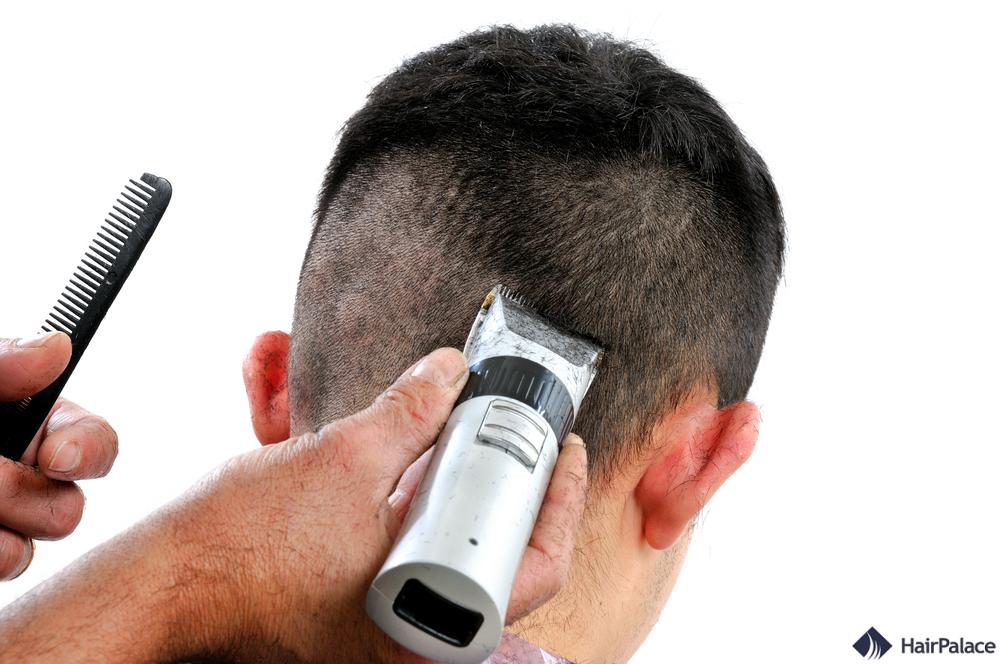
Unshaven recipient, shaved donor. The recipient area is left completely unshaven, with grafts placed between your existing hairs. The donor area at the back is shaved. Which means the front and top look normal throughout, and the back is visible if you have short hair or tie it up. This is the commonest version and the most practical — and frequently what a clinic means by “no shave” without further qualification.
Partially shaved donor, concealed. A strip or several small areas of the donor are shaved, with the longer hair above combed down over them. This conceals the shaved area entirely in most patients with hair of moderate length. It is a genuinely good middle ground, and the version we most often recommend to women — our hair transplant for women guide covers why.
Fully unshaven. Neither the donor nor the recipient is cut. Extraction is performed among long hair, with each graft’s hair trimmed individually as it is removed. Considerably slower and more demanding, with the lowest graft ceiling and the highest cost.
| Level | What is cut | Graft ceiling | Cost |
|---|---|---|---|
| Unshaven recipient, shaved donor | Donor only, at the back | Close to a standard session | Standard to modest premium |
| Partially shaved donor, concealed | Small donor areas, hidden under longer hair | Similar, limited by the size of the shaved area | Modest premium |
| Fully unshaven | Nothing | Substantially lower — extraction is the bottleneck | Highest |
What to ask: « Qu’est-ce qui sera rasé exactement, et où ? » A clear answer with a diagram is what you want.
Why it is technically harder
The reasons behind the limits are worth understanding, because they explain everything that follows.
Extraction among long hair. The surgeon must part the hair to find each follicular unit, judge its angle among surrounding shafts, and extract without catching neighbouring hairs. That is slower, and it raises the transection risk — a point our FUE hair transplant guide covers in detail. And each extracted graft’s hair must be trimmed individually so it can be handled and placed.
Placement among existing hair. Recipient sites cannot easily be made with a blade among long hair, because the blade cannot see what it is cutting near. Which is why implanter technique is standard here — see our DHI hair transplant guide. Unshaven work is the clearest genuine indication for DHI there is.
Visibility of the field. Blood and long hair together make the field harder to see, which slows everything down.
The graft hair length. A graft with a long hair attached is more awkward to load and place than a trimmed one.
The consequence of all four is the same: more time per graft. Which translates directly into the ceiling below.
The graft ceiling
Stated plainly, because it is the main limitation of the whole approach.
What is realistic. An unshaven recipient with a shaved donor allows graft numbers close to a standard session, because the extraction is normal. A partially shaved donor is similar, limited by the size of the shaved area. Fully unshaven is substantially lower, because extraction is the bottleneck. A large session fully unshaven is not comparable to a large shaved session.
Why the numbers matter. The area you need covered requires a certain number of grafts — that calculation is in our main guide. If the unshaven approach cannot deliver them, you have two options: a smaller result, or more than one session, which means more than one trip. And a clinic quoting a large number fully unshaven should be asked how long the extraction will take.
What we do is tell you the realistic ceiling for the approach you want, and where your target requires more, say so. Ask: « Combien de greffons est-il réaliste de poser sans rasage dans mon cas ? »
The trade, honestly
What you gain. Discretion. You can return to work immediately looking essentially normal — which for some patients is the whole point. No visible shaved head. No waiting for hair to regrow before your appearance is acceptable to you. And for women, this is frequently the difference between having the procedure and not.
What you give up. Graft numbers, particularly fully unshaven. Cost — it takes longer and requires more staff time, which is a genuine price difference rather than an invented one. A somewhat higher transection risk, from extraction among hair. And the crusting is still there, which is the part patients underestimate.
Who it is worth it for. Patients who cannot take visible downtime — public-facing work, an event, a small community. Women, almost always. Patients adding density to a thinning area rather than covering bare scalp, where the number needed is lower anyway. And patients having a small procedure — temporal points, a limited zone, eyebrows.
Who should reconsider. Patients needing large graft numbers. Patients for whom cost is the constraint. And patients with very short hair anyway, for whom a shaved donor is barely a change.
The crusting is still visible
This is the point that most often surprises patients.
What happens: grafts are placed between your existing hairs, each one crusts for seven to ten days, and those crusts sit at the scalp surface among your hair.
What it looks like depends heavily on your hair length and density. With longer, denser surrounding hair, the crusting is largely concealed — the best case. With shorter or sparser hair, the crusts are visible as small scabs at the scalp, and someone looking at your head closely will see them. There may also be redness, which likewise shows through thinner hair.
The honest framing is this. “No shave” means you do not have a shaved head. It does not mean nobody can tell anything happened. A patient who expected complete invisibility from day one is disappointed. Ask: « À quoi ressemblera mon cuir chevelu à une semaine, compte tenu de ma densité actuelle ? »
Where we would want more information first
Very short existing hair, where the unshaven approach gains you little — and we would say so. Very dense surrounding hair in the recipient area, which makes placement harder and raises shock loss risk to those native hairs. A large graft requirement. And everything in the candidacy section of our main guide, which applies regardless of shaving.
Your Canadian options
Not covered. Unshaven techniques are available privately in Canada, and availability varies — because they require more staff time, not every clinic offers the fully unshaven version. Which is itself a reason some patients look abroad, alongside cost.
Part two — preparing
From first contact to confirmed dates
The online consultation. Send photographs from all angles — front, both sides, top, crown and donor area — hair dry and styled as you normally wear it, and then a second set with the hair pushed back or parted so we can see the actual density. Both sets matter here: the first shows what you are trying to preserve, and the second shows what we are working with. Plus everything in the consultation section of our main guide, and specifically how you wear your hair and how long it is, whether you can tie it back, and whether visible downtime is a constraint and how much.
What you receive. A plan stating which level of unshaven is appropriate, the realistic graft ceiling, what your scalp will look like at a week, the design, a medical treatment recommendation, the stay, and the cost including the unshaven premium. Within 24 to 48 hours.
Questions worth asking before you commit. « Qu’est-ce qui sera rasé exactement ? » « Combien de greffons de façon réaliste sans rasage ? » « À quoi ressemblera mon cuir chevelu à sept jours ? » « Quel est le supplément de prix, et que couvre-t-il ? » And « Utilisez-vous des implanteurs ? » — where the answer should be yes.
What to arrange at home before you travel. Grow your hair where you can, because longer surrounding hair conceals crusting better. Start medical treatment where recommended. Stop smoking, four weeks before and after. And plan the time anyway — ten days, even unshaven.
Part three — the stay
Your stay in Tunisia
Four to six days.
Day 2 — consultation and planning. As in our main guide, with the shaving plan agreed and drawn: exactly which areas, if any, will be trimmed.
Day 3 — the procedure. Frequently longer than a shaved session for the same graft number. Extraction among long hair, with each graft trimmed individually — or from a concealed partially shaved area, where that was agreed. Implanter placement between existing hairs. And a longer day, which is worth expecting.
Day 4 — first wash and review. Demonstrated. Washing long hair over fresh grafts requires particular care, which is shown to you.
Days 5 to 6 — review and departure. Final examination, and your documentation: an operative report stating grafts by area, what was shaved if anything, and the technique; written aftercare in French or English; and a letter for your Canadian physician.
The first two weeks
Crusting among your hair for seven to ten days. Washing carefully, as demonstrated — long hair requires more care not to disturb grafts. No tying the hair tightly for the period advised, because tension on fresh grafts is a genuine risk. No hats that press on the grafts. No styling products for the period advised. And no heat styling while the scalp is numb, because you will not feel burning properly. Everything else follows the aftercare section of our main guide.
Part four — what follows
Growth and shedding
Unchanged by the shaving question. Shedding at two to six weeks — and in an unshaven procedure this is less visible, because the surrounding hair conceals it. Growth from three to four months. Final result at twelve to eighteen months.
Your Canadian follow-up
As in our main guide. Continue your medical treatment, and keep your operative report.
Part five — practical matters
Canadian patients: travelling to Tunisia from your region
Aylan Clinic works with patients from every province and territory in Canada. And discretion is frequently the reason patients choose this approach — which matters more in some regions than others.
Montreal and the surrounding region. Montreal is our largest Canadian source for Tunisia, with connections through Paris, Frankfurt or Istanbul. Patients from Laval, Longueuil and Brossard are within easy reach of the airport.
Quebec City and across the province. From Quebec City and the Capitale-Nationale region including Lévis, most patients connect through Montreal — as do patients from Trois-Rivières, Sherbrooke, Drummondville and Saint-Jérôme. Gatineau patients depart from Ottawa or drive to Montreal. On this page the francophone advantage sits at the expectations conversation: you are being told what your scalp will actually look like at a week, which is the thing patients most often misunderstand about unshaven procedures, and you are being told the realistic graft ceiling, which may be lower than you hoped. Patients consistently tell us they understood both properly in their own language, and adjusted their plans accordingly.
Acadia and New Brunswick. We work with patients from Moncton, Fredericton and Saint John. Moncton and the surrounding Acadian communities are served in French throughout.
Francophone Ontario. Sudbury, Thunder Bay and Sault Ste. Marie all have substantial francophone populations, served in French from first contact onward. Ottawa patients typically connect through Montreal.
Greater Toronto Area and southern Ontario. Toronto patients connect through European hubs. Across the wider Greater Toronto Area: Mississauga, Brampton, Markham, Vaughan, Richmond Hill and Oshawa. Along the lake: Hamilton, Burlington, Oakville, St. Catharines and Niagara Falls. In southwestern Ontario: London, the Waterloo region — Kitchener, Waterloo and Cambridge — plus Guelph, Windsor and Barrie. Kingston patients generally drive to Toronto or Montreal.
Vancouver and British Columbia. Vancouver patients face the longest journey, typically two connections. And the discretion advantage is real on the journey home: you travel looking essentially normal, which patients value. A window seat and nothing touching the grafts still applies. Across the Lower Mainland: Surrey, Burnaby and Richmond. From Victoria and Nanaimo, ferry or short flight. Kelowna, Abbotsford and Kamloops connect through Vancouver or Calgary.
Alberta. Calgary and Edmonton both offer European connections. Red Deer and Lethbridge patients generally drive to Calgary.
Manitoba and Saskatchewan. Winnipeg patients connect through Toronto or Montreal, and Saint-Boniface is served in French. From Saskatoon and Regina, a domestic connection plus two further flights. And one practical advantage: the headwear problem is less acute unshaven, because you are not exposing a shaved scalp to prairie cold. A loose hood that does not press on the grafts is manageable.
Atlantic Canada. Halifax routes through Montreal or Toronto. From Charlottetown and St. John’s, two or three connections.
Northern Canada. We work with patients from Whitehorse in Yukon, and from communities across the Northwest Territories and Nunavut. And here the discretion argument is strongest. A shaved head returning to a small community is noticed; an unshaven procedure is not — which for a number of northern patients is the deciding factor. It also eases the cold problem, as above. Weighed against a lower graft ceiling, which we set out honestly.
We plan the full stay plus buffer. Your coordinator arranges transfers, confirms your hotel, and builds your schedule around your arrival time.
Five recommendations. Ask exactly what will be shaved. Ask the realistic graft ceiling. Ask what your scalp looks like at a week. Grow your hair beforehand. And consider the partially shaved concealed option, which is frequently the best balance.
What your package includes
- Free consultation in French or English, with diagnosis before grafts
- Trichoscopic assessment of donor density and miniaturisation
- A shaving plan agreed and drawn — exactly which areas, if any
- An honest statement of the realistic graft ceiling for your chosen approach
- An honest description of what your scalp will look like at a week
- Blood tests where indicated
- A hairline designed with you and explained
- A medical treatment recommendation
- Unshaven or partially shaved extraction, with each graft trimmed individually where required
- Implanter placement between existing hairs
- Recipient site planning by the surgeon
- The first wash performed at the clinic and demonstrated, with technique for long hair
- Medication and aftercare supplies
- Review appointments across the stay
- Operative report stating grafts by area, what was shaved, and the technique
- Written aftercare in French or English, including hair tying, styling and heat restrictions
- A letter for your Canadian physician
- Continued contact in French or English through the growth period
- Hotel accommodation, full board
- A companion at no extra cost, accommodated and fed in the same room
- Airport–clinic–hotel transfers
- A personal coordinator from arrival to departure
- French-speaking care throughout, with English available on request
Results by patient profile
The concealed partial shave. A woman with shoulder-length hair who could not accept any visible shaving. A small donor area shaved and covered entirely by the hair above it. Nobody knew, and the graft number was close to a standard session. Frequently the best balance.
Where the ceiling mattered. A patient at Norwood 4 wanting full frontal coverage fully unshaven. We explained the realistic ceiling, and that his target would need two sessions unshaven, or one shaved. He chose the concealed partial shave, which delivered it in one.
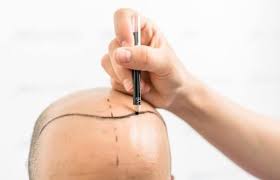
Where we said it gained him little. A patient who wore his hair at grade two. A shaved donor would barely have been a change for him, and the unshaven premium bought him almost nothing. We said so.
Where discretion was decisive. A patient in a small northern community, public-facing work. Fully unshaven, a modest graft number, and a return to work within days. A smaller result than a shaved session would have given — and the right decision for his circumstances.
A patient from Québec who had assumed unshaven meant invisible. His comment was about the week: « On m’a montré à quoi ressemblerait mon cuir chevelu à sept jours. Ce n’était pas invisible. J’ai pu organiser ma semaine en conséquence. »
Practical points to know
What to expect. A shaving plan agreed before surgery. A longer procedure for the same graft number. A lower graft ceiling, particularly fully unshaven. Crusting visible among your hair for seven to ten days — not invisible. And the same twelve to eighteen month timeline.
Recognised points. The general considerations are those in our main hair transplant guide and our FUE guide. Unshaven-specific: a higher transection risk from extraction among hair; a lower graft ceiling; greater shock loss risk to the dense native hair being worked among; a longer procedure; and a higher cost.
Three things within your control. Growing your hair beforehand. Not tying it tightly afterwards. And understanding what a week looks like.
Who this suits. Patients who cannot take visible downtime, women, those adding density rather than covering bare scalp, and small procedures. Who should reconsider. Large graft requirements, very short hair anyway, and patients for whom cost is the constraint.
Price: how it is built and how to compare it
What determines your price. The number of grafts. Which level of unshaven — and fully unshaven costs most. Implanter use. And the length of stay. Itemised, and fixed once you approve it.
What is included. Everything in the package list above. A companion is accommodated and fed at no additional cost.
What sits outside it. Flights, travel insurance, finasteride and minoxidil, and any further session — which is more likely where the ceiling limited the first.
How to compare quotes properly. Four checks. Exactly what will be shaved, because “no shave” is used for three different things. What graft number is realistic for that approach — and a large number quoted fully unshaven warrants a question about extraction time. Whether the premium is explained: it reflects more time and more staff, which is genuine. And whether implanter placement is used.
Why the lowest quote is a concern here. Because unshaven work takes longer and costs more to deliver properly, and a quote that does not reflect that is either not fully unshaven, or is being rushed. And rushing extraction among long hair raises transection.
Canadian coverage. Not covered. Treatment of any complication is covered.
Getting your assessment. Send two sets of photographs — hair as you wear it, and hair pushed back. A plan and quote follow within 24 to 48 hours, in French or English, including the realistic graft ceiling.
Glossary
- Unshaven recipient — the treated area left uncut; the commonest version
- Partially shaved donor — small areas shaved and concealed under longer hair
- Fully unshaven — neither area cut; lowest ceiling, highest cost
- Implanter — the device allowing placement between existing hairs
- Transection — follicle damage during extraction; risk is higher among long hair
- Graft ceiling — the realistic maximum for a given approach
- Shock loss — temporary shedding of native hair
How Canadians search for this
“No shave hair transplant Tunisia” is the most common search, and “greffe sans rasage Tunisie” is how most Quebec patients search. “What does no shave actually mean” — three different things; ask exactly what will be cut. “How many grafts no shave” — fewer, particularly fully unshaven, because extraction is the bottleneck. “Is a no shave transplant invisible” — no; crusting is visible among your hair for seven to ten days, and not having a shaved head is a different thing. “Unshaven hair transplant cost” — more, and the premium is genuine: more time and more staff. “No shave hair transplant for women” — almost always the right approach. “Partial shave hair transplant” — a small donor area concealed under longer hair, frequently the best balance. “DHI no shave” — implanters are standard for unshaven work, because blades cannot be used accurately among long hair. “Can I tie my hair after a transplant” — not tightly, and not for the period advised, because tension on fresh grafts is a real risk. And “French speaking hair surgeon abroad” — Tunisia’s distinguishing feature.
In summary
“No shave” means three different things, and clinics use the term for all of them: unshaven recipient with a shaved donor, a partially shaved donor concealed under longer hair, or fully unshaven throughout. The last is the most restrictive and the most expensive, and asking exactly what will be cut is the first question.
The graft ceiling is genuinely lower, because extraction among long hair is slower and more difficult — which means a large session fully unshaven either is not possible or requires two trips. And the crusting is still there. You will not have a shaved head, which is the point, and you will have small scabs among your hair for seven to ten days, concealed well by longer denser hair and visible through shorter or sparser hair. A patient expecting complete invisibility is disappointed.
For the right patient the trade is clearly worth it — women almost always, anyone who cannot take visible downtime, and anyone adding density rather than covering bare scalp. At Aylan Clinic Tunisia that means a shaving plan agreed and drawn before surgery, an honest graft ceiling, an honest description of week one, implanter placement among your existing hair, and a willingness to tell you it gains you little. It takes place in a French-speaking country, which matters when the expectations are this specific. With accommodation, full board and a companion at no extra cost, for up to 60% less than Canadian private prices.
Five things to hold onto. Ask exactly what will be shaved, and where — the term covers three different procedures at three different prices. Expect a lower graft ceiling fully unshaven, because extraction is the bottleneck, and a large number quoted this way deserves a question about timing. It is discreet, not invisible. Consider the concealed partial shave, frequently the best balance: close to standard graft numbers, and nobody sees anything. And if you wear your hair very short, it may gain you little — and we will tell you.
Send two sets of photographs and you will have an honest answer within 24 to 48 hours, including the realistic graft ceiling for the approach you want.
Continue with our procedure page on unshaven hair restoration in Tunisia, explore the full hair transplant in Tunisia section, compare plastic surgery prices in Tunisia, or request a free, personalized quote.