
The short answer is yes, we use them — and this page will tell you honestly that the blade matters far less than the hand holding it. Sapphire FUE at Aylan Clinic Tunisia uses blades made from synthetic sapphire crystal to create the recipient incisions — the sites the grafts are placed into — over a stay of four to six days, for up to 60% less than Canadian private prices. Sapphire describes the recipient incision, not the extraction: your grafts are still extracted by FUE, and a clinic presenting “Sapphire FUE” as a different operation is overstating it. The advantages are real and modest — finer, more precise incisions, less tissue trauma, potentially denser placement — and they are refinements rather than transformations. The variables that actually determine your result are elsewhere: the angle, direction and density of those incisions, the hairline design, the transection rate, and whether you are on medical treatment. The blade material is well down that list.
This is the pedagogical guide. When you are ready to look at the operation itself — how the day runs, the stay, the aftercare and the documentation you leave with — the procedure page is Sapphire Fue Hair Grafting in Tunisia. For what it costs and how a Tunisian quote compares with a Canadian private one, see plastic surgery prices in Tunisia. Our main hair transplant guide covers diagnosis, donor supply, hairline design and medical treatment — read it first if you have not, because all four matter more than the blade. One thing distinguishes Tunisia: it is a French-speaking country. Not a clinic with French-speaking staff — a country where French is a working language across medicine and daily life.
Part one — deciding
1. What sapphire blades actually are
The material. Synthetic sapphire — a crystalline form of aluminium oxide, manufactured rather than mined. It is extremely hard, which allows a very fine, sharp edge that stays sharp through a long procedure.
What they are used for. Creating the recipient incisions — the small slits in the scalp into which each graft is placed. Not for extraction. Extraction is done with a punch, and our FUE guide covers that.
The shape. Sapphire blades are typically made in a V-shaped profile, as opposed to the flat U or spear shape of a steel blade. That produces a narrower, deeper channel for a given surface opening — and that shape is the basis of the claimed advantages.
What they replace. Steel blades, custom-cut to size, which have been the standard for decades and which remain in wide use. And needles, used in some techniques to make the sites.
The honest framing. This is a refinement of one step. Every other part of the operation is unchanged.
2. Why the recipient incision matters at all
Worth understanding before the blade question, because it puts it in context.
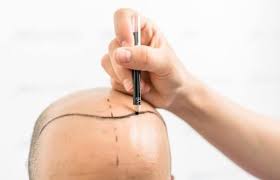
What the incision determines. Angle — the angle at which each hair will emerge from the scalp; get it wrong and the hair stands up rather than lying naturally. Direction — which way each hair points; a natural hairline has hairs pointing forward and slightly outward, in a pattern that changes across the scalp. Depth — too shallow and the graft sits proud, too deep and it can be buried, causing cysts or pitting. Density and distribution — how close together the sites are, which determines coverage. And size — each site must match the graft going into it: too large and the graft moves or sits loosely, too small and it is traumatised on insertion.
Why this is the aesthetic step. The hairline looks natural or artificial based almost entirely on these decisions. Which is why our main guide insists on asking whether the surgeon creates the sites — and why blade material is a secondary question.
3. The claimed advantages, assessed
Taken one at a time.
Finer, more precise incisions. Genuine. A harder material holds a sharper edge, and the V shape allows a narrower channel. Which means less tissue is disrupted per site.
Less trauma and faster healing. Reasonable, and modestly supported. Smaller channels mean less bleeding, less scabbing, and a somewhat faster early recovery — which patients notice in the first week. The difference is real and it is not dramatic.
Denser placement. The most substantive claim. Narrower channels can theoretically be placed closer together without compromising the blood supply between them, which allows higher density in the recipient area. Whether that translates into better results in practice depends heavily on the surgeon’s judgement about how dense is safe — and packing sites too densely compromises graft survival regardless of blade material.
Better graft survival. Plausible and not firmly established. Less trauma should favour survival, and the published comparative evidence is limited and mixed. We would rather say that than claim a proven advantage.
Reduced risk of the graft popping out. A snug channel holds the graft better, which technicians notice. A practical benefit rather than a clinical one.
The honest summary. Real refinements, modest magnitude, and limited comparative evidence. A good surgeon with steel blades produces excellent results, and has done so for decades.
4. What it does not change
The list that keeps this in proportion.
- It does not change extraction — and transection, which determines how many grafts grow, happens at extraction. Our FUE guide sets it out.
- It does not change your donor supply — which is the real lifetime constraint.
- It does not change the hairline design — the single largest determinant of whether the result looks natural.
- It does not change the angle or direction of the incisions — those are the surgeon’s decisions, whatever the blade.
- It does not stop hair loss — which is why medical treatment matters more than any of this.
- It does not change the shedding phase or the growth timeline.
- And it does not change the final density achievable, which depends on graft number, hair calibre and coverage.
5. What actually determines your result
Ranked honestly, which is the point of this page.
- Whether you are a suitable candidate at all, and whether the diagnosis is right.
- Your donor supply and how it is planned over a lifetime.
- The hairline design and whether it will still work at sixty.
- Whether you are on medical treatment.
- The angle, direction and density of the recipient sites, and who creates them.
- The transection rate at extraction.
- Graft handling and time out of the body.
- Your own hair characteristics, which you cannot change.
And somewhere after all of that: the blade material. We say this plainly because the marketing inverts the list — and a patient choosing a clinic on the word “sapphire” is choosing on the least important variable. Ask instead: « Qui crée les incisions, et comment décidez-vous de l’angle et de la densité ? »
6. Where it genuinely helps most
Because it is not equally relevant to everyone.
High-density work at the hairline. Where sites are placed close together in the frontal zone, the narrower channel allows tighter packing with less risk to the blood supply. The clearest genuine advantage, and our high density hair transplant guide covers that work in full.
Fine hair. Where each graft is small, a precisely sized channel matters more — a large steel-cut site around a fine graft leaves it loose.
Patients wanting a faster early recovery. Less scabbing and a somewhat cleaner appearance in the first week, which matters if you are returning to work quickly.
Where it matters less. Crown work, where density is lower and the visual return per graft is modest anyway. Coarse hair, where graft and channel are both larger and the precision advantage narrows. And any case where the design or the candidacy is the real issue.
7. What to be cautious of
Two marketing patterns worth recognising.
Sapphire as a premium tier. Some clinics price sapphire as a substantially more expensive option. The blades cost more than steel, and the difference is modest — and a large price step for the blade material alone is difficult to justify. Ask what the difference actually covers.
Sapphire as a substitute for expertise. A clinic emphasising its blades and vague about its surgeon’s involvement is inverting the priorities in section 5. The blade is not what makes the hairline natural.
And one more. “Sapphire” is sometimes used loosely — including for blades that are not sapphire. It is a fair question to ask what is actually being used, and a clinic should answer plainly.
8. Sapphire, steel, needles and implanters
| Steel blade | Sapphire blade | Needle | DHI implanter | |
|---|---|---|---|---|
| Creates the site | Yes | Yes | Yes | Site and placement together |
| Channel shape | Flat / spear | V-shaped, narrow | Round | Round |
| Edge sharpness | Good | Excellent and durable | Good | — |
| Density achievable | Good | Potentially higher | Good | Good, and slower |
| Placement step | Separate | Separate | Separate | Combined |
| Cost | Lowest | Modestly higher | Low | Higher |
The DHI point. DHI is not an alternative to sapphire — it is an alternative to the separate incision-then-placement sequence entirely, because the implanter does both. Our DHI guide covers it, including where it genuinely helps and where it does not. Which means: you either use blades — steel or sapphire — and place grafts into them, or you use implanters. “Sapphire DHI” as a single product is a marketing construction.
Part two — preparing
9. From first contact to confirmed dates
The online consultation. Send photographs from all angles — front, both sides, top, crown and the donor area — hair dry, not styled to conceal, in daylight and unfiltered. Plus the medical information our main guide asks for.
What you receive. A plan stating your donor density, the proposed graft number and distribution, the hairline design and its reasoning, a medical treatment recommendation, the technique including which blades and why, the stay, and the cost. Within 24 to 48 hours.
Questions worth asking before you commit.
- « Qui crée les incisions ? » — section 5, and the question that matters most here.
- « Comment décidez-vous de l’angle, de la direction et de la densité ? »
- « Quelle est ma densité donneuse ? » — our main guide.
- « Quel est votre taux de transection ? » — our FUE guide.
- « Qu’est-ce que le saphir change concrètement dans mon cas ? » — and an honest answer is “modestly, and here is where.”
- « Quelle est la différence de prix, et que couvre-t-elle ? » — section 7.
What to arrange at home before you travel. Start medical treatment where recommended. Stop smoking — four weeks before and after. Stop alcohol for a week before. Review blood thinners and supplements. And arrange time off — ten to fourteen days, with a note that early scabbing may be somewhat lighter than with steel.
Part three — the stay
10. Your stay in Tunisia
Four to six days, as for any transplant.
Day 1 — Arrival. Your driver meets you at the airport and takes you to your hotel with your companion. Nothing clinical today.
Day 2 — Consultation and planning. Trichoscopy, donor assessment, safe zone mapping and blood tests. Hair calibre assessment, which informs both punch size and blade size. Then the design conversation, drawn with you in a mirror. And the technical plan, stating which blades and sizes.
Day 3 — The procedure. Six to eight hours with breaks, under local anaesthesia. Extraction by FUE. Recipient sites created with sapphire blades — by the surgeon — with sizes matched to the grafts they will receive, and angles and directions set across the scalp. Implantation into those sites. A dressing on the donor area.
Day 4 — First wash and review. Performed at the clinic and demonstrated to you.
Days 5 to 6 — Review and departure. Final examination, and your documentation: an operative report stating grafts extracted and placed by area, punch size, blade sizes used, and technique; written aftercare in French or English; the washing protocol; and a letter for your Canadian physician. Then your transfer to the airport.
11. The first weeks
Identical to any FUE procedure, with one possible difference. Scabbing in the recipient area may be somewhat lighter and shorter-lived — which is the most noticeable practical benefit of the finer channels. Everything else is the same: forehead swelling from day two to five, crusting for seven to ten days, donor soreness, and shedding at two to six weeks. Our main guide covers it in full.
Part four — what follows
12. Growth and the timeline
Unchanged by the blade. Shedding at two to six weeks. Growth from three to four months. Meaningful result at eight to ten months. Final result at twelve to eighteen. A clinic implying that sapphire produces faster growth is misrepresenting it — it affects healing of the channel, not the follicle’s cycle.
13. Your Canadian follow-up
Continue your medical treatment, arrange a physician who will see you if needed, and keep your operative report — which states blade and punch sizes, useful to any future surgeon.
Part five — practical matters
14. Canadian patients: travelling to Tunisia from your region
Aylan Clinic works with patients from every province and territory in Canada.
Montreal and the surrounding region. Montreal is our largest Canadian source for Tunisia, with connections through Paris, Frankfurt or Istanbul. Patients from Laval, Longueuil and Brossard are within easy reach of the airport.
Quebec City and across the province. From Quebec City and the Capitale-Nationale region including Lévis, most patients connect through Montreal — as do patients from Trois-Rivières, Sherbrooke, Drummondville and Saint-Jérôme. Gatineau patients depart from Ottawa or drive to Montreal.
On this page the francophone advantage is at the moment we tell you the blade is not the important variable. That is a nuanced message — acknowledging a genuine refinement while explaining that the marketing has inverted the priority list. Patients consistently tell us they understood it properly in their own language, and then asked the questions in section 9, which are the ones that matter.
Acadia and New Brunswick. We work with patients from Moncton, Fredericton and Saint John. Moncton and the surrounding Acadian communities are served in French throughout.
Francophone Ontario. Sudbury, Thunder Bay and Sault Ste. Marie all have substantial francophone populations, served in French from first contact onward. Ottawa patients typically connect through Montreal.
Greater Toronto Area and southern Ontario. Toronto patients connect through European hubs. Across the wider Greater Toronto Area: Mississauga, Brampton, Markham, Vaughan, Richmond Hill and Oshawa. Along the lake: Hamilton, Burlington, Oakville, St. Catharines and Niagara Falls. In southwestern Ontario: London, the Waterloo region — Kitchener, Waterloo and Cambridge — plus Guelph, Windsor and Barrie. Kingston patients generally drive to Toronto or Montreal.
Vancouver and British Columbia. Vancouver patients face the longest journey — typically two connections. The return flight falls when grafts are most fragile: a window seat, a neck pillow, and nothing touching the recipient area. We frequently recommend extending by a day. Across the Lower Mainland: Surrey, Burnaby and Richmond. From Victoria and Nanaimo, ferry or short flight. Kelowna, Abbotsford and Kamloops connect through Vancouver or Calgary.
Alberta. Calgary and Edmonton both offer European connections. Red Deer and Lethbridge patients generally drive to Calgary.
Manitoba and Saskatchewan. Winnipeg patients connect through Toronto or Montreal, and Saint-Boniface is served in French. From Saskatoon and Regina, a domestic connection plus two further flights. And the headwear constraint — no close-fitting hat for the first days, which in a prairie winter matters. Consider the timing.
Atlantic Canada. Halifax routes through Montreal or Toronto. From Charlottetown and St. John’s, two or three connections.
Northern Canada. We work with patients from Whitehorse in Yukon, and from communities across the Northwest Territories and Nunavut. Cold and headwear — the same constraint, more acutely, and timing for a warmer month is worth considering. And continuing access to finasteride and minoxidil, which matters more than any technique choice. We plan the full stay plus buffer.
How we handle the logistics. Your coordinator arranges transfers, confirms your hotel, and builds your schedule around your arrival time.
Five recommendations. Ask who creates the incisions. Ask what sapphire changes in your specific case. Ask the transection rate. Start medical treatment. And choose the surgeon, then ask about the blade.
15. What your package includes
- Free consultation in French or English, with diagnosis before grafts
- Trichoscopic assessment of donor density, calibre and miniaturisation
- Hair calibre assessment, informing punch and blade sizing
- Safe zone mapping and a planned extraction distribution
- Blood tests where indicated
- A hairline designed with you and explained
- A medical treatment recommendation
- FUE extraction with punch matched to your follicle calibre
- Recipient sites created by the surgeon with sapphire blades, sized to the grafts they will receive, with angle, direction and density set across the scalp
- Cooled holding solution, grafts kept moist, implantation proceeding alongside extraction
- The first wash performed at the clinic and demonstrated to you
- Medication and aftercare supplies
- Review appointments across the stay
- Operative report stating grafts by area, punch size, blade sizes and technique
- Written aftercare in French or English, including the washing protocol and shedding timeline
- A letter for your Canadian physician
- Continued contact in French or English through the growth period
- Hotel accommodation, full board
- A companion at no extra cost, accommodated and fed in the same room
- Airport–clinic–hotel transfers
- A personal coordinator from arrival to departure
- French-speaking care throughout, with English available on request
The clinical team. Surgeon specialising in hair restoration, frequently French-trained. Experienced technical team, working under supervision. Dedicated nurse.
16. Results by patient profile
Where it helped most. A patient with fine hair and a frontal hairline requiring high density. Sapphire blades sized precisely to his small grafts, placed at high density in the frontal zone. This is the clearest genuine indication.
Where we said it mattered little. A patient with coarse hair wanting crown coverage. We explained that in his case the blade material would make very little difference, and that his graft number, donor supply and medical treatment were the variables that mattered. He chose us on the surgeon’s approach rather than the equipment, which was the right basis.
Where the price step was the question. A patient who had been quoted elsewhere with a substantial premium for sapphire. We explained that the blades cost modestly more than steel, and that a large step for the material alone is difficult to justify. He asked the other clinic what the difference covered, and did not get a clear answer.
Where the real issue was design. A patient focused entirely on technique, whose photographs showed rapidly progressing loss at twenty-six. The blade was not his question. Whether to operate at all was — and we recommended medical treatment and reassessment.
A patient from Sherbrooke. A patient who chose Tunisia after comparing several clinics on technology. His comment was about the reordering: « On m’a expliqué que le saphir était la huitième chose la plus importante, pas la première. Personne d’autre ne m’avait dit ça. »
17. Practical points to know
What to expect. A standard FUE procedure, with sapphire blades creating the recipient sites. Possibly somewhat lighter scabbing in the first week. And everything else identical — swelling, crusting, shedding, and a twelve to eighteen month timeline.
Recognised points. The considerations are those of any FUE procedure — our FUE guide sets them out — including transection, donor over-extraction, dot scarring, shock loss, folliculitis, infection, numbness, cysts, and the need for further sessions. Specific to recipient site creation, whatever the blade: sites too large for the grafts, causing loose placement; sites too deep, causing pitting or cysts; sites too dense, compromising blood supply and graft survival; and incorrect angle or direction, which produces an unnatural growth pattern — the commonest aesthetic failure in this field, and a design rather than a material problem.
Three things within your control. Choosing the surgeon rather than the equipment. Starting medical treatment. And following the washing protocol exactly.
Who this suits. Anyone suitable for FUE — and it helps most in high-density frontal work and in fine hair.
Who should focus elsewhere. Anyone whose candidacy, donor supply or design is the real question — which is most patients, and which section 5 sets out.
18. Price: how it is built and how to compare it
What determines your price. The number of grafts — the principal driver. Whether sapphire blades are used — a modest difference. Whether DHI implantation is used instead. Whether an unshaven approach is used. And the length of stay. Itemised, and fixed once you approve it.
What is included. Everything in section 15. A companion is accommodated and fed at no additional cost.
What sits outside it. Flights, travel insurance, finasteride and minoxidil, and any further session.
How to compare quotes properly. Four checks. Is the price difference for sapphire proportionate — the blades cost modestly more than steel, and a large premium warrants an explanation. Who creates the incisions — section 5, and it matters far more than the material. Was your donor density measured before a graft number was quoted. And what transection rate does the clinic report.
Why the lowest quote is the wrong question here. Because sapphire is not where the value or the risk sits. A clinic marketing on blade material while being vague about surgeon involvement has inverted the priorities — and the hairline that looks artificial in ten years will not be the blade’s fault. Choose the surgeon. Then ask about the blade. You can compare the full range on our plastic surgery prices in Tunisia page.
Canadian coverage. Not covered. Treatment of any complication is covered.
Getting your assessment. Send photographs from all angles including the crown and donor area, hair dry and unstyled. A plan and quote follow within 24 to 48 hours, in French or English — including an honest statement of what the blade will and will not change for you. You can request a free, personalized quote to start.
19. Glossary
- Sapphire blade — a synthetic crystal blade used to create recipient incisions
- Recipient incision — the site each graft is placed into
- Angle and direction — the surgeon’s decisions determining how hair emerges
- Channel — the opening created; V-shaped with sapphire, flatter with steel
- Density — sites per square centimetre in the recipient area
- FUE — the extraction method; unchanged by the blade
- DHI — an implanter-based alternative to the incision-then-placement sequence
- Pitting — depressed grafts from sites made too deep
20. How Canadians search for this
- “Sapphire FUE Tunisia cost” — the most common search.
- “Sapphire FUE Tunisie” — how most Quebec patients search.
- “What is sapphire FUE” — FUE extraction plus sapphire blades for the recipient incisions. It is a refinement of one step.
- “Sapphire vs classic FUE” — the extraction is identical. Only the incision differs.
- “Sapphire vs DHI” — different steps. DHI replaces the incision-then-placement sequence entirely.
- “Does sapphire heal faster” — somewhat lighter scabbing in the first week, and no change to the growth timeline.
- “Is sapphire worth the extra cost” — the blades cost modestly more than steel, and a large premium warrants an explanation.
- “Sapphire FUE density” — the most substantive claim, and it depends on the surgeon’s judgement about safe density.
- “Best blade for hair transplant” — the wrong question. Who creates the incisions matters far more than what with.
- “Hair transplant angle and direction” — the decisions that determine whether a hairline looks natural.
- “French speaking hair surgeon abroad” — Tunisia’s distinguishing feature.
In summary
Sapphire describes the recipient incision, not the extraction — your grafts come out by FUE either way. “Sapphire FUE” means FUE plus sapphire blades, and it is a refinement of one step rather than a different operation.
The advantages are real and modest: finer, V-shaped channels with less tissue trauma, somewhat lighter scabbing in the first week, and potentially denser placement — which is the most substantive claim, and which depends on the surgeon’s judgement about how dense is safe.
And the variables that actually determine your result sit well above it: whether you are a candidate at all, your donor supply, the hairline design, medical treatment, the angle and density of the sites, and the transection rate at extraction. The marketing inverts that list — and a patient choosing a clinic on the word “sapphire” is choosing on the least important variable.
At Aylan Clinic Tunisia that means the surgeon creates your recipient sites, blade sizes matched to your grafts, an honest statement of what sapphire changes in your case, and a price difference proportionate to what the blades actually cost. It takes place in a French-speaking country, which matters when we are explaining that the technology is not the important variable. With accommodation, full board and a companion at no extra cost, for up to 60% less than Canadian private prices.
Five things to hold onto. Ask who creates the incisions — the angle, direction and density decide whether your hairline looks natural, far more than the blade material. Sapphire changes one step; extraction, donor supply, design and medical treatment are all unchanged, and all matter more. A large price premium warrants an explanation, because the blades cost modestly more than steel. It helps most in high-density frontal work and fine hair, and in coarse hair and crown work the difference narrows considerably. And choose the surgeon, then ask about the blade — a clinic marketing on equipment while vague about surgeon involvement has its priorities backwards.
Send your photographs and you will have an honest answer within 24 to 48 hours, including where the blade will make very little difference for you. When you are ready for the operation itself, the procedure page is Sapphire Fue Hair Grafting in Tunisia. Compare the figures on plastic surgery prices in Tunisia, read the full hair transplant overview, or request a free, personalized quote.
