
Can Afro-textured hair be transplanted? The short answer is yes — and this operation is technically different enough that experience with it is a fair thing to ask about directly. Transplanting Afro-textured hair at Aylan Clinic Tunisia accounts for a follicle that curves beneath the skin, a higher transection risk, specific scalp conditions that must be excluded first, and a genuine keloid consideration — over a stay of four to six days, for up to 60% less than Canadian private prices.
This guide explains the decision, the screening and the stay. The matching procedure page, Afro Textured Hair Grafting in Tunisia, sets out how the intervention itself is performed, what the stay includes and how aftercare is organised. Both sit within our wider hair transplant in Tunisia hub. You can review plastic surgery prices in Tunisia at any point, or request a free, personalised quote with no obligation.
Three things before you read further
The follicle is curved, and the surgeon cannot see the curve. This raises the transection risk substantially, and it is the single technical fact that distinguishes this work. It changes punch choice, technique and pace.
Two conditions must be excluded before any surgery. Central centrifugal cicatricial alopecia, a scarring alopecia that is considerably more common in women of African descent, and traction alopecia, which is treatable surgically only once the tension has stopped.
And there is one genuine advantage. Curly hair covers more scalp per hair than straight hair does, which means fewer grafts achieve the same visual coverage. The arithmetic works in your favour.
Our main hair transplant guide covers diagnosis, donor supply and design — read it first if you have not. One thing distinguishes Tunisia: it is a French-speaking country. Not a clinic with French-speaking staff — a country where French is a working language across medicine and daily life.
Part one — deciding
What “Afro-textured” means technically
The hair itself is tightly curled or coiled, with an elliptical rather than round cross-section, and a curved follicle beneath the skin. The shaft emerges at a sharp angle — frequently close to the scalp surface — rather than the more upright angle of straight hair.
The terminology matters. This page uses “Afro-textured” to describe hair characteristics, not ethnicity, because the technical points apply to the hair, and hair texture varies within every population. A patient of any background with tightly coiled hair faces the considerations on this page. And a patient of African descent with looser curl faces fewer of them. What matters is your hair, and we assess it.
The curved follicle: the central technical fact
This is the reason experience matters here. The follicle curves beneath the skin, frequently in a C or J shape. The surgeon can see the angle at which the hair emerges. They cannot see where it goes below. Which means a punch aligned to the visible hair can cut straight through the curve — transecting the follicle.
Why transection matters: a transected follicle may not grow, and you are charged for it regardless. And in Afro-textured hair the baseline risk is materially higher than in straight hair. Our FUE guide covers the mechanism in detail.
What reduces it:
- Larger punch diameters — giving the curved follicle room within the cylinder.
- Blunt or hybrid punches, which separate tissue rather than cutting it — and which push the follicle aside rather than severing it.
- Manual or slow motorised extraction, giving the tactile feedback that lets an experienced operator feel the curve.
- A slower pace — and this is genuine: careful extraction in this hair type takes longer, and a clinic promising the same graft numbers per day is either very well staffed or cutting corners.
- Shorter trimming in the donor area, so the emergence angle is clearer.
- And sometimes a small test extraction at the start — taking a few grafts, examining them under magnification, and adjusting punch size and technique before proceeding. This is good practice and worth asking about.
What to ask, in French or English:
- « Quelle taille de punch utiliserez-vous pour mes cheveux, et pourquoi ? »
- « Faites-vous une extraction test au début ? »
- « Combien de patients aux cheveux crépus opérez-vous par an ? »
A clinic that answers these specifically has thought about it. One that gives the same answer it would give a patient with straight hair has not.
The advantage: coverage per hair
Genuine, and worth knowing before you compare graft numbers. A curled hair occupies more space and casts more shadow than a straight one, which means it covers more scalp per hair.
The practical consequence is that fewer grafts achieve the same apparent density. A patient with tightly coiled hair can look well covered at a graft number that would look sparse on straight hair. Our high density guide covers why the eye reads coverage rather than count — and curl is one of the three factors, alongside calibre and contrast.
And contrast: where hair colour and skin tone are closer, the scalp shows through less, which compounds the advantage. A patient with dark hair and dark skin has a lower contrast than a patient with dark hair and pale skin — and looks fuller at the same density.
What this means for your quote: a lower graft number may be entirely appropriate. And a clinic quoting the same number it would quote for straight hair is not accounting for your texture. Ask: « Compte tenu de ma texture, combien de greffons sont réellement nécessaires ? »
The two conditions to exclude first
Both are more relevant in this population, and both are decisive.
Central centrifugal cicatricial alopecia (CCCA)
A scarring alopecia that begins at the crown and spreads outward, considerably more common in women of African descent, though it occurs in men too. It destroys the follicle permanently.
The signs: loss beginning at the vertex and expanding centrifugally; the affected scalp looking smooth and shiny rather than normal; tenderness, itching or burning; and sometimes scaling or pustules.
Why it is decisive: grafts placed into active CCCA are destroyed by the same process. And surgery can trigger further activity. What must happen first is dermatological assessment, frequently with a scalp biopsy, and the disease must be quiescent — typically for a period of at least a year on treatment — before any transplant is considered. That assessment is available in Canada and covered. We will not transplant into suspected active CCCA, and we will say so.
Traction alopecia
Loss caused by sustained tension on the hair — from tight braids, weaves, extensions, locs, tight ponytails, or chemical processing combined with tension. It typically affects the hairline and temples, in a characteristic pattern, frequently with a preserved fringe of fine hairs at the very front — a recognisable sign.
Early traction alopecia is reversible if the tension stops. Late traction alopecia is scarring and permanent — and that is the transplantable stage. The crucial condition: the practice causing it must have stopped, and stayed stopped. Because grafts placed into a hairline that continues to be pulled will be lost the same way — and that donor supply does not come back. We will ask directly about your styling, and we will ask what has changed. Ask yourself honestly before you enquire.
Keloid and hypertrophic scarring
A real consideration, stated plainly rather than avoided. Keloid and hypertrophic scarring are more common in people with darker skin, and the nape of the neck is among the more common sites. Which is directly relevant, because the donor area sits there.
Acne keloidalis nuchae is a specific condition — firm papules and keloid-like scarring at the nape and occipital scalp, more common in men of African descent. Where it is present, the donor area is affected, and extraction in that region may be inadvisable or may need to avoid it. We examine for it, and it is a genuine reason a donor plan may be modified.
What we do: ask about your personal and family history of keloid — on the ears, the chest, the shoulders, after piercings or surgery; examine the nape specifically; and where a tendency exists, a smaller test area first is reasonable, extraction is planned to minimise trauma, and scar treatment is started early — silicone, and where indicated injections.
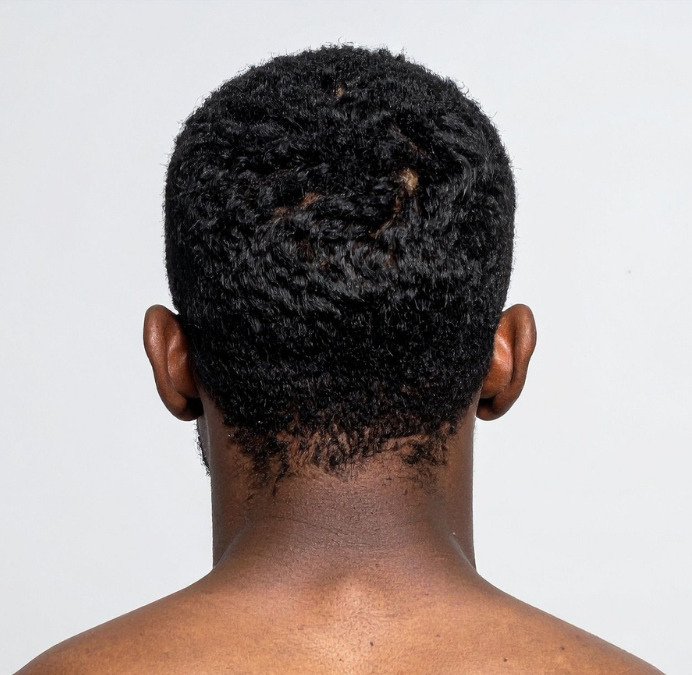
The honest position: a history of keloid does not automatically prevent surgery, and it changes the plan and the counselling. A clinic that does not ask about it is not assessing you. Tell us, and be complete — including keloids elsewhere on your body, which patients frequently do not think to mention.
Post-inflammatory hyperpigmentation
A practical point about recovery. Darker skin is more prone to pigment change after inflammation or injury, which means the extraction points and the recipient area can darken during healing — and that darkening can persist for months. It generally resolves.
What reduces it: strict sun protection — and the scalp is exposed, so a loose hat once permitted, and sunscreen on any exposed scalp thereafter; gentle handling in the washing protocol, avoiding picking crusts; and prompt treatment of any folliculitis. We set this out in your aftercare, and it matters more than in lighter skin.
Design considerations
The hairline. The same principles as our main guide — age-appropriate height, natural irregularity, single-hair grafts at the leading edge. With one texture-specific point: tightly coiled hair at the hairline creates a softer, less defined edge naturally, which is forgiving, and which means the transition zone can be designed slightly differently.
Angle. Afro-textured hair emerges at a sharper angle, closer to the scalp, and the recipient incisions must reproduce that. Placing curly hair at the angle appropriate to straight hair looks wrong. Which is another reason to ask about the surgeon’s experience with this texture.
Density. Our high density guide applies — and the coverage-per-hair point above means the target density can frequently be lower for the same visual result.
Women’s patterns. Our women’s guide covers female assessment in full — and the CCCA and traction points apply with particular force.
Who is a good candidate
Suits surgery:
- Stable androgenetic loss with a stable donor, as for any patient.
- Late traction alopecia where the tension has genuinely stopped.
- Scar alopecia from trauma or previous surgery.
- And a surgeon with demonstrated experience in this hair type.
Should not proceed yet:
- Suspected or active CCCA — dermatological assessment first.
- Traction alopecia where the causative styling continues.
- Active acne keloidalis nuchae in the donor area, pending assessment.
- And undiagnosed scalp inflammation, which needs a diagnosis before grafts.
Your Canadian pathway
Two things are covered and worth pursuing at home: dermatological assessment for a suspected scarring alopecia, including biopsy, which is covered and which must come first; and treatment of CCCA or acne keloidalis, which is medical care. Where either applies, that is your next step rather than a flight — and we will say so.
Part two — preparing
From first contact to confirmed dates
The online consultation
Send photographs:
- Front hairline, with the hair as short or as parted as you can manage so the pattern is visible.
- Both temples specifically — because traction alopecia shows there.
- The crown from above — and this matters for CCCA screening.
- The top of the head.
- The donor area at the back, and specifically the nape.
- And a photograph of the hairline edge, showing whether a fringe of fine hairs remains.
Natural daylight, no filters. Plus: your age, when the loss started and how it has progressed, your styling history in detail — braids, weaves, extensions, locs, relaxers, heat — and what you use now, any scalp itching, burning, tenderness or bumps, any personal or family history of keloid anywhere on your body, any bumps at the nape, family history of hair loss, medications, and whether you smoke. And for women: everything in our women’s guide, including blood results.
What you receive
An assessment stating the likely diagnosis, whether a scarring alopecia is suspected, whether traction is the cause and whether it has stopped, your donor assessment including the nape, the graft number accounting for your texture, the technical approach, and whether surgery is appropriate. Within 24 to 48 hours. And where dermatological assessment in Canada should come first, the plan will say so.
Questions worth asking before you commit
- « Combien de patients aux cheveux crépus opérez-vous par an ? » — a fair and direct question.
- « Quelle taille et quel type de punch pour ma texture ? »
- « Faites-vous une extraction test ? »
- « Avez-vous exclu une CCCA ? »
- « Ma nuque est-elle adaptée au prélèvement ? »
- « Le nombre de greffons tient-il compte de ma texture ? »
What to arrange at home before you travel
- Dermatological assessment where a scarring process is suspected — covered in Canada.
- Stop the causative styling if traction is the issue — and give it time.
- Treat any scalp inflammation.
- Stop smoking — four weeks before and after.
- And for women: the blood workup in our women’s guide.
Part three — the stay
Your stay in Tunisia
Four to six days. The texture-specific points across those days are these.
Day 2 — consultation
Trichoscopy — donor density, calibre, miniaturisation, and specifically the crown for CCCA and the nape for keloid or acne keloidalis. Assessment of the hairline for traction pattern. Hair texture and curl assessed, informing punch selection and angle planning. Blood tests. Then the design conversation, with angle and density planned for your texture. Where a scarring process is suspected, we say so here and recommend assessment in Canada.
Day 3 — the procedure
Six to nine hours, and frequently longer than the same graft number in straight hair, because careful extraction in curved follicles takes time. A test extraction at the start where indicated — examining grafts under magnification and adjusting punch size before proceeding. Extraction with punch and technique matched to your follicle curvature. Recipient sites created by the surgeon at the angles appropriate to your texture. Implantation proceeding alongside extraction.
Day 4 — first wash and review
Performed at the clinic and demonstrated, with specific attention to gentle handling and the pigmentation points above.
Days 5 to 6 — review and departure
Final examination, and your documentation: an operative report stating grafts by area, punch size and type, and the technique; written aftercare in French or English, including pigmentation and sun protection guidance; and a letter for your Canadian physician. Then your transfer to the airport.
The first weeks
- Pigment change at extraction points and in the recipient area. Sun protection matters.
- Ingrown hairs in the donor area are more common in curly hair, because the regrowing hair can curl back into the skin. They usually settle, and a warm compress helps. Do not dig them out.
- Folliculitis, which is common in any transplant and should be reported if extensive.
- Styling — no tension at all on the recipient area, and for a considerable period.
Part four — what follows
Styling after a transplant
This is the section that protects your result long-term.
The permanent change. If traction caused your loss, the styling must not resume. Grafts are not immune to tension — they are subject to exactly the same mechanism. And a patient who returns to tight braiding will lose them.
Practical guidance. No braids, weaves, extensions or locs involving the transplanted area, and for a prolonged period after, on your surgeon’s advice. When styling does resume, tension is the thing to avoid — not the style itself. Loose braids do not cause traction alopecia; tight ones do. Pain while a style is being done is a warning sign, not a normal part of it. And bumps or tenderness at the hairline afterwards indicate too much tension.
Chemical processing. Relaxers and chemical straightening damage the shaft and, at the scalp, can cause irritation. Avoid entirely for several months after surgery, and discuss with your surgeon before resuming.
Heat. Minimise, and avoid entirely while the scalp is numb — because you will not feel burning properly, which is a genuine early risk.
Your Canadian follow-up
- Dermatological follow-up where CCCA or acne keloidalis was identified.
- Scar monitoring where a keloid tendency exists — and early treatment is considerably more effective than late.
- And report any new scalp tenderness, itching or expanding loss at the crown, which could indicate CCCA activity.
Take your operative report.
Part five — practical matters
Canadian patients: travelling to Tunisia from your region
Aylan Clinic works with patients from every province and territory in Canada.

Montreal and the surrounding region
Montreal is our largest Canadian source for Tunisia, with connections through Paris, Frankfurt or Istanbul. Patients from Laval, Longueuil and Brossard are within easy reach of the airport. Montreal’s Haitian, West African, Central African and Caribbean communities are substantial — and a number of our patients come to us specifically because they want a surgeon who operates on hair like theirs routinely.
Quebec City and across the province
From Quebec City and the Capitale-Nationale region including Lévis, most patients connect through Montreal — as do patients from Trois-Rivières, Sherbrooke, Drummondville and Saint-Jérôme. Gatineau patients depart from Ottawa or drive to Montreal.
On this page the francophone advantage is at the history-taking. You are being asked in detail about styling, about braids and relaxers and how long you wore them, about scalp symptoms, and about keloids elsewhere on your body. Those are detailed personal histories — and they determine whether a scarring process is present and whether surgery will hold. Patients consistently tell us they gave a fuller account in their own language.
Acadia and New Brunswick
We work with patients from Moncton, Fredericton and Saint John. Moncton and the surrounding Acadian communities are served in French throughout.
Francophone Ontario
Sudbury, Thunder Bay and Sault Ste. Marie all have substantial francophone populations, served in French from first contact onward. Ottawa patients typically connect through Montreal.
Greater Toronto Area and southern Ontario
Toronto patients connect through European hubs. Across the wider Greater Toronto Area: Mississauga, Brampton, Markham, Vaughan, Richmond Hill and Oshawa. Along the lake: Hamilton, Burlington, Oakville, St. Catharines and Niagara Falls. In southwestern Ontario: London, the Waterloo region — Kitchener, Waterloo and Cambridge — plus Guelph, Windsor and Barrie. Kingston patients generally drive to Toronto or Montreal.
Vancouver and British Columbia
Vancouver patients face the longest journey — typically two connections. The return flight falls when grafts are fragile: a window seat, a neck pillow, and nothing touching the recipient area. We frequently recommend extending by a day. Across the Lower Mainland: Surrey, Burnaby and Richmond. From Victoria and Nanaimo, ferry or short flight. Kelowna, Abbotsford and Kamloops connect through Vancouver or Calgary.
Alberta
Calgary and Edmonton both offer European connections. Red Deer and Lethbridge patients generally drive to Calgary. And dry air makes scalp dryness and ingrown hairs more uncomfortable.
Manitoba and Saskatchewan
Winnipeg patients connect through Toronto or Montreal. Saint-Boniface is served in French. From Saskatoon and Regina, a domestic connection plus two further flights. And the headwear constraint — no close-fitting hat for the first days — which in a prairie winter matters.
Atlantic Canada
Halifax routes through Montreal or Toronto. From Charlottetown and St. John’s, two or three connections.
Northern Canada
We work with patients from Whitehorse in Yukon, and from communities across the Northwest Territories and Nunavut. Two points. Dermatological access: where CCCA assessment requires travel south anyway, arranging it before you consider surgery is sensible. And cold and headwear, as above, with timing worth considering. We plan the full stay plus buffer.
How we handle the logistics
Your coordinator arranges transfers, confirms your hotel, and builds your schedule around your arrival time. Five recommendations: send the crown photograph, because it matters for CCCA screening; give your styling history in full; mention keloids anywhere on your body; ask how many patients with your texture the surgeon operates on; and if traction caused it, stop the styling before you travel.
What your package includes
- Free consultation in French or English, with diagnosis before grafts.
- Trichoscopic assessment of donor density, calibre and miniaturisation.
- Specific examination of the crown for CCCA and the nape for acne keloidalis and keloid tendency.
- Assessment of the hairline for traction pattern, and a direct conversation about whether the cause has stopped.
- Hair texture and curl assessment, informing punch selection and angle planning.
- Blood tests where indicated.
- A graft number that accounts for your texture.
- A hairline designed with you, with angles appropriate to your curl.
- A medical treatment recommendation where applicable.
- A test extraction at the start where indicated, with punch adjustment.
- Extraction with punch size and type matched to your follicle curvature, at a pace appropriate to it.
- Recipient sites created by the surgeon.
- Implantation proceeding alongside extraction.
- The first wash performed at the clinic and demonstrated, with attention to gentle handling.
- Early scar treatment where a keloid tendency exists.
- Medication and aftercare supplies.
- Review appointments across the stay.
- Operative report stating grafts by area, punch size and type, and technique.
- Written aftercare in French or English, including pigmentation guidance, sun protection, ingrown hair management and styling restrictions.
- A letter for your Canadian physician.
- Continued contact in French or English through the growth period.
- Hotel accommodation, full board.
- A companion at no extra cost, accommodated and fed in the same room.
- Airport–clinic–hotel transfers.
- A personal coordinator from arrival to departure.
- French-speaking care throughout, with English available on request.
The clinical team: a surgeon experienced in Afro-textured hair specifically, frequently French-trained; an experienced technical team working under supervision; and a dedicated nurse.
Results by patient profile
Where the test extraction changed the plan. A patient with tightly coiled hair. A test extraction at the start showed transection at the initially chosen punch size. A larger blunt punch and a slower pace, adjusted before the main extraction began. This is what the test extraction exists for, and it takes twenty minutes.
Traction alopecia, treated properly. A patient with hairline and temporal loss from years of tight braiding, with the characteristic preserved fringe of fine hairs. She had stopped the styling eighteen months earlier, and the loss had stabilised. A hairline and temporal restoration, with a clear conversation about never resuming tight styling on that area. At fourteen months the result holds — because the cause had genuinely stopped.
Where CCCA was identified. A patient with expanding crown loss, a smooth shiny scalp in the affected area, and tenderness. We declined to transplant and recommended dermatological assessment in Canada, where CCCA was confirmed on biopsy. Grafts would have been destroyed — and surgery could have accelerated it.
Where the nape was the constraint. A patient with acne keloidalis nuchae at the occipital hairline. The donor plan avoided the affected region, and extraction was planned above it. Which reduced his available supply, and he was told so before committing.
Where texture worked in his favour. A patient quoted a high graft number elsewhere. We explained that his curl and low contrast meant fewer grafts would achieve the same coverage. A lower number, a shorter procedure, and donor supply preserved.
A patient from Montréal. A patient of Haitian heritage who chose Tunisia specifically. His comment was about the question he asked first: « J’ai demandé combien de patients aux cheveux comme les miens ils opéraient par an. La réponse était précise. Ailleurs on m’avait dit “pas de problème” sans chiffre. »
Practical points to know
What to expect: a consultation including specific screening for CCCA and keloid tendency; a detailed styling history; a procedure that takes longer than the same graft number in straight hair; a larger punch, and possibly a test extraction first; pigment change during healing, resolving over months; and a final result at twelve to eighteen months.
Recognised points. The general considerations are those in our main hair transplant and FUE guides. Texture-specific: higher transection risk, the principal technical concern; keloid or hypertrophic scarring in the donor area; post-inflammatory hyperpigmentation, usually resolving; ingrown hairs, more common in curly hair; loss of grafts to continuing traction where styling resumes; and destruction of grafts by an unrecognised scarring alopecia.
Three things within your control: stopping the styling that caused traction, permanently; reporting scalp symptoms and keloid history; and strict sun protection during healing.
Who this suits: adults with stable diagnosed loss, a donor area free of acne keloidalis, no active scarring alopecia, and where traction was the cause, a genuine and lasting change in styling.
Who should not proceed yet: suspected or active CCCA, where dermatological assessment comes first; traction alopecia where the styling continues; and undiagnosed scalp inflammation.

Price: how it is built and how to compare it
What determines your price: the number of grafts — and coverage per hair means it may be lower than you expected; the technique, and the longer procedure time this texture requires; and the length of stay. Itemised, and fixed once you approve it. What is included is everything listed in the package above, and a companion is accommodated and fed at no additional cost. What sits outside it: flights, travel insurance, your Canadian dermatological assessment, medical treatment, and any further session. Full context is on our plastic surgery prices in Tunisia page.
How to compare quotes properly — five checks:
| Check | The question to ask | What a good answer looks like |
|---|---|---|
| Experience with your texture | How many patients with your texture does the surgeon operate on? | A number, not a reassurance |
| Scarring alopecia | Has CCCA been excluded, and the crown examined? | The crown assessed, and biopsy advised where indicated |
| Donor area | Has the nape been examined for acne keloidalis and keloid tendency? | A specific nape examination and a keloid history |
| Graft number | Does the graft number account for your texture? | A number adjusted for curl and contrast |
| Technique | What punch size and type, and is a test extraction performed? | A larger, frequently blunt punch and a stated pace |
Why the lowest quote is a serious concern here. Because a clinic extracting Afro-textured hair at the pace and with the punch it uses for straight hair will transect a substantial proportion of your follicles. You are charged per graft extracted. And you find out at twelve months. The technical difference here is real enough that experience is not a marketing claim — it is the variable.
Canadian coverage. Surgery is not covered. Dermatological assessment and treatment of CCCA or acne keloidalis are — and where they apply, they come first.
Getting your assessment. Send photographs including the crown, both temples, the hairline edge and the nape, in daylight and unfiltered. Plus your full styling history, any scalp symptoms, and any keloid history anywhere on your body. A response follows within 24 to 48 hours, in French or English — including where dermatological assessment at home should come first.
Glossary
- Afro-textured hair — tightly curled hair with a curved follicle and elliptical cross-section.
- Transection — follicle damage during extraction; the principal technical risk here.
- Blunt punch — separates tissue rather than cutting; reduces transection in curved follicles.
- Test extraction — a small initial harvest to calibrate punch size and technique.
- CCCA — central centrifugal cicatricial alopecia; a scarring alopecia beginning at the crown.
- Traction alopecia — loss from sustained tension; transplantable only once the tension has stopped.
- Acne keloidalis nuchae — keloid-like scarring at the nape; affects the donor area.
- Post-inflammatory hyperpigmentation — darkening after injury; more common in darker skin.
- Contrast — the difference between hair and skin colour; lower contrast reads as fuller.
How Canadians search for this
- Afro hair transplant Tunisia — the most common search.
- Greffe cheveux afro Tunisie — how most Quebec patients search.
- Curly hair transplant transection — the curved follicle is the central technical fact, and it raises the risk substantially.
- Traction alopecia transplant — treatable once the tension has genuinely stopped, and grafts are lost the same way if it resumes.
- CCCA hair transplant — a scarring alopecia that destroys grafts. Dermatological assessment and a quiescent period first.
- Keloid hair transplant — the nape is a common keloid site, and the donor area sits there. Tell your surgeon about keloids anywhere on your body.
- Acne keloidalis nuchae — affects the donor area, and may change or limit the extraction plan.
- Do I need fewer grafts with curly hair — frequently yes; curl covers more scalp per hair.
- Punch size afro hair transplant — larger, and frequently blunt or hybrid, to give the curve room.
- Braids after hair transplant — tension is the risk, not the style. Loose, and not for a prolonged period.
- Dark marks after hair transplant — post-inflammatory hyperpigmentation, usually resolving, and sun protection matters.
- French speaking hair surgeon afro hair — Tunisia’s distinguishing feature.
In summary
This operation is technically different enough that experience with it is a fair thing to ask about directly — and “how many patients with my texture do you operate on annually” deserves a specific answer.
The central fact is the curved follicle. It curves beneath the skin, the surgeon cannot see the curve, and a punch aligned to the visible hair can cut straight through it, which raises the transection risk substantially. It changes punch size, punch type, pace, and whether a test extraction is performed first.
Two conditions must be excluded before any surgery: central centrifugal cicatricial alopecia, which destroys grafts and is considerably more common in women of African descent; and traction alopecia, which is transplantable only once the tension has genuinely stopped, because grafts are lost to exactly the same mechanism. And the nape matters — a common keloid site, where the donor area sits — which is why we ask about keloids anywhere on your body and examine for acne keloidalis specifically.
There is also a genuine advantage. Curl covers more scalp per hair, and lower contrast reads as fuller, so fewer grafts frequently achieve the same coverage.
At Aylan Clinic Tunisia that means the crown screened for CCCA and the nape examined, a detailed styling history, punch and pace matched to your follicle curvature, a test extraction where indicated, and a graft number that accounts for your texture. It takes place in a French-speaking country, which matters at a consultation built on detailed personal history. With accommodation, full board and a companion at no extra cost, for up to 60% less than Canadian private prices.
Five things to hold onto:
- Ask how many patients with your texture the surgeon operates on. The technical difference is real, and a specific answer is what you want.
- The curved follicle is why. Larger, frequently blunt punches, a slower pace, and a test extraction first — that is what the difference looks like in practice.
- If braids caused it, the braids must stop permanently. Grafts are lost to the same tension, and that donor supply does not come back.
- Report scalp tenderness, itching and expanding crown loss. CCCA destroys grafts, and it must be excluded and quiescent first.
- Tell us about keloids anywhere on your body, and expect the nape to be examined. The donor area sits in a common keloid site.
Send your photographs and your styling history and you will have an honest answer within 24 to 48 hours — including where dermatological assessment at home should come first.
Read the procedure page for Afro Textured Hair Grafting in Tunisia, explore the wider hair transplant in Tunisia hub, compare plastic surgery prices in Tunisia, or request a free, personalised quote.