
The short answer is yes. Dental implants at Aylan Clinic Tunisia allow patients from Montreal, Quebec City, Toronto, Ottawa, Moncton and across Canada to replace missing teeth with the closest thing modern dentistry offers to a natural tooth, for up to 60% less than Canadian private prices. And one thing distinguishes Tunisia: it is a French-speaking country. Not a clinic with French-speaking staff, but a country where French is a working language across medicine, dentistry, administration and daily life. Your dentist explains your treatment plan in French, your written aftercare is in French, and the report you take to your dentist in Rimouski or Moncton is in French.
This guide is the long, pedagogical companion to our procedure page on tooth implant surgery in Tunisia, which sets out how the operation itself works, the length of each stay and the care that follows. Here we go further: the biology that dictates two trips, the CBCT planning that decides where the implant goes, the gum treatment that comes first, the implant passport you keep permanently, and the Canadian follow-up that separates implants lasting decades from implants failing at year seven. For the cost framework alongside other treatments, see our overview of plastic surgery prices in Tunisia, and for the wider treatment map our dental care in Tunisia section.
Two things determine whether your implants last thirty years, and both are set out plainly below. The planning: a CBCT scan before anything is placed, so that the implant goes where the bone actually is and where the tooth should be. And what happens afterwards, at home: an implant is not a tooth that never needs attention — it needs cleaning differently and checking regularly. This guide is organised around your journey: deciding, preparing, the trips, and the years that follow.
Part one — deciding
What a dental implant actually is
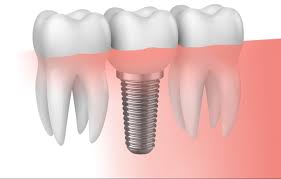
There are three separate components, and understanding them explains almost everything about timing and cost. The implant is a titanium screw placed into the jawbone, replacing the root of the tooth. The abutment is the connector attached to the implant once it has integrated, projecting through the gum. The crown is the visible tooth, fitted onto the abutment. A quote for "an implant" may mean any of these — which is where most confusion arises when comparing prices.
Why it takes two trips
Because bone has to grow onto the implant before it can carry a tooth. That process — osseointegration — takes three to six months, and it cannot be rushed. It is biology, not scheduling. On trip one the implant is placed, and you leave with a temporary tooth where it matters. Then three to six months at home, during which the implant integrates. On trip two the abutment and the definitive crown are fitted. Any clinic offering a permanent crown on a fresh implant in a single week is not describing osseointegration accurately.
Why an implant rather than a bridge
An implant replaces the root, which means it stimulates the bone and prevents the resorption that follows tooth loss. And it does not involve the neighbouring teeth. A conventional bridge requires the teeth on either side to be prepared — permanently reduced — to carry it. Where those teeth are healthy, an implant preserves them. Where they are already heavily restored or crowned, a bridge is a reasonable option, and our page on fixed dental bridges in Tunisia covers that route.
How long do implants last?
With good hygiene and regular maintenance, published survival rates at ten years are high, and a substantial proportion are functioning well at twenty years and beyond. The two things that determine it are your cleaning and your follow-up — both covered in detail further down this guide.
Are you a candidate?
What is needed: adequate bone volume, assessed by CBCT — and where it is lacking, bone grafting or a sinus lift can create it. Healthy gums, since active gum disease is treated before implants are placed. General health sufficient for a minor surgical procedure. And a commitment to cleaning and follow-up, which matters more than most patients expect.
Where we would want to talk first: uncontrolled diabetes, which affects healing and integration — well-controlled diabetes is not a barrier. Smoking, which is the single largest modifiable risk factor for implant failure. Certain bone medications, particularly intravenous bisphosphonates — tell us what you take. Recent radiotherapy to the jaw. And untreated gum disease, which we address first rather than work around.
If a tooth is still in place, frequently the implant can be placed at the time of extraction, which saves a healing phase and sometimes a trip. Whether that applies to you is a CBCT question, and your plan will say.
The CBCT scan: why the planning matters more than the implant
A CBCT is a three-dimensional scan of your jaw, showing bone height, bone width, bone density, and the position of the nerve in the lower jaw and the sinus in the upper. A two-dimensional panoramic X-ray cannot show width or density. It shows a flat picture of a three-dimensional problem.
What it establishes: whether you have enough bone, and where. Whether grafting or a sinus lift is needed, which changes your timeline and your cost — and which is far better known before you book than discovered during surgery. Where the nerve runs in the lower jaw, because placing an implant too close to it causes lasting numbness of the lip and chin, and the CBCT is what prevents that. Where the sinus sits in the upper jaw. And where the implant should go to support a tooth in the right position — not simply where there happens to be bone.
This is the question to ask any clinic: « Un scanner 3D est-il réalisé avant la pose ? » A clinic placing implants from a panoramic X-ray alone is planning a three-dimensional procedure with two-dimensional information. We perform a CBCT on every implant patient, and the planning is done on it before anything is placed.
Can I have it done in Canada? Yes, and a number of patients do. It is available at most Canadian dental radiology practices and it is frequently more economical than you expect. Send us the DICOM files — the raw scan data, not a printed report — and we can plan from them and give you a far more accurate quote before you travel. That is the single most useful thing you can do at the enquiry stage.
Gum disease: treated first, not worked around
Implants are susceptible to a condition analogous to gum disease, called peri-implantitis — inflammation with progressive bone loss around the implant. A patient with untreated gum disease who receives implants is at materially higher risk of losing them.
We assess your gum health at your first appointment, and treat what needs treating before implants are placed. Where periodontal treatment is needed, it forms part of your plan and it may extend your first trip. A clinic that skips this is not saving you money: it is placing implants in a mouth where the conditions that caused tooth loss are still active. Ask: « Mon état parodontal sera-t-il évalué et traité avant la pose ? »
Why Canadian patients choose Tunisia
| Canada (private) | Tunisia — Aylan Clinic | |
|---|---|---|
| Cost | High, and annual insurance maximums are quickly exhausted | Up to 60% less |
| Language | English or French | French throughout the country |
| Dentist training | Canadian | Frequently French-trained |
| CBCT planning | Standard at good practices | Standard, included |
| Laboratory | External | In-house, technician on site |
| Accommodation | Not applicable | Included, full board |
| Companion | Not applicable | Free, accommodated and fed |
| Implant passport | Should be provided | Provided as standard |
Where the cost difference bites hardest is Canadian dental insurance annual maximums. A single implant frequently exhausts a substantial part of a yearly maximum, and a patient needing several is looking at treatment spread across multiple benefit years — driven by insurance limits rather than by clinical logic. Here the sequence is determined by what your mouth needs.
Where the in-house laboratory matters: the technician is in the same building, which means try-ins happen during your visit rather than by post, and adjustments are made the same day. For crowns on front teeth in particular, having the ceramist see you in person rather than work from a shade tab is what produces a natural result.
Where the language matters on this treatment is your treatment plan. An implant plan involves several components, a timeline across two trips, and frequently a decision about grafting. Understanding it properly — and being able to ask what happens if something changes — is what makes patients comfortable committing to a course of treatment they will complete months later. And your documentation is in French, which matters when you hand it to your dentist in Quebec City or Moncton. On training: a substantial proportion of Tunisian dentists and oral surgeons trained in France. Ask where yours qualified. We answer directly.
Part two — preparing
From first contact to confirmed dates
The online consultation begins with a recent panoramic X-ray — and if you have a CBCT, send the DICOM files. What to send: the panoramic radiograph, any CBCT, photographs of your smile and of the area concerned, a note of which teeth are missing and how long they have been missing, your medical history and all medications, whether you have or have had gum disease, and whether you smoke. In French or in English, whichever you prefer.
What you receive is a plan naming how many implants, where, whether grafting or a sinus lift is anticipated, the number of trips, the intervals, and the cost of the whole course — itemised by component, within 24 to 48 hours. We itemise by component because "an implant" means three things, and a quote that does not separate them cannot be compared with one that does. Your quote lists the implant, the abutment and the crown separately, plus any grafting.
Questions worth asking before you commit
- « Un scanner 3D est-il réalisé, et la planification se fait-elle dessus ? » — the most important question.
- « Le devis comprend-il l’implant, le pilier et la couronne ? » — the most common source of quote confusion.
- « Mon état parodontal sera-t-il évalué et traité d’abord ? »
- « Une greffe osseuse ou un comblement sinusien est-il anticipé ? » — better known before booking.
- « Quelle marque d’implant, et recevrai-je un passeport implantaire ? »
- « Combien de voyages, et à quels intervalles ? »
- « Aurai-je une dent provisoire entre les deux voyages ? » — for a front tooth this matters a great deal.
- « Où votre praticien a-t-il été formé ? »
What to arrange at home before you travel
Stop smoking — it is the single largest modifiable risk factor. Have any active dental infection treated, and tell us about it. Get your CBCT done in Canada if you can, because it transforms the accuracy of your plan and your quote. Arrange your Canadian dentist for follow-up — one conversation, before you travel. And bring a complete medication list, including bone medications and blood thinners.
Your temporary teeth between trips
This is worth addressing early, because it is what patients worry about most. For a front tooth, you will not go home with a gap: a temporary tooth is provided — typically a bonded temporary or a small removable appliance — so that your appearance is normal between trips. Say so at consultation if this matters to you, and it will be built into the plan. For a back tooth, frequently nothing is needed, since it is not visible and you can chew elsewhere.
What a temporary is not: it is not the definitive crown. It is designed to look reasonable and function adequately for a few months, not to match the final result. Patients who understand that are comfortable with it.
Part three — the trips
Trip one: placement
Typically four to six days, longer where grafting or periodontal treatment is involved.
Day 1 — Arrival. Your driver meets you at the airport and takes you to your hotel with your companion. Nothing clinical today.
Day 2 — Assessment and planning. Clinical examination, periodontal assessment, photographs, and CBCT if you have not brought one. Then your consultation: the plan on screen, with your scan in front of you — how many implants, where, why there, and what the timeline looks like. By the end of the day your plan is confirmed.
Day 3 — Surgery. Implant placement under local anaesthesia, with sedation available. Forty-five minutes to two hours depending on the number of implants and whether grafting is performed. Most patients are surprised by how straightforward it is: the sensation is pressure rather than pain, and the discomfort afterwards is generally less than an extraction. Your temporary tooth is fitted where one is planned.
Days 4 to 5 — Review and healing. A review appointment to check the site and your temporary. Swelling peaks around day two or three. Ice, and the medication you are given on schedule. Soft food.
Day 6 — Final check and departure. Final review, and your documentation: treatment report, your CBCT, written aftercare guidance in French or English, and your implant passport. Then your transfer to the airport.
The interval is three to six months, during which the implant integrates. Your plan states the interval, and it is a minimum rather than an appointment — if four months suits you better as six, that is entirely fine. Integration simply continues.
Smoking: the honest section
We put this in the treatment section rather than the small print, because it is the single largest modifiable factor in implant success.
What the evidence shows: smoking substantially increases the risk of implant failure, and it increases the risk of peri-implantitis over the years. The mechanism is direct — nicotine constricts the small blood vessels the bone and gum depend on to heal around the implant.
What we ask: stop for at least four weeks before placement and eight weeks afterwards, and ideally permanently. Canadian provincial quitlines are free, your pharmacist can advise on nicotine replacement, and combining behavioural with pharmacological support roughly doubles success rates.
If you are not going to stop, tell us honestly. We would rather plan around it than have you tell us what you think we want to hear. We will still treat you — but the plan, the expectations and the follow-up schedule are adjusted, and you should know your risk is higher. A clinic that does not raise this is not managing your long-term outcome.
Trip two: the crown
Typically four to six days, three to six months after placement.
Day 1 — Arrival. Transfer to your hotel. Nothing clinical today.
Day 2 — Assessment and impressions. A radiograph confirming integration. Then the abutment is placed and impressions or a digital scan taken for your crown. Shade selection with the ceramist present — and for a front tooth this is where the in-house laboratory earns its value.
Days 3 to 4 — Fabrication and try-in. Your crown is made in the on-site laboratory. A try-in appointment where you see it before it is finalised — shape, shade, how it sits against the neighbouring teeth. Say what you want changed. It is adjustable now.
Day 5 — Fitting. Your definitive crown is fitted, the bite is checked and adjusted.
Day 6 — Final check and departure. A final check, cleaning instruction specific to your implant, and your documentation: treatment report, updated implant passport, written care instructions in French or English, and guidance for your Canadian dentist. Then your transfer to the airport.
Eating, and the first weeks after placement
After placement: soft food for the first week, avoiding the implant site. No hot food or drink on the day of surgery. No straws, no rinsing vigorously, and no smoking. Ice for the first day or two, twenty minutes at a time. Take the medication you are given on schedule rather than waiting for discomfort to build.
Week two onward: gradually returning to normal food, still avoiding hard or crunchy items directly on the site until your dentist confirms.
What is normal: swelling peaking at day two or three, some bruising, a metallic taste occasionally, and minor bleeding on the first day.
What warrants contacting us: increasing pain after day three rather than improving; fever; significant swelling that worsens after day three; the temporary coming loose, which is not urgent but should be dealt with. Contact us — we are available, in French or English, and a photograph is usually enough for us to advise.
Part four — the years that follow
Your implant passport
You receive a record of the implant brand, model, diameter, length and lot number, for each implant placed, plus the position.
It matters for three concrete reasons. If a component ever needs replacing — a crown, an abutment, a screw — a dentist needs to know the exact system to obtain compatible parts, because implant systems are not interchangeable. If a manufacturer issues a safety notice, you need to know whether yours is affected. And if you ever need treatment in an emergency, or see a different dentist, the information is there.
Keep the original, photograph it, and give a copy to your Canadian dentist. Ask any clinic whether they provide one. It should be automatic, and if the answer is vague, that tells you something.
Cleaning an implant: it is different
An implant does not decay. But the bone around it can be lost, and that is what peri-implantitis is. The tissue attachment around an implant is weaker than around a natural tooth, which means plaque at the margin does more damage more quickly.

What is required: brushing twice daily, as with natural teeth; and cleaning between and around the implant, which is the part that differs. Depending on your situation — interdental brushes, superfloss, or a water flosser — and your dentist will show you which applies to your implant. Ask for a hands-on demonstration before you leave, with your own implant, rather than a printed sheet.
What to avoid: abrasive toothpaste on the crown margin; and neglecting the area because it does not decay, which is the most common mistake and the one that causes late failures.
Professional cleaning every six months, and your hygienist should know you have an implant. Instruments appropriate for implant surfaces exist, and metal scalers designed for natural teeth can damage the implant surface. Tell them. It is one sentence.
Your Canadian follow-up
What is required: a check-up and professional cleaning every six months, and a radiograph of the implant periodically to monitor bone levels. That is the whole commitment, and it is ordinary dental care. Your Canadian dentist provides it — this is routine work, and they are not being asked to take over the case, only to maintain it.
How to arrange it: have the conversation before you travel, and it is a simple one. « J’aurai un implant posé à l’étranger. Je reviendrai avec un compte rendu, un passeport implantaire et une radiographie. Pourriez-vous assurer le suivi habituel et un contrôle radiographique périodique ? » Most dentists say yes without hesitation.
If your dentist is hesitant, some are cautious about work they did not perform, which is a reasonable professional position rather than obstruction. What helps: approaching them beforehand rather than afterwards, being clear you are asking for routine maintenance, and bringing your documentation and implant passport. If they decline, tell us and we will help you work out the options.
This matters because implants that are maintained have excellent long-term survival, and implants that are not are the ones that fail at year seven. Arranging it takes one conversation. Not arranging it is the one avoidable mistake in an otherwise straightforward pathway.
Canadian insurance
Implants are frequently covered in part by Canadian dental plans, subject to your annual maximum — and treatment abroad may be reimbursable at your plan's rate. Ask your insurer in writing whether they reimburse treatment received outside Canada and at what rate, and request pre-determination if available. We provide itemised invoicing listing each component separately — implant, abutment, crown — in French or English. That itemisation is what makes a claim processable.
Part five — practical matters
Canadian patients: travelling to Tunisia from your region
Aylan Clinic works with patients from every province and territory in Canada. Wherever you live, the process begins the same way: a free consultation from your panoramic X-ray, in French or English.
Montreal and the surrounding region. Montreal is our largest Canadian source for Tunisia. Connections from Trudeau to Tunis typically route through Paris, Frankfurt or Istanbul, and patients from Laval, Longueuil and Brossard are all within easy reach of the airport. For a two-trip course, the frequency of Montreal departures makes scheduling straightforward — and many patients time the second trip around travel they were making anyway.
Quebec City and across the province. From Quebec City and the Capitale-Nationale region including Lévis, most patients connect through Montreal — as do patients from Trois-Rivières, Sherbrooke, Drummondville and Saint-Jérôme, all within driving distance of Trudeau. Gatineau patients depart from Ottawa or drive to Montreal. From Saguenay, a domestic connection through Montreal is the norm. Everything is in French — your treatment plan, your written aftercare, your implant passport, and the report you hand to your dentist at home.
Acadia and New Brunswick. We work with patients from Moncton, Fredericton and Saint John. Moncton and the surrounding Acadian communities are served in French throughout. Most connect through Montreal, which for francophone patients means French-language service from departure to arrival.
Francophone Ontario. Sudbury, Thunder Bay and Sault Ste. Marie all have substantial francophone populations, served in French from first contact onward. Journeys involve a domestic connection. Ottawa patients typically connect through Montreal.
Greater Toronto Area and southern Ontario. Toronto patients connect through European hubs, with Paris and Frankfurt the most common routes to Tunis. Across the wider Greater Toronto Area we work with patients from Mississauga, Brampton, Markham, Vaughan, Richmond Hill and Oshawa. Along the lake: Hamilton, Burlington, Oakville, St. Catharines and Niagara Falls. In southwestern Ontario: London, the Waterloo region — Kitchener, Waterloo and Cambridge — plus Guelph, Windsor and Barrie. Kingston patients generally drive to Toronto or Montreal.
Vancouver and British Columbia. Vancouver patients face the longest journey — typically two connections — so we schedule assessment for the day after arrival. Across the Lower Mainland: Surrey, Burnaby and Richmond. From Victoria and Nanaimo, patients cross by ferry or short flight. Kelowna, Abbotsford and Kamloops patients connect through Vancouver or Calgary. Because the journey is long, we plan British Columbia courses to accomplish as much as possible per trip — and where the CBCT allows simultaneous grafting and placement, we plan for it, since it converts a three-trip course into two.
Alberta. Calgary and Edmonton both offer European connections onward to Tunis. Red Deer and Lethbridge patients generally drive to Calgary.
Manitoba and Saskatchewan. Winnipeg patients connect through Toronto or Montreal, and the francophone community of Saint-Boniface is served in French. From Saskatoon and Regina, journeys involve a domestic connection followed by two further flights.
Atlantic Canada. Halifax patients typically route through Montreal or Toronto. From Charlottetown and St. John's, journeys involve two or three connections.
Northern Canada. We work with patients from Whitehorse in Yukon, and from communities across the Northwest Territories and Nunavut. For northern patients we plan to minimise trips — simultaneous grafting and placement wherever the CBCT allows, and everything needed combined into each visit. We also discuss your Canadian follow-up access early, since it matters as much as the surgery, and we plan northern itineraries with buffer days at both ends.
How we handle the logistics. Whichever city you are travelling from, your coordinator arranges airport transfers at both ends in Tunisia, confirms your hotel before you depart, and builds your schedule around your arrival time. Four recommendations: send your panoramic X-ray first — and a CBCT if you can get one in Canada; arrange your Canadian dentist before you travel; plan your trips around your own calendar, since the interval is a minimum rather than an appointment; and stop smoking.
What your package includes
- Free consultation in French or English, with a plan and quote itemised by component
- Full on-site assessment: clinical examination, periodontal assessment, photographs
- CBCT scan and three-dimensional planning
- Periodontal treatment where needed before placement
- Implant placement under local anaesthesia, sedation available
- Implants from established international manufacturers, named in your plan
- Bone grafting or sinus lift where planned
- Temporary tooth where one is needed
- Review appointments during each stay
- Abutment and definitive crown made in our on-site laboratory
- Shade selection with the ceramist present
- Try-in before the crown is finalised
- Bite adjustment
- Hands-on cleaning instruction specific to your implant
- Written care guidance in French or English
- Treatment report, your CBCT, and an implant passport recording brand, model, dimensions and lot number
- Guidance for your Canadian dentist
- Itemised invoicing listing implant, abutment and crown separately
- Hotel accommodation, full board, for each trip
- A companion at no extra cost, accommodated and fed in the same room
- Airport–clinic–hotel transfers
- A personal coordinator from arrival to departure
- French-speaking care throughout, with English available on request
The clinical team: an oral surgeon or implantologist for placement, grafting and sinus lift, frequently French-trained; a prosthodontist for the abutment, crown and bite; a periodontist for gum treatment before placement; a dental radiologist for CBCT interpretation; a master ceramist on site for shade and anterior aesthetics; and an in-house laboratory for fabrication and same-visit adjustments.
Results by patient profile
A single back tooth. A patient who had lost a lower molar and did not want the neighbouring healthy teeth prepared for a bridge. One implant, two trips, four months apart. No temporary needed since it was not visible. The most straightforward presentation, and among the most predictable.
A front tooth. A patient who had lost an upper front tooth in an accident. A temporary bonded tooth from the day of placement, so she was never without. Shade selection with the ceramist in the room, and a try-in before the crown was finalised. For a front tooth, the in-house laboratory is what makes the difference between a crown that matches and one that nearly does.

Where the CBCT changed the plan. A patient whose panoramic X-ray looked adequate. Her CBCT showed insufficient bone width in one site. A graft was planned at the time of placement — which added healing time but avoided a failed implant, and it was known before she booked rather than discovered in the chair. This is what the scan is for.
Gum disease treated first. A patient with moderate periodontal disease and several failing teeth. Periodontal treatment first, then extractions and implants once the gums were healthy. A longer plan, and the right one. Placing implants into an actively inflamed mouth would have been building on a deteriorating foundation.
A patient who got her CBCT in Canada. A patient who had a CBCT taken in Montreal and sent us the DICOM files. Her plan and quote were accurate before she booked anything, including the confirmation that no grafting was needed. This is the single most useful thing a patient can do at the enquiry stage.
A patient from Rimouski. A patient who chose Tunisia so that the whole treatment plan could be explained in French. Her comment concerned the two-trip structure. She said that understanding exactly what would happen, when, and what would happen if she needed to move the second trip — in her own language — was what made her comfortable committing to a course of treatment she would finish six months later.
Practical points to know
What to expect: placement under local anaesthesia, with pressure rather than pain, and discomfort afterwards generally less than an extraction. Swelling peaking at day two or three. Soft food for a week. Three to six months of integration, during which you wear a temporary where one is needed. A second trip for the crown, with a try-in before it is finalised.
Recognised points. Dental implants are among the most predictable procedures in dentistry, with high published survival rates in well-selected, well-maintained patients. Your surgeon will discuss the considerations relevant to you. The main ones: failure to integrate, uncommon, where the implant does not bond to the bone — it is removed and, after healing, usually replaced successfully; infection, uncommon and treated promptly; peri-implantitis, inflammation with bone loss around the implant over the years, the main late consideration and largely preventable with the cleaning and follow-up described above; nerve injury in the lower jaw causing numbness of the lip or chin, which is precisely what the CBCT is performed to prevent; sinus complications in the upper jaw; screw loosening, straightforward to correct; crown fracture or wear over many years; and gum recession exposing the implant margin, more likely with thin tissue.
Three things within your control: stopping smoking, the largest modifiable factor; cleaning around the implant properly; and attending your six-monthly follow-up in Canada.
Who this suits: adults with adequate bone or the willingness to have it created, healthy or treatable gums, general good health, and the intention to maintain the implant. In pregnancy, elective implant treatment is deferred.
Price: how it is built and how to compare it
We quote per case, because the number of implants, whether grafting is needed, whether periodontal treatment comes first, and the number of trips all vary. Your quote is built from your radiograph — and your CBCT where you send one — itemised by component, and fixed once you approve it.
What determines your price. Six factors: how many implants, and where; whether bone grafting or a sinus lift is needed, which is the largest variable and the one the CBCT establishes; whether periodontal treatment is required first; the implant brand, which is named in your plan; the crown material — zirconia, porcelain-fused-to-metal, or layered ceramic for anterior teeth; and the number and length of your trips.
What is included in your quote: everything in the package list above, including the CBCT and three-dimensional planning, periodontal treatment where needed, the placement, the implant, abutment and crown, any grafting, the temporary, all review appointments, the crown made in our on-site laboratory with a try-in, cleaning instruction, your treatment report, CBCT and implant passport, guidance for your Canadian dentist, itemised invoicing, your hotel with full board for each trip, transfers, and your coordinator. A companion is accommodated and fed at no additional cost, on every trip.
What sits outside it: flights for each trip, travel insurance, your six-monthly maintenance in Canada, and eventual crown replacement after many years.
How to compare quotes properly. Five checks, and implant quotes are among the least comparable in dentistry. Does the quote include the implant, the abutment and the crown? That is the single largest source of confusion, since a quote for "an implant" at a very low price frequently means the screw alone. Is a CBCT included, and is the planning done on it? Is grafting anticipated, and is it included or extra — a quote that does not mention it may become considerably more expensive once you are in the chair. Is the implant brand named, since established international manufacturers with long-term data and available components sit at a different price point from unbranded systems, and components you cannot obtain in fifteen years are a genuine problem. And is an implant passport provided?
Why the lowest quote is rarely the best value. On implants, the savings available are identifiable: no CBCT, an unnamed implant system, grafting priced separately once you have arrived, and the crown quoted as an extra. The implant brand matters most long term. In fifteen years, when a crown needs replacing, a dentist in Sherbrooke needs to obtain a compatible abutment. For an established international system that is routine. For an unbranded one it may be impossible — and the whole implant then has to be replaced. That is what your implant passport and a named brand protect you from.
Insurance and payment. Implants are frequently covered in part by Canadian dental plans, subject to your annual maximum, and treatment abroad may be reimbursable at your plan's rate. Ask your insurer in writing, request pre-determination if available, and note that where your treatment spans two calendar years, two annual maximums may be available — worth asking how your insurer dates a claim. Our itemised invoicing lists each component separately, in French or English. A deposit confirms the dates for each trip, and the balance for each is settled on site, under terms set out in full when you approve your plan. There are no additional charges once accepted — and where the CBCT changes the plan, we discuss the revised plan and cost with you before proceeding.
Getting your figure. Send a recent panoramic X-ray — and DICOM files if you have a CBCT. Add photographs of your smile and the area concerned, a note of which teeth are missing and for how long, your medical history and medications, whether you have gum disease, and whether you smoke. You will receive a plan and quote within 24 to 48 hours, itemised by component, in French or English.
Glossary
| Term | Meaning |
|---|---|
| Implant | The titanium screw placed in the jawbone, replacing the root |
| Abutment | The connector between implant and crown |
| Crown | The visible tooth |
| Osseointegration | Bone growing onto the implant; takes three to six months |
| CBCT | Three-dimensional scan showing bone height, width, density and nerve position |
| Peri-implantitis | Inflammation with bone loss around an implant; the main late consideration |
| Bone grafting | Creating bone volume where it is insufficient |
| Sinus lift | Raising the sinus floor to create bone height in the upper jaw |
| Immediate placement | Implant placed at the time of extraction |
| Implant passport | Record of brand, model, dimensions and lot number |
How Canadians search for this
- "Dental implants Tunisia cost" — the most common search. Ask whether the quote includes the abutment and crown.
- "Implants dentaires Tunisie" — how most Quebec patients search, and the reason this page exists in both languages.
- "How much does a dental implant cost in Canada" — the comparison point, and the reason annual insurance maximums matter.
- "Dental implant two trips" — yes, three to six months apart, because osseointegration cannot be rushed.
- "Implant or bridge" — an implant preserves the neighbouring teeth; a bridge requires preparing them. Where they are already crowned, a bridge is reasonable.
- "Do I have enough bone for an implant" — a CBCT question. Get one in Canada and send the DICOM files.
- "Dental implant failure rate" — low in well-selected, well-maintained patients. Smoking is the largest modifiable factor.
- "Peri-implantitis" — bone loss around an implant, the main late consideration, and largely preventable with cleaning and six-monthly follow-up.
- "How to clean dental implants" — differently from natural teeth. Ask for a hands-on demonstration.
- "Dental implant brand" — named in your plan, and it matters in fifteen years when a component needs replacing.
- "Dental implant passport" — you should receive one. Ask any clinic.
- "Are dental implants covered by insurance Canada" — frequently in part, subject to your annual maximum. Ask about treatment abroad and pre-determination.
- "French speaking dentist abroad" — Tunisia's distinguishing feature.
In summary
Dental implants at Aylan Clinic Tunisia combine CBCT planning before anything is placed, periodontal treatment first where needed, implants from established international manufacturers named in your plan, a crown made in our on-site laboratory with the ceramist present at your shade selection, and an implant passport you keep permanently. And it takes place in a French-speaking country, which means your treatment plan, your aftercare and the report you hand to your dentist at home are all in your own language — with accommodation, full board and a companion at no extra cost on every trip, for up to 60% less than Canadian private prices.

Five things determine whether your implants last thirty years. Get a CBCT — and if you can have one taken in Canada and send us the DICOM files, your plan and quote will be accurate before you book anything. Have your gums treated first, because implants placed into an inflamed mouth are built on a deteriorating foundation. Check that any quote includes the implant, the abutment and the crown, the single largest source of confusion when comparing. Stop smoking, the largest modifiable factor in implant failure — and we would rather you told us honestly. And arrange your six-monthly follow-up in Canada before you travel: one conversation, and it is what separates implants that last decades from implants that fail at year seven.
Continue with the procedure page on tooth implant surgery in Tunisia for the operation, the stay and the care that follows, explore the wider dental care in Tunisia section, compare plastic surgery prices in Tunisia, or request a free, personalized quote. Send your panoramic X-ray and you will have a plan within 24 to 48 hours — in French or in English.
Related reading: All-on-4 dental implants, All-on-6 dental implants, dental bone grafting, sinus lift, fixed dental bridges and full mouth restoration in Tunisia.