
All-on-6 at Aylan Clinic Tunisia allows patients from Montreal, Quebec City, Toronto, Ottawa, Moncton and across Canada to replace a full arch of teeth on six implants — with fixed teeth fitted during the same trip — for up to 60% less than Canadian private prices. This guide exists because six implants are not simply “better than four”. They are the right answer for a specific group of patients, and an unnecessary expense for others. It sets out honestly which group you are in, what the two extra implants actually buy you, and what the whole course involves from first contact to your Canadian follow-up.
This is the pedagogical guide. When you are ready to look at the procedure itself — how it is performed, the length of each stay and the aftercare — see our page on All On 6 Dental Implant in Tunisia, and compare figures on our plastic surgery prices in Tunisia page. The full range of treatments is set out in our dental care in Tunisia overview.
One thing distinguishes Tunisia: it is a French-speaking country. Not a clinic with French-speaking staff — a country where French is a working language across dentistry and daily life. English is available on request throughout.
Two things about All-on-6 deserve to be understood before you commit. The teeth you leave with on trip one are temporary: fixed, presentable, and not your definitive bridge. And the additional resilience is the real argument, not the additional implants in themselves — what that means when something goes wrong in year eight is explained below. This guide is organised around your journey: deciding, preparing, the trips, and the years that follow.
Part one — Deciding
What All-on-6 is
The concept is a full arch of fixed teeth, supported on six implants. Typically four implants are placed vertically across the front and middle of the arch, with two angled at the back — the same principle as All-on-4, with two additional implants distributing the load. A bridge of twelve teeth is fixed onto those six implants.
What the two extra implants change
Three things, and they are worth stating precisely.
- Load distribution. Six points of support spread the force of chewing more evenly across the arch and across each implant.
- Reduced cantilever. With more implants, and implants positioned further back, the bridge extends less far beyond the last implant. That overhanging portion — the cantilever — is where mechanical stress concentrates, and reducing it reduces stress on the whole construction.
- Resilience. Explained in its own section below, because it is the argument that actually matters.
What it replaces
An upper arch, a lower arch, or both. For patients with a failing dentition — teeth breaking, moving, repeatedly treated — it replaces a cycle of emergencies with a single definitive solution. For patients wearing a complete denture, it replaces something that moves with something that does not.
Fixed, not removable
The bridge is screwed onto the implants. It does not come out. You clean it in your mouth, differently from natural teeth. Only your dentist removes it, at a maintenance appointment.
Four or six? The honest assessment
This is the most useful section on this page.
Where six is genuinely the better choice
- Softer bone. Bone density varies considerably between patients and between jaws — the upper jaw is typically softer than the lower, and the back of the upper jaw is softer still. Where your CBCT shows lower density, six implants distribute the load across more surface area, and that is a real advantage rather than a marketing one.
- Significant bruxism. Grinding transmits substantially higher forces than normal chewing, sustained over hours. Six implants and a shorter cantilever handle that better, and this is one of the clearest indications.
- A natural opposing arch. This matters more than patients expect. A full arch of natural teeth delivers considerably more force than a denture or another bridge opposing it. Where your lower teeth are natural and your upper arch is being reconstructed, the forces are at the high end — and six implants are a reasonable response.
- A long arch, or a large jaw. More span to support.
- Where you want more resilience — see the section that follows.
Where four is the right answer
Good bone density, confirmed on CBCT. No significant bruxism. A denture or another bridge opposing, delivering moderate forces. And where the posterior angulation of All-on-4 works well with your anatomy, which the CBCT establishes. In that situation, six implants are two more than you need, with two more surgical sites, more cost, and no measurable benefit. We will say so.
How we decide
From your CBCT — bone density and volume across the arch — your bite, what opposes the arch, and whether you grind. Your plan states which we recommend and why, with the reasoning referenced to your own anatomy rather than a general preference.
Ask directly: « Quatre ou six implants dans mon cas, et pourquoi ? » An answer that references your bone density, your opposing arch and whether you grind is an assessment. An answer that says “six is always better” is not.
Where neither is right
Where you have healthy teeth in the arch, All-on-6 requires removing them. We will not remove sound teeth to fit a treatment plan — and individual implants, crowns and bridges may serve you better. Our full mouth rehabilitation page covers that route.
Where a removable option would suit you better, an implant-retained overdenture on two to four implants costs considerably less, clips firmly, and some patients genuinely prefer being able to remove it for cleaning. Our page on removable dentures in Tunisia covers it.
The resilience argument, explained properly
This is the argument for six implants that actually matters, and it is rarely explained clearly.
What happens if an implant is lost
Implants occasionally fail — during integration, or years later through peri-implantitis. With six implants, losing one leaves five. The bridge frequently continues to function, and the situation is managed by placing a replacement implant or, in some cases, by adjusting the bridge. With four implants, losing one leaves three. That is frequently not enough to support a full arch bridge safely — which may mean placing a new implant and waiting for it to integrate, with the bridge out of service or converted to something temporary in the meantime.
Why this matters more at year eight than at year one
Because early failures are uncommon and usually straightforward to redo. It is the late failure — at year seven, eight, ten — that is disruptive, when you have a definitive bridge in place and a functioning mouth. Six implants give you a margin. For a patient who wants to minimise the chance of a significant problem years later, that margin is the reason to pay for two more implants.
Being honest about the frequency
This does not happen often. Implant survival rates in well-maintained patients are high, and most patients with All-on-4 never face it. But the consequence when it does happen is materially different, and that difference is worth understanding before you choose.
What reduces the risk either way
Not smoking. Cleaning under the bridge properly. Six-monthly maintenance. And a night guard if you grind. Those four things matter more than the number of implants — which is worth saying plainly, because a patient who chooses six and neglects maintenance is worse off than a patient who chooses four and maintains it.
The CBCT scan
What it establishes
Bone height, width and — critically for this decision — density, across the whole arch. The position of the nerve in the lower jaw, and the sinus in the upper. Whether six implants can be placed, and where: more implants require more suitable sites, which is not always available, and where it is not, four well-placed implants are better than six poorly placed ones. And whether bone grafting or a sinus lift is needed.
Why density matters here specifically
Because bone density is one of the main reasons to choose six over four. A panoramic X-ray cannot show it. A CBCT can, and it is what turns the four-or-six question from a preference into an assessment.
Get it in Canada if you can
Send us the DICOM files — the raw scan data. Your plan and quote will be accurate before you travel, including the four-or-six recommendation and whether grafting is anticipated. For a full-arch case this is the single most useful thing you can do at the enquiry stage.
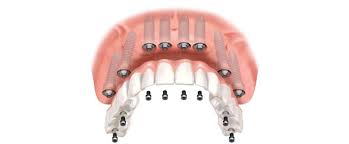
Your temporary bridge
What happens on trip one
Teeth are extracted where needed, six implants are placed, and a fixed temporary bridge is fitted — frequently the same day or the following day. You leave with fixed teeth. You are never without.
Why it is temporary
Because the implants have not yet integrated. The temporary is designed to look good, function adequately, and — importantly — to be lighter and more forgiving than a definitive bridge while bone is bonding to the implants. It is usually acrylic, and it is not intended to last.
What the definitive bridge is
Made at trip two, three to six months later, once integration is confirmed on radiograph. A different object: stronger materials, better fit, refined aesthetics, and made to last. The material choice is covered further down this page.
When comparing clinics
Ask directly: « Le bridge posé lors du premier séjour est-il provisoire ou définitif ? » A clinic offering “permanent teeth in one week” is either describing the temporary as permanent, or not describing osseointegration accurately.
Living with the temporary
Most patients find it entirely acceptable — it looks good, it is fixed, and it functions. Avoid very hard foods during integration, and if it fractures, contact us: it is repairable, and we can usually advise a local dentist on the repair.
Why Canadian patients choose Tunisia
| Canada (private) | Tunisia — Aylan Clinic | |
|---|---|---|
| Cost | Very high for full-arch work | Up to 60% less |
| Insurance | Annual maximum exhausted immediately | Same limitation, far lower total |
| Language | English or French | French throughout the country |
| Dentist training | Canadian | Frequently French-trained |
| Laboratory | External | In-house, technician on site |
| Accommodation | Not applicable | Included, full board |
| Companion | Not applicable | Free, accommodated and fed |
Why the absolute saving is largest here
Full-arch treatment involves a large number of components, and with six implants rather than four, the difference in absolute dollar terms between Canada and Tunisia is correspondingly larger. A number of patients find that All-on-6 in Tunisia costs less than All-on-4 in Canada — which changes the four-or-six decision from a financial one into a purely clinical one. That is worth knowing, because it means you can choose what your anatomy calls for rather than what your budget allows.
Where the in-house laboratory matters
Your definitive bridge is made on site, with the technician available. The try-in is where you see twelve teeth on your own face, and having the technician in the room while you assess it is worth more than any written instruction.
Where the language matters on this treatment
Two moments. The four-or-six conversation, which is a genuine clinical discussion about your bone density, your bite and your risk tolerance — understanding the trade-off properly is what makes the decision yours rather than the clinic’s. And the try-in, where you assess a full arch of teeth on your own face and say what you want changed, using vocabulary most people do not use daily. Patients consistently tell us they understood more and said more in their own language.
Dentist training
A substantial proportion of Tunisian dentists and oral surgeons trained in France. Ask where yours qualified. We answer directly.
Part two — Preparing
The online consultation
Send a recent panoramic X-ray — and DICOM files if you have a CBCT.
What to send: the panoramic radiograph, any CBCT, photographs of your smile, your teeth apart, and your face from the front and side, a note of which teeth remain and their condition, what opposes the arch being treated (natural teeth, a denture, or an existing bridge), your medical history and all medications, whether you grind, and whether you smoke. If you wear a denture, photograph it — and bring it with you. In French or in English, whichever you prefer.
What you receive
A plan naming whether four or six implants and why, whether the temporary is immediate, the number of trips, the intervals, the material for your definitive bridge, and the cost of the whole course. Within 24 to 48 hours. You can start with a free, personalised quote.
Questions worth asking before you commit
- « Quatre ou six implants dans mon cas, et pourquoi ? » — the most important question, and the answer should reference your bone density, your opposing arch and whether you grind.
- « Un scanner 3D est-il réalisé, et la planification se fait-elle dessus ? »
- « Le bridge du premier séjour est-il provisoire ou définitif ? » — the answer should be temporary.
- « Quel matériau pour le bridge définitif, et pourquoi celui-là ? »
- « Une greffe est-elle anticipée ? »
- « Y a-t-il assez de sites osseux pour six implants ? » — four well-placed implants are better than six poorly placed ones, and a surgeon willing to say so is assessing you.
- « Recevrai-je un passeport implantaire ? »
- « Comment nettoie-t-on sous le bridge, et me le montrerez-vous ? »
- « Où votre praticien a-t-il été formé ? »
What to arrange at home before you travel
Stop smoking. It is the largest modifiable risk factor for implant failure, and on a full arch the consequences are correspondingly larger. Four weeks before and eight weeks after, and ideally permanently. Canadian provincial quitlines are free, your pharmacist can advise on nicotine replacement, and combining behavioural with pharmacological support roughly doubles success rates.
Get your CBCT in Canada if you can. Arrange your Canadian dentist for maintenance. Bring a complete medication list, including bone medications and blood thinners. Prepare soft food for the first weeks after your return. And buy a water flosser — for a full-arch bridge it is close to essential.
Preparing for a long surgical appointment
Extractions and six implant placements in one session is a substantial appointment — two and a half to four hours, under local anaesthesia with sedation available. It is longer than an All-on-4 placement, and worth knowing. Swelling and bruising are expected, peaking around day two or three, and they can be more noticeable than patients anticipate for a full arch.
What helps: sedation, if a long appointment concerns you — discuss it at your consultation, as a number of patients choose it and are glad they did. Lip balm, because your lips are stretched during a long appointment and they dry out considerably. Soft, loose clothing. And telling us if you are anxious: it changes how the appointment is managed, and it is a reasonable thing to say.
Practical preparation: arrange soft food for the first two weeks at home — for your stay, we adapt your hotel meals — and plan not to have important commitments in the first week after you return.
Part three — The trips
Trip one: placement and your temporary bridge
Typically seven to nine days, slightly longer than All-on-4 given the additional implants.
Day 1 — Arrival. Your driver meets you at the airport and takes you to your hotel with your companion. Nothing clinical today.
Day 2 — Assessment and planning. Clinical examination, periodontal assessment, photographs, and CBCT if you have not brought one. Then your consultation: the plan on screen, with your scan in front of you — six implants confirmed or four recommended instead, where they will go, the angulation, whether grafting is needed, and what your temporary will look like. Shade and tooth shape are discussed. If you have photographs of yourself smiling before you lost teeth, bring them — they are genuinely useful, and patients who bring one consistently get a more natural result. By the end of the day your plan is confirmed.
Day 3 — Surgery. Extractions where needed, then six implants placed. Two and a half to four hours under local anaesthesia, with sedation available. Impressions or a digital scan are taken for your temporary.
Day 4 — Your temporary bridge. Your fixed temporary is fitted. This is the day patients remember: for someone who has worn a loose denture or lived with failing teeth, seeing a full arch of fixed teeth is significant. The bite is checked and adjusted.
Days 5 to 8 — Review and adjustment. Review appointments, because a new bridge on fresh implants needs the bite refined once you have used it for a day or two. Swelling peaks around day two or three after surgery: ice, and your medication on schedule. Soft food.
Day 9 — Final check and departure. Final review, cleaning instruction for your temporary, and your documentation: treatment report, your CBCT, an implant passport recording all six implants, and written aftercare in French or English. Then your transfer to the airport.
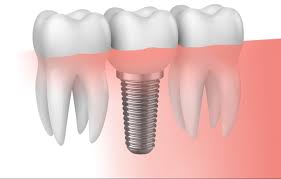
The interval. Three to six months, during which the implants integrate and you wear your temporary. Your plan states the interval, and it is a minimum rather than an appointment — if four months suits you better than six, integration simply continues.
Trip two: your definitive bridge
Typically seven to nine days, three to six months later.
Day 1 — Arrival. Transfer to your hotel. Nothing clinical today.
Day 2 — Assessment. A radiograph confirming integration of all six implants. The temporary is removed, the implants are checked individually, and impressions or a digital scan are taken for your definitive bridge.
Days 3 to 6 — Fabrication and try-in. Your bridge is made in the on-site laboratory. The try-in is the appointment that determines your result: you see the bridge — frequently in wax or as a trial — before it is finalised. Tooth shape, shade, how much shows when you smile, how full your lip looks, whether the teeth look too even or too white. Say what you want changed; everything is adjustable now. Take your time. Look at yourself in natural light. Speak. Smile. Photograph yourself, and look at the photographs rather than only the mirror — we see ourselves differently in images.
Day 7 — Fitting. Your definitive bridge is fitted and screwed onto the implants. The bite is checked and adjusted carefully across all six supports.
Days 8 to 9 — Adjustment and departure. An adjustment appointment, because a new bite takes a day or two of use for high spots to become apparent. Hands-on cleaning instruction, taught rather than described. Your night guard is fitted where indicated. Final documentation: treatment report, updated implant passport, written care guidance in French or English, and guidance for your Canadian dentist. Then your transfer to the airport.
Getting the appearance right
This deserves its own section, because a full arch determines the appearance of your whole lower face.
What is being decided
How much tooth shows at rest and when smiling. Tooth shade. Tooth shape and arrangement. How full your lip looks, which the thickness and position of the bridge at the front determines. This is facial design as much as dentistry.
Tooth shade
The most common regret is choosing teeth that are too white and too uniform. A full arch of brilliant white teeth on a patient of seventy reads as artificial immediately. Our practical advice: choose a shade one step less bright than your instinct, and assess it in natural daylight rather than under clinic lighting. Almost nobody regrets slightly less white.
Tooth arrangement
Natural teeth are never perfectly aligned or identical. A good technician builds in slight irregularity — a minor rotation, subtly different edges, a canine a touch more prominent. This is what makes an arch read as real rather than manufactured. If you prefer a more uniform look, say so at the try-in.
Lip support
Too little and the lip falls inward; too much and it looks pushed out. This is one of the things the try-in settles, and it is why looking at yourself in profile matters as much as from the front.
Bring a photograph
An old photograph of yourself smiling, from before you lost your teeth, is the single most useful thing you can bring. It tells us the shape, shade and arrangement of your own teeth — which is frequently exactly the target. Patients who bring one consistently get a more natural result.
Choosing your definitive bridge material
Acrylic on a metal framework
Teeth set in acrylic on a rigid metal substructure. Advantages: the most economical, lighter on the implants, and repairable — an individual tooth can be replaced without remaking the bridge. Considerations: the acrylic wears over years, and the teeth typically need replacing after five to ten years. This is expected rather than a failure, and it is worth budgeting for.
Zirconia
A solid milled zirconia bridge. Advantages: very strong, does not wear in the same way, and excellent aesthetics with modern layering. Considerations: more expensive, and rigid — which transmits more force to the implants. This matters more with six implants than four, since the construction as a whole is stiffer. Where a fracture occurs, the whole bridge is generally remade rather than repaired.
Ceramic on a titanium framework
A titanium substructure with ceramic teeth. Advantages: combines strength with good aesthetics, and individual segments can sometimes be repaired. Considerations: cost sits between the other two.
How we choose
From your bite, whether you grind, and what opposes the arch. A patient with a natural opposing arch and significant bruxism — the same patient for whom six implants were indicated — frequently benefits from a material that absorbs some force rather than transmitting all of it. Ask: « Quel matériau recommandez-vous, et pourquoi celui-là dans mon cas ? »
Eating: the progression
After trip one
Liquids and very soft food for the first week — nothing requiring chewing on the new bridge. Soft food for the following weeks, per your plan. And for the whole integration period, three to six months, avoid hard and crunchy foods: the temporary is more fragile, and more importantly, heavy loading during integration is what you are avoiding.
After trip two
Progressive return to normal food, guided by your dentist. Most patients eat normally within weeks, and describe the difference from a denture as the thing they most notice. With six implants, chewing efficiency is at the high end of what implant-supported bridges deliver — which for a patient who has been unable to eat properly for years is the change that matters.
Permanently
Sensible limits remain. Very hard items, nothing used as a tool, and caution with ice and hard nuts. A bridge on six implants is strong. It is not indestructible.
Part four — The years that follow
Your night guard
Where you grind — and grinding is one of the main reasons six implants were recommended — a night guard is part of the plan rather than an accessory. Bruxism transmits substantial force to the implants and the bridge, sustained over hours. It is the most common cause of bridge fracture and of screw loosening.
The logic is simple: if bruxism was part of why you have six implants rather than four, it is also why you need the guard. Patients who understand this at the outset wear it; patients handed one at the end frequently do not. It is made at your second trip and included where indicated, and it should be checked and replaced as it wears.
Your implant passport
You receive a record of the implant brand, model, dimensions and lot number for each of the six implants, plus positions and angulations.
Why it matters on a full arch: because a full-arch bridge is entirely dependent on compatible components. A screw, an abutment or a replacement bridge in ten years must fit the system that was placed, and implant systems are not interchangeable. For a full arch, a component you cannot obtain means a problem you cannot solve without replacing everything. Keep the original, photograph it, and give a copy to your Canadian dentist.
Cleaning under a fixed bridge
This determines whether your implants last twenty years, and it is a skill.
Why it is different. Your bridge does not come out, which means you cannot clean underneath it the way you would a denture. And there is a space beneath it, between the bridge and your gum, where plaque accumulates. That space is where peri-implantitis starts.
What is required. Superfloss or a floss threader, passed underneath the bridge and drawn along its length, daily. A water flosser, which most patients find is what makes this practical rather than tedious — for a full-arch bridge it is close to essential, and it is the single most useful thing you can buy. Interdental brushes around the implant sites, and with six implants there are more sites to clean than with four, which is worth knowing. And brushing the bridge itself, twice daily.
Learning it properly. Ask for a hands-on demonstration before you leave, with your own bridge, rather than a printed sheet. Do it in front of your dentist and have them check. A technique that feels right and is wrong achieves nothing.
Why patients underestimate it. Because the bridge feels like teeth. It does not decay, it does not hurt, and nothing signals that plaque is accumulating underneath. The first sign is frequently bone loss on a radiograph years later — which is why your Canadian follow-up matters.
Your Canadian follow-up
What is required. A check-up and professional cleaning every six months. Radiographs periodically to monitor bone levels around each of the six implants. And your bridge removed and cleaned professionally, typically annually, which your dentist does at an appointment.
Who provides it. Your Canadian dentist. This is routine maintenance, and they are not being asked to take over the case.
How to arrange it, before you travel: « J’aurai un bridge complet sur six implants posé à l’étranger. Je reviendrai avec un compte rendu, un passeport implantaire et des radiographies. Pourriez-vous assurer l’entretien habituel et un contrôle radiographique périodique ? » Most dentists say yes without hesitation.

If your dentist is hesitant. Some are cautious about work they did not perform, which is a reasonable professional position rather than obstruction. What helps: approaching them beforehand rather than afterwards, being clear you are asking for routine maintenance, and bringing your documentation and implant passport. If they decline, tell us and we will help you work out the options.
Why this matters more than the number of implants. Worth saying plainly, because it is the most useful thing on this page after the four-or-six assessment: a patient with six implants who neglects maintenance is worse off than a patient with four who maintains it properly. The two extra implants buy you resilience. They do not buy you exemption from cleaning.
Canadian insurance
Full-arch implant work exhausts any annual maximum immediately. Ask your insurer in writing whether they reimburse treatment received outside Canada and at what rate, request pre-determination if available, and ask how they date a claim — where your treatment spans two calendar years, two annual maximums may be available. We provide itemised invoicing, in French or English.
Part five — Practical matters
Canadian patients: travelling to Tunisia from your region
Aylan Clinic works with patients from every province and territory in Canada. Wherever you live, the process begins the same way: a free consultation from your panoramic X-ray, in French or English.
Montreal and the surrounding region. Montreal is our largest Canadian source for Tunisia. Connections from Trudeau to Tunis typically route through Paris, Frankfurt or Istanbul. Patients from Laval, Longueuil and Brossard are all within easy reach of the airport. For a two-trip course, the frequency of departures makes scheduling straightforward — and many patients time the second trip around travel they were making anyway.
Quebec City and across the province. From Quebec City and the Capitale-Nationale region including Lévis, most patients connect through Montreal — as do patients from Trois-Rivières, Sherbrooke, Drummondville and Saint-Jérôme, all within driving distance of Trudeau. Gatineau patients depart from Ottawa or drive to Montreal. From Saguenay, a domestic connection through Montreal is the norm. On this treatment the francophone advantage matters at two moments: the four-or-six conversation, a genuine clinical discussion about bone density, opposing forces and your own risk tolerance; and the try-in, where you assess a full arch on your own face.
Acadia and New Brunswick. We work with patients from Moncton, Fredericton and Saint John. Moncton and the surrounding Acadian communities are served in French throughout. Most connect through Montreal.
Francophone Ontario. Sudbury, Thunder Bay and Sault Ste. Marie all have substantial francophone populations, served in French from first contact onward. Ottawa patients typically connect through Montreal.
Greater Toronto Area and southern Ontario. Toronto patients connect through European hubs, with Paris and Frankfurt the most common routes to Tunis. Across the wider Greater Toronto Area we work with patients from Mississauga, Brampton, Markham, Vaughan, Richmond Hill and Oshawa. Along the lake: Hamilton, Burlington, Oakville, St. Catharines and Niagara Falls. In southwestern Ontario: London, the Waterloo region — Kitchener, Waterloo and Cambridge — plus Guelph, Windsor and Barrie. Kingston patients generally drive to Toronto or Montreal.
Vancouver and British Columbia. Vancouver patients face the longest journey, typically two connections, so we schedule assessment for the day after arrival. Across the Lower Mainland: Surrey, Burnaby and Richmond. From Victoria and Nanaimo, patients cross by ferry or short flight. Kelowna, Abbotsford and Kamloops patients connect through Vancouver or Calgary. Because the journey is long, we plan British Columbia courses to accomplish as much as possible per trip.
Alberta. Calgary and Edmonton both offer European connections onward to Tunis. Red Deer and Lethbridge patients generally drive to Calgary.
Manitoba and Saskatchewan. Winnipeg patients connect through Toronto or Montreal, and the francophone community of Saint-Boniface is served in French. From Saskatoon and Regina, journeys involve a domestic connection followed by two further flights.
Atlantic Canada. Halifax patients typically route through Montreal or Toronto. From Charlottetown and St. John’s, journeys involve two or three connections.
Northern Canada. We work with patients from Whitehorse in Yukon, and from communities across the Northwest Territories and Nunavut. For northern patients, full-arch treatment ordinarily means several journeys to a southern centre, so two well-planned trips compares favourably. We discuss your Canadian maintenance access early, since follow-up matters as much as the surgery — and for a patient who will find six-monthly appointments difficult, that is part of the four-or-six conversation too. We plan northern itineraries with buffer days at both ends.
How we handle the logistics. Whichever city you are travelling from, your coordinator arranges airport transfers at both ends in Tunisia, confirms your hotel before you depart, and builds your schedule around your arrival time.
Five recommendations: send your panoramic X-ray, and a CBCT if you can get one in Canada; bring photographs of yourself smiling before you lost teeth; arrange your Canadian dentist before you travel; buy a water flosser; and ask the four-or-six question directly.
What your package includes
- Free consultation in French or English, with a plan and quote for the whole course, including an honest four-or-six recommendation
- Full on-site assessment: clinical examination, periodontal assessment, photographs
- CBCT scan and three-dimensional planning, including bone density assessment
- Extractions where needed
- Six implants placed, with posterior angulation
- Bone grafting where planned
- A fixed temporary bridge during your first trip — you are never without teeth
- Review and bite adjustment appointments during each stay
- Definitive bridge made in our on-site laboratory
- Try-in before the bridge is finalised, with the technician available
- Shade and tooth shape selection, with your old photographs as reference if you bring them
- Bite adjustment appointments after fitting
- Night guard where indicated
- Hands-on cleaning instruction specific to your bridge
- Written care guidance in French or English
- Treatment report, your CBCT, and an implant passport recording all six implants
- Guidance for your Canadian dentist
- Itemised invoicing
- Hotel accommodation, full board, for each trip, with meals adapted to your dietary stage
- A companion at no extra cost, accommodated and fed in the same room
- Airport–clinic–hotel transfers
- A personal coordinator from arrival to departure
- French-speaking care throughout, with English available on request
The clinical team
- Oral surgeon or implantologist — placement and angulation; frequently French-trained
- Prosthodontist — bridge design, bite and try-in
- Periodontist — gum treatment where needed
- Dental radiologist — CBCT interpretation and bone density assessment
- Master ceramist, on site — shade and aesthetics
- In-house laboratory — fabrication, try-in and same-visit adjustments
Results by patient profile
Soft bone in the upper jaw
A patient whose CBCT showed low bone density across the upper arch, particularly toward the back. Six implants rather than four, distributing the load across more surface area. Her definitive bridge was ceramic on a titanium framework. This is the clearest indication for six, and it is a CBCT finding rather than a preference.
Bruxism and a natural opposing arch
A patient with marked grinding and a full natural lower arch opposing the upper reconstruction. Six implants, a shorter cantilever, and a night guard from the outset. Her forces were at the high end, and both the implant number and the guard follow from that.
Where we recommended four instead
A patient who enquired specifically about All-on-6, having read that more implants are better. Her CBCT showed good bone density, she did not grind, and a denture opposed the arch. We recommended four, explaining that two more implants would mean two more surgical sites and additional cost without measurable benefit for her anatomy. She had All-on-4 and is doing well. This happens often enough to mention.
Where six was possible but four was better placed
A patient whose bone allowed six implants in theory, but where two of the potential sites had marginal bone volume. Four well-placed implants rather than six with two compromised — and the surgeon explained why. Four good implants are better than six where two are poorly supported, and a surgeon willing to say so is assessing you rather than selling.
Resilience as the deciding factor
A patient of fifty-eight, good bone, no bruxism, who asked specifically about what happens if an implant is lost in ten years. We set out the resilience argument honestly: with six, losing one is manageable; with four, it is more consequential. She chose six for the margin, knowing four would probably have been adequate. That is a legitimate decision made with full information.

A patient who brought old photographs
A patient who brought a photograph of himself smiling from twenty-five years earlier. The ceramist set the teeth to match the shape and slight irregularity in the photograph. His family said he looked like himself again — which is the objective, and which a shade guide alone cannot achieve.
A patient from Sherbrooke
A patient who chose Tunisia so that the four-or-six conversation could happen in French. Her comment was that she asked three follow-up questions about bone density and load distribution that she would not have known how to phrase through an interpreter — and that the answers changed her decision. She chose six.
Practical points to know
What to expect
A long appointment on surgery day — two and a half to four hours — with swelling and bruising peaking at day two or three. Fixed temporary teeth from the first trip; you are never without. Three to six months of integration, on soft food and avoiding hard items. A definitive bridge at trip two, with a try-in before it is finalised. And cleaning that is a genuine skill, with more sites to clean than on four implants.
Recognised points
All-on-6 is a well-documented approach with good published survival rates in appropriately selected, well-maintained patients. Your surgeon will discuss the considerations relevant to you. The main ones: failure of an implant to integrate, uncommon — and with six implants, more manageable than with four. Infection, uncommon and treated promptly. Peri-implantitis over the years, the main late consideration and largely preventable with proper cleaning and maintenance. Screw loosening, straightforward to correct at a maintenance appointment. Fracture of the temporary bridge, repairable. Fracture or wear of the definitive bridge, depending on material and whether you grind. Nerve or sinus considerations, which the CBCT is performed to avoid. And speech adjustment in the first weeks, which settles within one to two weeks.
Three things within your control
Stopping smoking, the largest modifiable factor. Cleaning under the bridge properly — and buying a water flosser. And attending six-monthly maintenance in Canada, which matters more than whether you chose four implants or six.
Who this suits
Adults with a failing or absent arch, adequate bone volume and suitable sites for six implants, and the intention to maintain the bridge. In pregnancy, elective implant treatment is deferred.
Price: how it is built and how to compare it
Why we quote per case
Because whether six implants are appropriate, whether grafting is needed, the bridge material, and the number of trips all vary. Your quote is built from your radiograph — and your CBCT where you send one — itemised, and fixed once you approve it. Our prices page gives the wider context.
What determines your price
Six factors. Six implants rather than four — the two additional implants and their components. Whether grafting is needed, which the CBCT establishes. How many extractions. The implant brand, named in your plan. The definitive bridge material, the largest single variable after the implants. And the number and length of your trips.
The comparison worth making
All-on-6 in Tunisia against All-on-4 in Canada. A number of patients find the Tunisian six-implant option costs less than the Canadian four-implant one — which removes cost from the four-or-six decision entirely and leaves it a clinical question. That is the comparison worth running, and it is why we quote both options where both are reasonable for you.
What is included in your quote
Everything in the package list above, including the CBCT and planning with bone density assessment, extractions, six implants with angulation, any grafting, the fixed temporary bridge, all review and adjustment appointments, the definitive bridge made in our laboratory with a try-in, night guard where indicated, cleaning instruction, treatment report, CBCT and implant passport, guidance for your Canadian dentist, itemised invoicing, hotel with full board for each trip, transfers, and your coordinator. A companion is accommodated and fed at no additional cost, on every trip.
What sits outside it
Flights for each trip, travel insurance, your six-monthly maintenance in Canada, a water flosser and cleaning aids, and eventual replacement of an acrylic bridge after five to ten years where that is your material.
How to compare quotes properly
Five checks. Is the definitive bridge included, or only the temporary? This is the single largest source of confusion, because a very low quote frequently covers implants and a temporary only. Which bridge material? Materially different prices, and a quote that does not say is not comparable. Is a CBCT included, and is grafting anticipated? Is the implant brand named — on a full arch this matters more than anywhere. And how many trips, with the second trip included or not?
Why the lowest quote is rarely the best value
On All-on-6, the savings available are identifiable: no CBCT, an unnamed implant system, the definitive bridge quoted separately, and the cheapest material without discussing your bite. The implant system matters most. A full-arch bridge on six implants depends entirely on compatible components, and a system whose parts you cannot obtain in ten years is a bridge that cannot be maintained.
Payment and getting your figure
A deposit confirms the dates for each trip. The balance for each is settled on site, under terms set out in full when you approve your plan. There are no additional charges once accepted — and where the CBCT changes the plan, we discuss it with you before proceeding.
Send a recent panoramic X-ray, and DICOM files if you have a CBCT. Add photographs of your smile and face, which teeth remain and their condition, what opposes the arch being treated, your medical history and medications, whether you grind, and whether you smoke. If you wear a denture, photograph it. You will receive a plan and quote within 24 to 48 hours, in French or English, including an honest four-or-six recommendation.
Glossary
- All-on-6 — a full arch of fixed teeth supported on six implants
- Cantilever — the portion of bridge extending beyond the last implant; where stress concentrates
- Posterior angulation — angling the back implants to use available bone
- Bone density — how solid the bone is; a key factor in the four-or-six decision
- Temporary bridge — the fixed bridge fitted at the first trip, during integration
- Definitive bridge — the final bridge, made at the second trip
- Osseointegration — bone bonding to the implant; three to six months
- Peri-implantitis — inflammation with bone loss around an implant
- Superfloss — floss with a stiff threader, used to clean under a fixed bridge
- Implant passport — record of brand, model, dimensions and positions
How Canadians search for this
- “All-on-6 Tunisia cost” — the most common search. Ask whether the definitive bridge is included.
- “All-on-6 Tunisie” — how most Quebec patients search, and the reason this page exists in both languages.
- “All-on-4 vs All-on-6” — six for softer bone, bruxism or a natural opposing arch.
- “Is All-on-6 better than All-on-4” — not automatically. It is better for a specific group, and an unnecessary expense for others.
- “How many implants for full arch” — four or six, determined by bone density, opposing forces and whether you grind.
- “All-on-6 bone density” — the clearest indication for six, and a CBCT finding rather than a preference.
- “What if an implant fails All-on-4” — more consequential than with six.
- “Full mouth dental implants cost Canada” — very high, and annual insurance maximums make it difficult to fund.
- “All-on-6 bridge material” — acrylic on metal, zirconia, or ceramic on titanium. Different prices and different characteristics.
- “How to clean under a fixed bridge” — superfloss and a water flosser, daily. A skill, and it determines whether the implants last.
- “Will I have teeth immediately” — yes, fixed temporary teeth from the first trip.
- “French speaking dentist abroad” — Tunisia’s distinguishing feature.
In summary
All-on-6 at Aylan Clinic Tunisia combines CBCT planning including bone density assessment, six implants with posterior angulation, a fixed temporary bridge from your first trip so you are never without teeth, a definitive bridge made in our on-site laboratory with a try-in before it is finalised, and an implant passport recording all six. And it takes place in a French-speaking country, which matters most at the four-or-six conversation — a genuine clinical discussion — and at the try-in. With accommodation, full board and a companion at no extra cost on every trip, for up to 60% less than Canadian private prices.
Five things worth holding onto:
- Six is not automatically better than four. It is better for softer bone, bruxism, a natural opposing arch, or where you want resilience. Ask why, and expect an answer about your own anatomy.
- The resilience argument is the real one. With six, losing an implant in year eight is manageable. With four, it is more consequential. That margin is what you are buying.
- Run the comparison that matters: All-on-6 in Tunisia against All-on-4 in Canada. For a number of patients the Tunisian six-implant option costs less — which makes the decision purely clinical.
- The teeth you leave with on trip one are temporary, by design.
- Six implants do not exempt you from cleaning. A patient with six who neglects maintenance is worse off than one with four who does not. Buy the water flosser and arrange your six-monthly appointments before you travel.
Send your panoramic X-ray and you will have a plan within 24 to 48 hours — including an honest four-or-six recommendation, in French or in English.
To go further: read the procedure page for All On 6 Dental Implant in Tunisia, compare plastic surgery prices in Tunisia, explore our dental care in Tunisia overview, or request a free, personalised quote.
Related guides
- All-on-4 Dental Implants in Tunisia
- Dental Implants in Tunisia
- Full Mouth Rehabilitation in Tunisia
- Removable Dentures in Tunisia
- Dental Bone Grafting in Tunisia
- Sinus Lift in Tunisia
Ready to look at the procedure itself?
Technique, stay, aftercare and the full patient journey — on our All-on-6 procedure page.