
The short answer is yes. Gum contouring at Aylan Clinic Tunisia allows patients from Montreal, Quebec City, Toronto, Ottawa, Moncton and across Canada to reshape an uneven gum line, lengthen teeth that look short, or correct a gummy smile — frequently in a single short appointment — for up to 60% less than Canadian private prices. It is the smallest procedure in cosmetic dentistry and one of the most transformative. It is also the treatment where getting the diagnosis right matters most relative to the size of the procedure: a gummy smile has four possible causes, and only one of them is treated by trimming gum.
This guide is organised around your journey — deciding, preparing, the treatment, and what follows. It is a companion to our procedure page on gum reshaping in Tunisia, which sets out how the operation itself works, the stay and the aftercare in practical detail, and it sits within our wider dental care in Tunisia section. For an idea of how a dental plan is costed alongside other treatments, see our overview of plastic surgery prices in Tunisia.
Patients who have spent years covering their mouth when they laugh, or who have never liked a photograph of themselves smiling, frequently describe a twenty-minute appointment as the thing that changed it. But a patient whose gummy smile is caused by her jaw or her lip will not be helped by gum surgery, however well performed. We would rather tell you that than take your money.
One thing distinguishes Tunisia: it is a French-speaking country. Not a clinic with French-speaking staff — a country where French is a working language across dentistry and daily life.
Part one — Deciding
1. What gum contouring is
The principle. Reshaping the gum margin — the line where the gum meets the tooth — to improve the proportion and symmetry of your smile. It changes how much tooth shows, which changes how the whole smile reads.
What it treats:
- A gummy smile, where a substantial band of gum shows above the teeth when you smile — see section 3, because the cause determines the treatment.
- An uneven gum line, where the margins sit at different heights on adjacent teeth. Frequently the most noticeable issue, and the most satisfying to correct.
- Short-looking teeth, where the gum covers part of the crown so the tooth appears stubby rather than being genuinely short.
- Gum overgrowth, from certain medications, orthodontic treatment or inflammation.
- Asymmetry, where one side sits higher than the other.
- And as part of a veneer or crown plan, where the gum line is corrected first so the restorations are made to the right proportions — section 4.
What it does not treat: gum recession, where the gum has receded and exposed root surface. That is the opposite problem, and it requires a graft to add tissue rather than remove it — section 5. It also does not change the position of the teeth themselves, which is orthodontics, nor the position of the jaw, which is section 3.
The procedures:
- Gingivectomy — removing excess gum tissue to expose more tooth.
- Crown lengthening — removing gum and a small amount of underlying bone, where the bone sits too close to the tooth for gum removal alone to be stable. Section 6, and this distinction matters enormously.
- Gingivoplasty — reshaping the contour of the gum without necessarily removing height.
2. Why the gum line matters so much
Worth understanding, because patients frequently identify the wrong problem.
The frame. Your gums frame your teeth, and the eye reads the frame as much as the contents. Teeth of perfect shape and colour, framed by an uneven gum line, read as an unattractive smile — and patients in that situation frequently conclude their teeth are the problem and enquire about veneers.
Proportion. An ideal upper central incisor is roughly a specific proportion of width to length. Where the gum covers part of the crown, the tooth reads as too wide and too short — and no veneer corrects that, because adding length at the biting edge makes the tooth too long overall. The length has to come from the gum end.
Symmetry. The eye detects asymmetry in the gum line readily, even where it cannot identify what is wrong. A difference of one to two millimetres between the two central incisors is visible, and correcting it is frequently what patients notice most.
Why this leads to the wrong treatment. A patient looks at her smile, sees that it does not look right, and concludes she needs veneers. Sometimes the actual issue is that her gum line is uneven — and a twenty-minute gum procedure achieves more than eight veneers would. That is a genuinely common situation, and it is why section 4 exists.
3. A gummy smile has four causes — and only one is treated by trimming gum
The most important section on this page.
Cause one: altered passive eruption. The gum did not fully recede to its final position during development, so it still covers part of the crown. The teeth are the right size and in the right position; the gum is simply sitting too low. This is treated by gum contouring — gingivectomy, or crown lengthening where the bone also sits too high. Excellent, predictable results. This is the cause that gum surgery solves.
Cause two: a hyperactive upper lip. The lip elevates further than average when smiling, exposing more gum. The gum is in the correct position; the lip is doing something unusual. Trimming the gum in this situation exposes more tooth but the lip still rises the same amount — and the improvement is partial at best. This is treated by lip repositioning surgery, or by botulinum toxin to reduce the elevator muscle activity — a temporary treatment requiring repetition, but simple and reversible.
Cause three: a short upper lip. The lip is anatomically shorter than average, so even normal elevation exposes gum. Similar considerations to cause two, and gum surgery alone will not resolve it.
Cause four: vertical maxillary excess. The upper jaw is longer than average vertically, so the whole dental arch sits lower in the face. This is a skeletal difference, and gum surgery does not address it. Where it is marked, orthognathic surgery is the treatment — a substantial jaw operation, performed in a hospital setting, and not something we would undertake as a cosmetic dental procedure. Where it is mild, a combination of orthodontics and gum contouring may improve it meaningfully.
Frequently a combination. Many patients have more than one cause — a slightly short lip plus altered passive eruption, for instance. In that situation gum contouring produces a real improvement without full correction, and knowing that in advance is what makes the patient satisfied with a partial result rather than disappointed by it.
What we do. Measure and diagnose. How much gum shows. How far your lip travels between rest and full smile. The proportions of your teeth. Where the bone sits relative to the gum margin — which determines gingivectomy versus crown lengthening. And we tell you which cause or causes apply to you, and what each treatment would achieve.
Ask directly: « Quelle est la cause de mon sourire gingival, et le contournement gingival va-t-il vraiment la corriger ? » A specific answer naming the cause is a diagnosis. “Yes, we can fix that” is not.
Where we would say no. Where your gummy smile is caused predominantly by lip or jaw factors, we will say that gum contouring will not deliver what you want. That conversation costs us a procedure, and it prevents a patient paying for something that does not work.
4. Gum contouring alone, or with veneers?
When gum contouring alone is enough. Where your teeth are sound, well shaped and a colour you are happy with, and the only issue is that too little of them shows or the line is uneven. This is more common than patients expect: a twenty-minute procedure, no tooth removed, nothing irreversible done to the teeth — and a substantially improved smile. Where this applies to you, we will say so, even though it is a fraction of a veneer case.
When it comes before veneers. Where you are having veneers or crowns anyway, the gum line is corrected first. The sequence matters: veneers made to an uncorrected gum line, then contoured afterwards, leave the restoration margin exposed — and the result looks wrong. Contour first, let it heal, then make the restorations to the corrected line. This is frequently what turns a good veneer case into an excellent one, and it is covered in our guide to ceramic veneers in Tunisia.
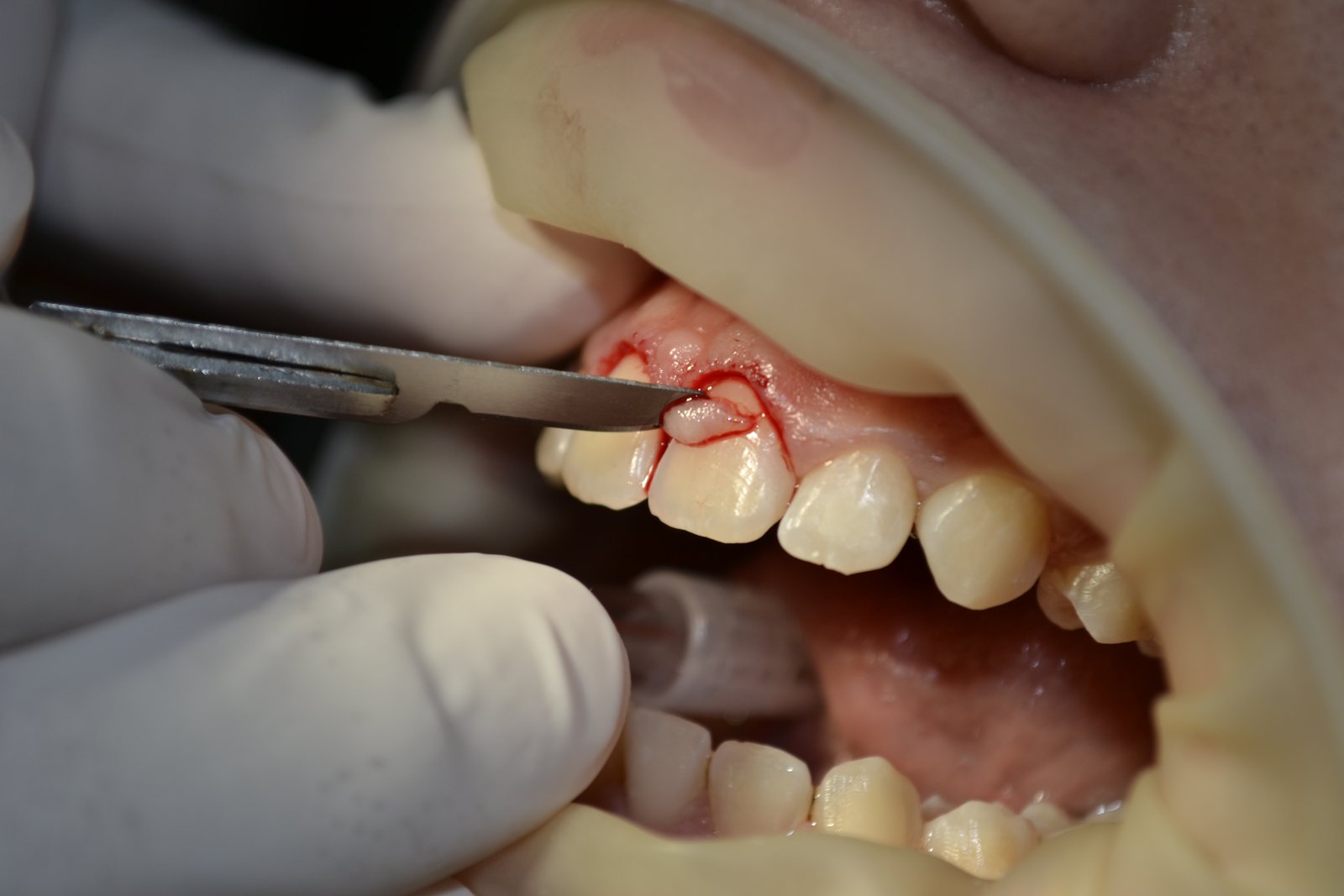
When veneers are needed too. Where your teeth are also discoloured, worn, chipped or poorly shaped. A mixed plan is common, and the gum work is the first stage.
What we do. Assess both, and tell you honestly if the gum work alone achieves what you want. Ask: « Le contournement gingival seul suffirait-il dans mon cas ? »
5. If your problem is recession, not excess
The opposite situation, and worth addressing because patients sometimes arrive at the wrong page.
What recession is. Gum that has pulled back, exposing root surface — teeth that look long rather than short.
Why it happens. Aggressive horizontal brushing with a hard brush, which is the most common cause and entirely modifiable. Gum disease. Thin gum tissue, which is genetic. Orthodontic movement beyond the bone envelope. Grinding.
Why it matters. The exposed root is softer than enamel and it is more vulnerable to decay and sensitivity. And it progresses if the cause is not addressed.
What treats it. A gum graft — tissue taken from the palate or a processed graft material, placed to cover the exposed root. It is a different procedure from gum contouring entirely: adding tissue rather than removing it.
What we would do. Address the cause first — brushing technique, gum disease treatment, a night guard if grinding is involved. Then graft where the recession is significant, aesthetically or functionally. If this describes your situation, tell us at the enquiry stage; it is a different plan.
6. Gingivectomy or crown lengthening? The distinction that determines stability
A technical point that patients are rarely told and that determines whether the result lasts.
The biologic width. There is a fixed distance between the top of the bone and the gum margin — a band of tissue attachment that your body maintains. This is not optional. It is biology.
What this means practically. If gum alone is removed and the bone is left too close to the new margin, the gum grows back, because your body restores that fixed distance. The result relapses within months, and the patient concludes the procedure did not work.
When gingivectomy alone is appropriate. Where there is sufficient distance between the bone and the proposed new gum margin. The gum is trimmed, and it stays.
When crown lengthening is needed. Where the bone sits too close. A small amount of bone is recontoured as well as the gum, re-establishing the correct relationship — and the result is stable.
How the decision is made. By measuring — a procedure called bone sounding, done under local anaesthesia — and by radiographs. It is not a judgement call made by eye.
Why this is the question to ask. Because a clinic that performs gingivectomy where crown lengthening was needed will produce a result that relapses, and the patient will not understand why. Ask: « Une gingivectomie suffira-t-elle, ou une élongation coronaire avec remodelage osseux est-elle nécessaire ? » A clinic that explains the biologic width and how they measured it is doing this properly.
The practical difference. Crown lengthening takes longer, involves raising a small flap, and heals over a longer period — typically three months before restorations are made, against two to four weeks for a simple gingivectomy. That difference matters for your travel planning, and section 9 covers it.
7. Why Canadian patients choose Tunisia
| Canada (private) | Tunisia — Aylan Clinic | |
|---|---|---|
| Cost | High for a periodontal procedure | Up to 60% less |
| Insurance | Generally not covered — cosmetic | Same, but far lower total |
| Language | English or French | French throughout the country |
| Dentist training | Canadian | Frequently French-trained |
| Diagnosis of gummy smile cause | Variable | Measured and named |
| Combined with veneers | Separate appointments | Sequenced in one plan |
| Accommodation | Not applicable | Included, full board |
| Companion | Not applicable | Free, accommodated and fed |
Where combining matters most. If you are having veneers or crowns, gum contouring should precede them — section 4. Doing both in one trip, correctly sequenced, is what a combined plan delivers. Arranging that in Canada frequently means two providers, two sets of appointments, and coordinating the timing yourself.
Where the language matters on this treatment. At the diagnosis. Being told that your gummy smile is caused by your lip rather than your gums — and that gum surgery will therefore not fix it — is disappointing and technical. Understanding why, what the alternatives are, and what a partial improvement would look like, is a conversation you want to have properly. Patients consistently tell us they asked more in their own language, and here that frequently means avoiding a procedure that would not have worked.
Dentist training. A substantial proportion of Tunisian dentists and periodontists trained in France. Ask where yours qualified. We answer directly.
Coverage in Canada. Gum contouring for cosmetic reasons is generally not covered. Where crown lengthening is performed for restorative reasons — to expose enough tooth for a crown, for instance — a plan may contribute. Worth asking, and we provide itemised invoicing in French or English.
Part two — Preparing
8. From first contact to confirmed dates
The online consultation. Send photographs, and one matters more than the others. What to send: a full natural smile photograph in daylight, unfiltered; a photograph at rest with lips relaxed, showing how much tooth shows without smiling; a close-up of your upper teeth and gums; and — the important one — a photograph of your widest, most genuine smile, since that is what shows the maximum gum display. A posed, restrained smile underestimates the problem and produces an inaccurate assessment.
Plus a recent panoramic X-ray, what specifically bothers you, whether you are also considering veneers, any medications, and whether you have had gum disease. In French or in English, whichever you prefer.
What you receive. A plan naming the likely cause of your gum display, whether gum contouring will address it, whether gingivectomy or crown lengthening is anticipated, how many teeth, whether veneers should follow, and the healing interval — with an itemised quote, within 24 to 48 hours. And where the cause is predominantly lip or jaw related, the plan will say so. You can start that process with a free, personalised quote.
Questions worth asking before you commit:
- « Quelle est la cause de mon sourire gingival ? » — the most important question, and the answer should name a cause rather than promise a fix.
- « Une gingivectomie suffira-t-elle, ou une élongation coronaire est-elle nécessaire ? » — section 6, and this determines whether the result lasts.
- « Comment mesurez-vous cela ? » — bone sounding and radiographs, not by eye.
- « Le contournement seul suffirait-il, ou des facettes sont-elles nécessaires ? »
- « Combien de dents seront traitées ? »
- « Quel délai avant que les facettes puissent être faites ? » — two to four weeks after gingivectomy, around three months after crown lengthening. This determines your travel planning.
- « Le résultat peut-il régresser ? » — and a clinic that explains biologic width in answering is doing this properly.
- « Où votre praticien a-t-il été formé ? »
What to arrange at home before you travel. Have any gum disease treated, or tell us and we will address it — contouring inflamed gums produces an unpredictable result. Tell us about any medication associated with gum overgrowth: certain anticonvulsants, immunosuppressants and calcium channel blockers. It affects both the plan and the likelihood of recurrence. Improve your brushing and flossing in the weeks beforehand, since healthy, non-inflamed gums heal better and give a more predictable result. And stop smoking if you can, because it impairs gum healing.
9. Understanding the healing timeline
This determines your travel planning, particularly if veneers are part of the plan.
After gingivectomy. Initial healing within one to two weeks. The gum margin settles over two to four weeks, and restorations can generally be made after that. A short trip is sufficient, or it is combined with other treatment in the same visit.
After crown lengthening. Longer, and this is the key planning point. Initial healing over two to three weeks. But the gum margin continues to mature and settle for around three months — and restorations made before that risk being made to a margin that then moves. Where crown lengthening precedes veneers, the veneers are made at a second visit around three months later.
| Plan | Trips |
|---|---|
| Gingivectomy alone | One short trip |
| Gingivectomy plus veneers | One trip |
| Crown lengthening alone | One trip |
| Crown lengthening plus veneers | Two trips, around three months apart |
This is set out in your plan from the outset, so you can arrange your travel rather than discover it.
Why we do not compress it. Because veneers made to a margin that subsequently moves look wrong, and remaking them costs considerably more than the second trip. Where a single trip is genuinely possible, we plan for it. Where it is not, we say so.
Part three — The treatment
10. Your trip, day by day
Two to four days for gum contouring alone. Six to eight days where veneers are combined after a gingivectomy.
Day 1 — Arrival. Your driver meets you at the airport and takes you to your hotel with your companion. Nothing clinical today for patients travelling far; for shorter journeys, assessment can be the same day.
Day 2 — Assessment and diagnosis. Clinical examination and periodontal assessment. Photographic and video smile analysis — how much gum shows, how far your lip travels between rest and full smile, and the proportions of your teeth. Measurement of the gum margins and bone sounding under local anaesthesia to establish whether gingivectomy or crown lengthening is needed. Radiographs. Then your consultation: the cause of your gum display, whether contouring will address it, the technique, how many teeth, and the healing interval. If the cause is predominantly lip or jaw related, this is where we say so.
Day 3 — The procedure. Under local anaesthesia. Gingivectomy typically takes twenty to forty minutes depending on the number of teeth, performed with a soft tissue laser or fine instruments. Crown lengthening is longer, involving raising a small flap to access and recontour the bone, then repositioning the gum. The new gum line is planned and marked before any tissue is removed, referenced to your tooth proportions and your smile line. Where veneers follow in the same trip, the gum work is done first and the preparation follows once initial healing has occurred.
Day 4 — Review and departure. A review appointment to check healing. Care instruction, and your documentation: a treatment report naming the procedure and the teeth treated, written aftercare guidance in French or English, and guidance for your Canadian dentist. Then your transfer to the airport.
Where veneers are combined. The trip extends to six to eight days after a gingivectomy, following the pathway in our ceramic veneers guide. After crown lengthening, the veneers are a second trip around three months later.
11. What it feels like, and healing
During. Under local anaesthesia — pressure rather than pain. A soft tissue laser produces very little bleeding and is generally more comfortable than blade surgery, which is why we use it where appropriate. Crown lengthening involves more, since a flap is raised, and it is correspondingly more uncomfortable afterwards.
The first days. Mild to moderate discomfort, typically managed with over-the-counter pain relief. The treated area appears red and raw, and this is normal — it is a surface healing by secondary intention after a gingivectomy. Some swelling, more noticeable after crown lengthening. Minor bleeding in the first day.
What to do. Soft, cool food for the first days; nothing hot, spicy, acidic or crunchy. Antiseptic mouthwash as prescribed, rather than brushing the treated area directly for the first days. Do not pull your lip up to inspect the site repeatedly — it disturbs healing, and patients do it constantly. Resume gentle brushing of the area as instructed, usually within a week; avoiding it entirely allows plaque to accumulate and impairs healing.
The timeline. Days one to three, the area looks raw and feels tender. Week one, a healing layer forms and discomfort resolves. Weeks two to four, the gum margin takes its shape — this is when patients first see the result properly. Months one to three, final maturation, particularly after crown lengthening.
What is not normal. Increasing pain after day three. Significant bleeding. Fever. Contact us, in French or English. A photograph is usually enough for us to advise.
12. Will it grow back?
The question patients most want answered, and it deserves a precise one.
Where the procedure was correctly indicated: no. A gingivectomy performed where there was adequate distance from the bone, or a crown lengthening where the bone was recontoured appropriately, produces a stable result.
Where it relapses. Two situations, and both are avoidable. First, where gingivectomy was performed but crown lengthening was needed — section 6: the body restores the biologic width and the gum regrows. This is the most common cause of relapse, and it is a planning error rather than a biological inevitability. Second, where the underlying cause persists, most commonly medication-related gum overgrowth. Certain anticonvulsants, immunosuppressants and calcium channel blockers cause the gum to overgrow, and it will do so again after trimming. Where you take such a medication, tell us. The procedure can still be worthwhile, but you should know recurrence is likely and plan accordingly — and never stop a prescribed medication on your own initiative.
Inflammation. Inflamed gums swell, which can look like regrowth. Good hygiene and six-monthly cleaning maintain the result, and this is the ordinary part.
What to ask. « Le résultat peut-il régresser dans mon cas, et pourquoi ? » A clinic that explains biologic width and asks about your medications is thinking about year two.
Part four — What follows
13. Maintaining the result
Brushing technique. This matters more after gum contouring than before. Gentle circular brushing with a soft brush at the gum line. Aggressive horizontal brushing causes recession — and having just adjusted your gum margin to the right position, you do not want it receding past it. A number of patients who have gum contouring are patients who brush hard, so this is worth addressing directly.
Cleaning between the teeth. Daily, with floss or interdental brushes. Gum health depends on it, and inflamed gums swell and undo the aesthetic result.
Six-monthly professional cleaning. Ordinary dental care, and it is what maintains the gum health the result depends on.
If you grind. A night guard, particularly where crown lengthening has been performed and restorations follow.
14. Your Canadian follow-up
What is required. Your normal six-monthly check-up and cleaning. Nothing specific to the gum contouring itself, beyond maintaining gum health.
What to tell your dentist. What was done and on which teeth, which your treatment report records. This matters if you have had crown lengthening, because the bone level was altered — and a dentist assessing your periodontal measurements later should know that, so a normal post-surgical measurement is not misread as disease. That is a genuinely useful detail, and it is in your report.
The conversation before you travel. « J’aurai un remodelage gingival fait à l’étranger. Je reviendrai avec un compte rendu précisant la procédure et les dents traitées. Pourriez-vous assurer le suivi habituel ? » Most dentists say yes without hesitation.
Canadian insurance. Cosmetic gum contouring is generally not covered. Crown lengthening performed for restorative reasons — exposing enough tooth structure for a crown — may be covered as a periodontal procedure. Worth asking. Ask your insurer in writing, and our itemised invoicing distinguishes the procedures, in French or English.
Part five — Practical matters
15. Canadian patients: travelling to Tunisia from your region
Aylan Clinic works with patients from every province and territory in Canada. Wherever you live, the process begins the same way: a free consultation from your photographs, including your widest genuine smile, in French or English.
Montreal and the surrounding region. Montreal is our largest Canadian source for Tunisia. Connections from Trudeau to Tunis typically route through Paris, Frankfurt or Istanbul. Patients from Laval, Longueuil and Brossard are all within easy reach of the airport. For gum contouring alone, this is a very short trip — and a number of Montreal patients combine it with a holiday.
Quebec City and across the province. From Quebec City and the Capitale-Nationale region including Lévis, most patients connect through Montreal — as do patients from Trois-Rivières, Sherbrooke, Drummondville and Saint-Jérôme, all within driving distance of Trudeau. Gatineau patients depart from Ottawa or drive to Montreal. From Saguenay, a domestic connection through Montreal is the norm. On this treatment the francophone advantage matters at the diagnosis: being told that your gummy smile is caused by your lip rather than your gums is disappointing and technical, and understanding why, and what a partial improvement would look like, is what prevents a procedure that would not have worked.

Acadia and New Brunswick. We work with patients from Moncton, Fredericton and Saint John. Moncton and the surrounding Acadian communities are served in French throughout. Most connect through Montreal.
Francophone Ontario. Sudbury, Thunder Bay and Sault Ste. Marie all have substantial francophone populations, served in French from first contact onward. Ottawa patients typically connect through Montreal.
Greater Toronto Area and southern Ontario. Toronto patients connect through European hubs, with Paris and Frankfurt the most common routes to Tunis. Across the wider Greater Toronto Area we work with patients from Mississauga, Brampton, Markham, Vaughan, Richmond Hill and Oshawa. Along the lake: Hamilton, Burlington, Oakville, St. Catharines and Niagara Falls. In southwestern Ontario: London, the Waterloo region — Kitchener, Waterloo and Cambridge — plus Guelph, Windsor and Barrie. Kingston patients generally drive to Toronto or Montreal.
Vancouver and British Columbia. Vancouver patients face the longest journey, typically two connections. For a procedure this short, the journey is disproportionate on its own — which is why we generally recommend combining it with other treatment. And where crown lengthening plus veneers would mean two trips, we tell you at the planning stage so you can weigh it properly. Across the Lower Mainland: Surrey, Burnaby and Richmond. From Victoria and Nanaimo, patients cross by ferry or short flight. Kelowna, Abbotsford and Kamloops patients connect through Vancouver or Calgary.
Alberta. Calgary and Edmonton both offer European connections onward to Tunis. Red Deer and Lethbridge patients generally drive to Calgary. The same combining advice applies: a short procedure alone rarely justifies the journey.
Manitoba and Saskatchewan. Winnipeg patients connect through Toronto or Montreal. The francophone community of Saint-Boniface is served in French. From Saskatoon and Regina, journeys involve a domestic connection followed by two further flights.
Atlantic Canada. Halifax patients typically route through Montreal or Toronto. From Charlottetown and St. John’s, journeys involve two or three connections.
Northern Canada. We work with patients from Whitehorse in Yukon, and from communities across the Northwest Territories and Nunavut. For northern patients, combining treatment is essential — a twenty-minute procedure does not justify the journey on its own. And where crown lengthening plus veneers would require two trips, we say so at the outset so you can decide whether a gingivectomy-only plan, done in one visit, would serve you adequately.
How we handle the logistics. Whichever city you are travelling from, your coordinator arranges airport transfers at both ends in Tunisia, confirms your hotel before you depart, and builds your schedule around your arrival time.
Four recommendations. Send your widest genuine smile — a restrained one underestimates the problem. Ask what the cause is before assuming gum surgery will fix it. Ask whether gingivectomy or crown lengthening is needed, since it determines your travel. And consider combining with other treatment if you are travelling far.
16. What your package includes
- Free consultation in French or English, with a diagnosis of the cause of your gum display
- Full on-site assessment: clinical examination, periodontal assessment, radiographs
- Photographic and video smile analysis, including lip movement between rest and full smile
- Measurement of gum margins and bone sounding, to determine gingivectomy or crown lengthening
- Treatment of gum inflammation before contouring
- The new gum line planned and marked before any tissue is removed
- Gingivectomy or crown lengthening, under local anaesthesia
- Soft tissue laser where appropriate
- Antiseptic mouthwash and pain relief
- Review appointment before departure
- Written aftercare guidance in French or English
- Treatment report naming the procedure and the teeth treated, including any bone recontouring
- Guidance for your Canadian dentist
- Itemised invoicing
- Hotel accommodation, full board
- A companion at no extra cost, accommodated and fed in the same room
- Airport–clinic–hotel transfers
- A personal coordinator from arrival to departure
- French-speaking care throughout, with English available on request
The clinical team. A periodontist for diagnosis, contouring and crown lengthening, frequently French-trained. A cosmetic dentist for smile analysis and restorative planning where veneers follow. And a master ceramist, on site, where restorations form part of the plan.
17. Results by patient profile
Altered passive eruption. A patient in her late twenties whose upper teeth looked short, with a substantial band of gum showing when she smiled. Bone sounding showed the bone sat close to the gum margin, so crown lengthening rather than gingivectomy — the distinction that made the result stable. Six teeth treated, twenty-five minutes. Her teeth now show their full length. She had assumed she needed veneers. She did not.
An uneven gum line. A patient whose two upper central incisors had gum margins at visibly different heights. A small gingivectomy on one tooth, under fifteen minutes. She described it as the thing she had disliked about her smile for twenty years — and she had never known it could be corrected.
Where we said gum surgery would not work. A patient with a marked gummy smile whose lip travelled an unusually long distance between rest and full smile. We explained that her gum position was normal and her lip was the cause, and that trimming gum would expose more tooth without changing how far the lip rose. We set out lip repositioning and botulinum toxin as the relevant options. She did not have gum surgery with us. That conversation was the right outcome.
A combination case. A patient with both altered passive eruption and a slightly short upper lip. Gum contouring produced a real improvement without full correction, and she was told that in advance with the expected outcome shown. She is pleased, because the result matched what she had been told to expect. Being told beforehand is what makes a partial result satisfying rather than disappointing.
Contouring before veneers. A patient having eight veneers, whose gum line was uneven. Gum contouring first, healed, then veneers made to the corrected line. She commented that the gum work made more difference than she expected — and it is frequently what separates a good veneer case from an excellent one.
Medication-related overgrowth. A patient taking a calcium channel blocker, with significant gum overgrowth. We explained that recurrence was likely while the medication continued, and suggested she discuss alternatives with her prescribing physician, without ever suggesting she stop it herself. She proceeded knowing the result might need repeating. Her physician did subsequently change her medication, and the result has held.
A patient from Gatineau. A patient who chose Tunisia so the diagnosis could happen in French. Her comment was that she asked what proportion of her gum display came from each cause — a question she would not have known how to phrase through an interpreter. The answer was mostly passive eruption with a minor lip component, which told her exactly what to expect.
18. Practical points to know
What to expect. A diagnosis naming the cause, rather than a promise to fix it. Bone sounding under local anaesthesia to determine gingivectomy versus crown lengthening. A short procedure — twenty to forty minutes for gingivectomy, longer for crown lengthening. A raw-looking area for the first days, which is normal. The gum margin settling over two to four weeks, and up to three months after crown lengthening.
Recognised points. Gum contouring is a well-established procedure with excellent results in correctly diagnosed cases. Your dentist will discuss the considerations relevant to you. The main ones: relapse, most commonly where gingivectomy was performed but crown lengthening was needed (section 6) or where a medication cause persists; sensitivity of the newly exposed tooth surface, usually temporary; asymmetry if the new margins are not planned precisely, which is why marking before cutting matters; excessive removal exposing root surface, which is difficult to correct and is the reason the new line is planned rather than judged freehand; delayed healing, more likely in smokers; infection, uncommon; and a partial result where more than one cause of gum display is present, which is why the diagnosis in section 3 matters.
Three things within your control. Gentle brushing with a soft brush, since aggressive brushing causes the recession you have just paid to avoid. Daily interdental cleaning, since inflamed gums swell and undo the result. And telling us about any medication associated with gum overgrowth.
Who this suits. Adults with healthy or treatable gums, a gum display caused wholly or partly by gum position, and realistic expectations where more than one cause is present.
Who this does not suit. Where the cause is predominantly a hyperactive or short lip, or vertical maxillary excess — section 3, and we will tell you.

19. Price: how it is built and how to compare it
Why we quote per case. Because the number of teeth, and whether gingivectomy or crown lengthening is needed, change the procedure substantially. Your quote is built from your photographs and assessment, and fixed once you approve it. Our price overview for Tunisia explains how a dental plan is presented alongside other treatments.
What determines your price. Four factors: how many teeth are treated; gingivectomy or crown lengthening, the largest variable, since crown lengthening involves raising a flap and recontouring bone; whether periodontal treatment is needed first; and whether restorations follow, which are quoted separately.
What is included in your quote. Everything in section 16, including the diagnosis of cause, smile analysis with lip movement assessment, bone sounding and measurement, any preliminary gum treatment, the procedure, medication, the review appointment, written aftercare, the treatment report including any bone recontouring, guidance for your Canadian dentist, itemised invoicing, hotel with full board, transfers, and your coordinator. A companion is accommodated and fed at no additional cost.
What sits outside it. Flights, travel insurance, any restorations, and your normal maintenance in Canada.
How to compare quotes properly. Four checks. Has the clinic diagnosed the cause of your gum display? That is the most important check: a clinic that quotes for contouring without establishing whether your lip or jaw is responsible may be quoting for a procedure that will not work. Is bone sounding included, and is gingivectomy or crown lengthening specified? They are different procedures at different prices, and performing the wrong one produces relapse. How many teeth? And if restorations follow, is the sequence and interval stated? Crown lengthening plus veneers means two trips.
Why the lowest quote is rarely the best value. On this procedure, the cost of getting it wrong is disproportionate to the price. A gingivectomy performed where crown lengthening was needed relapses within months, and you have paid, travelled and healed for nothing. A gum procedure performed where the cause was the lip achieves almost nothing. What you are paying for is the diagnosis and the measurement, which take longer than the procedure itself.
Payment. A deposit confirms your dates. The balance is settled on site, under terms set out in full when you approve your plan. There are no additional charges once accepted — and where bone sounding shows crown lengthening is needed rather than gingivectomy, we discuss the revised plan and cost before proceeding.
Getting your figure. Send a full natural smile photograph in daylight, a photograph at rest with lips relaxed, a close-up of your upper teeth and gums, and your widest genuine smile — the one that shows maximum gum display. All unfiltered. Plus a recent panoramic X-ray, what specifically bothers you, whether you are considering veneers, any medications, and any gum disease history. You will receive a plan and quote within 24 to 48 hours, in French or English, including a diagnosis of the cause.
20. Glossary
- Gingivectomy — removing excess gum tissue to expose more tooth
- Crown lengthening — removing gum and recontouring bone; needed where the bone sits too close
- Gingivoplasty — reshaping the gum contour
- Biologic width — the fixed distance between bone and gum margin your body maintains
- Bone sounding — measuring the bone level under anaesthesia to plan the procedure
- Altered passive eruption — the gum failing to recede fully during development
- Gummy smile — excessive gum display when smiling; four possible causes
- Vertical maxillary excess — a vertically long upper jaw; a skeletal cause
- Lip repositioning — surgery limiting how far the upper lip elevates
- Gum recession — the opposite problem, treated by grafting
21. How Canadians search for this
- Gummy smile treatment Tunisia — the most common search. Ask what is causing yours before comparing prices.
- Gingivoplastie Tunisie — how most Quebec patients search, and the reason this page exists in both languages.
- Why is my smile gummy — four possible causes, and only one is treated by trimming gum. Section 3.
- Gum contouring cost — determined by the number of teeth and whether bone recontouring is needed.
- My teeth look too short — frequently the gum covering the crown rather than short teeth, and correctable in a short appointment.
- Uneven gum line — one of the most noticeable issues and the most satisfying to correct.
- Will my gums grow back after contouring — not where the procedure was correctly indicated. Relapse usually means crown lengthening was needed but gingivectomy was performed.
- Gingivectomy vs crown lengthening — determined by where the bone sits, measured by bone sounding. It determines whether the result lasts.
- Gummy smile botox — relevant where a hyperactive lip is the cause, not where the gum position is the issue.
- Lip repositioning surgery — for a hyperactive or short lip.
- Gum contouring before veneers — yes, that sequence. Veneers made to an uncorrected gum line leave the margin exposed.
- Gum recession treatment — the opposite problem, treated by grafting. Section 5.
- French speaking dentist abroad — the distinguishing feature of Tunisia.
In summary
Gum contouring at Aylan Clinic Tunisia begins with a diagnosis of what is actually causing your gum display — because only one of the four causes is treated by trimming gum — followed by bone sounding that determines whether gingivectomy or crown lengthening is needed, and a new gum line planned and marked before any tissue is removed. And it takes place in a French-speaking country, which matters most at the diagnosis, particularly when the honest answer is that gum surgery will not deliver what you want. With accommodation, full board and a companion at no extra cost, for up to 60% less than Canadian private prices.
Five things worth holding onto:
- Ask what is causing your gummy smile. Four causes exist, only one is treated by gum surgery — and a clinic that promises a fix without naming a cause has not diagnosed you.
- Ask whether gingivectomy or crown lengthening is needed, and how they measured it. Performing the wrong one is the most common reason results relapse.
- You may not need veneers. Where your teeth are sound, gum contouring alone can achieve what you want — and it is a fraction of the treatment.
- If you are having veneers, the gum work comes first. Restorations made to an uncorrected gum line leave the margin exposed.
- Send your widest genuine smile. A restrained, posed smile underestimates the problem and produces an inaccurate assessment.
Send your photographs and you will have a diagnosis within 24 to 48 hours, in French or in English. Read the procedure page on gum reshaping in Tunisia for the operative detail, the stay and the aftercare, compare plastic surgery prices in Tunisia, explore the wider dental care in Tunisia section, or request a free, personalised quote.
Related reading: ceramic veneers in Tunisia, the Hollywood smile makeover, zirconia crowns, lumineers and professional teeth whitening.