
Yes, clear aligner treatment can be started in Tunisia — and it works differently from everything else on our site. Invisalign at Aylan Clinic Tunisia allows patients from Montreal, Quebec City, Toronto, Ottawa, Moncton and across Canada to straighten their teeth with clear removable aligners, for up to 60% less than Canadian private prices. But orthodontics takes twelve to twenty-four months, and you are not staying in Tunisia for that. So the honest question is not whether we can make your aligners. It is how the treatment is monitored across an ocean — and section 4 answers it plainly, including where this model works well and where it does not. We would rather set that out clearly than have you discover it at month eight.
This guide is the long, pedagogical companion to our procedure page on Invisalign clear aligners in Tunisia, which sets out how the treatment itself is delivered, the length of stay and the care that follows. It sits within our wider dental care in Tunisia section, and if you want to see how aligners compare in cost with other treatments, our plastic surgery prices in Tunisia page gives the broader picture.
Three things to establish up front. Invisalign is a brand — several clear aligner systems exist, and the differences matter less than who plans your treatment (section 2). Aligners do not treat everything — section 3 sets out honestly where they work, where fixed braces are better, and where surgery is the real answer. And a treatment you do not wear does not work: aligners are removable, which is their advantage and their weakness — twenty to twenty-two hours a day, every day.
One thing distinguishes Tunisia: it is a French-speaking country. Not a clinic with French-speaking staff — a country where French is a working language across dentistry and daily life. This guide is organised around your journey: deciding, preparing, the trip, and the year that follows.
Part one — deciding
1. What clear aligner treatment is
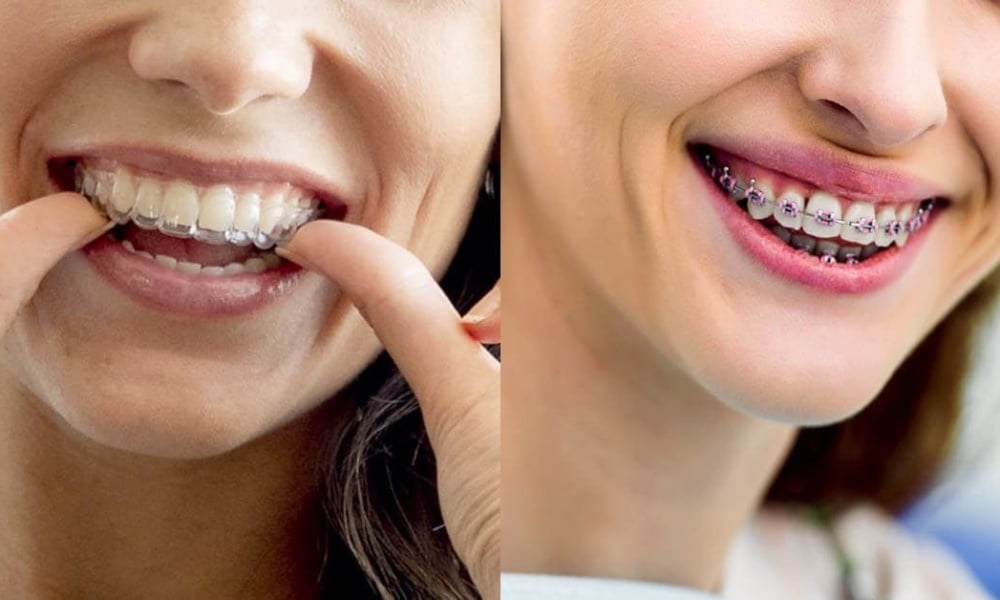
The principle. A series of clear removable trays, each one fractionally different from the last, worn in sequence to move your teeth gradually into a planned position. Each aligner moves the teeth a small amount. You wear it for one to two weeks, then move to the next.
The components. The aligners themselves — typically twenty to sixty in a full course, depending on how far the teeth need to move. Attachments — small tooth-coloured bumps bonded to certain teeth, giving the aligner something to grip so it can apply the right force in the right direction; they are removed at the end. Interproximal reduction, where needed — a very small amount of enamel polished from between the teeth to create space for crowding, as an alternative to extractions. And retainers at the end: section 12, and this is the part patients most underestimate.
How the movement is planned. A digital scan of your teeth is used to plan the entire sequence of movements in three dimensions before any aligner is made. You see a simulation of the planned outcome before treatment begins — and this is genuinely useful, though section 5 explains what a simulation does and does not tell you.
How long it takes. Six to nine months for limited treatment — front teeth only, minor correction. Twelve to eighteen months for most cases. Eighteen to twenty-four months or longer for complex ones. This is biological. Teeth move at the rate bone remodels, and no system accelerates it meaningfully.
2. Invisalign, or another system?
Worth clarifying, because patients search for the brand and the brand is not the whole story.
What Invisalign is. A brand of clear aligner — the longest established, with the largest clinical dataset and the most refined software.
What else exists. Several other aligner systems, some manufactured by major dental companies and some produced in-house by laboratories. They vary in the sophistication of the planning software, the material, and the range of movements they handle reliably.
What actually matters. Who plans your treatment. An aligner system is a tool. The planning — deciding which teeth move where, in what order, with which attachments, and how to manage the bite — is done by a person. A well-planned course on a mid-range system outperforms a poorly planned course on the best system available.
Our position. We will tell you which system we propose for your case and why, and where a case is complex enough to warrant a particular system, we say so. Ask: « Quel système proposez-vous, et qui planifie le traitement ? » The second half of that question matters more than the first.
3. Will aligners work for your case?
The honest assessment, because they do not treat everything.
Where aligners work well. Mild to moderate crowding. Spacing and gaps. Mild to moderate rotations, particularly of the front teeth. Relapse after previous orthodontic treatment — a very common presentation, and one aligners handle excellently. Alignment before veneers, so that far less tooth needs removing: our ceramic veneers guide explains why this matters. And minor bite corrections.
Where fixed braces are better. Severe crowding requiring substantial movement. Significant rotations of round teeth — premolars in particular, which aligners grip poorly. Large vertical movements, bringing a tooth down or pushing it up significantly. Complex bite correction requiring precise three-dimensional control. And where patient compliance is a genuine concern — fixed braces work whether you cooperate or not, which is occasionally the deciding factor.
Where surgery is the real answer. A significant skeletal discrepancy — where the upper and lower jaws do not relate correctly to each other. Aligners move teeth. They do not move jaws. Where a substantial skeletal problem exists, aligners can camouflage it to a degree — tilting teeth to compensate — but the underlying relationship is unchanged, and pushed too far this produces an unstable result. Orthognathic surgery, combined with orthodontics, is the treatment for a genuine skeletal discrepancy — and it is hospital surgery, not something we would undertake as a dental tourism procedure. Where we assess your case as skeletal, we will say so and recommend assessment in Canada.
What we do. Assess from a scan and photographs, and tell you honestly. Where aligners will achieve most of what you want but not all, we say what the limit is — because a patient who knows the expected result is satisfied, and one who does not is disappointed by the same outcome. Ask directly: « Mon cas est-il adapté aux aligneurs, ou un appareil fixe donnerait-il un meilleur résultat ? »
4. How this works across an ocean — read this before anything else
The most important section on this page, and the reason a number of patients decide this treatment is not for them.
The structure. One trip to Tunisia for assessment, scanning, planning, attachment placement and your first aligners. Then the remainder of your treatment at home in Canada, changing aligners on schedule, with remote monitoring and a defined protocol for problems. A second trip at the end — or, where the plan allows, at a midpoint — for review, refinement and retainers.
What remote monitoring involves. You photograph your teeth at defined intervals using a simple kit, and the images are reviewed. Where progress is on track, you continue to the next aligner. Where a tooth is not tracking as planned, that is detected — and this is precisely what the monitoring is for.
What happens when something goes wrong. And something will, at some point in a twelve to eighteen month course. An attachment comes off — the most common issue by a wide margin. An aligner cracks. A tooth stops tracking, so the aligner no longer seats fully on it. Or you lose an aligner.
The honest answer about each. A lost or cracked aligner — you move to the next one early, or go back to the previous one, per a protocol you are given. We replace it and ship it. Manageable. An attachment coming off — this needs a dentist chairside. It is a five-minute procedure, and any dentist can do it — but you need a dentist in Canada willing to do it. A tooth not tracking — detected on monitoring, and it usually means a refinement: a new scan and a new set of aligners. That may mean an additional trip, or a scan taken in Canada and aligners shipped, depending on what your case needs.
The arrangement you must make before travelling. A Canadian dentist willing to re-bond an attachment if one comes off. This is not optional, and it is the single most important thing to arrange. The conversation: « Je vais suivre un traitement par aligneurs commencé à l’étranger. Il se peut qu’un taquet se décolle pendant le traitement. Accepteriez-vous de le recoller ? Je reviendrai avec un plan de traitement détaillé et les spécifications des taquets. » Most dentists say yes — it is a simple procedure and they are not taking over the case. Some decline, which is a reasonable professional position. Find that out before you travel, not at month seven with a loose attachment.
Where this model works well. Straightforward to moderate cases, where the planning is predictable and refinements are unlikely. Patients who are organised and compliant. Patients with an established Canadian dentist who has agreed to help. Patients in or near major centres, where a dental appointment is easy to arrange.
Where we would be cautious. Complex cases likely to need multiple refinements, where the back-and-forth becomes impractical. Patients without a Canadian dentist willing to assist. Patients in remote communities where an unplanned dental appointment is genuinely difficult. And patients who tell us honestly that they are unlikely to wear aligners twenty-two hours a day — which is a legitimate thing to say, and it points toward fixed braces.
Why we set this out. Because a patient who understands the model and arranges the support has a good experience. A patient who discovers at month eight that no local dentist will touch her attachments does not. That is entirely preventable with one conversation before travelling.
5. What the simulation shows, and what it does not
What it is. A three-dimensional animation of the planned tooth movements, from your current position to the planned result. It is genuinely useful. It shows you what is being aimed at, it lets you ask for changes to the plan before it starts, and it makes an abstract treatment concrete.
What it is not. A guarantee. It is a plan, generated by software, of how the teeth are intended to move. Teeth are living structures in bone, and they do not always move exactly as planned — which is precisely why refinements exist and why monitoring matters.
What to do with it. Look at it carefully and ask questions. « Ce résultat est-il réaliste pour mon cas ? » « Qu’est-ce qui pourrait ne pas se dérouler comme prévu ? » « Une phase de raffinement est-elle probable, et est-elle incluse ? » — section 15, and the answer matters financially. And look at the bite, not just the front teeth. A simulation showing beautifully aligned front teeth may involve compromises further back, and it is worth asking how the bite is being managed.
6. Why Canadian patients choose Tunisia
| Canada (private) | Tunisia — Aylan Clinic | |
|---|---|---|
| Cost | Very high for a full course | Up to 60% less |
| Insurance | Orthodontic maximum, frequently lifetime | Same limitation, far lower total |
| Appointments | Every six to eight weeks, in person | One trip, then remote monitoring |
| Language | English or French | French throughout the country |
| Dentist training | Canadian | Frequently French-trained |
| Accommodation | Not applicable | Included, full board |
| Companion | Not applicable | Free, accommodated and fed |
Where the cost difference matters most. Canadian orthodontic insurance is frequently a lifetime maximum rather than an annual one — meaning once it is used, it does not renew. For an adult starting orthodontic treatment, that maximum typically covers a fraction of a full course. The saving here is therefore largely out of pocket either way — which is precisely why the percentage difference translates into a substantial real one.
Where the model differs. In Canada, you attend every six to eight weeks. That is convenient if you live near the practice and a burden if you do not. Here, you travel once, and the monitoring happens remotely. For a patient in a smaller community who would have driven two hours each way to an orthodontist, that is a genuine advantage — provided the support in section 4 is arranged.
Where the language matters on this treatment. At the planning consultation, and it matters more than it first appears. This is a twelve to eighteen month commitment that you will carry out alone, at home, following instructions. Understanding the protocol fully — what to do if an aligner cracks, what an attachment coming off feels like, when to send photographs, what the retainer regime is — is what makes the treatment work. And your written protocol is in French, which you will be referring to for a year. Patients consistently tell us they asked more in their own language — and here, the questions you ask at the outset determine how well you cope with the months that follow.
Dentist training. A substantial proportion of Tunisian dentists and orthodontists trained in France. Ask where yours qualified. We answer directly.
Part two — preparing
7. From first contact to confirmed dates
The online consultation. Send photographs and radiographs. What to send: a full smile photograph, a photograph of your teeth together from the front with lips retracted, from each side with teeth together, your upper arch from above and your lower arch from below if you can manage it. Plus a recent panoramic X-ray, any previous orthodontic history, whether you have any crowns, veneers or implants, whether you grind, and your medical history. In French or in English, whichever you prefer.
What you receive. A plan stating whether aligners suit your case, the estimated number of aligners and duration, whether attachments and interproximal reduction are anticipated, whether refinement is likely, the monitoring protocol, and the cost of the whole course — including retainers. Within 24 to 48 hours. And where fixed braces or surgical assessment would serve you better, the plan will say so.
Questions worth asking before you commit.
- « Mon cas est-il adapté aux aligneurs ? » — section 3.
- « Comment le traitement est-il suivi une fois rentrée au Canada ? » — section 4, and the answer determines whether this model works for you.
- « Que dois-je faire si un taquet se décolle ? »
- « Une phase de raffinement est-elle probable, et est-elle incluse dans le prix ? » — ask this explicitly, section 15.
- « Les contentions sont-elles incluses, et lesquelles ? » — section 12, and they are not optional.
- « Combien de voyages au total ? »
- « Qui planifie mon traitement ? »
- « Où votre praticien a-t-il été formé ? »
What to arrange at home before you travel. A Canadian dentist willing to re-bond an attachment — section 4, and this is the critical one. Any decay or gum disease treated: aligners are not fitted over active disease, because teeth are moved through bone, and inflamed gum tissue is a poor environment for that. Any necessary extractions discussed — where your plan involves them, they may be done here or at home. And tell us about any crowns, veneers or implants. Implants do not move, and the plan must account for that. Attachments bond poorly to ceramic, which affects where they can be placed.
8. What you are committing to
Worth being direct about, because compliance is the single largest determinant of success.
Twenty to twenty-two hours a day. Every day, for the whole course. That means removing them only to eat, to drink anything other than water, and to clean your teeth. A patient who wears aligners sixteen hours a day will not get the planned result — the teeth will not track, refinements will be needed, and the course will extend.
What that means practically. Eating takes longer, because you remove them, eat, brush, and replace them. Snacking becomes inconvenient, which a number of patients find is an unexpected side benefit. Coffee and tea must be drunk without the aligners in, or they stain. You will need to clean your teeth after every meal, away from home — which means carrying a brush.
Speech. A slight lisp for the first days, resolving within a week for most people. Reading aloud accelerates it.
Discomfort. Pressure and tenderness for the first two or three days after each new aligner, particularly early in the course. This is the teeth moving, and it is expected. Over-the-counter pain relief if needed.
Honest self-assessment. If you know you will not wear them as required, say so. It is a legitimate thing to say, and it points toward fixed braces, which work regardless of cooperation. We would rather have that conversation at the planning stage than at month ten.
Part three — the treatment
9. Your trip to Tunisia
Typically four to six days.
Day 1 — Arrival. Your driver meets you at the airport and takes you to your hotel with your companion. Nothing clinical today.
Day 2 — Assessment. Clinical examination, periodontal assessment, radiographs, and photographs. A digital scan of both arches — no impressions, a handheld scanner. Bite analysis, and assessment of any existing restorations. Treatment of any decay or gum disease where needed before proceeding.
Day 3 — Planning and your simulation. Your treatment plan is built in three dimensions, and you see the simulation. This is the appointment to ask questions — section 5. Adjustments to the plan are made now, before any aligner is manufactured. The number of aligners, the duration, the attachments and any interproximal reduction are confirmed.
Day 4 — Attachments and first aligners. Attachments are bonded to the teeth that need them — a painless procedure, and their exact positions are recorded in your treatment plan so a Canadian dentist can re-bond one correctly. Interproximal reduction where planned. Your first aligners are fitted, and you are shown how to insert and remove them properly. Your monitoring protocol is explained in full, and you are given the kit.

Days 5 to 6 — Review and departure. A review appointment to check the aligner fit and answer questions once you have worn them for a day. This matters — most practical questions only arise after the first twenty-four hours. Your documentation: full treatment plan including attachment positions and specifications; your aligner schedule; monitoring protocol in French or English; guidance for your Canadian dentist, including how to re-bond an attachment; and your first set of aligners. Then your transfer to the airport.
Your remaining aligners. Shipped to you in batches, on a schedule matched to your progress. Not all at once — because if a refinement is needed, later aligners in the original sequence become obsolete.
10. The months at home
The routine. Change aligners on schedule — typically every one to two weeks, per your plan. Wear them twenty to twenty-two hours a day. Send monitoring photographs at the defined intervals. Keep your previous aligner until the next one is seating well — it is your backup if one cracks or is lost.
Cleaning them. Rinse every time you remove them. Brush them gently with a soft brush and cool water — not hot water, which distorts them, and not toothpaste, which is abrasive and clouds them. Soak periodically in a cleaning solution or as advised.
When something goes wrong. An aligner cracks or is lost — go back to the previous aligner and contact us. We ship a replacement. Do not skip ahead unless instructed. An attachment comes off — contact us and see your Canadian dentist; your treatment plan specifies the exact position and shape, so it can be re-bonded correctly. An aligner does not seat fully — this is the important one. It means a tooth is not tracking. Photograph it and send it rather than forcing the aligner. And if anything hurts sharply rather than aching, contact us.
Chewies. Small soft cylinders you bite on to help the aligner seat fully. They matter more than patients expect, particularly for the back teeth, and a number of tracking problems come from aligners never seating properly in the first place. Use them as instructed.
Staying in touch. We are available in French or English throughout your treatment. A photograph and a message resolve most questions, and the monitoring protocol exists precisely so that problems are caught at week two rather than month five.
11. Refinement: expect it, and ask whether it is included
A section that will save you money and disappointment.
What refinement is. Near the end of the planned sequence, the teeth are reassessed. Where some have not moved exactly as planned — which is common — a new scan is taken and a further set of aligners is made to finish the job.
How often it happens. Frequently. A substantial proportion of aligner cases need at least one refinement phase. This is normal, not a failure. Teeth are biological, and planning software predicts rather than dictates.
Why it matters financially. Because some clinics include refinement in the quoted price, and some charge for it separately. A quote that excludes refinement may be substantially cheaper up front and cost more overall. Ask explicitly: « Une phase de raffinement est-elle incluse, et combien de raffinements ? » Get the answer in writing.
Why it matters logistically for a Canadian patient. Because a refinement needs a new scan. Depending on your case, that may mean a second trip, or a scan taken by a Canadian dentist and sent to us, with the refinement aligners shipped. Your plan states which is anticipated, and section 4 is the context.
Our position. We tell you at the planning stage whether refinement is likely for your case, and what it involves. For a straightforward case it may not be needed. For a complex one it is close to certain — and knowing that before you commit is what lets you compare quotes properly.
Part four — the years that follow
12. Retainers: the part that determines whether it lasted
The most under-appreciated section in all of orthodontics.
Teeth move back. This is not a failure of treatment. It is what teeth do. Teeth are held in bone by fibres that have memory, and after being moved they tend to drift back toward their original position — particularly in the first year, and measurably for years afterwards. Relapse after orthodontic treatment is common, and it is almost entirely preventable.
The regime. Full-time wear for the first period — typically three to six months, per your plan. Then nightly, indefinitely. Yes, indefinitely. A retainer worn nightly for life is what keeps the result. Patients who stop after a year frequently find their teeth have moved by year three — and a substantial proportion of the aligner cases we treat are patients correcting relapse from orthodontics they had as teenagers and stopped retaining.
The types. Removable clear retainers — like a final aligner, worn at night: simple, invisible, and replaceable. Fixed bonded retainers — a thin wire bonded behind the front teeth, permanently in place. Frequently both — a fixed retainer on the lower front teeth, which are the most prone to relapse, plus removable retainers at night.
What we provide. Retainers are included in your plan, and the type is specified. Ask any clinic whether they are included — a quote that excludes retainers is not a quote for orthodontic treatment, it is a quote for the moving part only.
Replacing them. Removable retainers wear out and need replacing every few years. Keep your final scan — it means a replacement can be made without starting over. This is ordinary and inexpensive, and your Canadian dentist can arrange it.
If a fixed retainer comes loose. See a dentist promptly. A partially detached bonded retainer can apply unintended force to a tooth and cause movement. This is one of the specific things to mention to your Canadian dentist.
13. Your Canadian follow-up
During treatment. Your six-monthly check-up and cleaning continue as normal. Tell your dentist you are in aligner treatment. And confirm — before you travel — that they will re-bond an attachment if one comes off. Section 4.
After treatment. Normal six-monthly care. Tell your dentist about your retainers, particularly any fixed retainer, which needs checking at each visit and cleaning around.
Cleaning around a fixed retainer. It makes flossing between the lower front teeth more difficult, and plaque accumulates there. Superfloss or a floss threader, or a water flosser, daily. Ask for a demonstration — it is a small technique change and it prevents gum problems over the years.
Keep your documentation. Your treatment plan, attachment specifications, and your final scan. The final scan is what allows replacement retainers to be made without a new impression. Photograph it. Give a copy to your Canadian dentist.
Canadian insurance. Orthodontic coverage is frequently a lifetime maximum rather than annual — once used, it does not renew. Ask your insurer in writing whether orthodontic treatment received abroad is reimbursable, what your lifetime maximum is and whether any remains, and request pre-determination if available. We provide itemised invoicing separating the aligners, attachments and retainers, in French or English.
Part five — practical matters
14. Canadian patients: travelling to Tunisia from your region
Aylan Clinic works with patients from every province and territory in Canada. Wherever you live, the process begins the same way: a free consultation from your photographs and radiograph, in French or English. And on this treatment, one thing applies everywhere: arrange a Canadian dentist willing to re-bond an attachment before you travel. Section 4.
Montreal and the surrounding region. Montreal is our largest Canadian source for Tunisia. Connections from Trudeau to Tunis typically route through Paris, Frankfurt or Istanbul. Patients from Laval, Longueuil and Brossard are all within easy reach of the airport. For patients here, a refinement trip is straightforward to arrange — which makes the remote model comfortable even for moderately complex cases.
Quebec City and across the province. From Quebec City and the Capitale-Nationale region including Lévis, most patients connect through Montreal — as do patients from Trois-Rivières, Sherbrooke, Drummondville and Saint-Jérôme, all within driving distance of Trudeau. Gatineau patients depart from Ottawa or drive to Montreal. From Saguenay, a domestic connection through Montreal is the norm. On this treatment the francophone advantage matters because of what happens after you leave. You carry out this treatment alone, at home, for a year or more, following a written protocol — what to do if an aligner cracks, when to send photographs, what a tooth not tracking looks like. That protocol is in French, and you will be referring to it for months.
Acadia and New Brunswick. We work with patients from Moncton, Fredericton and Saint John. Moncton and the surrounding Acadian communities are served in French throughout. Most connect through Montreal.
Francophone Ontario. Sudbury, Thunder Bay and Sault Ste. Marie all have substantial francophone populations, served in French from first contact onward. Ottawa patients typically connect through Montreal. For patients in these regions, the remote model has a genuine advantage — it removes the long drive to an orthodontist every six weeks. Provided the attachment arrangement in section 4 is in place.

Greater Toronto Area and southern Ontario. Toronto patients connect through European hubs, with Paris and Frankfurt the most common routes to Tunis. Across the wider Greater Toronto Area we work with patients from Mississauga, Brampton, Markham, Vaughan, Richmond Hill and Oshawa. Along the lake: Hamilton, Burlington, Oakville, St. Catharines and Niagara Falls. In southwestern Ontario: London, the Waterloo region — Kitchener, Waterloo and Cambridge — plus Guelph, Windsor and Barrie. Kingston patients generally drive to Toronto or Montreal.
Vancouver and British Columbia. Vancouver patients face the longest journey — typically two connections. For this treatment specifically, the journey length changes the calculation. A refinement requiring a second trip is a substantial undertaking from the west coast — so we assess complexity carefully at the planning stage and are explicit about the likelihood. Where refinement is likely, we plan for a scan to be taken in Canada and aligners shipped wherever that is clinically adequate. Across the Lower Mainland: Surrey, Burnaby and Richmond. From Victoria and Nanaimo, patients cross by ferry or short flight. Kelowna, Abbotsford and Kamloops patients connect through Vancouver or Calgary.
Alberta. Calgary and Edmonton both offer European connections onward to Tunis. Red Deer and Lethbridge patients generally drive to Calgary. Same considerations as British Columbia regarding refinement planning.
Manitoba and Saskatchewan. Winnipeg patients connect through Toronto or Montreal. The francophone community of Saint-Boniface is served in French. From Saskatoon and Regina, journeys involve a domestic connection followed by two further flights.
Atlantic Canada. Halifax patients typically route through Montreal or Toronto. From Charlottetown and St. John’s, journeys involve two or three connections.
Northern Canada. We work with patients from Whitehorse in Yukon, and from communities across the Northwest Territories and Nunavut. For northern patients, this treatment requires the most careful assessment of all. Section 4 applies with particular force: where an unplanned dental appointment is genuinely difficult to arrange, an attachment coming off becomes a substantial problem rather than an inconvenience. We discuss this honestly at the planning stage. For some northern patients the remote model works well — the alternative is repeated journeys south anyway. For others, we would say plainly that the support requirements make it impractical, and fixed braces arranged closer to home may serve better. That conversation happens before you book, not after.
How we handle the logistics. Whichever city you are travelling from, your coordinator arranges airport transfers at both ends in Tunisia, confirms your hotel before you depart, and builds your schedule around your arrival time.
Five recommendations. Arrange a Canadian dentist for attachments before you travel — the critical one. Ask whether refinement is likely and whether it is included. Ask whether retainers are included. Be honest about whether you will wear them twenty-two hours a day. And keep your previous aligner as a backup throughout.
15. What your package includes
- Free consultation in French or English, with an honest assessment of whether aligners suit your case
- Full on-site assessment: clinical examination, periodontal assessment, radiographs, photographs
- Digital scan of both arches
- Treatment of decay or gum disease before proceeding
- Three-dimensional treatment planning, with a simulation you review and can adjust
- Attachment placement, with positions and specifications recorded
- Interproximal reduction where planned
- All aligners for the planned course, shipped to Canada in batches
- Remote monitoring kit and protocol
- Refinement phase where included in your plan — stated explicitly
- Review appointment before departure
- Retainers — removable, fixed, or both as specified
- Your final scan, for future retainer replacement
- Written protocol in French or English, covering what to do if anything goes wrong
- Guidance for your Canadian dentist, including how to re-bond an attachment
- Itemised invoicing separating aligners, attachments and retainers
- Support in French or English throughout your treatment
- Hotel accommodation, full board
- A companion at no extra cost, accommodated and fed in the same room
- Airport–clinic–hotel transfers
- A personal coordinator from arrival to departure
- French-speaking care throughout, with English available on request
The clinical team. An orthodontist or dentist with orthodontic training handles planning and case assessment — frequently French-trained. A periodontist provides gum treatment where needed before movement. And a treatment coordinator manages monitoring and communication throughout your course.
16. Results by patient profile
Relapse after teenage orthodontics. A patient of thirty-four whose lower front teeth had crowded again after braces at fifteen and no retainer since. Nine months of aligners, plus a fixed lower retainer and nightly removable retainers. A very common presentation, and one aligners handle excellently. Her comment: nobody had told her at fifteen that retention was for life.
Alignment before veneers. A patient with mild crowding who wanted veneers. Five months of limited aligner treatment first, after which far less tooth needed removing for the veneers. Alignment first preserved considerably more of her own teeth — and it is covered in our ceramic veneers guide.
Where we recommended fixed braces. A patient with significant rotation of two premolars and substantial crowding. We explained that aligners grip round teeth poorly and that the case would likely need multiple refinements. Fixed braces were the better answer, and she arranged them in Canada.
Where we recommended Canadian assessment. A patient whose photographs showed a significant skeletal discrepancy. We explained that aligners move teeth, not jaws, and that camouflaging it would produce an unstable result. We recommended orthognathic assessment in Canada, which is hospital surgery and not a dental tourism procedure.
Where the model worked well. A patient from a smaller Ontario community, who had been facing a two-hour drive each way to an orthodontist every six weeks. Her dentist agreed in advance to re-bond attachments. One came off at month five and was re-bonded in ten minutes. Fourteen months, one refinement, done. The remote model suited her better than the Canadian one would have.
Where we advised against. A patient in a northern community with no regular dental access, and a moderately complex case. We set out honestly that an attachment coming off would be a substantial problem for her, and that refinements would likely need a second trip. She chose not to proceed. That was the right outcome, and telling her before she booked is why.
A patient from Rouyn-Noranda. A patient who chose Tunisia so the protocol could be explained in French. Her comment concerned the year afterwards. She said she asked what a tooth “not tracking” actually looks like, how she would know, and what she should photograph. She caught a tracking problem herself at week nine and sent photographs. It was resolved with a single aligner repeat rather than a refinement.
17. Practical points to know
What to expect. One trip for assessment, planning, attachments and first aligners. Twelve to eighteen months at home for most cases, with twenty to twenty-two hours of wear daily. Pressure and tenderness for two to three days after each new aligner. A slight lisp for the first days, resolving within a week. Remote monitoring, with photographs at defined intervals. A refinement phase, which is common and normal. Retainers at the end — nightly, indefinitely.
Recognised points. Clear aligner treatment is well established with good outcomes in appropriately selected, compliant patients. Your clinician will discuss the considerations relevant to you. The main ones: incomplete tooth movement where compliance is inadequate or a tooth does not track — addressed by refinement. Attachment debonding, the most common practical issue, requiring a chairside appointment. Relapse after treatment, almost entirely preventable with retention. Root resorption, a shortening of the root that can occur with any orthodontic movement, usually minor and detected on radiographs. Gum recession, where teeth are moved beyond the bone envelope. Temporary sensitivity. Enamel decalcification where hygiene is poor — less common with aligners than fixed braces, since they are removed for cleaning. Bite changes during treatment, which are planned for. And an unstable result where a skeletal discrepancy was camouflaged rather than addressed — section 3.
Three things within your control. Wearing them twenty to twenty-two hours a day — the single largest determinant of success. Sending your monitoring photographs on schedule. And wearing your retainers, indefinitely.
Who this suits. Adults with mild to moderate alignment issues, healthy teeth and gums, the discipline to wear aligners as required, and a Canadian dentist willing to assist with attachments.

Who this does not suit. Severe crowding or rotation, significant skeletal discrepancy, patients without local dental support, and patients who know they will not wear them consistently.
18. Price: how it is built and how to compare it
Why we quote per case. Because the number of aligners, the duration, and whether refinement is likely vary enormously by case. Your quote is built from your scan and photographs, itemised, and fixed once you approve it.
What determines your price. Five factors. The complexity of your case, which determines the number of aligners. The duration. Whether attachments and interproximal reduction are needed. Whether a refinement phase is included — and it should be stated explicitly. And the retainers, which are included and specified.
What is included in your quote. Everything in section 15, including the assessment and scan, three-dimensional planning with a simulation you can adjust, attachment placement with specifications recorded, all aligners shipped to Canada, the monitoring kit and protocol, refinement where included, retainers, your final scan, the written protocol, guidance for your Canadian dentist, itemised invoicing, support in French or English throughout, hotel with full board, transfers, and your coordinator. A companion is accommodated and fed at no additional cost.
What sits outside it. Flights, travel insurance, appointments with your Canadian dentist for attachment re-bonding, shipping where applicable, replacement retainers in future years, and a second trip where refinement requires one.
How to compare quotes properly. Five checks, and aligner quotes are among the least comparable in dentistry.
- Is refinement included, and how many phases? The single largest source of cost difference. A quote excluding refinement may be substantially cheaper and cost more overall.
- Are retainers included, and which type? A quote without retainers is not a quote for orthodontic treatment.
- Are all aligners included, or is the quote for a fixed number? Where a case extends, additional aligners may be charged.
- Is the monitoring included for the whole course?
- What happens if a tooth does not track — is a second trip required, and is it quoted?
Why the lowest quote is rarely the best value. On aligners, what you are paying for is the planning. The trays are manufactured from a digital file. The value is in the person who decided which teeth move where, in what order, with which attachments, and how the bite is managed. A poorly planned case needs more refinements, takes longer, and may not reach the result — and none of that is visible in the initial price. Ask who plans your treatment, section 2.
Canadian insurance. Orthodontic coverage is frequently a lifetime maximum, not annual. Ask your insurer in writing whether treatment abroad is reimbursable, what your lifetime maximum is and whether any remains, and request pre-determination. Our itemised invoicing separates aligners, attachments and retainers, in French or English.
Payment. A deposit confirms your dates. The balance is settled under terms set out in full when you approve your plan. There are no additional charges once accepted — and where your case requires a refinement not included in your original plan, we discuss it with you before proceeding.
Getting your figure. Send a full smile photograph, your teeth together from the front with lips retracted, from each side, and your upper and lower arches if you can manage it. Plus a recent panoramic X-ray, any previous orthodontic history, whether you have crowns, veneers or implants, whether you grind, and your medical history. You will receive a plan and quote within 24 to 48 hours, in French or English — including whether aligners suit your case, whether refinement is likely, and the monitoring protocol. You can also request a free, personalised quote directly.
19. Glossary
| Term | Meaning |
|---|---|
| Clear aligners | Removable trays moving teeth in sequence; Invisalign is one brand |
| Attachments | Small bonded bumps giving the aligner grip; removed at the end |
| Interproximal reduction | A small amount of enamel polished between teeth to create space |
| Tracking | Whether a tooth is moving as planned; visible from how the aligner seats |
| Refinement | A new scan and further aligners to finish the result; common and normal |
| Chewies | Soft cylinders bitten on to seat the aligner fully |
| Retention | Wearing retainers after treatment; nightly, indefinitely |
| Fixed retainer | A wire bonded behind the front teeth |
| Relapse | Teeth drifting back; almost entirely preventable with retention |
| Skeletal discrepancy | A jaw relationship problem; aligners do not treat it |
20. How Canadians search for this
- “Invisalign Tunisia cost” — the most common search. Ask whether refinement and retainers are included.
- “Invisalign Tunisie” — how most Quebec patients search, and the reason this page exists in both languages.
- “Invisalign abroad how does it work” — section 4 is the honest answer, and it is the question that should decide it.
- “Clear aligners without visiting the dentist” — remote monitoring, yes, but you need a Canadian dentist for attachments.
- “Invisalign vs braces” — aligners for mild to moderate cases; braces for severe crowding, significant rotations, and where compliance is uncertain.
- “How long does Invisalign take” — six to nine months limited, twelve to eighteen typical, longer for complex cases.
- “Do I have to wear aligners 22 hours” — yes, and a treatment you do not wear does not work.
- “Invisalign attachment came off” — the most common practical issue, and it needs a dentist chairside. Arrange this before you travel.
- “Invisalign refinement” — common and normal, and the largest source of cost difference between quotes.
- “Do I need retainers forever” — nightly, indefinitely. Relapse is common and almost entirely preventable.
- “Invisalign before veneers” — frequently yes, and it means far less tooth needs removing.
- “Aligners for overbite” — depends whether it is dental or skeletal. Aligners move teeth, not jaws.
- “French speaking orthodontist abroad” — Tunisia’s distinguishing feature.
In summary
Clear aligner treatment at Aylan Clinic Tunisia combines an honest assessment of whether aligners suit your case, three-dimensional planning with a simulation you review and can adjust, all aligners shipped to Canada, remote monitoring with a protocol in your own language, and retainers included — with one trip rather than an appointment every six weeks. And it takes place in a French-speaking country, which matters because you carry out this treatment alone, at home, for a year or more, following a written protocol you will keep referring to. With accommodation, full board and a companion at no extra cost, for up to 60% less than Canadian private prices.
Five things that determine whether this works for you.
- Arrange a Canadian dentist willing to re-bond an attachment before you travel. This is the single most important preparation — most say yes, and finding out at month seven is too late.
- Ask whether refinement is included, and how many phases. It is common, it is normal, and it is the largest source of cost difference between quotes.
- Be honest about compliance. Twenty to twenty-two hours a day — and if you know you will not, fixed braces work regardless.
- Ask whether your case genuinely suits aligners. Severe crowding, premolar rotations and skeletal discrepancies are better treated otherwise, and we will tell you.
- Plan to wear retainers indefinitely. Nightly, for life — and a substantial proportion of our aligner patients are here because nobody told them that the first time.
Send your photographs and panoramic X-ray and you will have an honest answer within 24 to 48 hours — in French or in English. When you are ready to look at the procedure itself, our page on Invisalign clear aligners in Tunisia covers how the treatment is carried out, the length of stay and the follow-up that goes with it. You can also compare plastic surgery prices in Tunisia, browse the full dental care in Tunisia overview, or request a free, personalised quote.
Related guides
- Ceramic veneers in Tunisia — frequently combined with limited aligner treatment first, so that far less tooth needs removing.
- Lumineers in Tunisia
- Teeth whitening in Tunisia
- Hollywood Smile in Tunisia