
The short answer is that PRP has genuine evidence behind it, a modest effect, and a protocol that varies enormously between clinics — which is why results do too. PRP at Aylan Clinic Tunisia — platelet-rich plasma — concentrates platelets from your own blood and injects them into the scalp, in a course of sessions, for up to 60% less than Canadian private prices. The evidence is real and moderate: multiple randomised trials and meta-analyses show benefit in androgenetic alopecia, and the effect is an improvement in density rather than a transformation. It is not a substitute for medical treatment, and it is not a hair transplant.
This guide is the long-form companion to our procedure page on PRP scalp treatment in Tunisia, which sets out how a session runs, what a stay involves and how aftercare is organised. Here we deal with the questions that come before that: does it work, how much, for whom, and what the whole commitment actually costs. For the budget side, see plastic surgery prices in Tunisia, and for the wider picture our hair transplant in Tunisia hub covers every option alongside this one.
Three things before you read further. First, “PRP” describes a category, not a standard — platelet concentration, centrifugation protocol, whether it is activated, injection technique, volume and session spacing all vary, and a clinic that cannot tell you its protocol is not following one. Second, finasteride and minoxidil have far stronger evidence, and PRP is best understood as an addition rather than an alternative. Third, one thing distinguishes Tunisia: it is a French-speaking country. Not a clinic with French-speaking staff — a country where French is a working language across medicine and daily life.
Part one — deciding
1. What PRP is
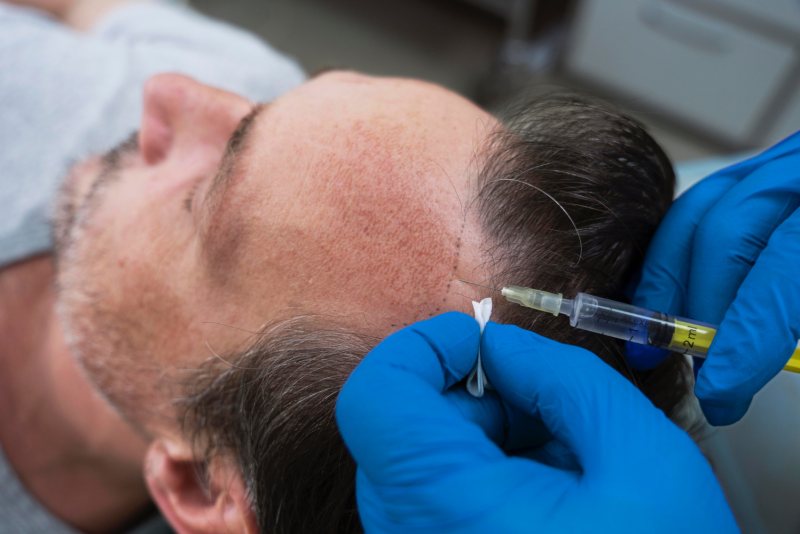
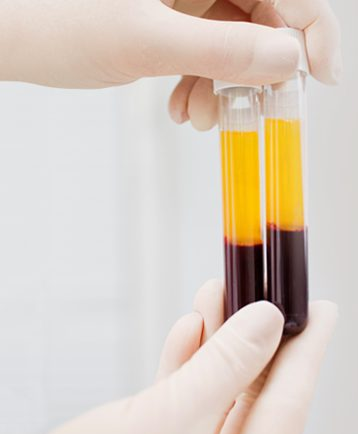
The preparation. Your blood is drawn — typically a few tubes. It is centrifuged, separating red cells, plasma and the platelet layer. The platelet-rich fraction is drawn off, producing a concentrate several times the platelet level of whole blood. And it is injected into the scalp in the affected areas.
The rationale. Platelets contain growth factors — platelet-derived growth factor, vascular endothelial growth factor, transforming growth factor and others. The proposed mechanism is stimulation of the dermal papilla, prolongation of the growth phase, and improved perifollicular vascularity. That is a plausible mechanism, and the clinical evidence rather than the mechanism is what matters.
What it is not. It is not a hair transplant. It does not create follicles. It does not work where follicles are gone — which means it does nothing for bald areas, only for thinning ones with surviving miniaturised follicles. And it does not stop androgenetic alopecia: it is not a DHT blocker.
2. The evidence, graded honestly
The section this page exists for.
What the studies show. Multiple randomised controlled trials in androgenetic alopecia report increases in hair density and thickness compared with placebo. Meta-analyses generally support a positive effect. And the effect size is modest — an improvement in density measured in hairs per square centimetre, not a restoration of lost hair.
The honest caveats. Protocols vary enormously between studies — different preparation systems, platelet concentrations, volumes and intervals — which makes pooling them difficult and comparison across clinics unreliable. Follow-up in most studies is short, frequently six to twelve months, so long-term durability is not well established. Some trials are small. And there is publication bias to consider, as in any field with commercial interest.
Where the evidence is strongest. Androgenetic alopecia in men and women, in early to moderate thinning.
Where it is weaker or absent. Advanced loss with bald areas — no follicles to stimulate. Scarring alopecias, where it is used as an adjunct and remains experimental. Alopecia areata — some studies, less consistent, and other treatments are established.
How we describe it. A treatment with genuine evidence and a modest effect, best used alongside established medical therapy rather than instead of it. A clinic promising dramatic regrowth from PRP is overstating what the literature supports.
3. The protocol is the variable
Which is why results differ so much between clinics.
Platelet concentration. PRP is defined as a concentration above baseline — and how far above varies enormously. Some systems produce a modest concentration; others considerably more. There is evidence that concentration matters, with a suggestion that both too low and excessively high may be less effective. Ask what concentration the system produces.
Single or double spin. A second centrifugation produces a higher platelet concentration, and it is more commonly used in the protocols that reported benefit.
Leukocyte content. Leukocyte-rich versus leukocyte-poor PRP. Debated — some evidence suggests leukocyte-poor is preferable for hair, because inflammatory cells may be counterproductive. Not settled, and worth knowing the clinic has a position.
Activation. Whether the platelets are activated before injection — with calcium chloride or other agents — or allowed to activate on contact with tissue. Protocols differ, and both appear in the positive literature.
Injection technique. Depth, into the dermis at the level of the follicles. Spacing, typically a grid at defined intervals. And volume per site. Technique is operator-dependent, and it matters.
The course. Most protocols reporting benefit use an initial series — frequently three to four sessions at four to six week intervals — followed by maintenance. A single session is not a course, and a clinic offering one session as a treatment is not following a protocol from the literature.
Maintenance. Typically every four to six months, indefinitely, because the effect wanes.
What to ask. « Quel est votre protocole exact : concentration plaquettaire, nombre de centrifugations, activation, et espacement des séances ? » A clinic with a specific answer is following a protocol. A clinic that describes it vaguely is not.
4. Who it genuinely suits
Best candidates. Early to moderate androgenetic alopecia with surviving miniaturised follicles. Patients wanting to add to medical treatment. Women, for whom the medical options are more limited than for men — our guide to hair transplant for women in Tunisia sets out why — and for whom PRP is frequently a more useful addition than it is in men. Patients who cannot or will not take finasteride, where PRP is one of the remaining options, with honest expectations. And patients having a transplant, where PRP is assessed as an adjunct.
Poor candidates. Advanced loss with bald areas — nothing to stimulate. Scarring alopecia, outside a specialist setting. Patients expecting transformation. And patients with blood disorders, platelet dysfunction, active infection or on certain medications.
And one honest note. In a man with progressive androgenetic alopecia who is not on finasteride, PRP is treating the symptom while the cause continues. We would recommend the medical treatment first, and PRP as an addition.
5. PRP against the alternatives
| Minoxidil | Finasteride | PRP | Transplant | |
|---|---|---|---|---|
| Evidence strength | Strong | Strong | Moderate | Strong |
| Creates new coverage | No | No | No | Yes |
| Works on bald areas | No | No | No | Yes |
| Requires ongoing use | Yes | Yes | Yes | No |
| Systemic side effects | Minimal topical | Yes, discussed | Minimal | No |
| Cost pattern | Ongoing, low | Ongoing, low | Ongoing, higher | One-off, higher |
| Suits women | Yes, first-line | Restricted | Yes | Sometimes |
Reading this. Minoxidil and finasteride have stronger evidence and lower cost. PRP has minimal systemic side effects, which is its clearest advantage — and it is more expensive to maintain. And a transplant is the only one that produces coverage where there is none.
The honest positioning. PRP is an addition to a medical regimen, not a replacement for one. And for a patient who cannot take finasteride, or a woman with limited options, it is a reasonable component.
6. PRP around a transplant
A common combination, and worth assessing separately.
The rationale. Growth factors applied at the time of transplantation may improve graft survival and speed the onset of growth. And PRP in the months afterwards may reduce shock loss to surrounding native hair.
The evidence. Several studies report faster growth onset and improved density when PRP is used alongside transplantation. The evidence is smaller and less consistent than for PRP in androgenetic alopecia alone, and it is reasonably encouraging.
What we do. Offer it where it is appropriate, and describe it as a plausible adjunct with moderate supporting evidence rather than as an essential part of the procedure. A clinic that presents PRP as necessary for a transplant to work is overstating it. And a clinic that charges substantially for it as a mandatory add-on is worth questioning. Our guide to exosomes for hair loss in Tunisia covers a related and considerably less established adjunct, including its regulatory status — and the distinction between the two matters.
7. What to expect realistically
The timeline. Nothing visible for the first two to three months. Reduced shedding is frequently the first change patients notice, and it is a genuine early sign. Density improvement from three to six months. And the effect assessed at six months, after the initial course.
The magnitude. Modest. Measured in the literature as an increase in hairs per square centimetre — noticeable to you, and frequently not dramatic to others.
Duration. The effect wanes without maintenance, typically requiring sessions every four to six months indefinitely. Which makes it an ongoing commitment and an ongoing cost, and that should be clear before you start.
Where it does not work. A proportion of patients do not respond. And there is no reliable way to predict who beforehand, which is an honest limitation. We would assess at six months and stop if there is no benefit, rather than continuing indefinitely.
8. Safety, and who should not have it
The safety profile. Good, because it uses your own blood, which avoids the immunological and infectious concerns of donor products. Common effects: scalp tenderness, redness and mild swelling for a day or two; headache; and pinpoint bruising. The injections are uncomfortable, and topical anaesthetic or a nerve block is generally used. Uncommon: infection, and bleeding in patients with clotting problems.
Who should not have it. Platelet dysfunction disorders or low platelet counts. Active infection of the scalp. Anticoagulant therapy, depending on the agent and dose — a physician’s assessment. Active malignancy, as a general precaution. Certain haematological conditions. And pregnancy, as a precaution.
Medications to declare. Anticoagulants and antiplatelet agents, including aspirin. Non-steroidal anti-inflammatories, which affect platelet function and which are generally stopped for a period before. And systemic corticosteroids.
9. PRP in specific conditions, beyond pattern loss
Because patients ask, and the answers differ.
Alopecia areata. Some studies report benefit, and the evidence is less consistent than in androgenetic alopecia. Established treatments exist — intralesional corticosteroids principally — and they are covered in Canada under dermatological care. Which means PRP here is an adjunct considered by a dermatologist, not a first option.
Scarring alopecias. Our women’s guide and our afro hair guide cover the conditions. PRP has been studied as an adjunct in some of them — and the evidence is early, the disease must be inactive, and this belongs in a specialist setting. It does not regenerate a destroyed follicle, which is the defining feature of these conditions.
Traction alopecia. Where the loss is early and the tension has stopped, some follicles may still be viable, and PRP is a reasonable adjunct alongside stopping the cause. Where the loss is established and scarred, there is nothing to stimulate.
Telogen effluvium. It recovers on its own, and PRP is not necessary. Where a patient wants to do something, treating the underlying cause is the intervention that works.
Chemotherapy-related loss. Regrowth usually occurs spontaneously, over months. PRP is not established here, and waiting is the standard advice, with assessment where regrowth is incomplete at a year.
Eyebrows. Small studies exist, and our eyebrow grafting guide sets out the causes that must be excluded first. PRP does not create eyebrow follicles.
The general principle. PRP stimulates surviving miniaturised follicles. Where the condition destroys follicles, or where there are none left, it has nothing to act on — whatever the diagnosis.
10. What “regenerative” means on a clinic website
A short section on vocabulary, because it recurs.
The word. “Regenerative medicine” describes a genuine field — tissue engineering, cell therapy, and approaches aiming to restore rather than replace. And commercially it is applied far more broadly than that.
What it covers on clinic websites. PRP, which has evidence and is not regenerative in the technical sense; it is an autologous growth factor preparation. Exosome products, not approved as hair loss treatments. “Stem cell” preparations, which usually contain no characterised stem cells. And various proprietary blends.
How to read it. The word tells you nothing about evidence, approval status or composition. Which means the useful questions are the specific ones — what is in it, what supports it, and is it authorised.
Why we raise it here. Because PRP is frequently grouped with products that have considerably less behind it, and that grouping flatters them rather than PRP. PRP has randomised trials and meta-analyses. It deserves to be described as what it is, rather than folded into a category with things that do not.
11. Your Canadian options
PRP is widely available privately in Canada, and it is not covered. Which matters here more than on most of our pages, because PRP requires a course and then indefinite maintenance. Flying for a course of four sessions is not practical.
The realistic pattern. PRP is worth having in Tunisia when it is combined with a transplant, or when you are already travelling for another procedure. And maintenance is done in Canada, where it is available. We say this plainly rather than selling a course that requires four flights. Where you want a full course here, it means an extended stay or repeat visits, and we would set out what that involves honestly.
Part two — preparing
12. From first contact to confirmed dates
The online consultation. Send photographs from all angles — front, both sides, top, crown and donor area — hair dry, not styled to conceal, in daylight and unfiltered. Plus: your age, the pattern and duration of your loss, whether you take finasteride or minoxidil, any blood disorder or clotting problem, all medications including aspirin and anti-inflammatories, any active scalp condition, and whether you are also considering a transplant. And for women, the workup set out in our women’s guide, because PRP for an untreated iron deficiency is treating the wrong thing.
What you receive. An assessment stating whether you have surviving follicles to stimulate, whether PRP is appropriate for your pattern, what protocol we use, what course and maintenance would be required, and how that fits with travelling. Within 24 to 48 hours. And where medical treatment should come first, or where Canadian PRP is more practical, the plan will say so.
Questions worth asking before you commit. « Quel est votre protocole exact ? » — the key question. « Combien de séances, à quel intervalle, et quel entretien ensuite ? » « Ai-je encore des follicules à stimuler dans cette zone ? » « Le PRP remplace-t-il le traitement médical ? » — and the correct answer is no. « Que ferez-vous si je ne réponds pas à six mois ? » — and a clinic willing to stop is being honest.
What to arrange at home before you travel. Start medical treatment where recommended. Stop non-steroidal anti-inflammatories for the period advised. Discuss anticoagulants with your physician. Hydrate well before the session — it makes the blood draw easier. And avoid alcohol for a day or two before.
Part three — the treatment
13. The session
Forty-five minutes to an hour. Blood drawn — a few tubes. Centrifuged per the protocol. The scalp cleaned and anaesthetised, with topical anaesthetic, a ring block, or both. Injections placed in a grid across the affected area, at follicular depth. And that is the session. You can leave immediately.
Afterwards. Tenderness and redness for a day or two. Do not wash for the period advised, typically several hours to a day. Avoid strenuous exercise, sauna and swimming for forty-eight hours. Avoid anti-inflammatories for a few days, as instructed. And expect a headache in some patients, which settles.
14. Where it fits in a trip
Practically. Combined with a transplant, PRP is given at the time of surgery and sometimes at a follow-up. As a standalone course, it requires four sessions over three to four months, which is not compatible with a single trip. Which is why the Canadian-options section above matters, and why we are direct about it.
Part four — what follows
15. Assessing whether it worked
The measure. Standardised photographs, in the same light and the same position. And where available, trichoscopic density measurement, which is objective and which we use.
The timeline. Assess at six months, after the initial course. Not before, because nothing is visible for the first two to three months.
If it worked. Maintenance every four to six months, indefinitely.
If it did not. Stop. A proportion of patients do not respond, and continuing indefinitely in a non-responder is spending money for nothing. We say so.
16. Your Canadian follow-up
Continue your medical treatment, which does more than PRP does. Arrange Canadian maintenance sessions where PRP is working. And annual review with your physician, particularly where a medical cause was treated.
Part five — practical matters
17. Canadian patients: travelling to Tunisia from your region
Aylan Clinic works with patients from every province and territory in Canada. And on this page we would say plainly: PRP alone is not worth a flight.
Montreal and the surrounding region. Montreal is our largest Canadian source for Tunisia, with connections through Paris, Frankfurt or Istanbul. Patients from Laval, Longueuil and Brossard are within easy reach of the airport. PRP here makes sense combined with a transplant, and maintenance is done at home.
Quebec City and across the province. From Quebec City and the Capitale-Nationale region including Lévis, most patients connect through Montreal — as do patients from Trois-Rivières, Sherbrooke, Drummondville and Saint-Jérôme. Gatineau patients depart from Ottawa or drive to Montreal. On this page the francophone advantage is at the evidence conversation. You are being told that the evidence is genuine and moderate, that the effect is an improvement rather than a restoration, that protocols vary and that maintenance is indefinite. That is a carefully graded message, and patients consistently tell us they weighed it properly in their own language, rather than hearing either “it works” or “it does not.”
Acadia and New Brunswick. We work with patients from Moncton, Fredericton and Saint John. Moncton and the surrounding Acadian communities are served in French throughout.
Francophone Ontario. Sudbury, Thunder Bay and Sault Ste. Marie all have substantial francophone populations, served in French from first contact onward. Ottawa patients typically connect through Montreal.
Greater Toronto Area and southern Ontario. Toronto patients connect through European hubs. Across the wider Greater Toronto Area: Mississauga, Brampton, Markham, Vaughan, Richmond Hill and Oshawa. Along the lake: Hamilton, Burlington, Oakville, St. Catharines and Niagara Falls. In southwestern Ontario: London, the Waterloo region — Kitchener, Waterloo and Cambridge — plus Guelph, Windsor and Barrie. Kingston patients generally drive to Toronto or Montreal.
Vancouver and British Columbia. Vancouver patients face the longest journey, typically two connections. And here the point is sharpest: a four-session course is not compatible with travelling from the west coast. PRP alongside a transplant, and maintenance at home. Across the Lower Mainland: Surrey, Burnaby and Richmond. From Victoria and Nanaimo, ferry or short flight. Kelowna, Abbotsford and Kamloops connect through Vancouver or Calgary.
Alberta. Calgary and Edmonton both offer European connections. Red Deer and Lethbridge patients generally drive to Calgary.
Manitoba and Saskatchewan. Winnipeg patients connect through Toronto or Montreal. Saint-Boniface is served in French. From Saskatoon and Regina, a domestic connection plus two further flights.
Atlantic Canada. Halifax routes through Montreal or Toronto. From Charlottetown and St. John’s, two or three connections.
Northern Canada. We work with patients from Whitehorse in Yukon, and from communities across the Northwest Territories and Nunavut. And the maintenance problem is most acute here: indefinite four-to-six-monthly sessions require access. Which is worth establishing before you start a course, because a treatment you cannot maintain gives a temporary result. We raise it.
How we handle the logistics. Your coordinator arranges transfers, confirms your hotel, and builds your schedule around your arrival time.
Five recommendations. Ask for the exact protocol. Establish where you will get maintenance. Start medical treatment first. Assess objectively at six months. And combine it with something rather than flying for it alone.
18. What your package includes
- Free consultation in French or English, with an honest grading of the evidence
- Trichoscopic assessment confirming surviving follicles in the target area
- Assessment of whether medical treatment should come first
- A stated protocol — platelet concentration, centrifugation, activation, injection pattern and course
- Blood draw, preparation and injection, with topical anaesthetic or ring block
- Standardised baseline photography and trichoscopic density measurement
- PRP at the time of a transplant where combined and quoted
- A written protocol you can give to a Canadian provider for maintenance
- Written aftercare in French or English
- A letter for your Canadian physician
- Continued contact in French or English
- Where combined with surgery: hotel accommodation, full board, a companion at no extra cost, transfers and a coordinator
- French-speaking care throughout, with English available on request
The clinical team. A physician or surgeon performs the injections, frequently French-trained, with a dedicated nurse.
19. Results by patient profile
Where it was a sensible addition. A woman of forty-two with early diffuse thinning, on topical minoxidil, with normal blood results. PRP alongside her medical treatment. At six months her trichoscopic density had improved modestly, and she continues maintenance in Canada. A reasonable use — and our women’s guide explains why the medical options are more limited for her.
Where we said medical treatment first. A man of thirty-one with progressive loss, not on finasteride, wanting PRP instead. We explained that PRP would be treating the symptom while the cause continued, and that finasteride has considerably stronger evidence. He started medical treatment, and added PRP afterwards.
Where there was nothing to stimulate. A patient with an entirely bald crown. No surviving follicles — and PRP stimulates existing follicles rather than creating them. A transplant was the option, and we said so.
Combined with a transplant. A patient having a transplant who asked about PRP at the same time. We described it as a plausible adjunct with moderate supporting evidence rather than as essential. He chose to have it. And a clinic presenting it as mandatory would have been overstating it.
Where we stopped at six months. A patient with no measurable change on trichoscopy after a full course. We told him he was a non-responder and recommended stopping. Continuing indefinitely would have been spending money for nothing.
Where PRP was the wrong answer for the pattern. A patient with an entirely bare frontal zone who had been offered a course elsewhere. PRP stimulates surviving miniaturised follicles, and where there are none, there is nothing to act on. A transplant was the option, and we said so.
Where the maintenance was the deciding factor. A patient living several hours from the nearest provider. We set out what five years of maintenance would involve, and she concluded she could not commit to it. She started topical minoxidil instead, which she could manage at home. That was the right decision for her circumstances, and it came from the arithmetic being stated rather than the first course being sold.
Where the protocol mattered. A patient who had had PRP elsewhere with no benefit. The record showed a single-spin preparation and sessions at eight to twelve week intervals, neither matching the protocols in the positive literature. We explained that a non-response to one protocol does not establish non-response to another, and that it also does not guarantee she would respond. She tried a properly spaced course, with objective measurement, and it worked.
A patient from Québec. A patient who had been given very different accounts of PRP by different clinics. His comment was about the grading. « On m’a dit que les preuves étaient réelles mais modérées, et que l’effet serait une amélioration, pas une restauration. Les autres disaient soit que c’était miraculeux, soit que c’était inutile. »
20. Comparing PRP quotes across countries
Because patients comparing a Tunisian price with a Canadian one are frequently comparing different things.

What varies between clinics. The preparation system — and double-spin closed systems with a stated platelet concentration cost more per session than a basic kit. The volume of blood drawn, and therefore the volume of preparation produced. Whether the injections are performed by a physician or by a delegated practitioner, which varies by jurisdiction and by clinic. Whether anaesthesia is included, and what kind. And whether objective measurement is included, which most cheap offerings do not include.
The comparison to make. Not the price of one session. The price of the initial course plus five years of maintenance, which is the actual commitment. And where maintenance will be done at home, the Canadian price is the one that dominates that figure. Our price page for Tunisia sets out how the Tunisian side of that arithmetic is built.
Which leads to the practical conclusion. PRP is not a treatment to travel for. It belongs alongside a transplant here, with maintenance in Canada.
What to ask a Canadian provider. The same questions — protocol, concentration, spins, spacing — and whether they will match a protocol you bring them. A provider willing to do that is one you can maintain a result with.
Insurance and receipts. Not covered by provincial health plans. And some private and employer plans reimburse a portion of treatments performed by particular categories of practitioner, which varies by plan and is worth checking before assuming. Keep itemised receipts stating what was performed and by whom.
And one caution about very cheap offerings. PRP is offered at a wide range of prices, including by non-medical settings in some jurisdictions. A preparation with an unstated protocol, at a price that does not cover a proper kit, is unlikely to be the treatment that was studied — and it is a place where the cost pressure is invisible to the patient.
21. Injection technique and anaesthesia
Because it is the part of the session patients ask about, and because technique varies.
The injections. Placed into the dermis at the level of the follicles — too superficial and the preparation sits in the wrong layer; too deep and it disperses into fat. Typically in a grid across the affected area, at defined spacing, with a small volume at each point. Which means a substantial number of individual injections, frequently several dozen across a scalp.
Why it is uncomfortable. The scalp is well innervated, and repeated needle passes are not pleasant. This is the aspect patients most often find worse than expected.
What reduces it. Topical anaesthetic, applied in advance and given time to work, which is frequently rushed. A ring block — local anaesthetic around the perimeter of the scalp, which is the most effective option and which adds its own brief discomfort at the start. Vibration or cooling devices, which are simple and genuinely help. Fine needles, and a slow technique. Ask which are used, because a clinic that offers only a topical cream is offering the minimum.
Mesotherapy guns and injector devices. Some clinics use a mechanical injector rather than a manual syringe. Faster and more consistent in depth, and less controllable in individual placement. Neither is clearly superior, and it is reasonable to ask which is used.
Microneedling combined with PRP. Some protocols combine the two, creating micro-channels and applying PRP topically, or injecting alongside. There is some published support, and protocols vary considerably. Where it is offered, ask what the evidence is for that specific combination — and note that topical application is not the same as injection.
Afterwards. Tenderness for a day or two, and a headache in some patients. Avoid anti-inflammatories, and paracetamol is the alternative.
22. Practical points to know
What to expect. A blood draw and a forty-five minute session. Uncomfortable injections, with anaesthetic. Tenderness for a day or two. Nothing visible for two to three months. Reduced shedding as the first sign. Modest density improvement from three to six months. And indefinite maintenance.
Recognised points. PRP has a good safety profile because it uses your own blood. Your physician will discuss the considerations relevant to you. The main ones: non-response, in a proportion of patients, and not predictable in advance; tenderness, redness and swelling for a day or two; headache; bruising; infection, uncommon; bleeding in patients with clotting problems; and the ongoing cost and commitment of maintenance.
Three things within your control. Being on medical treatment alongside it. Assessing objectively at six months. And establishing maintenance access before you start.
Who this suits. Early to moderate thinning with surviving follicles, alongside medical treatment, and with realistic expectations of a modest effect. And women particularly, whose medical options are narrower.
Who should do something else. Anyone with bald areas — a transplant. Any man with progressive loss not on finasteride — that first. Anyone expecting transformation. And anyone who cannot access maintenance.
23. Price: how it is built and how to compare it
What determines your price. The number of sessions. Whether it is combined with a transplant. And the protocol used, since double-spin systems and higher-specification kits cost more. Itemised, and fixed once you approve it.
What is included. Everything in the package list above.
What sits outside it. Flights and travel insurance, maintenance sessions in Canada, and your medical treatment.
The cost pattern to understand. PRP is not a one-off. An initial course plus indefinite maintenance every four to six months — and over ten years that accumulates substantially. It should be compared against that horizon, not against a single session price.
How to compare quotes properly. Four checks. Can the clinic state its protocol precisely — concentration, spins, activation, spacing? A vague answer means no protocol. Is the course from the literature, or is a single session being sold as a treatment? Is objective measurement done at baseline and at six months? Photographs alone are weak evidence. And does the clinic recommend medical treatment alongside? One that positions PRP as a replacement for finasteride is not following the evidence.
Why the lowest quote is the wrong question here. Because a cheap single session with an unstated protocol is not the same treatment as a properly prepared course. And because the real cost is the maintenance, not the first session.
Canadian coverage. Not covered. Treatment of any complication is covered.
Getting your assessment. Send photographs from all angles, hair dry and unstyled, plus your medications, any blood disorder, and whether you are on finasteride or minoxidil. A response follows within 24 to 48 hours, in French or English — including where medical treatment or a transplant would serve you better.
24. The variables you control
Because response to PRP is partly biological and partly not.
Be on medical treatment. This is the largest one. PRP alongside finasteride and minoxidil is a different proposition from PRP alone in an untreated progressive loss.
Treat the underlying cause. Particularly in women — iron, thyroid, androgens. PRP for an untreated ferritin deficiency is treating the wrong thing.
Do not smoke. It affects perifollicular vascularity, which is the tissue PRP acts on.
Stop anti-inflammatories before and after. Non-steroidal anti-inflammatories affect platelet function, and they are stopped for a defined period around each session. Patients frequently take them for the post-session headache, which is exactly the wrong moment. Paracetamol is the alternative, on advice.
Keep the interval. Sessions drifting from four weeks to ten weeks are not the protocol that was studied. Which matters more than patients assume.
Measure objectively. A patient who has baseline trichoscopic density has an answer at six months rather than an impression.
And be patient through the first three months. Nothing is visible. Reduced shedding is the first sign, and it precedes any visible density change. Patients who stop at eight weeks have stopped before the treatment could have worked.
25. Reading a PRP study, briefly
Because patients are frequently shown one, and knowing what to look at is useful.
What to check first. Was it randomised, and against what? A comparison against no treatment is weaker than a comparison against a saline injection, because injecting the scalp at all has some effect, and because expectation influences self-assessment. Split-scalp designs — where one side receives PRP and the other a control, in the same patient — are among the more informative for this question.
How was the outcome measured? Objective density measurement, trichoscopy or phototrichogram, counts for considerably more than patient satisfaction scores or before-and-after photographs. And photographs without standardised lighting, angle and hair length are not evidence.
What preparation was used? A study on a double-spin leukocyte-poor preparation at a stated concentration says little about a single-spin kit — and “PRP” in the title does not mean the same product as the one you are being offered.

How long was the follow-up? Six months tells you it worked at six months. It does not tell you about durability, and long follow-up is what this field lacks.
How many participants? Small studies are common here, and a positive result in twenty patients is a signal rather than a conclusion.
And who funded it? Fair to ask, in any field with commercial interest.
The practical version. Meta-analyses pooling multiple randomised trials are the most useful summary, and they support a positive effect of modest size. Which is what we tell you, rather than showing you a single favourable study.
26. What a maintenance plan actually looks like
Because the initial course is the part clinics describe and the maintenance is the part that determines whether you keep the result.
The pattern. An initial course — three to four sessions at four to six week intervals. Then an assessment at six months. Then, where it worked, maintenance every four to six months indefinitely.
What that means over five years. The initial course, plus roughly ten to fifteen maintenance sessions. Which is a substantial cumulative cost, and it should be part of the decision rather than a discovery.
Where the sessions happen. In Canada, for most patients. Which means arranging a provider there before you begin, and knowing what they charge.
The protocol continuity problem. A course started on one preparation and maintained on another is not the same treatment. Which is why we provide a written protocol you can give to a Canadian provider, and why asking them to match it is reasonable.
If you stop. The effect wanes over months. Not instantly, and not permanently retained either — and the hair returns toward where it would have been. Which is the same pattern as minoxidil, and which patients find easier to accept when it is stated in advance.
The honest framing. PRP is a maintenance treatment, not a course of treatment. A patient who cannot commit to that should weigh whether to start.
27. Glossary
- PRP — platelet-rich plasma, prepared from your own blood
- Platelet concentration — how far above baseline; a key protocol variable
- Double spin — a second centrifugation producing higher concentration
- Leukocyte-poor / leukocyte-rich — whether white cells are included; debated
- Activation — triggering platelet growth factor release before injection
- Dermal papilla — the follicular structure PRP is proposed to stimulate
- Maintenance — ongoing sessions every four to six months
- Non-responder — a patient with no measurable benefit after a full course
28. How Canadians search for this
| What is searched | The short answer |
|---|---|
| “PRP hair loss Tunisia cost” | The most common search. Ask for the protocol. |
| “PRP cheveux Tunisie” | How most Quebec patients search. |
| “Does PRP work for hair loss” | The evidence is genuine and moderate, with a modest effect and heterogeneous protocols. |
| “PRP vs minoxidil” | Minoxidil has stronger evidence and lower cost. PRP has minimal systemic effects, which is its advantage. |
| “How many PRP sessions for hair” | Typically three to four initially, then maintenance every four to six months indefinitely. |
| “PRP protocol hair” | Concentration, spins, activation and spacing vary enormously — a clinic that cannot state its protocol is not following one. |
| “PRP for bald spots” | It does not work where follicles are gone. It stimulates surviving follicles. |
| “PRP with hair transplant” | A plausible adjunct with moderate evidence, not an essential component. |
| “PRP not working” | A proportion do not respond, and it is not predictable. Assess objectively at six months and stop if there is no benefit. |
| “PRP women hair loss” | Frequently a more useful addition in women, whose medical options are narrower. |
| “Exosomes vs PRP” | Different evidence and different regulatory status, and our exosome guide covers it. |
| “French speaking hair specialist abroad” | Tunisia’s distinguishing feature. |
In summary
PRP has genuine evidence, a modest effect, and a protocol that varies enormously between clinics — which is why results do too. Multiple randomised trials and meta-analyses support a benefit in androgenetic alopecia, and the effect is an improvement in density rather than a restoration, and the studies are heterogeneous with short follow-up. We grade it that way rather than selling it as a cure or dismissing it.
“PRP” describes a category, not a standard. Platelet concentration, number of centrifugations, activation, injection technique and session spacing all vary — and a clinic that cannot tell you its protocol is not following one. And it is an addition to medical treatment, not a replacement. Finasteride and minoxidil have far stronger evidence, and in a man with progressive loss who is not on them, PRP is treating the symptom while the cause continues.
It also requires maintenance indefinitely, which is why PRP alone is not worth a flight: it belongs alongside a transplant here, with maintenance at home. At Aylan Clinic Tunisia that means a stated protocol, confirmation that you have follicles to stimulate, objective density measurement at baseline and six months, a written protocol you can take to a Canadian provider, and a willingness to tell you to stop if you are a non-responder. It takes place in a French-speaking country, which matters when the message is carefully graded rather than yes or no. With a companion at no extra cost where combined with surgery, for up to 60% less than Canadian private prices.
And one framing worth keeping. PRP is a maintenance treatment, not a course of treatment. The initial three or four sessions are the part clinics describe. The ten to fifteen sessions over the following five years are the part that determines whether you keep the result, and they are the part patients discover afterwards. Which means the decision to start is a decision about the next five years, and it is better made with that in view.
Five things to hold onto. Ask for the exact protocol — concentration, spins, activation and spacing; a vague answer means there is no protocol. It is an addition, not a replacement: finasteride and minoxidil have stronger evidence, and PRP alone in progressive loss treats the symptom. It does nothing on bald areas: it stimulates surviving follicles, which means early to moderate thinning is where it belongs. Establish your maintenance before you start, because the effect wanes and a treatment you cannot maintain gives a temporary result. And measure objectively at six months, and stop if it has not worked — a proportion of patients do not respond, and it is not predictable in advance.
When you are ready to look at the procedure itself, our page on PRP scalp treatment in Tunisia sets out the session, the stay and the aftercare, and plastic surgery prices in Tunisia shows how the quotation is built. You can also compare the surgical route on our hair transplant in Tunisia page, or browse the full hair restoration section. Send your photographs and you will have an honest answer within 24 to 48 hours — including where medical treatment or a transplant would serve you better: request a free, personalized quote.