
Can teeth whitening give you the smile you came looking for? The short answer is yes — and for a substantial number of patients, this is the treatment they actually need rather than the one they came asking about. Professional whitening at Aylan Clinic Tunisia lightens your natural teeth without removing any tooth structure, in a short visit, for up to 60% less than Canadian private prices. It is the most conservative treatment in cosmetic dentistry: nothing is drilled, nothing is bonded, nothing is permanent. If you do not like the result, it fades. It is also the treatment we recommend to patients who enquired about veneers more often than any other. But whitening does not work on everything, and this page is honest about that.
This guide is organised around your journey: deciding, preparing, the treatment, and keeping the result. When you are ready to move from reading to planning, the procedure page for Professional Teeth Whitening in Tunisia sets out how the treatment is delivered, what your stay looks like and what aftercare is provided; our dental care in Tunisia hub places it alongside the other treatments it is often combined with, and plastic surgery prices in Tunisia shows how costs here compare with Canadian private fees.
One point of sequencing matters enormously: if you are having any restoration — a veneer, a crown, an implant crown, a bridge — whitening comes first, always. The section below on restorations explains why it cannot be reversed. And one thing distinguishes Tunisia: it is a French-speaking country. Not a clinic with French-speaking staff — a country where French is a working language across dentistry and daily life.
Part one — deciding
How whitening actually works: the chemistry, briefly
A peroxide gel is applied to the tooth surface. It penetrates the enamel into the dentine beneath, where it breaks down the pigmented molecules that cause discolouration. The tooth structure itself is unchanged. Nothing is removed, and the enamel is not thinned. What changes is the colour of the molecules inside it.
The two agents
Hydrogen peroxide acts quickly and is used for in-office treatment. Carbamide peroxide breaks down into hydrogen peroxide more slowly and is used for take-home trays. The total exposure determines the result — a lower concentration over longer produces broadly similar outcomes to a higher concentration over less time.
What determines your result
- The type of discolouration — and this matters more than anything else.
- The starting shade. Yellower teeth respond considerably better than greyer ones.
- The thickness and translucency of your enamel, which varies genetically.
- Your age. Dentine darkens over the years and enamel thins, so an older patient generally achieves less change than a younger one.
- Compliance, where take-home trays form part of the plan.
Realistic expectations
Most patients achieve several shades of lightening, and the change is clearly visible. Nobody achieves the shade of a ceramic veneer, because a veneer is an opaque material and a tooth is a translucent one. A patient who wants brilliant uniform white is describing veneers, and this guide addresses that honestly below.
In-office, take-home, or both?
In-office whitening
A higher-concentration gel applied in the surgery, with the gums protected, typically in two or three applications during one appointment. Advantages: fast, done under supervision, and a visible result on the same day. Considerations: more likely to cause sensitivity during and immediately after, and the initial result includes some dehydration effect — the point patients most misunderstand, covered below.
Take-home trays
Custom trays made to fit your teeth, used with a lower-concentration gel for a defined period daily over one to two weeks. Advantages: gentler on sensitivity, a more gradual and often more stable result, and you keep the trays — which matters enormously for maintenance. Considerations: it requires you to actually do it, and it takes longer.
Both together
Our usual recommendation. In-office treatment produces an immediate visible change, and the take-home trays consolidate and extend it over the following two weeks. And you go home with the trays, which is what makes the result maintainable for years rather than months.
Why we favour this combination for Canadian patients
Because you are here for a short time and the maintenance happens at home. A patient who has in-office whitening alone and no trays has no way to top up without buying a new system in Canada. A patient who leaves with custom trays can maintain her result indefinitely for the cost of a syringe of gel. That is a genuine practical difference, and it is why trays are included in our plans.
Which discolourations respond, and which do not
The most important section on this page.
What responds well
- Age-related yellowing. The most common reason patients whiten, and it responds excellently. Dentine darkens gradually over decades, and whitening reverses much of it.
- Extrinsic staining — coffee, tea, red wine, tobacco, curry. These sit on and just within the enamel surface, and they lift readily. A professional clean before whitening removes much of it before any gel is applied.
- Genetic yellowness. Teeth that have always been on the yellower side respond well.
- Mild fluorosis — faint white or light brown mottling from fluoride exposure during development. Often improves, and sometimes the contrast reduces enough that it stops being noticeable.
What responds partially
- Grey-toned teeth. Greyness responds less well than yellowness — this is the most important nuance in whitening. A grey tooth may lighten but stay grey, and the patient who wanted warmth will be disappointed.
- Moderate fluorosis, where the mottling is more pronounced. Whitening can lighten the background but the mottled areas may remain visible, and sometimes become more obvious by contrast.
- Some tetracycline staining — the mildest forms, with prolonged treatment.
What does not respond
- Tetracycline staining. Banded grey, brown or blue discolouration from antibiotic exposure during tooth development. It is deep within the dentine, and standard whitening barely touches it. Very prolonged whitening can produce some improvement in mild cases, over months rather than weeks — and it is worth attempting only where the patient understands the odds. For moderate or severe tetracycline staining, veneers are the honest answer, and we will say so.
- A dead or root-treated tooth. A single dark tooth among lighter neighbours does not respond to external whitening, because the discolouration comes from inside the tooth. This has its own treatment — internal whitening — and it is frequently not offered.
- Existing restorations. Fillings, crowns, veneers and bonding do not whiten at all.
- White spot lesions — chalky white marks, frequently from early decay or orthodontic treatment. Whitening lightens the surrounding tooth but the spots stay white, and they can become more obvious. Where this applies, other treatments exist — resin infiltration, microabrasion — and we will say so.
What we do
We assess your discolouration type and tell you honestly what whitening will achieve. Where the answer is “very little,” we say that — and set out what would work instead. Ask directly: « Quel type de coloration ai-je, et que puis-je réalistement attendre d’un blanchiment ? » A specific answer naming the type of staining is an assessment. “Yes, we can whiten that” is not.
Restorations do not whiten — and this changes everything
The sequencing point, and it is not reversible.
The principle
Ceramic, composite and all restorative materials hold their colour permanently. Only natural tooth structure whitens.
What this means if you have existing restorations
A white filling in a front tooth, matched to your current shade, will look darker once the tooth around it lightens. A crown or veneer will stay exactly as it is while the neighbouring natural teeth get lighter. The mismatch appears gradually and is permanent until the restoration is replaced.
The practical answer: whiten first, let the shade stabilise for around two weeks, then replace the restorations to match the new shade. Not the other way round.
What this means if you are planning any restoration
This is the point that matters most. If you are planning veneers, crowns, an implant crown, a bridge, or even a single front filling — whiten first. Because your restorations will be made to a chosen shade, and every natural tooth you do not restore will keep its own colour. If those teeth are darker, the difference is visible and permanent. And if you whiten afterwards, your natural teeth become lighter than your ceramic — which cannot be corrected without remaking the restorations.
Our practice
Whitening is included as the first stage in our veneer, crown and Hollywood Smile plans — and it is one of the things that prevents the most common cause of dissatisfaction with those treatments. Our guides to ceramic veneers in Tunisia, the Hollywood Smile and zirconia crowns cover it in that context.
Tell us about existing restorations
At the enquiry stage, with photographs. A patient with a composite filling in an upper front tooth should know beforehand that it will need replacing after whitening — and it is a small additional cost, not a surprise.
When whitening is not what you need
Because we would rather tell you.
Where veneers are the honest answer
- Moderate or severe tetracycline staining.
- Where you want brilliant, uniform white. Whitening lightens your teeth; it does not make them a uniform opaque shade. A patient describing the result she wants in those terms is describing veneers.
- Where the shape is also the issue — worn, chipped, uneven or poorly proportioned teeth. Whitening changes colour only.
- Where the teeth are crowded and you want them to look straight.
Our Lumineers guide covers the thinnest, least invasive veneer option where that direction becomes relevant.
Where gum contouring is the answer
Where your teeth look short or the gum line is uneven. A patient who thinks her teeth need whitening sometimes has a gum line problem instead — and our gum reshaping guide covers it.
Where a professional clean is the answer
Worth stating plainly. A substantial proportion of what patients perceive as discolouration is surface staining and calculus — and a thorough professional cleaning removes it. Some patients who arrive for whitening need a scale and polish. We tell them, and it costs a fraction.
Where internal whitening is the answer
A single dark root-treated tooth. See the section below.
Our position
We will tell you where whitening will not achieve what you want. That is a smaller treatment for us, and it is the right answer — because a disappointed patient who paid for a treatment that could not work is worse for everyone than an honest assessment.
The single dark tooth: internal whitening
Worth its own section, because it is frequently overlooked and it solves a specific problem well.
The situation
One front tooth noticeably darker than its neighbours, usually following trauma or root canal treatment. The discolouration comes from inside the tooth — blood products or the root filling material — so external whitening barely touches it.
What internal whitening is
Whitening gel placed inside the tooth, in the access cavity left from the root canal treatment, and sealed in temporarily. It is changed over several appointments until the shade matches the neighbouring teeth, then the tooth is permanently restored.
Why it matters
Because the alternative is a crown or veneer on that tooth — which means preparing it. Internal whitening removes no tooth structure, and where it works it produces an excellent result.
Considerations
It requires the root canal treatment to be sound, and it is assessed radiographically first. Some regression over the years is common, and it can be repeated. A rare complication — external root resorption — is associated with the technique, and it is minimised by proper technique including an adequate barrier over the root filling. We discuss it as part of consent. It takes several appointments, so it needs planning into your trip.
Worth asking about
« Un éclaircissement interne serait-il possible pour cette dent ? » A clinic that offers a crown for a single dark root-treated tooth without mentioning internal whitening is not offering you the conservative option.
Why Canadian patients choose Tunisia
| Canada (private) | Tunisia — Aylan Clinic | |
|---|---|---|
| Cost | High for in-office plus trays | Up to 60% less |
| Insurance | Not covered — cosmetic | Same, but far lower total |
| Language | English or French | French throughout the country |
| Dentist training | Canadian | Frequently French-trained |
| Honest assessment | Variable | We tell you if it will not work |
| Custom trays | Frequently extra | Included, with gel |
| Combined with other treatment | Separate appointments | Sequenced in one plan |
The honest position on travelling for whitening alone
We will say this plainly: whitening alone rarely justifies a flight from Canada. It is a short treatment, and the cost saving — while real — is on a relatively small sum.
Where it makes sense: combined with other dental treatment, which is how most of our whitening patients have it; as the first stage of a veneer, crown or Hollywood Smile plan, where it is included anyway; or combined with a holiday, which a number of patients do. Where it does not: as a sole reason to travel. We would rather tell you that than take the booking.
Where the in-clinic assessment matters
A photograph shows colour imperfectly. Assessing whether your discolouration is yellow-toned or grey-toned, whether the mottling is fluorosis or white spot lesions, and whether a tooth is dark from within — is done in person, and it determines what we can promise.
Where the language matters on this treatment
At the point where the answer is disappointing. Being told that your tetracycline staining will not respond, or that your grey tooth will lighten but stay grey, is not what you hoped to hear — and understanding why, and what the alternatives cost in tooth structure, is a conversation worth having properly. Patients consistently tell us they asked more in their own language — and here that frequently means avoiding a treatment that would not have worked.
Dentist training
A substantial proportion of Tunisian dentists trained in France. Ask where yours qualified. We answer directly.
Part two — preparing
What to expect from the result: the dehydration effect
The point patients most misunderstand, and it is worth knowing before you see your result. During in-office whitening the teeth dehydrate, which makes them appear temporarily whiter and more opaque than they will settle at. Over the following days they rehydrate, and the shade rebounds somewhat. This is normal, expected, and not the treatment failing. Your genuine result is visible at around two weeks, once the teeth have rehydrated and the shade has stabilised.
Why we mention it early: because a patient who sees a dramatic result on day one and a slightly less dramatic one on day five concludes the whitening is fading. It is not. It is settling — and knowing that makes the difference between satisfaction and worry.
Shade recording
We record your shade before and after, photographically and against a shade guide. This matters — colour memory is unreliable, and patients frequently underestimate how much change occurred because they adapt to seeing it daily. The before-and-after record is what shows you the actual change.
Evenness
Teeth do not whiten perfectly evenly. The incisal edges are more translucent and can appear greyer. The neck of the tooth, where enamel is thinner, may lighten less. Canines are naturally more saturated and often remain slightly darker than incisors. All of this is normal, and it is part of what makes teeth look like teeth. A perfectly uniform result is what veneers produce, not what whitening produces.
From first contact to confirmed dates
The online consultation
Send photographs, and daylight matters. What to send: a close-up of your upper teeth with lips retracted, in natural daylight, unfiltered; a full smile photograph; a close-up of your lower teeth; and a photograph of any specific tooth or area that concerns you. Plus a recent panoramic X-ray, a note of which teeth have fillings, crowns or root treatment, whether you have ever had tetracycline or significant fluoride exposure as a child, whether your teeth are sensitive, and your medical history. In French or in English, whichever you prefer.
What you receive
A plan stating what type of discolouration we believe you have, what whitening will realistically achieve, whether in-office, trays or both, whether any restoration will need replacing afterwards, and whether another treatment would serve you better — with a quote, within 24 to 48 hours. And where whitening will not achieve what you want, the plan will say so. You can start that process through our free quote request.
Questions worth asking before you commit
- « Quel type de coloration ai-je ? » — the answer should name a type, not promise a result.
- « Combien de teintes puis-je réalistement gagner ? »
- « Mes obturations ou couronnes devront-elles être remplacées après ? » — it should be raised before you commit.
- « Les gouttières sont-elles incluses, et avec du gel ? » — they are what makes the result maintainable.
- « Un détartrage professionnel suffirait-il ? » — a clinic willing to suggest it is being straight with you.
- « Un éclaircissement interne conviendrait-il pour ma dent foncée ? »
- « Où votre praticien a-t-il été formé ? »
What to arrange at home before you travel
- Have any decay treated. Whitening gel entering a cavity causes significant sensitivity, and active decay is treated first.
- Have gum disease treated, or tell us — inflamed gums are more sensitive to the gel.
- Consider a professional clean before you travel, or we do it here. It removes surface staining and lets the whitening work on the tooth itself.
- If your teeth are already sensitive, tell us — there is a good deal we can do about it.
Who should not whiten
Short, and worth stating.

- Under eighteens, since the pulp chamber is larger and the tooth more sensitive.
- During pregnancy or breastfeeding, as a precaution — elective treatment is deferred.
- Where there is untreated decay or active gum disease, which is treated first.
- Where enamel is significantly eroded or worn, exposing dentine — whitening on exposed dentine causes marked sensitivity and unpredictable results.
- Where expectations cannot be met.
Severe sensitivity is not an absolute barrier, but it changes the protocol substantially.
Part three — the treatment
Sensitivity: what it is and how we manage it
The most common side effect by a wide margin, and it is largely manageable.
What it feels like. Sharp, short “zingers” — brief shooting sensations, frequently unprompted, in the hours after treatment. Cold sensitivity, which can be pronounced for a day or two. Occasionally gum tenderness where gel contacted the tissue.
Why it happens. Peroxide passes through the enamel and dentine and produces a temporary inflammatory response in the pulp. It is reversible, and it resolves within one to three days in the great majority of patients. It does not damage the tooth.
What reduces it
- Desensitising treatment before whitening — potassium nitrate and fluoride applications in the days before, which measurably reduce sensitivity. We do this as standard where you report existing sensitivity.
- Desensitising gel in the trays, used alternately with the whitening gel.
- A lower concentration over longer rather than a high concentration quickly — which is one reason we favour combining in-office with take-home trays rather than in-office alone.
- Desensitising toothpaste for two weeks before and during.
- Spacing the sessions where sensitivity is significant.
What to do if it happens
Stop for a day or two and resume — this alone resolves most cases. Use the desensitising gel provided. Avoid very cold food and drink for a day or two. Contact us: we are available in French or English, and there is a protocol.
Who is more likely to experience it
Patients with existing sensitivity. Patients with gum recession, where root surface is exposed. Patients with cracks or worn enamel. And younger patients, whose pulp chambers are larger. Tell us in advance — the protocol changes, and it works.
Your visit
Whitening alone is a short treatment. Most patients have it as part of a larger plan, and the schedule below assumes that.
Assessment
- Clinical examination, shade recording against a guide and photographically, and assessment of your discolouration type.
- Radiographs where indicated, and assessment of any dark tooth to determine whether internal whitening applies.
- Treatment of any decay or gum inflammation first.
- A professional clean — which removes surface staining and is part of the treatment rather than an extra.
In-office whitening
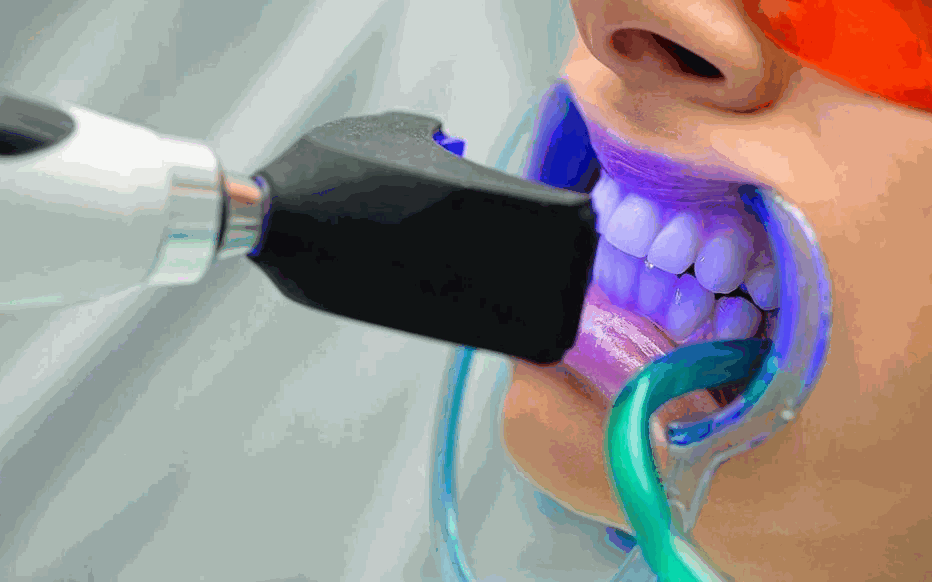
Your gums and lips are protected with a barrier. The gel is applied in two or three cycles during one appointment, typically sixty to ninety minutes in total. Desensitising treatment is applied afterwards.
Your take-home trays
Custom trays are made from a scan or impression and fitted before you leave. You are shown exactly how much gel to use — a common error is using too much, which causes gum irritation without improving the result. And you are given a schedule for the following one to two weeks, plus spare gel for maintenance.
Before you leave
Your shade is recorded again, with photographs. You receive written guidance in French or English, including the two-week white diet, the sensitivity protocol, and your maintenance schedule. Your trays and gel go home with you.
Where restorations need replacing
Any front fillings that no longer match are replaced after the shade has stabilised — around two weeks. Where that falls within your trip, it is done before you leave. Where it does not, your plan says so, and it may be done by your Canadian dentist or at a later visit.
Part four — keeping the result
The first two weeks: the white diet
For around forty-eight hours, and ideally two weeks, the enamel is temporarily more porous and more receptive to staining. Avoid: coffee, tea, red wine, cola, dark fruit juice, red sauces, soy sauce, curry, beetroot, berries, and tobacco. A practical rule: if it would stain a white shirt, it will stain your teeth. White wine is not exempt — its acidity increases porosity even though it has no pigment.
Why this matters. Staining acquired in this window is more stubborn than staining acquired later. Two weeks of care protects a result you will keep for a year or more.
If you cannot avoid coffee. Drink it through a straw where practical, rinse with water immediately afterwards, and do not brush for thirty minutes — the enamel is temporarily softened by acidity and brushing immediately is abrasive.
The shade settling. Your teeth rehydrate over the first days and the shade rebounds somewhat. Assess your result at two weeks, not on day one.
Maintaining it for years
How long does it last? Typically one to three years before a top-up is wanted, and it varies enormously with your habits. A patient who drinks coffee and red wine daily will see change within a year. One who does not may go three or four.
What your trays give you. This is the practical value of take-home trays, and it is why they are included. A top-up is two or three nights with a syringe of gel, once or twice a year. That maintains the result indefinitely for a small cost, and it is what separates a whitening result that lasts from one that fades.
Buying more gel. Your Canadian dentist can supply it, and your treatment report records the concentration used. Take the report to them.
Habits that preserve it
- Rinsing with water after coffee, tea or wine.
- Using a straw for cold staining drinks.
- Not smoking, which is the single largest staining factor.
- Six-monthly professional cleaning, which removes surface staining before it accumulates.
- Waiting thirty minutes after acidic food or drink before brushing.
What to avoid
Abrasive “whitening” toothpastes, which do not whiten — they remove surface stain by abrasion, and over years they wear enamel. Charcoal products, which are abrasive and have no whitening mechanism. A regular toothpaste with a soft brush is what protects the enamel that makes your teeth look good.
Your Canadian follow-up
What is required. Your normal six-monthly check-up and cleaning. Nothing specific to the whitening, beyond maintenance.
What to tell your dentist. That you whitened, and when. And take your treatment report, which records the gel concentration and your before-and-after shades — so they can supply top-up gel and assess any future restoration against the right shade. This matters if you ever need a front filling or crown: it must be matched to your whitened shade, not your original one.
Replacing restorations. Any front restorations that no longer match should be replaced after the shade stabilises. Your Canadian dentist can do this, and the shade record makes it straightforward.
Canadian insurance. Whitening is cosmetic and is not covered. Replacing a front restoration that no longer matches may be, as a restorative procedure — worth asking. We provide itemised invoicing in French or English.
Part five — practical matters
Canadian patients: travelling to Tunisia from your region
Aylan Clinic works with patients from every province and territory in Canada. Wherever you live, the process begins the same way: a free consultation from your daylight photographs, in French or English. And one thing applies everywhere on this page: whitening alone rarely justifies the journey. Most of our whitening patients have it combined with other treatment, or as the first stage of a restorative plan.
Montreal and the surrounding region. Montreal is our largest Canadian source for Tunisia. Connections from Trudeau to Tunis typically route through Paris, Frankfurt or Istanbul. Patients from Laval, Longueuil and Brossard are all within easy reach of the airport. For Montreal patients combining whitening with a short holiday, the arithmetic works — but we would not encourage a flight for whitening alone.
Quebec City and across the province. From Quebec City and the Capitale-Nationale region including Lévis, most patients connect through Montreal — as do patients from Trois-Rivières, Sherbrooke, Drummondville and Saint-Jérôme, all within driving distance of Trudeau. Gatineau patients depart from Ottawa or drive to Montreal. From Saguenay, a domestic connection through Montreal is the norm. On this treatment the francophone advantage matters when the answer is disappointing: being told that your tetracycline staining will not respond, or that your grey teeth will lighten but stay grey, is not what you hoped to hear — and understanding why, and what the alternative costs in tooth structure, is worth doing properly.
Acadia and New Brunswick. We work with patients from Moncton, Fredericton and Saint John. Moncton and the surrounding Acadian communities are served in French throughout. Most connect through Montreal.

Francophone Ontario. Sudbury, Thunder Bay and Sault Ste. Marie all have substantial francophone populations, served in French from first contact onward. Ottawa patients typically connect through Montreal.
Greater Toronto Area and southern Ontario. Toronto patients connect through European hubs, with Paris and Frankfurt the most common routes to Tunis. Across the wider Greater Toronto Area we work with patients from Mississauga, Brampton, Markham, Vaughan, Richmond Hill and Oshawa. Along the lake: Hamilton, Burlington, Oakville, St. Catharines and Niagara Falls. In southwestern Ontario: London, the Waterloo region — Kitchener, Waterloo and Cambridge — plus Guelph, Windsor and Barrie. Kingston patients generally drive to Toronto or Montreal.
Vancouver and British Columbia. Vancouver patients face the longest journey — typically two connections. For whitening specifically, the journey is disproportionate on its own, which is why we would only recommend it as part of a larger plan. Across the Lower Mainland: Surrey, Burnaby and Richmond. From Victoria and Nanaimo, patients cross by ferry or short flight. Kelowna, Abbotsford and Kamloops patients connect through Vancouver or Calgary.
Alberta. Calgary and Edmonton both offer European connections onward to Tunis. Red Deer and Lethbridge patients generally drive to Calgary. Same considerations — combine it with other treatment.
Manitoba and Saskatchewan. Winnipeg patients connect through Toronto or Montreal. The francophone community of Saint-Boniface is served in French. From Saskatoon and Regina, journeys involve a domestic connection followed by two further flights.
Atlantic Canada. Halifax patients typically route through Montreal or Toronto. From Charlottetown and St. John’s, journeys involve two or three connections.
Northern Canada. We work with patients from Whitehorse in Yukon, and from communities across the Northwest Territories and Nunavut. For northern patients, the take-home trays matter more than anywhere. A patient who can top up at home once or twice a year has a result that lasts indefinitely. One who cannot has a result that fades. We make sure northern patients leave with trays, adequate gel, and a clear supply plan — including how to obtain more.
How we handle the logistics. Whichever city you are travelling from, your coordinator arranges airport transfers at both ends in Tunisia, confirms your hotel before you depart, and builds your schedule around your arrival time.
Four recommendations. Combine it with other treatment — whitening alone rarely justifies the flight. Send daylight photographs, since colour is what is being assessed. Tell us about any front fillings or crowns, as they will need replacing. And make sure trays and gel are included.
What your package includes
- Free consultation in French or English, with an honest assessment of what whitening will achieve on your discolouration
- Full on-site assessment: clinical examination, radiographs where indicated, discolouration type assessment
- Shade recording before and after, photographically and against a guide
- Treatment of decay or gum inflammation first
- Professional cleaning, which removes surface staining before whitening
- Desensitising preparation where you report existing sensitivity
- In-office whitening with gum and lip protection
- Custom take-home trays, fitted before you leave
- Whitening gel for your course, plus spare gel for maintenance
- Desensitising gel for use in the trays
- Internal whitening for a single dark root-treated tooth, where indicated
- Replacement of front restorations that no longer match, where the timing allows
- Written guidance in French or English — the white diet, the sensitivity protocol, and your maintenance schedule
- Treatment report recording the gel concentration and your before-and-after shades
- Guidance for your Canadian dentist, including how to supply top-up gel
- Itemised invoicing
- Hotel accommodation, full board
- A companion at no extra cost, accommodated and fed in the same room
- Airport–clinic–hotel transfers
- A personal coordinator from arrival to departure
- French-speaking care throughout, with English available on request
The clinical team
- Dentist — assessment, discolouration diagnosis and treatment; frequently French-trained
- Endodontist — internal whitening where indicated
- Hygienist — professional cleaning before whitening
Results by patient profile
Age-related yellowing
A patient in her forties with no restorations and evenly yellowed teeth. Professional cleaning, in-office whitening, then two weeks of trays. Several shades of change, and she maintains it with two nights of gel twice a year. The ideal case, and the most common.
Where we recommended whitening instead of veneers
A patient who enquired about eight veneers, with well-shaped, well-aligned teeth and no restorations. Her only concern was colour. We recommended whitening. It cost a fraction, removed nothing, and achieved what she wanted. She has since sent us two family members — which is worth noting, because the honest answer produced more business than the veneer case would have.
Where whitening would not work
A patient with banded grey tetracycline staining. We explained that standard whitening would barely touch it, and that veneers were the honest answer. She chose veneers, knowing the enamel cost — and she was not disappointed by a whitening course that could not have worked.
The single dark tooth
A patient with one upper central incisor noticeably darker after root canal treatment years earlier. Internal whitening over three appointments, matched to the neighbouring teeth, then permanently restored. No preparation of the tooth, where the alternative offered in Canada had been a crown. Frequently overlooked, and worth asking about.
Where a clean was enough
A patient with substantial surface staining from tea and tobacco. A thorough professional cleaning removed most of it. She had a short whitening course afterwards for the remainder — but most of the change came from the clean.
Sensitivity managed
A patient with significant pre-existing sensitivity who had abandoned an over-the-counter whitening attempt. Desensitising treatment for several days beforehand, a lower-concentration take-home protocol rather than in-office, and desensitising gel alternating with the whitening gel. She completed the course comfortably. Telling us in advance is what made that possible.
Whitening before restorations
A patient having six veneers. Whitening first, shade stabilised for two weeks, then the veneer shade chosen against her whitened lower teeth. This sequence prevents the most common cause of dissatisfaction with veneers — and it is included in those plans.
A patient from Sherbrooke
A patient who chose Tunisia so the assessment could happen in French. Her comment was about what she learned. She had assumed her teeth were simply stained, and the assessment identified mild fluorosis — which changed what she could expect and what she asked for. « J’ai compris pour la première fois pourquoi mes dents étaient comme ça. »
Practical points to know
What to expect
- A professional clean first, which does more than patients expect.
- In-office treatment of sixty to ninety minutes, with a visible result the same day.
- Take-home trays for one to two weeks afterwards.
- Some sensitivity, usually resolving within one to three days.
- A dehydration effect making teeth look temporarily whiter on day one — your genuine shade is at two weeks.
- Uneven whitening across the tooth, which is normal and natural.
Recognised points
Professional whitening is well established and safe when properly supervised. Your dentist will discuss the considerations relevant to you. The main ones: sensitivity, the most common effect by a wide margin, reversible and manageable; gum irritation where gel contacts the tissue, resolving quickly; uneven results across the tooth surface and between teeth, which is normal; no effect on restorations, which then need replacing; regression over time, addressed by top-ups; little or no effect on tetracycline staining or a dark root-treated tooth; and, with internal whitening specifically, a rare risk of external root resorption, minimised by proper technique.
Three things within your control
- The white diet for two weeks, which protects a result you keep for years.
- Using your trays for maintenance — two nights, twice a year.
- Avoiding abrasive whitening pastes and charcoal products, which wear enamel without whitening.
Who this suits, and who it does not
It suits adults with yellow-toned, extrinsic or age-related discolouration, healthy teeth and gums, and realistic expectations. It does not suit tetracycline staining beyond the mildest forms, a patient wanting uniform brilliant white, untreated decay or gum disease, pregnancy, under eighteens — and a patient whose concern is shape rather than colour.
Price: how it is built and how to compare it
Why we quote per case
Because whether in-office, trays, both, or internal whitening is needed varies, and whether restorations need replacing afterwards varies too. Your quote is built from your photographs and assessment, and fixed once you approve it.

What determines your price
Four factors: whether you have in-office, trays, or both; whether internal whitening is needed for a dark tooth, which involves several appointments; whether any restorations need replacing afterwards; and whether it forms part of a larger plan — in which case it is frequently included.
What is included in your quote
Everything in the package list above, including the assessment and discolouration diagnosis, shade recording, professional cleaning, desensitising preparation where needed, in-office whitening, custom trays with gel plus spare gel for maintenance, desensitising gel, written guidance, treatment report with gel concentration and shades, guidance for your Canadian dentist, itemised invoicing, hotel with full board, transfers, and your coordinator. A companion is accommodated and fed at no additional cost.
What sits outside it
Flights, travel insurance, top-up gel in future years, and replacement of restorations where the timing falls outside your trip.
How to compare quotes properly
Four checks. Are custom trays and gel included? A quote for in-office whitening alone leaves you with no way to maintain the result. Is spare gel for maintenance included? Is a professional clean included — it removes surface staining and is part of the treatment. And has the clinic assessed your discolouration type? A quote issued without establishing whether your staining will respond is a quote for a treatment that may not work.
Why the lowest quote is rarely the best value
On whitening the materials cost relatively little. What you are paying for is the assessment and the supervision. An honest assessment of whether your discolouration will respond is worth more than the treatment itself, because the alternative is paying for something that could not have worked. And custom trays with maintenance gel are what make the result last years rather than months.
On over-the-counter products
Worth addressing, because patients ask. Over-the-counter strips and kits contain lower concentrations and use generic trays, which means gel contacts the gums more and reaches the teeth less evenly. They produce some effect on mild extrinsic staining. What they do not do is assess your discolouration type, treat decay first, protect your gums, manage sensitivity, or tell you that your staining will not respond. For mild cases they are a reasonable starting point. For anything else, they are a way of finding out slowly that whitening was not the answer.
Canadian insurance and payment
Whitening is cosmetic and not covered. Replacing a front restoration that no longer matches may be — worth asking. A deposit confirms your dates. The balance is settled on site, under terms set out in full when you approve your plan. There are no additional charges once accepted.
Getting your figure
Send a close-up of your upper teeth with lips retracted, in natural daylight, a full smile photograph, a close-up of your lower teeth, and a photograph of any specific area that concerns you — all unfiltered. Plus a recent panoramic X-ray, which teeth have fillings, crowns or root treatment, any history of tetracycline or significant fluoride exposure in childhood, whether your teeth are sensitive, and your medical history. You will receive a plan and quote within 24 to 48 hours, in French or English — including what whitening will realistically achieve on your discolouration.
Glossary
| Term | What it means |
|---|---|
| Hydrogen peroxide | The active agent in in-office whitening |
| Carbamide peroxide | A slower-releasing agent, used in take-home trays |
| Extrinsic staining | Surface staining from coffee, tea, wine, tobacco; responds well |
| Intrinsic staining | Discolouration within the tooth; responds variably |
| Tetracycline staining | Banded discolouration from antibiotic exposure during development; does not respond |
| Fluorosis | Mottling from fluoride exposure during development; responds partially |
| White spot lesion | A chalky white mark; does not whiten with the tooth |
| Internal whitening | Gel placed inside a root-treated tooth |
| Dehydration effect | Teeth appearing temporarily whiter immediately after treatment |
| White diet | Avoiding staining foods for two weeks afterwards |
| Zingers | Brief sharp sensations during or after whitening; reversible |
How Canadians search for this
- “Teeth whitening Tunisia cost” — the most common search. Ask whether trays and gel are included.
- “Blanchiment dentaire Tunisie” — how most Quebec patients search, and the reason this page exists in both languages.
- “How many shades whiter” — several for most patients, determined mainly by the type of discolouration.
- “Whitening or veneers” — whitening if your teeth are well shaped and your concern is colour. Veneers if the shape is also an issue or the staining will not respond.
- “Does whitening work on tetracycline stains” — essentially no, beyond the mildest forms. Veneers are the honest answer.
- “One tooth darker than the others” — internal whitening, and it is frequently not offered.
- “Do fillings whiten” — no, and neither do crowns or veneers. They will need replacing afterwards.
- “Should I whiten before veneers” — yes, always. Whitening afterwards creates a permanent mismatch.
- “Teeth whitening sensitivity” — the most common effect, reversible, and largely preventable with desensitising preparation.
- “How long does teeth whitening last” — one to three years typically, and trays make it maintainable indefinitely.
- “Whitening toothpaste” — abrasive rather than whitening, and over years it wears enamel.
- “Charcoal teeth whitening” — abrasive, with no whitening mechanism.
- “White diet after whitening” — two weeks. If it would stain a white shirt, it will stain your teeth.
- “French speaking dentist abroad” — Tunisia’s distinguishing feature.
In summary
Professional whitening at Aylan Clinic Tunisia begins with an honest assessment of what your type of discolouration will actually respond to, includes a professional clean, desensitising preparation where needed, in-office treatment and custom take-home trays with maintenance gel, and — where you have a single dark tooth — internal whitening rather than a crown. And it takes place in a French-speaking country, which matters most when the honest answer is that whitening will not achieve what you hoped. With accommodation, full board and a companion at no extra cost, for up to 60% less than Canadian private prices.
Five things worth holding onto:
- Whitening alone rarely justifies the journey from Canada. Combine it with other treatment — and we would rather tell you that than take the booking.
- Ask what type of discolouration you have. Yellowing responds well; tetracycline staining and a dark root-treated tooth do not, and you deserve to know before paying.
- If you are planning any restoration, whiten first. Ceramic holds its shade permanently — and whitening afterwards creates a mismatch that cannot be corrected without remaking it.
- Make sure trays and maintenance gel are included. They are what make the result last years rather than months.
- Ask about internal whitening if one tooth is dark. It removes no tooth structure, and it is frequently not offered where a crown is proposed instead.
Send your daylight photographs and you will have an honest answer within 24 to 48 hours — in French or in English.
Next steps: read the procedure page for Professional Teeth Whitening in Tunisia to see how the treatment, the stay and the aftercare are organised, browse the wider dental care in Tunisia hub, compare plastic surgery prices in Tunisia, or request a free, personalized quote.
Everything about Teeth Whitening in Tunisia
Discolouration types, sequencing, sensitivity, pricing and maintenance — every detailed answer on the procedure page.